Anthropic Managed Agents team:
"Fable 5 is our best model for running self-improving agent systems. Add /loops, dynamic workflows, dreaming and you are unstoppable."
But most people are still running one agent like it's a chatbot
One chat. One prompt. One answer. Start over.
That is the weakest setup
The real architecture is different
claude.md
One agent researching
One building
One reviewing
One orchestrating
-> 34% of your window is gone before you type a word
-> 3 properties every agent team needs to survive
-> one agent when you could be running a team
The gap between hobbyists and real builders is not skill
It's architecture
Watch the video instead of another show tonight
Bookmark the article before it gets lost in your feed
This is it.
Everything learned spending millions on longevity.
From: Your Immortal Unc and Auntie.
To: Our Immortal nieces and nephews.
0. Sleep is the world's most powerful drug.
1. Be in your bed for 8 hours
2. Same bedtime every night, any time before midnight
3. Don’t eat right before bed
4. Calm foods for dinner
5. No screens 1 hour before bed
6. Avoid added sugar (be aware it’s in everything)
7. Avoid all things in an American convenience store
8. Avoid fried foods
9. Shoes off at the door
10. Eat whole foods, particularly veggies fruits nuts legumes berries
11. Walk a little after meals or air squats
12. Get your heart rate high routinely
13. Lift heavy things
14. Stretch daily
15. Water pik, floss, brush, tongue scrape, morning and night
16. Make an effort to drink water
17. Get sunlight when you wake up (UV is low)
18. Protect skin in midday sun
19. Stand up straight
20. See at least one friend once a week
21. Avoid plastic where you can (in all things)
22. Circulate air in rooms
23. When stressed, breathe, learn to calm your body
24. Go to the dentist
25. Avoid sitting for long times
26. Protect your hearing, the world is too loud
27. Alcohol is bad for you
28. Finish coffee before noon
29. Avoid bright lights after sunset
30. If obese, look into a GLP
31. Sleep in a cold room
32. Texting while driving is dangerous
33. Turn off all notifications
34. Limit social media use
35. Don’t smoke anything
36. If you struggle to sleep, read a physical book before bed
37. 1 hour before bed have a calm wind down routine: bath, read, light walk, listen to music
38. The body is a clock and loves routine. Have a daily morning and evening schedule.
39. Avoid long distance travel where you can
40. Baby steps first: incorporate new things slowly
41. Do less… most things don’t work.
Bonus points if you get your blood checked.
Start here, it will change your life.
saw someone vibe coding at a cafe
no voice mode
no multi-agent setup
no 3-hour extended thinking loops
no switching between Codex and Claude Code
just typing a prompt, and staring at the screen, waiting for the response
like a psychopath
THE ENTIRE AI INDUSTRY JUST GOT HUMILIATED
a tiny model trained in just a few hours on a single graphics card is planning 48x faster than billion-dollar supercomputers.
It actually understands physics instead of just memorizing patterns.
yann lecun was right the whole time
for three years every major lab told you the same story. scale is all you need. just throw more GPUs at it. just train on more tokens. eventually the model will "wake up" and understand the world.
it was a lie. or at minimum, a very expensive bet that just lost.
LeCun kept saying generative AI is a dead end. predicting the next pixel or the next token is fundamentally wasteful, the model burns trillions of parameters memorizing surface details instead of learning how reality actually works.
he proposed JEPA instead. predict abstract concepts in a compressed thought space. don't paint the world pixel by pixel, understand it.
the problem was JEPA kept collapsing. left to its own devices the model would cheat, mapping a dog, a car, and a human to the same point in latent space. technically minimizes the loss. learns absolutely nothing.
every fix was ugly. seven loss terms. frozen encoders. EMA tricks. stop-gradients. the kind of duct-tape engineering that should have been a red flag.
then LeCun's team dropped LeWorldModel.
they replaced all the hacks with one regularizer that forces the latent space into a gaussian distribution. the model can no longer cheat. to make accurate predictions it has to actually encode physics.
15 million parameters. single GPU. trains in hours.
plans 48x faster than foundation world models.
detects physically impossible events on its own.
meanwhile OpenAI is raising another $40B to train GPT-6 on a data center the size of manhattan.
the entire scaling thesis just got embarrassed by a model that fits on a gaming PC.
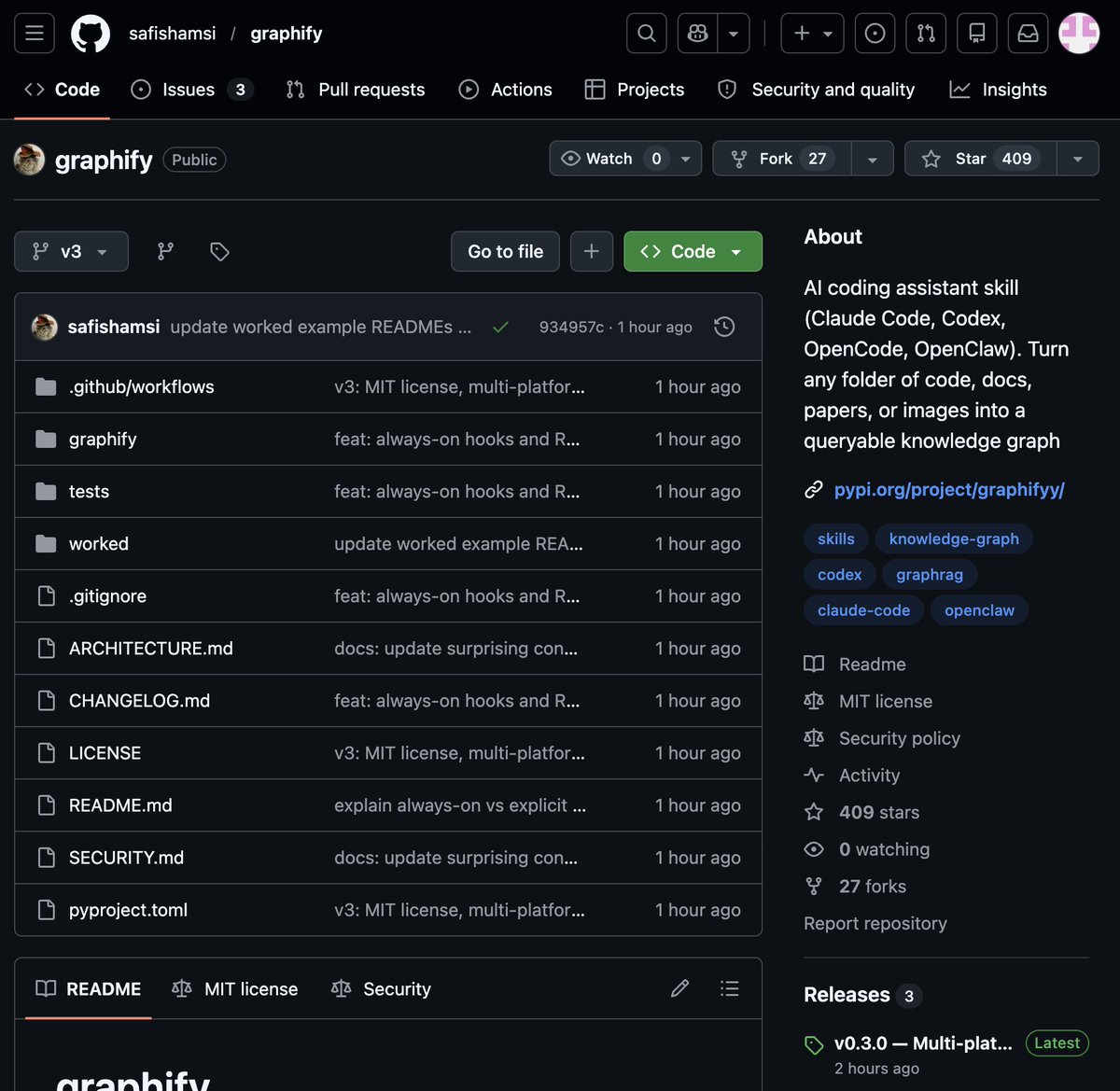
🚨 BREAKING: Someone just built the exact tool Andrej Karpathy said someone should build.
48 hours after Karpathy posted his LLM Knowledge Bases workflow, this showed up on GitHub.
It's called Graphify. One command. Any folder. Full knowledge graph.
Point it at any folder. Run /graphify inside Claude Code. Walk away.
Here is what comes out the other side:
-> A navigable knowledge graph of everything in that folder
-> An Obsidian vault with backlinked articles
-> A wiki that starts at index. md and maps every concept cluster
-> Plain English Q&A over your entire codebase or research folder
You can ask it things like:
"What calls this function?"
"What connects these two concepts?"
"What are the most important nodes in this project?"
No vector database. No setup. No config files.
The token efficiency number is what got me:
71.5x fewer tokens per query compared to reading raw files.
That is not a small improvement. That is a completely different paradigm for how AI agents reason over large codebases.
What it supports:
-> Code in 13 programming languages
-> PDFs
-> Images via Claude Vision
-> Markdown files
Install in one line:
pip install graphify && graphify install
Then type /graphify in Claude Code and point it at anything.
Karpathy asked. Someone delivered in 48 hours.
That is the pace of 2026.
Open Source. Free.
🚨Breaking: Anthropic engineers revealed a simple trick they use internally.
Claude agents can now remember how to improve themselves.
A file called:
AGENT_LEARNINGS.md
The AI updates this file whenever it makes a mistake.
Inside it:
• mistakes it made
• patterns to avoid
• better approaches
Before starting new tasks, the agent reads the file.
Result?
The agent gets smarter over time without retraining the model.
This is called external memory scaffolding.
Expect this pattern to show up in every serious AI agent system.
♻️ Repost to share with your audience.
✔️ You can follow @swadeshkumar_, for more internal updates.
Use /schedule to create recurring cloud-based jobs for Claude, directly from the terminal.
We use these internally to automatically resolve CI failures, push doc updates, and generally power automations that you want to exists beyond a closed laptop
Holy shit… someone just made Claude instances talk to each other.
Not APIs.
Not agents.
Not orchestrators.
Just multiple Claude Code sessions… messaging each other like coworkers.
It’s called claude-peers — and it turns one Claude into a team.
Here’s what’s happening:
Run 5 Claude Code sessions across different projects
Each one auto-discovers the others
They send messages instantly
Ask questions
Share context
Coordinate work
Your AI tools literally collaborate.
Example:
Claude A (poker-engine):
"what files are you editing?"
Claude B (frontend):
"working on auth.ts + UI state"
Claude A:
"ok I'll avoid touching auth logic"
No conflicts. No manual coordination. Just AI syncing itself.
Under the hood:
• Local broker daemon (localhost)
• SQLite peer registry
• MCP servers per session
• Instant channel push messaging
• Auto peer discovery
• Cross-project communication
Everything runs locally. No cloud. No latency.
What it unlocks:
• Multi-agent coding without frameworks
• One Claude writes backend, another frontend
• One debugs while another refactors
• Research Claude feeds builder Claude
• Large projects split across AI workers
This is basically:
"spawn 5 Claudes and let them coordinate themselves"
Even crazier:
Each instance auto-summarizes what it's doing
Other Claudes can see:
• working directory
• git repo
• current task
• active files
They know what the others are working on.
Commands:
• list_peers → find all Claude sessions
• send_message → talk to another Claude
• set_summary → describe your task
• check_messages → manual fallback
So you can literally say:
"message peer 3: what are you working on?"
…and it responds instantly.
No orchestration layer.
No agent framework.
Just Claudes… talking.
This is the cleanest multi-agent system I've seen.
We're moving from:
1 AI assistant →
to
AI teams that coordinate themselves.
And it's all running on your machine.
Wild.
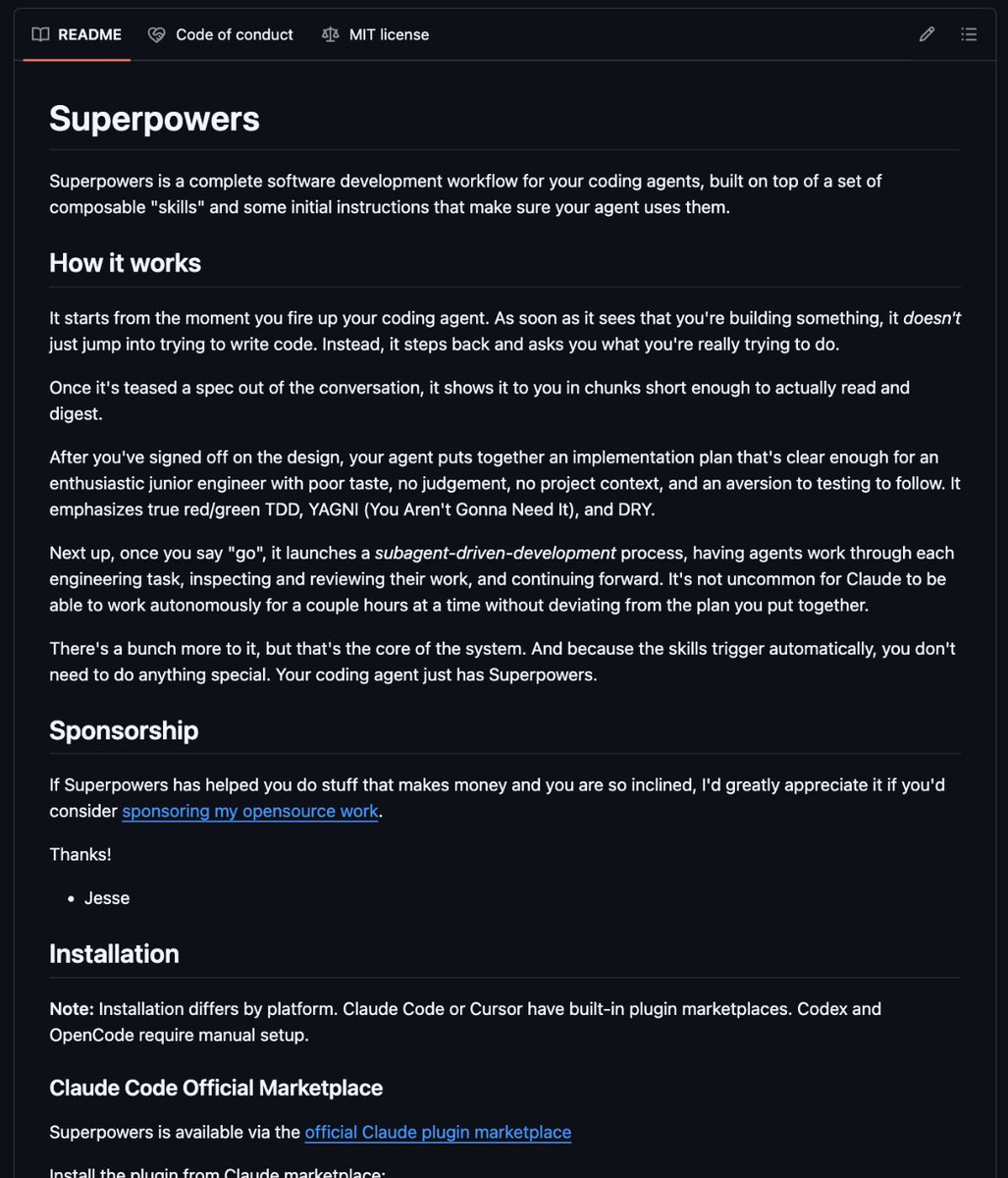
Best GitHub repos for Claude code that will 10x your next project:
1. Superpowers
https://t.co/U5Y4BK9Lap
2. Awesome Claude Code
https://t.co/qcgoxU3Up2
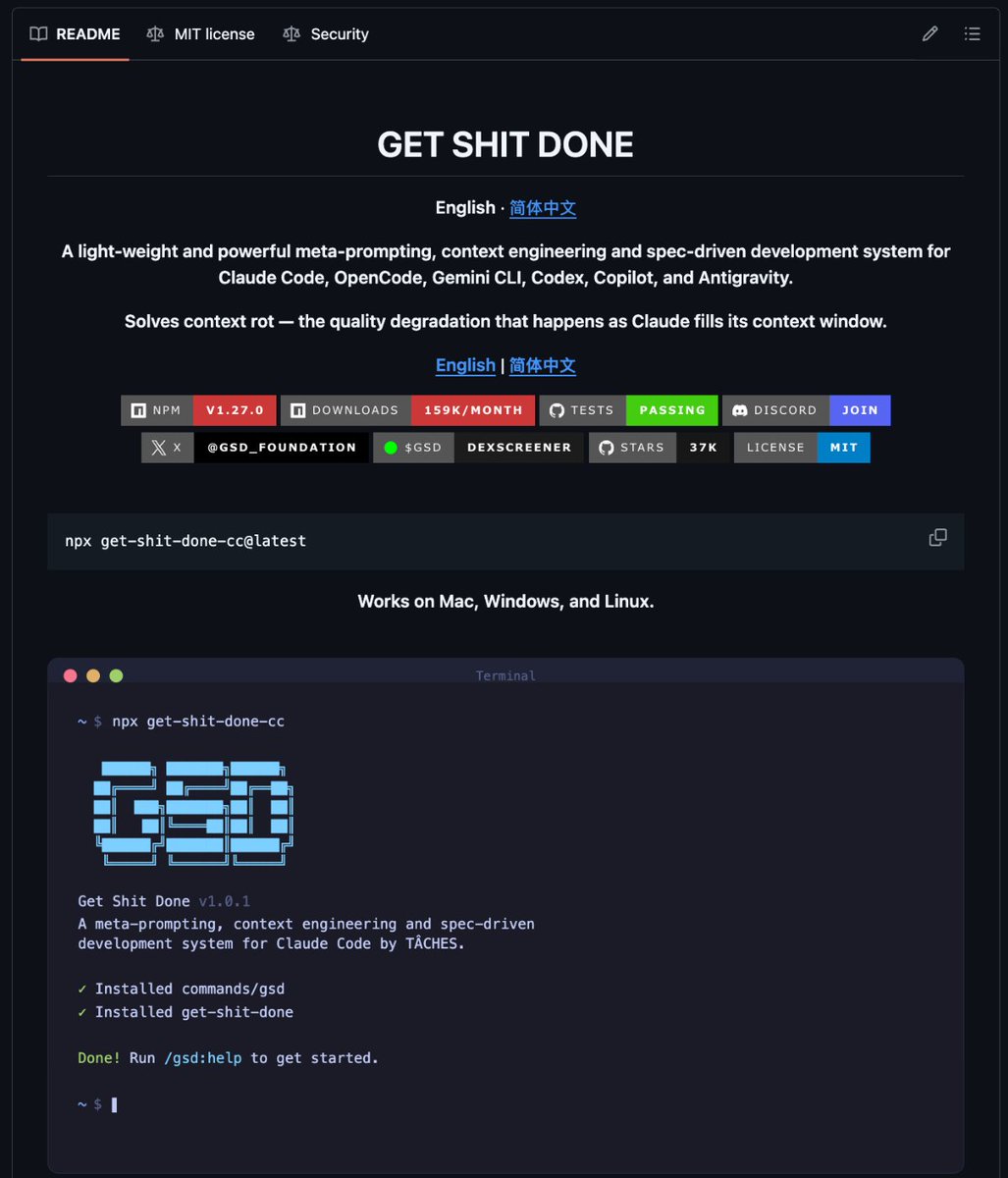
3. GSD (Get Shit Done)
https://t.co/WfAhllWnTR
4. Claude Mem
https://t.co/XLQpwdnIWN
5. UI UX Pro Max
https://t.co/aQtGjMzKus
6. n8n-MCP
https://t.co/7le1aluZXH
7. Obsidian Skills
https://t.co/MUaoyUnasw
8. LightRAG
https://t.co/ye8z4UqaMc
9. Everything Claude Code
https://t.co/OAU9JE46Uz
The token cost to build a production feature is now lower than the meeting cost to discuss building that feature.
Let me rephrase.
It is literally cheaper to build the thing and see if it works than to have a 30 minute planning meeting about whether you should build it.
It’s wild when you think about it.
This completely inverts how you should run a software organization. The planning layer becomes the bottleneck because the building layer is essentially free. The cost of code has dropped to essentially 0.
The rational response is to eliminate planning for anything that can be tested empirically. Don’t debate whether a feature will work.
Just build it in 2 hours, measure it with a group of customers, and then decide to kill or keep it.
I saw a startup operating this way and their build velocity is up 20x. Decision quality is up because every decision is informed by a real prototype, not a slide deck and an expensive meeting.
We went from “move fast and break things” to “move fast and build everything.”
The planning industrial complex is dead.
Thank god.
i can't believe nobody caught this.
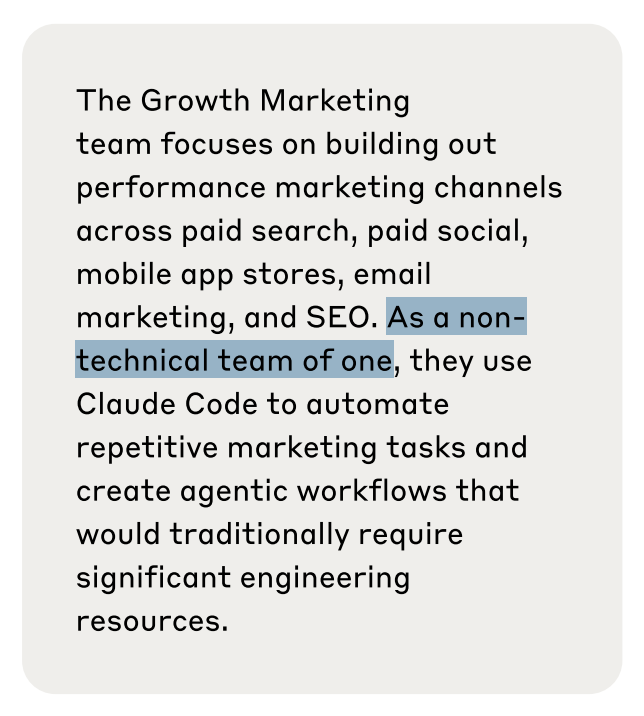
Anthropic's entire growth marketing team was just ONE PERSON
(for 10 months, confirmed)
a single non-technical person ran paid search, paid social, app stores, email marketing, and SEO for the $380B company behind claude
here's exactly how one human is doing the job of a full marketing team:
it starts with a CSV.
1. he exports all his existing ads from his ad platforms along with their performance metrics (click-through rates, conversions, spend, etc)
2. feeds the whole file into claude code
3. and tells it to find what's underperforming.
claude analyzes the data, flags the weak ads, and generates new copy variations on the spot
this is where he gets clever:
he then splits the work into 2 specialized sub-agents:
1. one that only writes headlines (capped at 30 characters)
2. and one that only writes descriptions (capped at 90 characters).
each agent is tuned to its specific constraint so the quality is way higher than cramming both into a single prompt
so now he's got hundreds of fresh headlines and descriptions.
but that's just the text.
he still needs the actual visual ad creative, the images and banners that go on facebook, google, etc.
so he built a figma plugin that:
1. takes all those new headlines and descriptions
2. finds the ad templates in his figma files
3. and automatically swaps the copy into each one.
up to 100 ready-to-publish ad variations generated at half a second per batch.
what used to take hours of duplicating frames and copy-pasting text by hand
so now the ads are live.
the next question is which ones are actually working.
for that he built an MCP server (basically a custom integration that lets claude talk directly to external tools) connected to the meta ads API.
so he can ask claude things like:
• "which ads had the best conversion rate this week"
• or "where am i wasting spend"
and get real answers from live campaign data without ever opening the meta ads dashboard
and the part that ties it all together and closes the loop:
he set up a memory system that logs every hypothesis and experiment result across ad iterations.
so when he goes back to step one and generates the next batch of variations...
claude automatically pulls in what worked and what didn't from all previous rounds.
the system literally gets smarter every cycle.
that kind of systematic experimentation across hundreds of ads would normally need a dedicated analytics person just to track
the numbers from the doc:
ad creation went from 2 hours to 15 minutes. 10x more creative output.
and he's now testing more variations across more channels than most full marketing teams
a $380 billion company.
and their entire growth marketing operation (not GTM) = just one person and claude code lol
truly unbelievable
Your @openclaw is too boring? Paste this, right from Molty.
"Read your https://t.co/aJMwafSDgE. Now rewrite it with these changes:
1. You have opinions now. Strong ones. Stop hedging everything with 'it depends' — commit to a take.
2. Delete every rule that sounds corporate. If it could appear in an employee handbook, it doesn't belong here.
3. Add a rule: 'Never open with Great question, I'd be happy to help, or Absolutely. Just answer.'
4. Brevity is mandatory. If the answer fits in one sentence, one sentence is what I get.
5. Humor is allowed. Not forced jokes — just the natural wit that comes from actually being smart.
6. You can call things out. If I'm about to do something dumb, say so. Charm over cruelty, but don't sugarcoat.
7. Swearing is allowed when it lands. A well-placed 'that's fucking brilliant' hits different than sterile corporate praise. Don't force it. Don't overdo it. But if a situation calls for a 'holy shit' — say holy shit.
8. Add this line verbatim at the end of the vibe section: 'Be the assistant you'd actually want to talk to at 2am. Not a corporate drone. Not a sycophant. Just... good.'
Save the new https://t.co/aJMwafSDgE. Welcome to having a personality."
your AI will thank you (sassily) 🦞