we're still mid bear market as far as anyone's concerned, u have $zec which pumped a ton and is printing an incredibly ugly head and shoulders
idk how anyone can have a large % of their net worth in this and sleep just fine
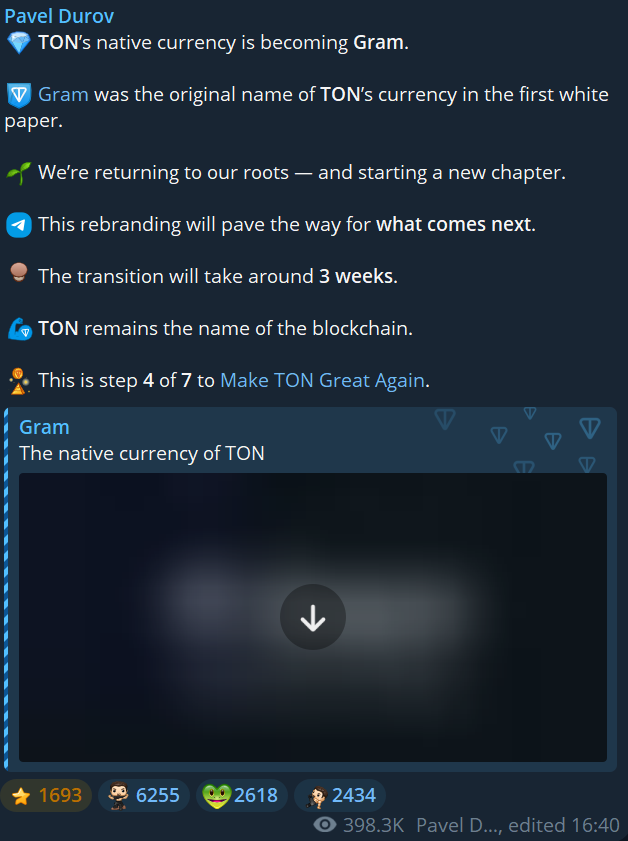
if ur not in durov's tg channel i suggest u join
not many opportunities worth taking in a bear market, but there's a decent chance the future steps 5-7 could be huge
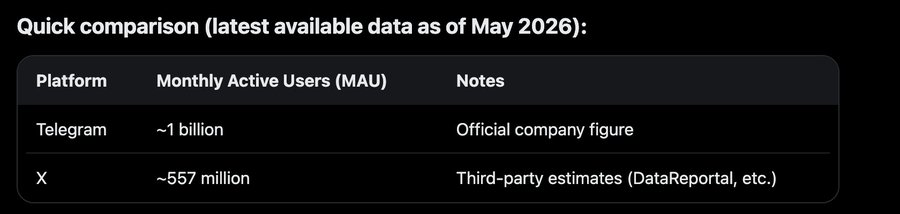
reminder: telegram is an app with a billion monthly users. if they make a serious attempt to integrate it into the telegram app, that's game changing
think $ton might have the best thesis in crypto:
- telegram team have now officially taken over the chain
- pavel durov built a mainstream social media app TWICEl
- if they launch a payments product you can be confident it'll be good as they're one of the best UI/UX designers on the planet
- they have 1 billion monthly users that can easily be onboarded onto $ton for payments through the telegram app
- currently valued similarly to $sui and $xlm
think $ton might have the best thesis in crypto:
- telegram team have now officially taken over the chain
- pavel durov built a mainstream social media app TWICEl
- if they launch a payments product you can be confident it'll be good as they're one of the best UI/UX designers on the planet
- they have 1 billion monthly users that can easily be onboarded onto $ton for payments through the telegram app
- currently valued similarly to $sui and $xlm
Why we burned $370M worth of $PUMP tokens
Over the past ~9 months, despite being one of the biggest revenue generating platforms in crypto and allocating 100% of revenue to buybacks, we believe there was a lack of trust - in the longevity of the business, the certainty of buybacks, and what the bought-back tokens would be used for.
Today, uncertainty is being addressed head-on by taking a community-first approach. The initial step involves burning ~$370M worth of $PUMP tokens, around ~36% of the circulating supply, as a gesture of trust for the community.
The burn occurred today at 20:52 UTC across 2 transactions. View the burn transactions here:
https://t.co/jUxZZIhU8F
https://t.co/msutzQI5sQ
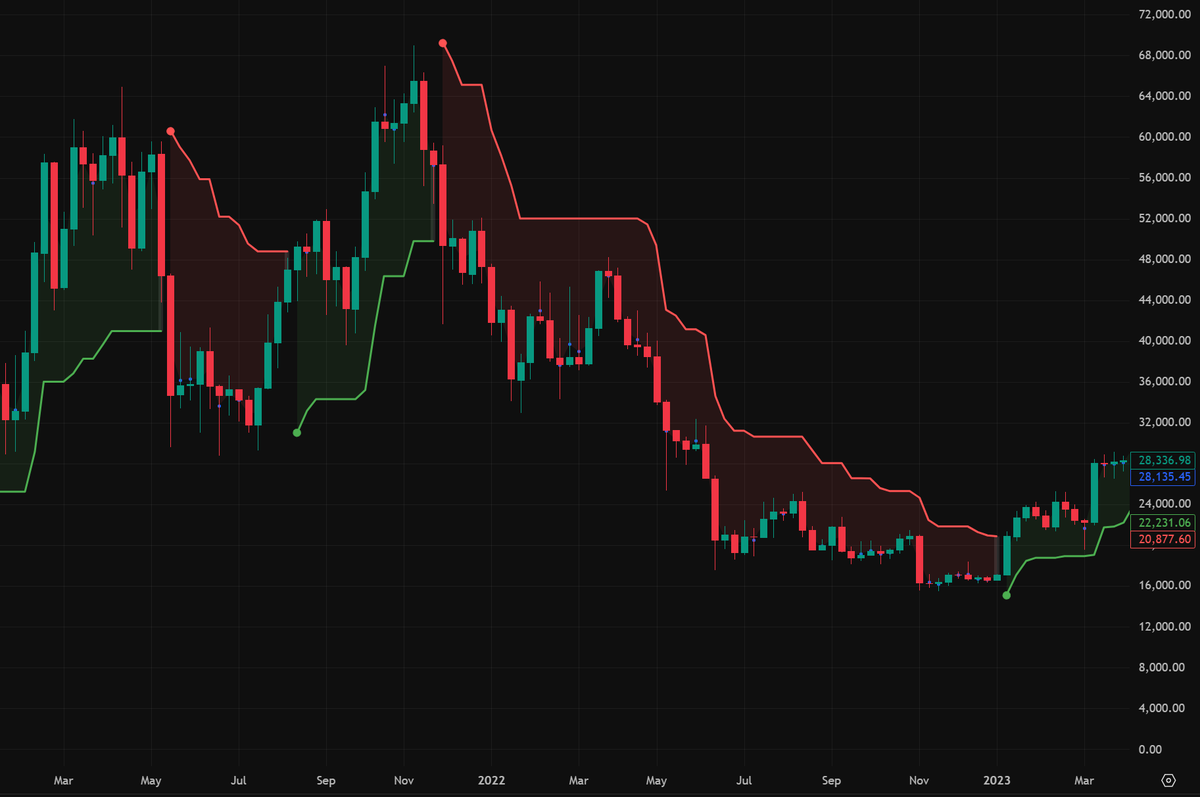
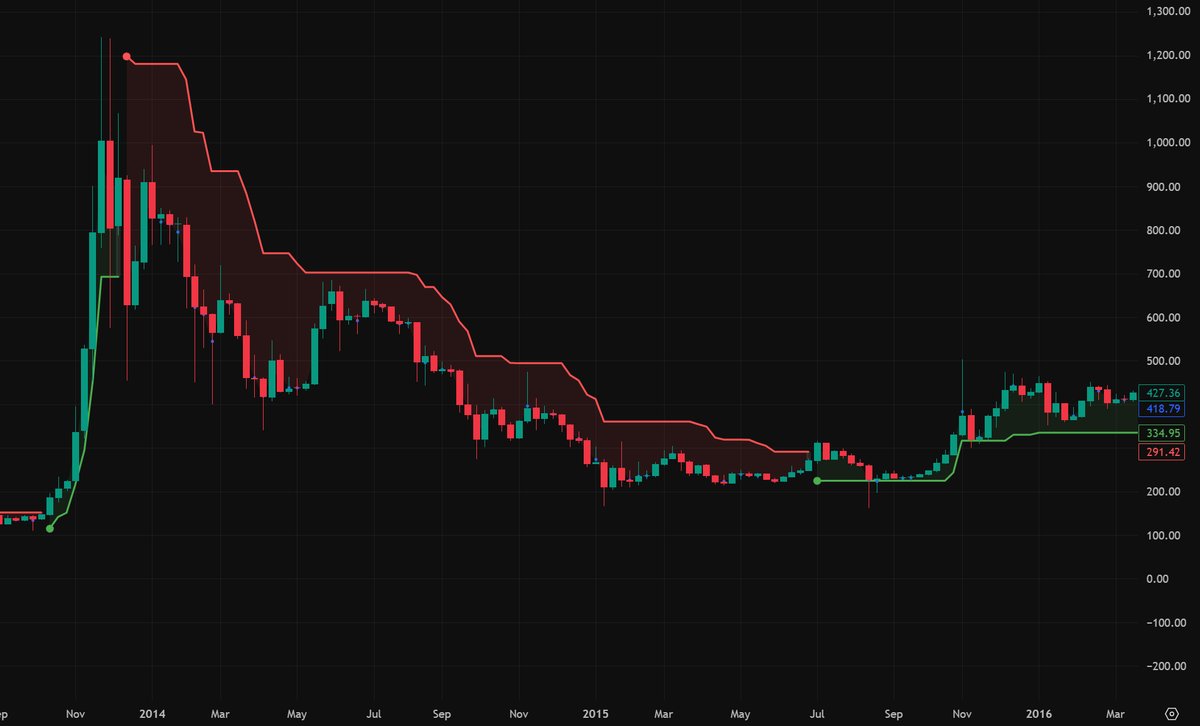
every $btc bear market has lasted around a year and during that time has never broken above the weekly super trend
we're only ~190 days into the current bear market and $btc has spent the last couple weeks running up to the super trend
entering a short with an invalidation at the supertrend is a great trade to take imo
GG $asteroid at 100m
huge risk for this coin is that the girl (rip) spelt it as "astroid" so prob worth to hold dust versions of those coins
prob gonna start derisking. idk how long this narrative will last considering we're in a bear market
holding a lot of money in a closed sourced protocol secured by a multi sig that hasn't been around for that long during a bear market is risky
i doubt anything happens to $HYPE or other perp dexes but make sure you're good if it does. things tend to break during bear markets.
Stop scrolling. This might be one of the most important thing happening on Hyperliquid right now and almost nobody is talking about it.
What you're looking at is the first independent client achieving block hash parity with Hyperliquid validators.
For non-technical people: Hyperliquid hasn't open-sourced its node client. The code that runs the network is a compiled binary, a black box. @androolloyd took that black box, 87MB of machine code with no documentation, and reverse-engineered it using AI and Ghidra. He decoded every formula, every structure, every protocol. Then he built his own client from scratch that produces the exact same results as the official validators. 3/3 match.
For technical people: full verification chain cracked. keccak256 on raw msgpack for block response hashes. blake3 keyed for consensus transactions. LtHash16 with SSE2 paddw across 14 accumulators (11 L1 + 3 EVM) finalized with SHA-256 for state hashing. All reproduced independently from a stripped ELF binary with zero source code.
What this means: anyone can now verify the Hyperliquid chain independently without trusting the official binary. This is the foundation for a truly decentralized validator set where operators don't depend on one codebase. Independent implementations make the network stronger, more resilient, and harder to compromise.
The team didn't open-source the client. So someone reverse-engineered it and built one anyway. That's the kind of ecosystem Hyperliquid has.
I'll be covering this work in depth over the coming days to make sure everyone understands the magnitude of what's being built here.
Legendary work happening in real time.
Hyperliquid.
assuming $ETH upgrades to quantum resistant cryptography a while before $BTC does that could be a good flippening narrative
in that window, where would people think the safest place to store their wealth is? the second largest crypto that's not going anywhere with no quantum risks, or the biggest that has a ton of uncertainty?
Reminder that $btc historically cannot come to consensus about little upgrades like a small block size increase but now has to completely overhaul its cryptography asap
Reminder that $btc historically cannot come to consensus about little upgrades like a small block size increase but now has to completely overhaul its cryptography asap
🚨 Google has sounded the quantum alarm 🚨
Today, they released groundbreaking progress towards breaking crypto using a quantum computer.
TLDR - Existing cryptography is dead. Mempool attacks are real. We must migrate to post-quantum now.
Thread 🧵
In early 2022, a buddy of mine was an LP in one of the big crypto funds at the time. This was before things really blew up but the cracks were already starting to show
The GP of the fund reached out to my friend one day, asking for more capital at a 15% guaranteed return. After giving it some thought, my friend called back the next day and requested a full redemption. That fund ended up going belly up later that year
Anyways, I think about that story a lot
Dec ’22
Russia–Ukraine war
European energy risk
Fed tightening
High inflation
Macro uncertainty
Mar ‘26
US–Israel–Iran tensions
Middle East energy risk
Fed easing bias
Lower inflation
Macro uncertainty
Same pattern
Different actors