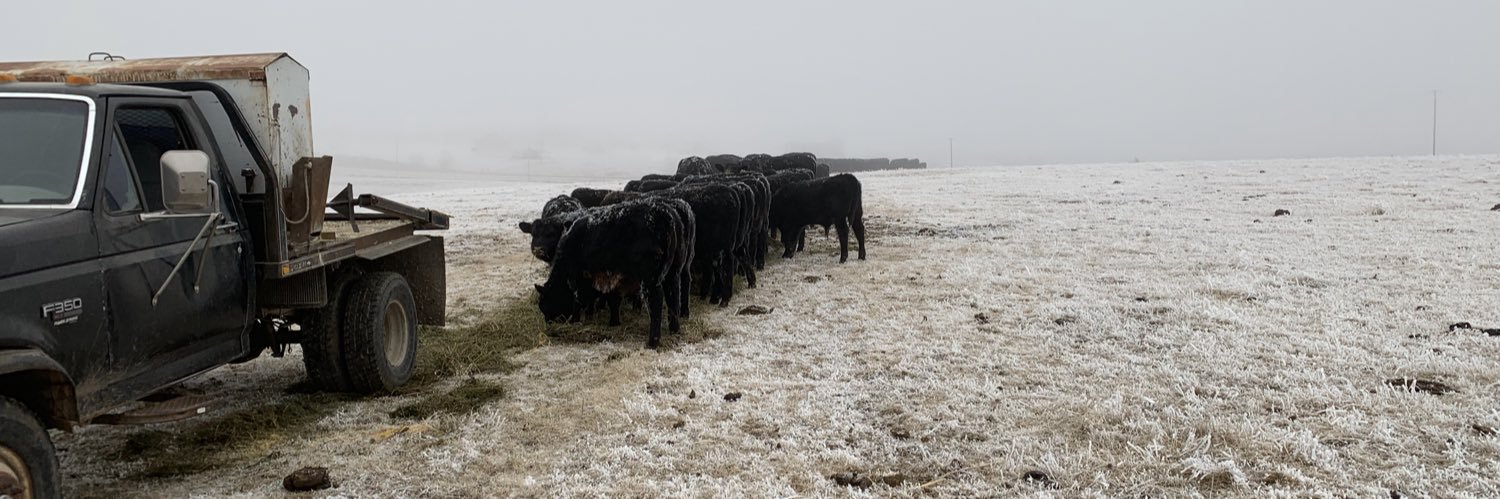
Activist: "Your cows are putting carbon into the atmosphere."
Farmer: "Where did they get it?"
Activist: "What?"
Farmer: "The carbon. Where did the cow get it before it put it anywhere."
Activist: "From... eating?"
Farmer: "From eating grass. And where did the grass get it."
Activist: "The soil?"
Farmer: "The air. The grass pulled it out of the air last spring. The cow ate the grass. The cow breathed some of it back out. It went back into the air it came from."
Activist: "But it's still going into the atmosphere."
Farmer: "It's going back. There's a difference between a thing going somewhere and a thing going back. You've described a circle and you're frightened of it."
Activist: "Then just don't have the cow."
Farmer: "The grass still dies in autumn. It rots where it falls. The carbon goes back into the air either way, just without anyone getting fed in the middle."
Activist: "It's not that simple."
Farmer: "It's grass, cow, breath, grass. Or it's grass, rot, air, grass. Same circle, fewer dinners. If that's complicated for you I'd stay away from the water cycle. That one's got clouds in it."
Teachers make around 1,500 decisions a day.
In a 10 hour day thats 150 decisions an hour.
That’s a decision to make every 24 seconds.
Nearly 300,000 decisions in 39 weeks of teaching.
Such a mentally demanding job.
Too many holidays, yeah right!
Ebooks count as reading.
Print books count as reading.
Audiobooks count as reading.
Braille books count as reading.
The only thing that doesn't count as reading is not reading.
We hope this post about orphaned negatives makes you gruntled.
An ‘orphaned negative’ is a word that SHOULD feel like it has a related word, but doesn’t.
‘Nonchalant’ is an orphaned negative because there is no ‘chalant.’
I’ve put a load of my most popular files together in a Dropbox folder. Let me know if you’d like the link. Can I also ask that you share this post pretty please 🙏 (as it seems the only way to get anything seen nowadays!). 😊
I just finished presenting a professional development session on direct instruction and reading instruction at my school.
Here is the overview ⬇️
1. Started the PD with Project Follow Through.
Reading thirty minutes a day adds two years to your life. Yale tracked 3,635 people over fifty for twelve years to find that out. The 23-month gap held no matter your gender, wealth, education, or starting health.
A University of Sussex study hooked people up to stress monitors and timed how fast different activities calmed them down. Six minutes of reading cut stress by 68%. Music came in at 61%. A cup of tea got 54%. A walk did 42%.
In October 2025, King's College London ran a study at the Courtauld Gallery. Fifty people aged 18 to 40 spent twenty minutes looking at real Van Goghs, Manets, and Gauguins. Cortisol, the body's main stress hormone, dropped 22% in those twenty minutes. A control group looking at copies only saw an 8% drop. Two inflammation markers tied to heart disease and depression also fell, by 30% and 28%.
At McGill in 2011, scientists stuck people in a brain scanner and played them their favorite songs. Music made their brains release dopamine, the same pleasure chemical that floods you during sex, eating, or doing drugs. The bump measures 6 to 9%, slotting music between a good meal and a hit of cocaine on the brain's pleasure scale. Just waiting for the chorus to drop is enough to start it.
Norway followed 35,902 adults for eight years. People who never went to art exhibits were 28% more likely to die from heart disease. People who did music, singing, or theatre were 27% less likely to die from cancer.
Paul Zak runs storytelling research at Claremont Graduate University, funded in part by the US military. In one experiment, he showed people short films and tracked their brain chemistry. Stories with strong characters flooded the brain with oxytocin, the same hormone that bonds a mother to her newborn. After watching a short clip about a dying child, viewers gave away more of their own cash to strangers in a lab game.
The average American spends 16 minutes a day reading for personal interest, according to the Bureau of Labor Statistics. Two hours and 21 minutes a day on social media. 95 minutes on TikTok alone. American teens hit 4 hours and 48 minutes a day on social apps. In 2012, 27% of American 13-year-olds read for fun almost every day. By 2023, that number had been cut nearly in half, to 14%.
Thirty minutes of reading. One album you actually listen to all the way through. Twenty minutes in front of a painting instead of a phone. A two-hour movie without scrolling. Each one shows up in your blood within twenty minutes.
Mini whiteboards (MWB) are great for formative assessment. But I always struggled with getting students to actually apply the feedback I gave them on their MWB responses.
Tick-Trick took care of that! I explain more in my new Substack post. You can find the link below ⬇️
Winston Churchill fought his depression with bricks. He'd lay them for hours at his country home in Kent. He joined the bricklayers' union. And in 1921 he wrote about why it worked. It took psychology another 75 years to catch up.
He called his depression the "Black Dog." It followed him for decades. His method for fighting it back was as basic as it sounds: laying brick after brick, hour after hour.
Churchill spelled out his theory in a long essay for The Strand Magazine. People who think for a living, he wrote, can't fix a tired brain just by resting it. They have to use a different part of themselves. The part that moves the eyes and the hands. Woodworking, chemistry, bookbinding, bricklaying, painting. Anything that drags the body into a problem the mind can't solve by itself.
Modern psychology now calls this behavioral activation. It's one of the most-studied depression treatments out there. Depression sets a behavior trap. You feel bad, so you stop doing things, and doing less means less to feel good about. Feeling worse makes you do even less. The loop tightens until you can't breathe inside it.
Behavioral activation breaks the loop from the action side. You schedule the activity first, even when every part of you doesn't want to. Doing it produces small rewards: a wall gets straighter, a painting fills in, a messy room gets clean. Those small rewards slowly rewire the brain. Action comes first, and the feeling follows.
Researchers at the University of Washington put this to the test in 2006. They studied 241 adults with major depression and compared three treatments: behavioral activation, regular talk therapy, and antidepressants. For the people who were most severely depressed, behavioral activation matched the drugs. It beat the talk therapy. A 2014 review of more than 1,500 patients across 26 trials backed up the result.
Physical work like bricklaying does something extra on top of this. It crowds out rumination, the looping bad thoughts that grind people down during the worst stretches of depression. Bricklaying needs both hands and gives feedback brick by brick: each one is straight or crooked. After an hour you can see exactly how much wall you built. No room left for the mental chewing.
The line George Mack used in his post, "depression hates a moving target," is good poetry. The science behind it is sharper. Depression hates a brain that has somewhere else to be.
Teacher Appreciation Week
If people truly understood what teachers do…
we wouldn’t need a week for this.
It would be every day.
Because this job asks more of you than people realize.
It’s patience when you’re exhausted.
It’s showing up when it would be easier not to.
It’s believing in kids on the days they don’t believe in themselves.
It’s the quiet kid you don’t give up on.
The tough kid you keep showing up for.
The moment a student finally thinks… maybe I can.
That’s the work.
And it matters more than people realize.
So thank you.
For caring the way you do.
For showing up the way you do.
For the difference you make in the lives of your students!
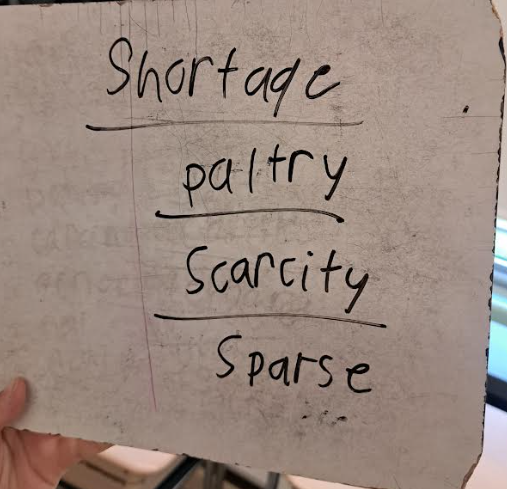
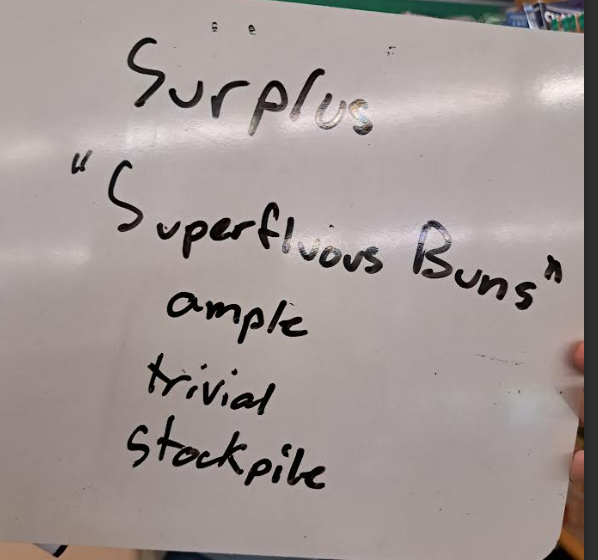
I know I repeat myself on here, but I need to reiterate this routine. I have found explicitly teaching words in pairs to be quite effective. An example pair would be shortage & surplus. Here is the routine I use on a daily basis.
1. Say the word
2. Students chorally repeat the word
This is the beginning of mapping a word into long-term memory.
3. Provide a student friendly defintion
4. Provide examples of this word in context
Pictures/Visuals can be used as an aid. For example, sweeping your hand up for the word ascend and then down for descend would most likely aid the process of mapping words into memory.
5. Repeat the first 4 steps for the antonym (unrelated word)
Mapping words into long-term memory is aided by saying the word, spelling the word, and learning the meaning of the word.
6. Have students differentiate between the pair. Provide an example sentence & students have to decide if that is an example of say the word shortage or surplus. They do this on mini white boards so they get practice spelling the words right away. Spelling words aids in mapping words into long-term memory.
7. Then encourage students to write other words that are synonyms or related to the word in some way. This builds semantic connections through categorization.
8. Grab a students white board and ask how all of these words are related? Extending learning here.
All of this moves quickly. You can teach a pair in 4 minutes. Only 4 minutes.
Subconscious fact of the day:
Saying an identity claim out loud while your body is still activates your hippocampus differently than just thinking it. Your brain encodes it as stronger, more real. Your voice is a tool. Most people never use it.
Consistency does not mean robotic teaching. It means students do not have to win the teacher lottery. A schoolwide literacy commitment should be visible from classroom to classroom. The goal is not sameness for adults; the goal is reliability for students
Kansas lost a trailblazer this weekend—Connie Palacioz, Kansas’ own Rosie the Riveter. Connie worked on the B-29 Superfortress production line in WWII and has advocated for women in aviation throughout her life. My condolences to her family and friends. https://t.co/KA9VrhSN5O
Do you care about questioning??
Do you want to get better at questioning??
IF YES then you have just a few more days to sign up to our webinar next week. We'll be covering a bunch of easy and effective strategies, link here and video example in reply!
https://t.co/DIQRiFDT27