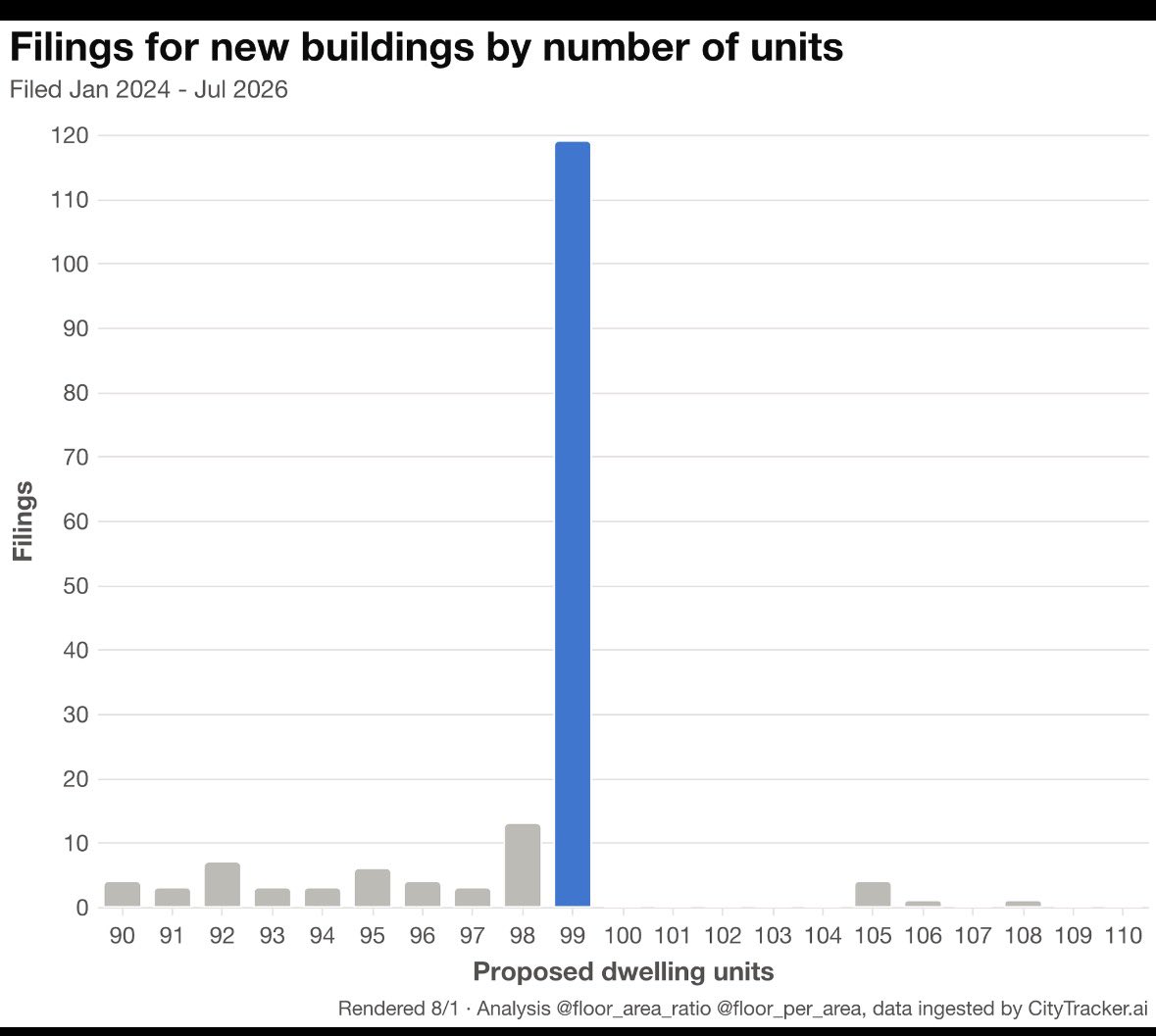
NYC ran an experiment: a separate minimum wage for construction workers on buildings above 99 units ($72.50 an hour)
As a result, almost all construction has been scaled back to 99 units, and we’ve built significantly less housing
And please, for the love of god, someone explain to me why this isn’t the social security model going forward.
Tell me why the 12.4% from you and the employer can’t go into an account in your name that you control and is YOURS. No loans, no withdraws etc until retirement.
Claude Fable 5 will be available again globally tomorrow.
After a series of productive conversations with the US government, we're redeploying the model with a new set of classifiers to target and block more cybersecurity tasks. In the near term, some routine tasks like coding and debugging will fall back to Opus 4.8. We’ll continue to refine these classifiers over the coming weeks to reduce false positives and better distinguish genuine misuse from legitimate requests.
We’ve also begun drafting a consensus framework—with Amazon, Microsoft, Google, and other Glasswing partners—for assessing the severity of AI jailbreaks and how AI developers should respond to them. We invite other industry partners and model providers to join us in this effort.
Finally, we’re scaling up our collaboration with the US government on model testing and safeguards. This will include pre-release access to models and safeguards for evaluation, information sharing on jailbreaks and misuse, and dedicated resources for joint research.
Thank you to our users for your patience, and to our partners across the government, industry, and the research community who worked alongside us to make Fable 5 available again.
Read our full blog: https://t.co/VHyum831ri
Claude Tag is a Trojan horse. Not because Anthropic is doing anything evil. Because the incentives are obvious.
Day one, this looks like a great feature: tag Claude in Slack, let it follow the thread, remember context, connect to tools, break down tasks, chase work, and act like a teammate.
But that is exactly the problem. The moment your AI vendor becomes a shared coworker, it stops being just a model provider. It starts becoming the place where work is interpreted, remembered, routed, and eventually executed.
That is not model lock-in. That is context lock-in. You are now renting your company back from them.
Models can be swapped. Agents can be copied. But the memory of how your company actually works is much harder, maybe impossible, to move: the Slack scar tissue, the exception paths, the customer promises, the unfinished threads, the weird workflows, the implicit owners, the “we tried that in Q2 and it failed” knowledge.
Once that lives inside one vendor’s agent layer, you are not renting intelligence anymore. You are renting your company’s operating memory.
And the pricing model makes it even more dangerous. A human coworker has a salary. Claude has unbounded tokenized activity. The more work moves through it, the more the vendor captures not just IT spend, but labor spend.
This is the enterprise bargain people will regret: Convenience now, and rapid decent into dependency.
The right architecture is simple: rent the best intelligence from whoever is best this month. OpenAI, Anthropic, Gemini, open source, whatever. But own the context layer.
Your company memory should be inspectable, permissioned, portable, and model-neutral. It should not be buried inside the same vendor that sells you the intelligence and the workflow surface.
Claude Tag is useful. That is why it is dangerous. Rent the intelligence, but own the context. Or, regret later.
@thsottiaux Truncation. I had to cancel my codex plan because no amount of prompting/context would make codex read entire files before writing over them on a consistent basis. Very hit or miss.
@chamath I’d argue the subscriber group creates more than pressure. Their non-overlapping needs give you two distinct usage streams, and the fast iteration from smaller teams and individuals naturally feeds back into sharpening the core for more complex enterprise work.
LIFTOFF OF ARTEMIS II
Carrying the hopes and dreams of millions as four of humanity’s bravest ride a great pillar of fire destined for the Moon, carrying the pride of nations.
📸 - @NASASpaceflight
STOP BLACK PILLING
Put the phone down.
Go outside.
Touch grass.
Call your mom.
Drink with your friends.
Be merry knowing you live in the best time in human history to ever be alive. You just need to slow down and take a moment to appreciate it.
That’s not the point at all. When I say “underutilized,” I’m talking about genuinely blighted spots: abandoned factories, vacant lots collecting trash, or rundown industrial zones that drag down the area and contribute nothing to the community. In Tampa, for instance, places like the old cigar factories or derelict warehouses near downtown aren’t anyone’s “perfect neighborhood”—they’re eyesores that we’ve been complaining about for years that could be revitalized into mid-density housing like rowhomes or townhouses, adding value without touching established suburbs.
As for “where does it stop?”—it’s not a slippery slope to endless high-rises if done right. Targeted, mid-density infill in zones already primed for redevelopment, not blanket upzoning of quiet SFH areas.
Zoning can (and should) set guardrails—places cap heights or require community input to prevent overreach, focusing on sustainable growth rather than developer free-for-alls. But US zoning laws rarely accommodate for infill.
And on sustainability? This is a sustainable solution compared to unchecked sprawl. In Florida, we’ve lost over 2 million acres of farmland and wetlands to low-density development since the ‘80s, jacking up flood risks and costing taxpayers billions in extended infrastructure (roads, sewers, power lines that sprawl costs 2-10x more per unit than infill).
Ironically I think we agree on the core issue: It’s about choice, not compulsion. property owners decide if they want to redevelop, and markets respond to demand. Cities should decide their policy on infill, and if so then zoning laws shouldn’t restrict these developers. Thereby giving those who want to live in the city an option.
If population growth keeps surging, sure, tough choices loom, but smart redevelopment now buys us time and balance. Why not build on what’s broken instead of breaking more ground?
You’re right—labeling any one lifestyle as “inherently better” misses the point in a country as big as the US. There’ll always be room for car-centric suburbs with big yards and highways, and plenty of people who love that setup. But not everyone does, and that’s okay. The goal shouldn’t be to force a shift, but to offer real choices that have been zoned out for decades.
I’ve grown up in Florida, so I see the “pie of location” getting sliced thinner with population growth—it’s unsustainable long-term, no argument there. But what I’ve witnessed isn’t just more people; it’s the type of development. Endless low-density sprawl gobbles up land, leading to higher infrastructure costs that outstrip tax revenue, more traffic, pollution, and the total destruction of our citrus fields and wetlands. Turning orange groves into cookie-cutter suburbs hasn’t solved affordability; it’s just spread out the problems.
Here’s where I push back on the pie being fixed: mid-density infill doesn’t require expanding it through endless sprawl; it creates more “slices” within the existing one by making smarter use of underutilized land in cities. For example, urban spots in places like Tampa—historic factories, industrial areas, low-density neighborhoods near downtown—sit underdeveloped or blighted while new suburbs keep sprawling out. A steady, sustainable increase in supply like this would be good for Floridians (if population growth slows, we agree on that); it eases pressure where demand is hottest. Population growth amps up demand, sure, but sprawl just displaces it outward, often leaving cities fiscally strained.
I want to live somewhere less dense when I’m older, and I drive an F150 and love the open road too—cars aren’t the enemy. The point is choice: not everyone, at every stage in life, wants a single-family home in a quiet suburb. Mid-density gives alternatives like walkable spots with transit for those who do, reducing car dependency without mandating it. No massive cultural shift overnight—just filling gaps to ease the fight over that pie.
Long story short- a large portion of the population wants to live in suburbs, yeah, but I’ve watched Florida quite literally run out of land to build these houses on. We need more long-term/sustainable options.
I get your point about prioritizing location, but I disagree that rowhomes or higher-density options inherently mean terrible quality of life. Well-designed mixed-use developments can actually enhance it. Cities like Amsterdam or Vienna have high density, top-tier quality of life rankings, walkability, less car dependency, more efficient land use and better transit.
I don’t think the American Housing Corporation’s mission is to wipe out suburbs or low-density living. It’s about giving families more choices in desirable spots without forcing everyone into endless sprawl or high-rises. Why not have both worlds?
@memeticsisyphus While Israel technically “purchases” the equipment via FMS, the payment is covered by U.S. aid dollars rather than Israel’s independent national funds.  Therefore, the financial burden ultimately falls on American taxpayers, as this aid is sourced from U.S. federal budgets.
Whenever I hear @elonmusk talk about data centers in space, he is always talking about scaling. Space scales massively better than Earth. Consider:
A permit for orbital locations for a mega constellation of 20,000 data centers requires 1 application and approval from the FCC.
But
20,000 locations on Earth require:
* 20,000 permits
* 20,000 site surveys
* 40,000 environmental studies
* 60,000 local political hearings
* 20,000 site development contracts
* 20,000 construction sites
* 20,000 power, phone, water, and sewage connections
* 60,000 building inspector reports
* 20,000 fire inspector approvals
Etc
Space scales massively better than Earth.