Female farrier (horseshoer) for over 30 years. Avid bird watcher and photographer. Nestled down in Rappahannock County, Va. News Weather Government & Politics
There is an animal that eats anthrax, botulism, cholera, and rabies for lunch and walks away fine. It doesn't have a good PR team, so most people have no idea what it's actually doing for us.
The turkey vulture's stomach acid runs at a pH of around 1, roughly as corrosive as battery acid, and hot enough to dissolve bones, hide, and virtually any pathogen that comes with the carcass.
A vulture eating a diseased animal isn't spreading the disease, but putting an ending to it. The infection chain terminates in the vulture's gut and goes nowhere else. Few other scavengers on Earth does this reliably.
Without vultures, things get bad for humans in a hurry. We've learned this hard lesson first hand.
In the 1990s, Indian farmers started giving their cattle a cheap painkiller called diclofenac. When vultures ate the carcasses, the drug destroyed their kidneys. The population collapsed by more than 95 percent in under a decade, one of the fastest declines of any bird species ever recorded.
The carcasses didn't disappear. Feral dogs and rats moved in to do the cleanup instead. Both species actually carry and spread rabies. Both brought the disease into contact with human populations in ways vultures never would have.
A 2024 study in the American Economic Review estimated the vulture collapse contributed to roughly 500,000 additional human deaths over the following decade. Not metaphorically. Counted deaths, linked statistically to the collapse of one bird.
The same thing is now beginning in sub-Saharan Africa, where poachers bait carcasses with poison to kill lions and elephants that might alert rangers. Vultures find the carcass first, as they always do. Six of Africa's eleven vulture species are now threatened with extinction.
The animal that shows up to the things nobody else will touch is doing more disease control than most of what we actively protect. It just has the misfortune of looking exactly like what it is.
🖤Another magnificent panful - here's Skunk, a super friendly "please, please, please rub my belly" boy! He always greets us with enthusiasm & we all love him! He's ready for his forever home, so please share!
#cat#cats#catsoftiktok#catsofinstagram#catlovers#catlife#panfur
Stay safe, stay hydrated but PLEASE look out for the wildlife & pets! Keep dogs in until later, keep cats in full stop & please please put some shallow dishes of water out for wildlife & ensure there's an escape route for insects & smaller animals! Please SHARE! #heatwave#heat
Something good is happening at this World Cup.
The Scots turned up. The English turned up. The Norwegians turned up. They sang their songs, got stuck in, and the Americans loved them for it. Glasgow and Boston are getting twinned off the back of it.
For 30 years we’ve been told to view the US as some sort of Great Satan — all imperialism and orange-man clichés. Not everyone buys it of course, but enough do.
And then Europeans actually go, and find a place that feels familiar. Makes sense to them. A bit richer, a bit further ahead, but recognisably ours. Settled by Europeans, still deeply European in its bones.
There’s a gathering-of-the-clans feeling to it. Old neighbours discovering they still like the same songs, the same drink, the same daft humour, and genuinely enjoying each other’s company.
None of it’s a surprise, really. It’s just been buried under so much politics that we forgot we were allowed to enjoy it.
Good to be reminded.
When adopting a cat, please take time to meet the scared ones, the shy ones, the ones hiding in the back, with plain fur or missing eyes, the seniors with tired bodies. They haven't given up they just need you. Maybe you need them too.
@RobynAnderson Uncle Mango is a great guy! Curious but accepting.
We have our own Uncle Ziggy. He was rescued from outside, took over the house, but when we rescued 3 kittens & momma he became the teacher of all things house and plays like crazy with them. Great uncle cat❤️
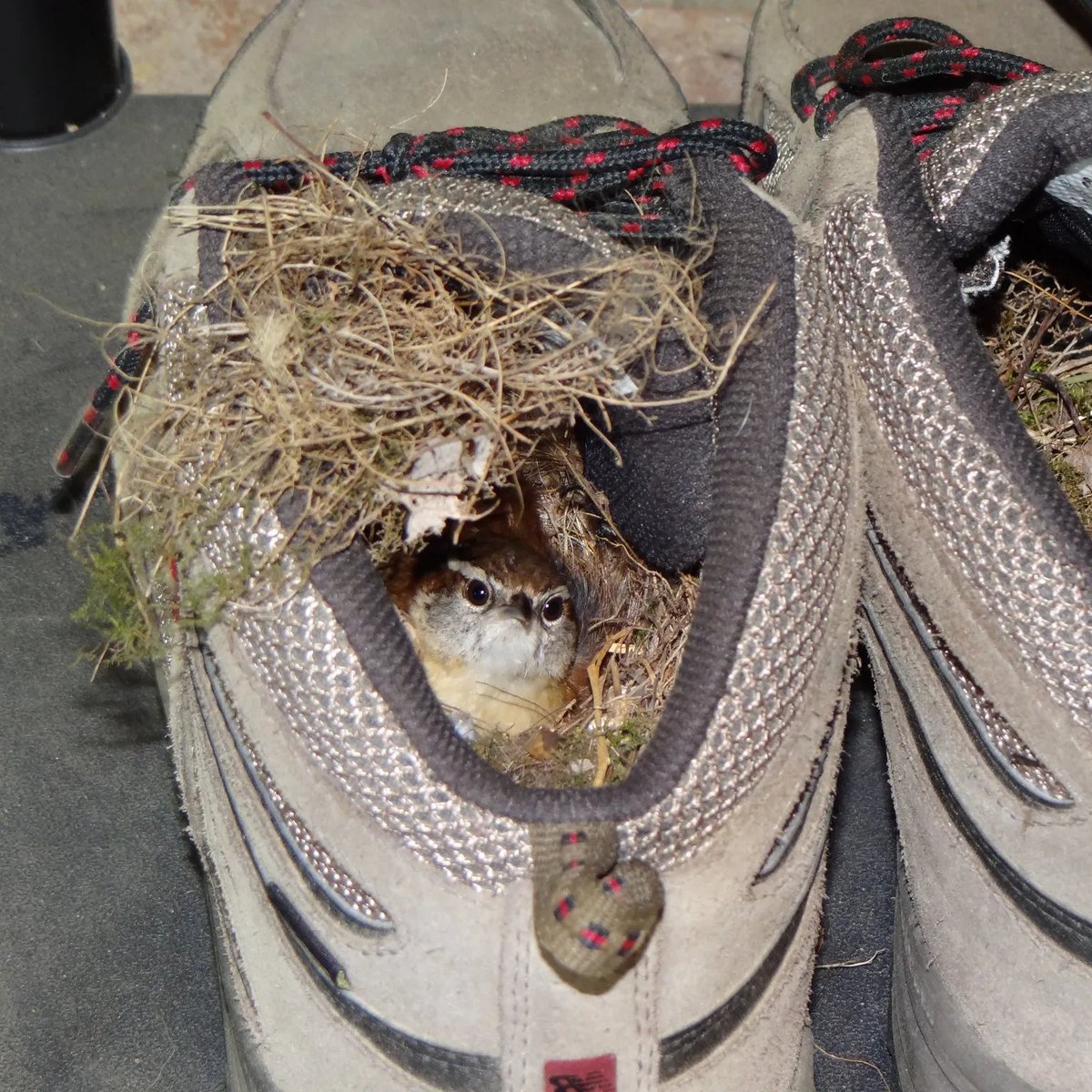
The house wren is four and a half inches long, weighs about as much as two quarters, and will nest in your shoe if you leave it outside long enough.
House wrens and Carolina wrens are among the most fearless, resourceful, and ecologically useful birds you can have in a yard.
They eat beetles, caterpillars, grasshoppers, ants, flies, and spiders, feeding their chicks almost entirely on insects from the moment they hatch. A pair raising young may make hundreds of feeding trips each day. They are doing serious pest-control work that costs you nothing.
They are also completely indifferent to the concept of appropriate nesting locations. Garden pots. Mailboxes. Old boots left on the porch. Coat pockets. Open toolboxes. Hanging baskets. A Carolina wren would nest in your hair if you sat still long enough.
If one moves into something inconvenient, the answer is usually patience. Incubation takes about two weeks, the chicks spend another two weeks in the nest, and before long they're gone.
Whatever they chose is legally protected under the Migratory Bird Treaty Act while the nest is active anyway, so you might as well wait them out and enjoy the show.
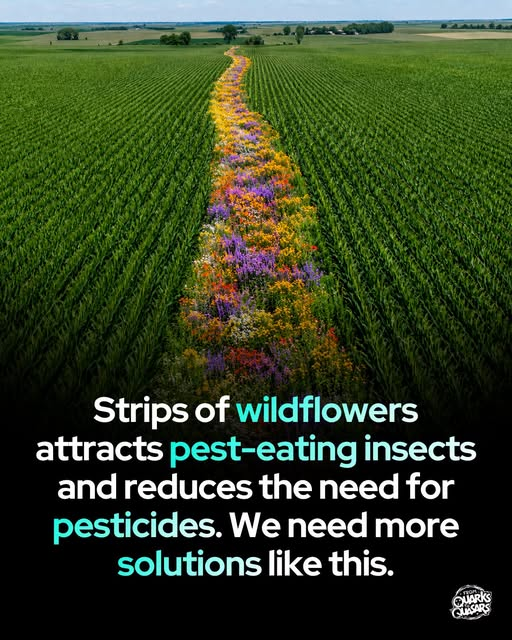
A strip of wildflowers can reduce the need for pesticides. Why aren't they everywhere? 📷📷📷
farmers are planting strips of wildflowers through and around their fields for a surprisingly powerful reason: they attract insects that help control crop pests.
Ladybugs are among the best-known examples. Both adults and larvae consume aphids, tiny insects that damage crops by sucking sap from plants. A single ladybug can eat dozens of aphids per day, while its larvae can consume hundreds during development.
But ladybugs are only part of it.
Wildflower strips also attract hoverflies, lacewings, parasitic wasps, and predatory beetles. Many of these insects are natural enemies of crop pests including aphids, whiteflies, thrips, and caterpillars.
Scientists call this "conservation biological control." Instead of introducing predators into a field, farmers create habitat that helps naturally occurring beneficial insects survive and reproduce.
The flowers provide nectar and pollen, which many beneficial insects need as adults. Research has shown that access to flowering plants can increase the lifespan, reproduction, and hunting activity of pest-eating insects.
Parasitic wasps provide one of the most remarkable examples. Some species lay their eggs inside aphids and caterpillars. The developing larvae consume the pest from within, eventually killing it.
Studies have found that fields with flower strips often support greater numbers of beneficial insects and experience higher rates of natural pest control than fields without them.
The benefits can extend beyond pest management. Flower strips may also support pollinators, improve biodiversity, reduce soil erosion, and provide habitat for wildlife in agricultural landscapes.
Researchers are now studying which flower species work best for different crops and regions. The goal is to design strips that support the most effective communities of beneficial insects while maximizing crop protection.
Run your garden hose for a few seconds before you point it at anything living.
Water sitting in a dark hose in direct afternoon sun hits 130 to 140 degrees. That's hot enough to scald a plant, kill the beneficial insects on the plants you're watering, and even burn a kid's hands.
It comes out scalding on the first burst and nobody expects it because a garden hose doesn't look like a hazard.
Run it into the mulch or the grass for a few seconds until it clears, then start watering.
That bag of cheap wild bird seed is mostly food your birds are going to throw on the ground, where mice will eat it.
The big reddish round grain in most budget seed mixes is milo, also called sorghum. It's cheap, it's heavy, and it fills the bag. Most songbirds, the chickadees, cardinals, finches, nuthatches that people actually want to see, largely ignore it or toss it aside in search of better seeds.
The leftovers pile up under the feeder, absorb moisture, and can sprout in spring. More importantly, spilled seed is one of the main reasons feeders attract rodents.
A lot of inexpensive blends are mostly low-value filler. So that $15 bag may contain far less bird food than you think.
The easiest fix is to buy straight black-oil sunflower seed. It attracts the widest variety of birds, produces much less wasted seed, and gives you more food that birds actually want. Add white proso millet in a separate ground feeder if you'd like to attract doves and native sparrows.
Read the ingredients on the back of the bag. If milo, wheat, or oats are near the top, keep looking.
Pro tip: get a library card, even if you won't use it much. Cities look at those numbers, and they help keep libraries open, funded properly, and safe from budget cuts.
The single biggest irrigated crop in America isn't corn, wheat, or soybeans. It's not even avocados or almonds. It's lawn.
We grow more grass than any food crop in the country, around 40 million acres of it, and almost none of it feeds a single living thing.
Think about how strange that is. We took a grass that isn't even from here, planted it coast to coast, and now we pour water, fertilizer, and pesticide into keeping it short, green, and perfectly useless.
To a bee, a butterfly, or a bird hunting caterpillars for its chicks, a manicured lawn is a desert. Nothing to eat, nowhere to nest, mile after mile of it.
But here's the good news, maybe the easiest win on this whole account: you don't have to fix the entire desert. You just have to claw back a corner.
Pick one strip. The hellstrip by the sidewalk, the run along the fence, that awkward patch you hate mowing anyway. Stop mowing it and plant it with native flowers, a few black-eyed Susans, some bee balm, a couple of coneflowers. That's it. No ripping out the whole yard, no fight with anybody. Just convert one piece.
And that piece stops being dead space and starts being habitat: bees, butterflies, and birds showing up to a spot that offered them nothing a year ago.
Now picture your neighbor doing the same, and the one after that. That's how a desert turns back into a meadow, one reclaimed corner at a time.
There's an invasive tree growing across America, and it's rolling out the welcome mat for the worst new bug on the continent.
It's called tree of heaven, and the name is a lie. It came over from China in the 1780s, and now it's everywhere: fast, scrappy, growing up through pavement, poisoning the soil around it so natives can't compete. One female makes over 300,000 winged seeds a year. Crush a leaf and it smells like rancid peanut butter.
And it's the favorite food of the spotted lanternfly, the invasive planthopper now chewing through grapes, orchards, and hardwoods across the East. An invading tree, feeding an invading bug. Kill the tree, starve the bug.
Here's the part that trips everyone up. Do not just cut it down. Cutting it, even cutting and painting the stump, makes it panic and shoot up dozens of root suckers. One tree becomes a thicket.
The move that works: treat the standing tree. Hack a ring of cuts into the bark and apply triclopyr in late summer, and it carries the poison down into its own roots.
Never advice I love to give, but it's the best way to end this invasion, one tree at a time.
The goldfish in the bowl is four inches long and seems harmless. But released into a pond, it can become a four-pound monster that wrecks the whole ecosystem.
People do this thinking it's the humane goodbye. It's the opposite. Goldfish are a serious invasive. Set loose, they don't stay small, they grow huge, root through the bottom like the little carp they are, uproot plants, muddy the water, fuel algae blooms, and gobble the food native fish need. Wildlife agencies pull football-sized goldfish out of lakes all the time, and they can foul a pond's water quality in about two years.
It's not just fish. Released red-eared sliders (sold tiny, they live 20-plus years and triple in size), and dumped aquarium plants like hydrilla and fanwort, become invasive the same way. Even the water itself can carry disease and hitchhiking species.
So when you're done with the tank, never release any of it, animals, plants, or water. Rehome the fish through a pet store return, a hobbyist group, or a surrender event.
It's hot. Put a dish of water outside today with a few stones in it.
During a heat wave, birds and bees need water as much as food. Honey bees drink it, haul it back to the hive, and use it to help cool the brood.
But bees need a safe place to land. A deep bowl of water can become a trap.
The fix is simple. Fill a shallow dish with pebbles or stones and add water until the tops stay dry. The bees get islands to stand on, and birds get a shallow edge to drink and bathe.
Set it in the shade and dump and refill it every day. Fresh water in the heat, no mosquito problem.
Two minutes, a dish, and a handful of rocks can make the hottest days a little easier for everything sharing your yard.