Had the not pleasant experience of being at a South African toll road and they won’t accept any of our cards because “they’re not local” and we don’t have any Rands. I thought Visa and Mastercard were accepted everywhere? Thanks to the kind stranger who paid for us. #SANRAL
We are hiring! 💼
We are seeking a highly-skilled Programme Officer to provide expert advice and capacity support for Indigenous and local knowledge.
More details about the role: https://t.co/sn7bp3MeUI
Closing date: 16 April 2024
🚨OPPORTUNITY KLAXON🚨A great chance to get up to ✨ £240,000 ✨ funding for social science projects engaging with environment and climate issues - especially aimed at ECRs!
Got an idea? Go for it!
@LewesTC bottom of Christie Road and Nevill completely #flooded but no surprise - all the road drains are so blocked, they have plants growing in them. These have been reported over and over. @LewesTC please do the maintenance to prevent totally avoidable #SurfaceWaterFlooding.
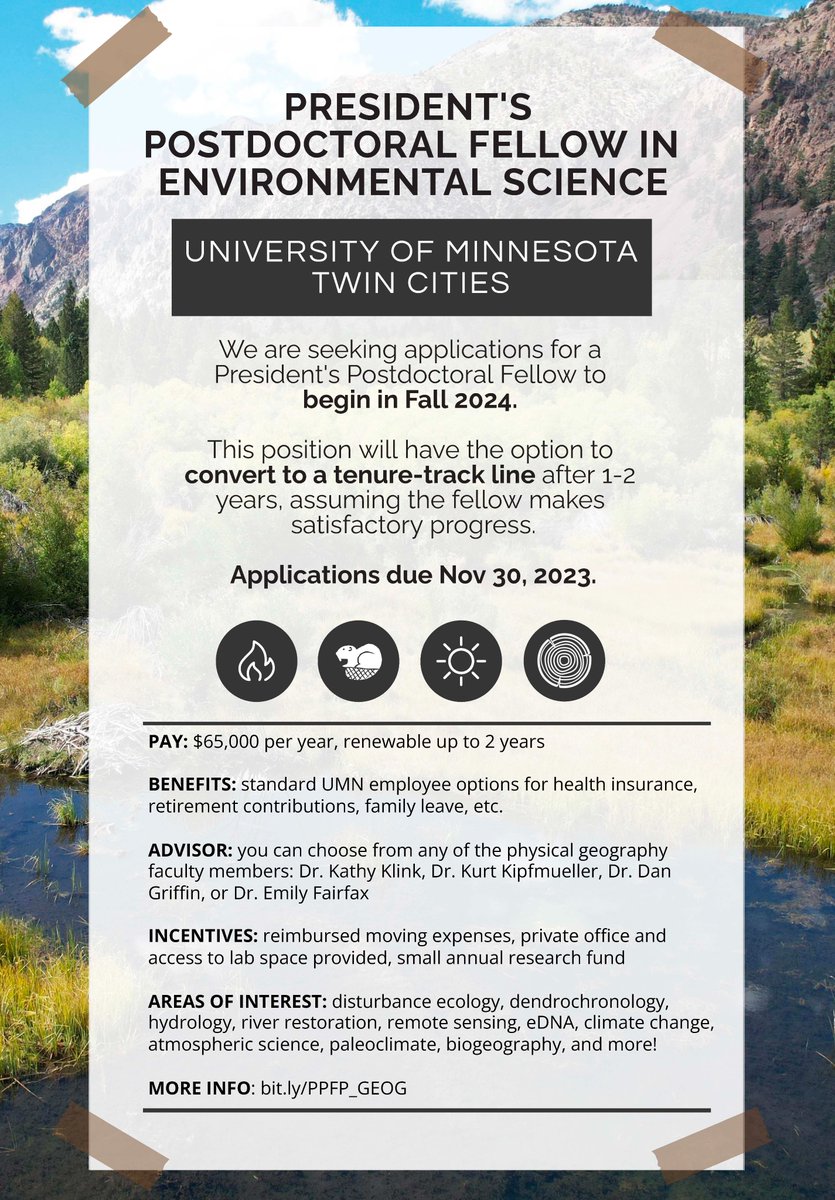
My department is searching for a Postdoc Fellow that will convert to a tenure-track Asst Professor job after 1-2 years!
Do you use eDNA? Or remote sensing? Or modeling? Or field work? Do you study environmental science? Or paleoclimate? Or #BEAVERS?
Our search is broad! Apply!
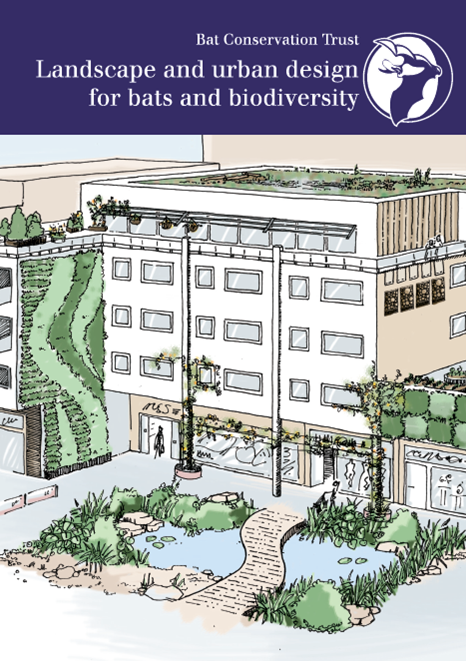
#WorldHabitatDay#worldhabitatday2023 Theme: Resilient urban economies.
Download the Landscape and Urban Design for Bats and Biodiversity for FREE https://t.co/QQsbgYrhm2
If you are an ecologist or evolutionary biologist working on climate change and biodiversity, sign up for this symposium!
🗓️8 Sept, 11am-6pm
Register here: https://t.co/RIfbRidqey
@jayacunzo Thank you for putting this out there. I’m always very honest about the difficulties of parenting but often feel that I’m the only one talking about it and it’s semi-taboo.
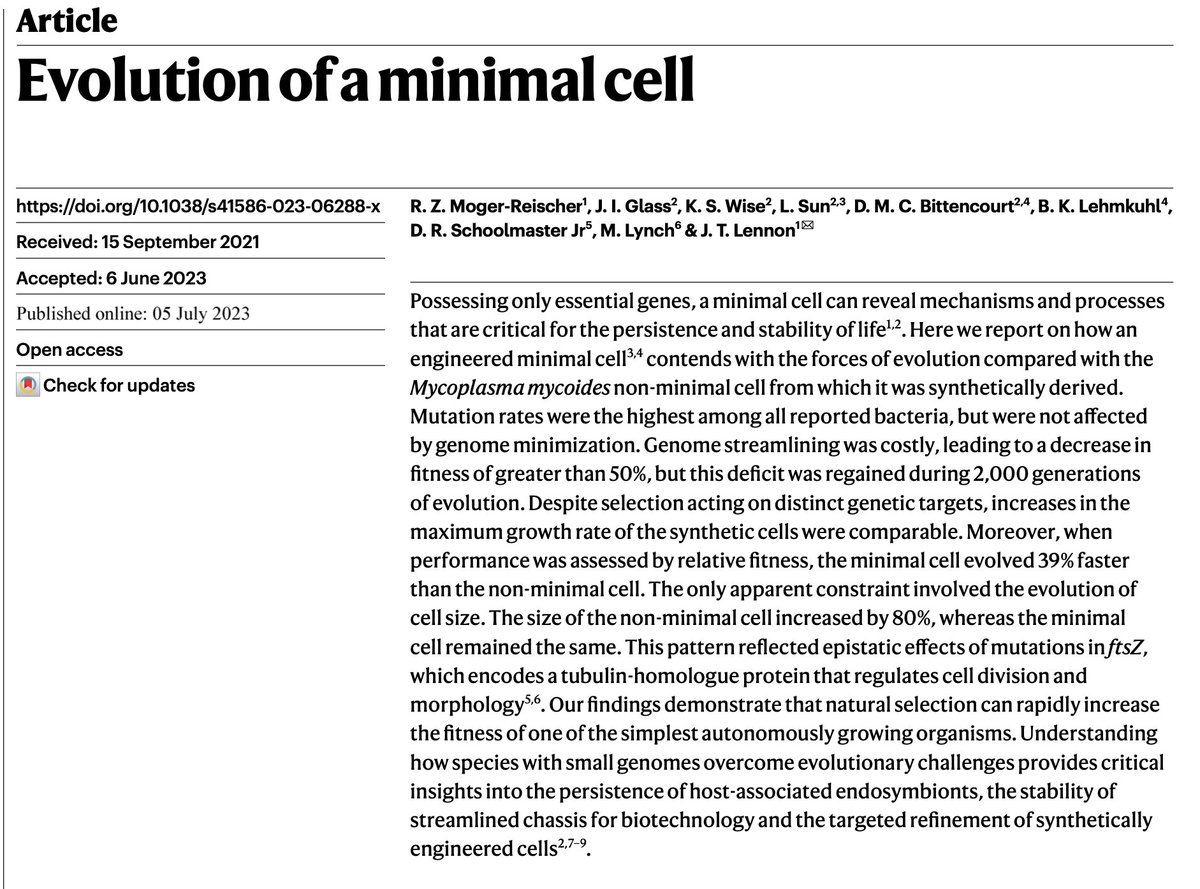
A mind-blowing paper has come out today in @Nature
In 2016, JC Venter Institute scientists trimmed a bacterial genome to its barest minimum required for life to synthesize what they called a "minimal genome" (https://t.co/Rk8oZJ0bUj).
Today, a group of scientists from Indiana University reports how that minimal genome evolved over 2000 generations in comparison to the non-minimal genome.
The authors found that even when you reduce a bacterial genome to its absolute minimum where every nucleotide matters, the genome undergoes mutational events generation after generation as much as the non-minimal genome. One simply cannot stop the evolution.
Just over 300 days of evolution (equivalent to 40,000 years in humans) the minimal cell has gained everything it lacked in fitness on day one in comparison to the non-minimal cell.
When comparing the evolved traits between the minimal and non-minimal cells, the scientists found something striking. The evolutionary process increased the cell size of non-minimal cells but not that of the minimal cell. But that is not the striking part.
The scientists were able to identify the key mutation that resulted in cell size evolution. And it turned out that the mutation that helped the non-minimal cells to grow bigger is the same that helped the minimal cells to stay smaller. Growing bigger had a survival advantage for non-minimal cells and not growing bigger had a survival advantage for minimal cells. So, the mutation had a context-dependent effect. This just demonstrates that the evolutionary effects on traits have no absolute direction. All that matter is what is beneficial for the organism's survival.
The conclusion of the paper is metaphorically a quote from the Jurassic Park movie:
“Listen, if there’s one thing the history of evolution has taught us is that life will not be contained. Life breaks free. It expands to new territories, and it crashes through barriers painfully, maybe even dangerously, but . . . life finds a way". (https://t.co/UlxRlb86CT)
https://t.co/zA9OAqSoAu
Great privilege to listen to Andy Stott’s insights on the Kunming-Montreal #GBF, in particular “what’s in it for trees?” at the @BritishEcolSoc symposium on Trees for Climate, Biodiversity and People.
Why not apply to be Head of Grants at the
Whitley Fund for Nature to manage its international conservation grants programmes. Whitley is a pioneering, deeply impressive, evidence-based funder who make a real difference by enabling young conservationists.
https://t.co/ELZxiM2O7h
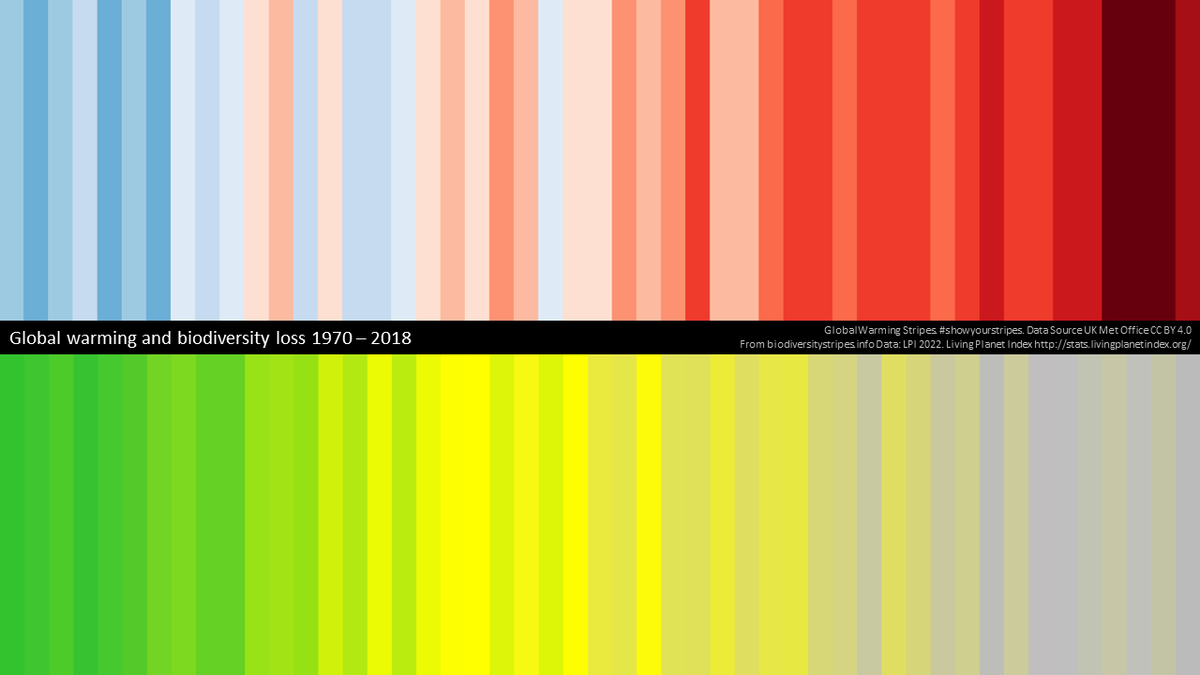
The biodiversity stripes have a new home, now twinned with the climate stripes - together they tell a story where few words are needed #showyourstripes
https://t.co/WBHDmCmZyN