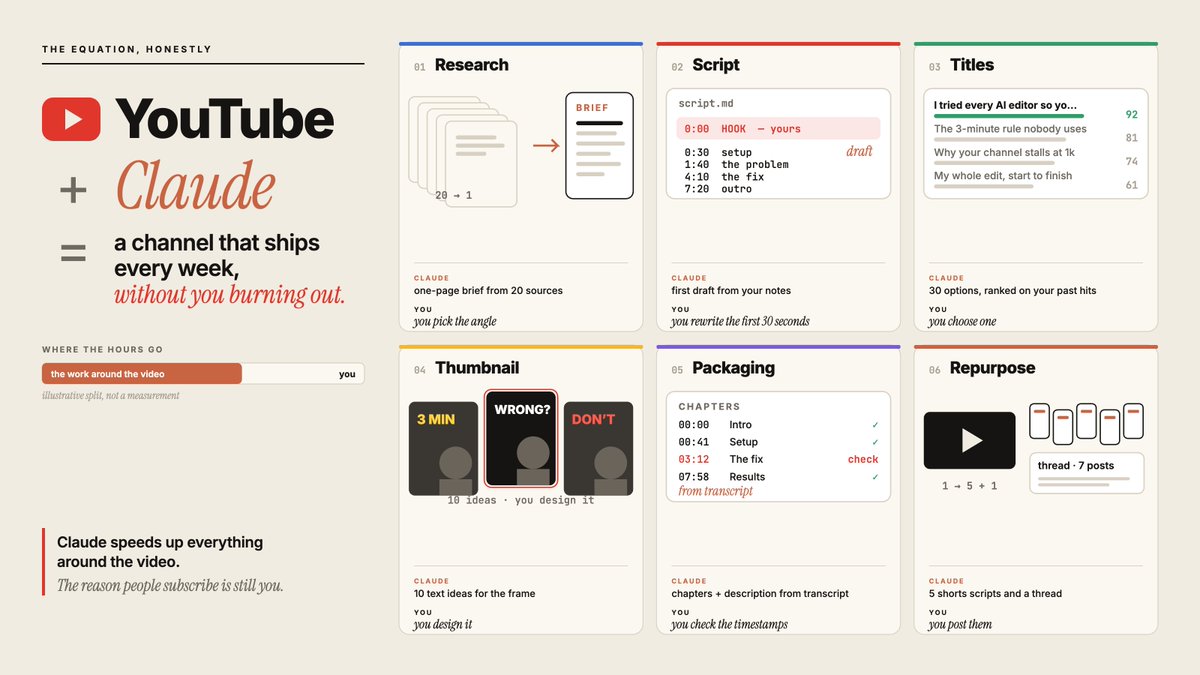
everyone's YouTube + Claude equation ends in a dollar sign. mine ends in "still uploading in month six"
it takes the work around the video:
research, 20 sources into a one-page brief
scripts, a first draft from your notes
titles, 30 options ranked on your past hits
chapters and descriptions straight from the transcript
one video into 5 shorts and a thread
what it can't take is the first 30 seconds, the face on the thumbnail, the reason anyone subscribes
channels rarely die from bad videos. they die when the creator runs out of hours
this is getting a little scary
the setup making the rounds: hundreds of Claude Code agents running in parallel, with a checking layer on top so none of them can make stuff up
how it runs:
- 500 agents writing and checking at the same time
- every claim checked against the source in about 150ms
- three passes over 150 company profiles until nothing is left to reject
- everything saved straight into an Obsidian vault
the trick is the split. one model writes, a cheaper one only decides if each claim is actually true. the loop keeps going until every claim checks out
an analyst team would bill weeks for this. here it's one run
@kevin_t_ngo 7,000 ants staying smooth is the impressive part. are they laying actual pheromone trails on a grid or steering straight at the sugar? the trail version is what gives you those ant highways
@ivanfioravanti curious if MiniMax Code changes the water shader itself or just the scaffolding around it. same prompt with a fixed camera path would make the two runs a fair 1:1
@SahilPanhotra 82M tokens for one pond smells like the harness re-reading the whole project every turn. a cheap model hides that, but run the same loop on a pricier one and that's a very expensive fish
@0xwhrrari made a few X videos this way this week. the animation was the easy part. export was the pain: recording the canvas in real time kept corrupting the H.264 file, rendering it frame by frame fixed it
Took me way too long to find this. Claude Code can keep a wiki of your work that rewrites itself and flags its own mistakes.
You can set up Claude Code to keep a wiki about your work that mostly writes itself. Three agents, one folder:
the reader drops every link, PDF and voice note into raw/ and never edits them the librarian rewrites every wiki page a new source touches, usually 10 to 15 of them the checker runs at night and hunts for contradictions, stale claims and pages nothing links to
Two rules keep it honest. When a new source disagrees with an old page, the checker tags you and keeps both versions, it never quietly overwrites. And a page that goes 30 days without a fresh source gets marked unconfirmed.
Good answers get filed back as pages too, so the wiki grows every time you ask it something.
Every page shows three things: the claim, the source file, and the date it was last confirmed.
Paste this into Claude Code:
Set up a second brain in this folder. raw/ holds my sources and you never edit them. wiki/ is yours, one page per topic, and every page shows the claim, the source file and the date it was last confirmed. Save good answers back as pages. Every night, check for contradictions, stale pages and pages nothing links to, and tag me instead of overwriting anything. Show me the structure first and create nothing until I say go.
Start with one topic you actually work on, not your whole life.
Hook options
Every new chat, your AI meets you for the first time. It doesn't have to.
3 agents, 1 folder, and an AI that remembers what you told it last month.
Your AI shouldn't sound sure about something you changed your mind on 3 weeks ago.
Pick: #1. Everyone has felt it, it's one short line, and the video answers it in the first second ("this one keeps notes").
Before posting
Paste from this file, not from a preview, so the blank lines stay.
Check the composer: no blue words in the text.
Attach second-brain.mp4.
@0xWast3 the host step is the part worth copying outside biology. an unknown record alone says little, but next to whatever else was in the same batch it starts to make sense. most teams delete their unclassified bucket before anyone looks
@RafaCrackYT depends how often it runs. a one-shot that a human reviews after, I pay for quality. a job that runs 100 times a day, $0.46 vs $55 decides if it ships at all
@EnvolDev the 2h07m is the number I'd price in. if you're sitting there waiting, 87 extra minutes costs more than $14. for overnight batch jobs though, 40 cents is hard to argue with
A Claude Code routine on a 15-minute timer runs 96 times a day. If 6 of those runs have something new to work on, you paid for 90 that did nothing.
At $0.40 a run that's $38 a day, about $1,152 a month.
One rule fixes it. Check first, run only when something changed.
every tick, hash the inputs and compare with the last run
same hash, exit before the model gets called
new hash, draft a plan and wait for your approval
non-urgent changes after 11pm wait until 7am
Same routine with the check costs about $2.50 a day, $75 a month. 5 changes still get handled the moment they land, the 6th waits for morning.
Paste this into Claude Code:
For every scheduled routine in this repo: before the full run, hash its inputs and compare with the last run. If nothing changed, exit without calling the model. If something changed, draft a plan and wait for my approval before any write or send. Hold non-urgent changes between 11pm and 7am until morning. Show me the monthly cost before and after, and change nothing until I say go.
The video is a simulation with the prices written in the footer. Plug in your own price per run.
@Sprytixl the underrated part is "never let the big model touch the old code." summaries in, decisions out. but one wrong service map and the rewrite inherits the error. do you run a reviewer pass that checks each summary against the real call graph before Opus plans anything?
@quietoraclex the strongest version of this: don't keep the key on disk at all. inject it at run time (op run, doppler run, etc.) so there's no .env for the agent, a script, or a stray commit to find. deny rules + sandbox + spend caps become the backup, not the only wall.
@karanC_12 the number I'd want next is cost per *correct* output. if the cheaper model needs 2 retries plus 15 min of your review, the 26x gap shrinks fast. did you count fix-up time on the DeepSeek run?
Your agent isn’t dumb. You gave it the wrong job.
A dev split 12 Claude agents into 4 roles and handed them 64 research papers:
→ Readers pull the equations and settings
→ Builders turn each method into standalone code
→ Reviewers check every result against the paper
→ Interface agents build the controls
The output: a lab that runs in your browser. Change the setup, watch the result move.
11 methods. 28 reference scenes. 7 matched. 4 still flagged.
My video runs the same idea with 2 models. Astra searches wide. Opus goes deep. The spider collects it all.
The trick isn’t more agents. It’s clear jobs + a reviewer.
Start with 1 paper. Get 1 result right. Then add agents.
Which role would you add first? 👇
@Klonzu The dev/bundle filter is the real edge here, most of the “alpha” in this space is just not holding what gets rugged. Curious how the sim handles slippage on those 50x–100x exits though, that’s usually where paper and live diverge.