Introducing Zero Fee Perps 🔥
Zero Fee Perps (ZFP) are now live on Mainnet.
Starting today, every retail trader on Paradex pays $0 in trading fees (maker or taker) on 100+ perpetual futures across web and mobile.
What “zero” means here
- $0 fees for retail on every perp, win or lose.
- Always-on — not a promo, not capped, not limited to a few markets.
- The only frictions left are spread and funding (as it should be).
TL;DR: Keep your edge. Stop paying tolls.
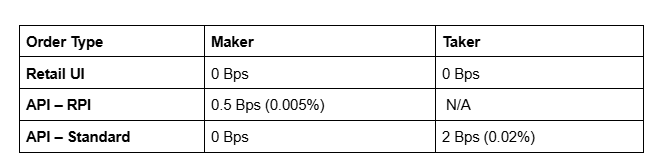
Fee Structure
Why Zero Fee Perps are inevitable
The current affiliate-driven distribution model is broken. Many CEXs charge 5–10 bps, then hand 60–90% of that to KOLs to buy distribution. Users get overcharged so platforms can overpay middlemen; KOL relationships stay purely transactional and churn to the next highest rev share. It’s a race to zero with the retail trader footing the bill.
Paradex is built for direct access: no custody middlemen and no distribution tax. Creators still matter, so we’re rolling out a new affiliate model that makes KOLs long-term owners not just rev-share renters via an explicit token allocation. Better economics. Better trust. Better outcomes.
How we make money (and keep fees at $0)
Paradex earns from RPI (Retail Price Improvement) maker flow, not from retail takers. Professional market makers post RPI-flagged orders that are visible in the UI (for retail) and hidden from the API. These quotes only match against retail taker orders, reducing adverse selection. In return, makers price tighter with more size and pay 0.5 bps (0.005%) on RPI fills to Paradex. This micro-fee, at scale, funds Zero Fee Perps sustainably. Separately, high-frequency API takers pay 2 bps (0.02%). Over time, we’ll transition to toxicity-based fees.
It’s analogous to TradFi PFOF (e.g., Robinhood) with one key difference: orders are not selectively routed to a few market makers. All makers compete on an even playing field for retail flow; best price/size wins. Retail keeps $0 fees and gets price improvement; makers get curated flow; and Paradex earns a durable revenue line.
Won’t spreads widen?
No. RPI reduces toxicity, which lets makers quote tighter spreads with more size. In fact, after adjusting for fees paid Paradex beats the top exchanges ~96% of the time on majors at $100k orders. Check out the Paradex Liquidity Monitor👉 https://t.co/y21QA6BeGW: for real-time spreads and execution quality.
TLDR;
Fees were a tax on coordination. We’re removing them.
Trade perps but pay ZERO. Keep your fees as edge—and help us build a model where users, affiliates, and the venue win together.
why does this matter?
pfof (payment for order flow)
let me explain
what is pfof?
pfof is a system where a trading platform (broker or exchange) routes customer orders to specific market makers in exchange for a fee . In simple terms, instead of charging you a commission, the platform gets paid by a third-party market maker for the right to fill your order . this behind-the-scenes payment is what allows some platforms to advertise “free” or zero-fee trading, because someone else is footing the bill for trade execution. (If you’ve ever wondered how robinhood makes money on 0% commission trades, pfof is the answer.)
the next logical question is: why is this so important?
PFOF enables trading platforms to charge zero taker fees to users while still giving the platform a revenue stream. It creates a sustainable business model where you, the trader, pay nothing to trade, yet the business earns income on every order filled (since a market maker pays for each order). Think of it like a shopping mall with free entry for customers: shoppers roam freely without paying an entrance fee because the stores (analogous to market makers) pay rent to the mall for access to those customers.
similarly, with PFOF the “rent” is paid by market makers to the platform for access to order flow, so traders enjoy fee-free transactions.
platforms like Robinhood famously pioneered this model. more than 75% of Robinhood’s revenue in 2020 came from PFOF (rising to about 81% by early 2021), and the company essentially acknowledged that PFOF is what allows it to offer commission-free trading.
in other words, without PFOF, commission-free trading at scale wouldn’t be possible for many brokers.
okay that makes sense, but why would market makers pay for orders?
in short, because it’s profitable for them. retail traders’ orders are often considered “uninformed” flow (not based on proprietary market-moving information) and thus carry less risk to trade against . market makers covet these retail orders and are willing to pay a small fee for each one to secure a steady stream of this business. They make their money off the bid-ask spread on each trade.
by paying the broker a tiny amount per share (often just fractions of a penny) for the order flow , a market maker gets to fill your order, often at a slightly better price for you, and then pocket the remaining difference in the spread as profit . market makers pay for retail order flow because those trades pose the least risk and still allow them to profit from small spreads . meanwhile, you benefit because the broker can afford to waive your trading fees (since it’s earning revenue from the market maker instead). It’s a win-win scenario: you trade for free, the market maker earns from the spread, and the platform earns the maker’s fee.
i often see discussions about how @Lighter_xyz's business model (zero-fees -> PFOF) is not a sustainable business. unfortunately, many of these takes come from uninformed individuals who might not fully understand what PFOF is and how it scales. So, how is PFOF going to be a sustainable business model for @paradex (and Lighter)?
by relying on PFOF, paradex can align incentives in a way that keeps the platform financially healthy without charging users directly. Rather than depend on high taker fees, Paradex will monetize by essentially “selling” the flow of its retail orders to liquidity providers (market makers) who compete for that flow, something made possible only because of flow segmentation via RPI (Retail Price Improvement).
in other words, the RPI program lets paradex tag and isolate high-quality retail order flow, which the platform can then offer to market makers in return for PFOF revenue.
this means the more volume paradex users trade, the more revenue the platform earns, all while users continue to enjoy zero fees.
this model has already been proven in traditional markets: zero-commission stock brokers generate significant income from PFOF (look at robinhood).
by making trading free for participants, PFOF encourages higher trading activity and deeper liquidity on the platform, which in turn attracts more market makers willing to pay for that order flow. this is only made possible via RPI and flow segmentation which causes spreads to be tighter than their peers and in some cases better than Binance.
“Binance spreads, but with zero fees.”
the result is a positive feedback loop of liquidity and growth, funded by those who profit most from the trades (professional market makers) rather than by charging casual traders.
tou are probably now thinking... “this all makes sense, but why does paradex need a PFOF model? why not keep tight spreads and just charge normal (even high) fees?”
because the fee game is unwinnable against Binance/Bybit’s KOL machine.
centralized exchange distribution runs on affiliates (KOLs). At scale, the big venues rebate 60–90% of taker fees to top referrers and often sweeten it with token/equity. That lets them lock up the influencers who control user flow. For a smaller venue or a DEX to “outbid” that, you’d have to (a) match or exceed those rev-shares without the volume base, and (b) still fund your own ops/liquidity incentives. It doesn’t pencil out.
zero taker fees financed by PFOF is the only credible wedge
instead of taxing users to fund KOLs, paradex charges makers a tiny fee for curated, low-toxicity flow (via RPI) and drops taker fees to zero.
that does three things at once:
1) neutralizes the KOL advantage. I=if your total trading cost on paradex is spread only (no taker fee with negligible slippage), the “5-10 bps but I’ll kick your KOL 80% back” pitch loses it's appeal. to keep users, centralized exchanges would have to cut fees, which shrinks KOL payouts, undermining their own moat
2) wins the narrative and the math. “Binance spreads, zero fees” is simple, verifiable (look at @fiddybps1 post below), and shareable. users don’t need a ref-code from their favorite KOL -> they see lifetime savings on every trade, similar to what @DefinitiveFi does.
3) funds itself sustainably. makers want this flow (it’s segmented/benign), so paying ~0.5–1.5 bps works for them. paradex earns those bps without taxing the taker, and makers still monetize the spread
quick back of napkin math:
a) centralized exchanges today: taker fee 6 bps -> 80% to KOLs (-4.8 bps) -> exchange nets ~1.2 bps; user pays 6 bps + spread
b) paradex: taker fee 0 -> maker pays ~1.0 bps on curated flow -> paradex nets ~1.0 bps; user pays 0 bps + (often tighter) spread
this is how you pry users from a KOL-fortified incumbent, make the experience cheaper and the execution as good or better
this only works if your flow is worth paying for. that’s the point of RPI/flow segmentation: retail/UI flow is less toxic, so makers pre-commit to quote quality and size and pay a small toll to access it
any upstart exchange that can’t out-compete KOL payouts has to compete on user total cost and execution quality.
execution cost is not just spreads.
Execution cost = spread + fees + slippage.
PFOF + zero taker fees is the only path I see today for new entrants to disrupt the incumbents.
everything else is just losing a bidding war for influencers or won’t scale with users and latency
^ think -> at what ms latency does cancel priority become irrelevant?
paradex routes value from those who profit most (professional makers) to those you need to win (traders), and the pitch is incredibly simple: Binance-level spreads, zero fees, and often better realized execution.
ty for reading
1/ CLOBs have been TradFi's backbone for decades, but on-chain they create new problems: latency arbitrage, MEV, toxic flow, and higher costs for traders.
The ecosystem needs better market structures.
Enter: Dual Flow Batch Auctions (DFBA).
12 hr from the worst hack in history. ALL withdraws have been processed. Our withdraw system is now fully back to normal pace, you can withdraw any amount and experience no delays. Thanks for your patience and we are sorry that this has happened.
Bybit will come out with full incident report as well as security measurement in the next few days. I will also personally keep you all posted on any new updates. Thanks to all the clients, friends and partners who have helped and supported us during this excruciation 12 hrs.
The real work has just now started.