Prologue to my Hero's Journey:
I am a patient diagnosed with RA that was told by my rheumatologist that I'd be on a cocktail of meds for life, diet had nothing to do with my diagnosis, and there was nothing I could do to heal or improve from the disease.
Through several personal experiences and reading others, I learned that this is what doctors are taught and what patients are led to believe.
I am Ken, a nobody from Canada that thought he was too small to make a difference. My BHAG (Big Hairy Audacious Goal) is to eradicate chronic disease and mental illness, improving health outcomes and healthcare systems.
We've known glyphosate/Roundup has contraceptive properties for some time. This study also shows it suppresses testosterone. And for those who would rebut, it's "animal studies." Yeah, humans are animals too - so, it's relevant.
Next step: EPA MUST act, as this was a first-of-its-kind HHS-ordered, NIH executed study.
Comment here. There are only 4 days left: https://t.co/V5zIcFjAGA
1) Posted by Cammy Benton MD on Facebook:
“Measles, vaccine safety, and why I keep asking questions
With measles outbreaks happening across the country, someone sent me a respectful private message. He was upset about the outbreaks and wanted to know why some parents are choosing to delay or skip vaccines. I understand why he’s worried. Measles can be dangerous, and vaccination is the most effective way to prevent it. One dose of MMR is about 93% effective at preventing measles, and two doses are about 97% effective. A small number of children still get measles after two doses and can spread it, although breakthrough cases are uncommon and generally less likely to pass it on. Those effectiveness figures describe how much the vaccine lowers the risk of measles. They don’t tell us exactly what percentage of vaccinated children lack immunity.
On November 17, the Pan American Health Organization announced that the U.S. had lost its measles elimination status after sustained transmission. I understand why that worries people. I think about the babies who are too young for their routine first dose, pregnant women who aren’t already immune, and people whose immune systems are too suppressed to receive a live vaccine. Those are real concerns. When fewer people around them get measles, they’re less likely to be exposed. That’s part of the greater good, and it matters to me.
In my clinic, I give families medical guidance and talk through the benefits, risks, and uncertainties. The decision about their child belongs to them. What I’ve been asking for all along is for the dogma to stop and for us to respect people enough to give them real informed consent. Tell them what we know about the benefits and risks. Tell them what the studies actually compared, including when they used plain saline, and how long they followed people. And when someone has a suspected vaccine injury, document it, report it, and study what happened.
And here’s the other part of the greater good that I don’t hear us talk about enough. Serious vaccine reactions are rare, and they do happen. If we ask people to do something in part to protect the people around them, then we owe something to the people who are harmed. I don’t want a parent to hear “it’s rare” and walk away feeling like what happened to their child doesn’t count. We owe that family a real evaluation, an honest conversation, and support. To me, that’s how the whole thing works. We look out for the baby who’s too young to be vaccinated, and we also look out for the child who had a serious reaction. Both are part of the community we say we’re trying to protect.
If you want to understand where I’m coming from and why some families have questions, I’d recommend reading these alongside the original studies:
* Dissolving Illusions: Disease, Vaccines, and the Forgotten History by Suzanne Humphries, MD, and Roman Bystrianyk.
* Turtles All the Way Down: Vaccine Science and Myth by anonymous authors, edited by Zoey O’Toole and Mary Holland, JD, with a foreword by Mary Holland. Look for that subtitle and foreword so you get the right book.
* Vaccines, Amen: The Religion of Vaccines by Aaron Siri.
For me, this started with my own kids.
All three of my children had health problems after vaccination that concerned me, including serious neurologic symptoms. I wrote down what I saw. I asked their pediatrician to put it in the chart, report it, and help me figure out what happened. She declined. My understanding was that the practice had adopted a clinic-wide policy requiring families to follow the vaccine schedule to stay in the practice. I wanted to talk through a different plan for my kids, and there wasn’t room for that under the policy.”
@jsm2334@dawreeuhn@DrKellyVictory Note that even one case would make it a contributor, but if you're uncomfortable with admitting that's a possibility, "we don't know" would be an acceptable answer.
@jsm2334@dawreeuhn@DrKellyVictory In case you've forgotten the question, it is:
"Do excess vaccinations and catch up vaccine visits contribute to the uptick on chronic disease (and mental illness)?"
I suggested my opinion was that they almost surely did.
@GovernorShapiro should take a break from campaigning for president to ask why medical care of measles in his state is so terrible. 8 fatalities from 1600 cases = 1/200. This is 25x the fatality rate in Canada in 2025 (2 fatalities from 5200 cases) and 50x the fatality rate in US in the 1950s (500 fatalities from 3,500,000 cases).
@jsm2334@dawreeuhn@DrKellyVictory Let me try a different way.
Is there anything in your series of posts that is substantive enough to show that my opinion is wrong?
You're collecting the screenshots.
Would you like to adjust your claim?
Is "significant harm" anywhere in my stated opinion?
Or is you stating what you think my opinion implied adequate for you to spend about 50 posts trying to tell me it's an unsubstantiated opinion.
Let me try again.
I believe that excess vaccinations and catch up visits are almost surely a contributor to a rise in the uptick of chronic disease (and mental illness).
Do you see the word "significant" or do you actually see me downplaying dawreeuhn's claim?
@jsm2334@dawreeuhn@DrKellyVictory Did any of your studies answer the question?
I engaged substantively showing they didn't.
It really doesn't matter how many studies exist if they don't answer the questions.
Yes, I expressed that opinion the other day and I stand by it.
You spent several posts trying to tell me my opinion was unsubstantiated.
Where did I claim that it leads to significant harm or was a substantive contributing factor to childhood chronic illness?
Here you provide a screenshot of a direct question I asked you, you didn't answer it, and tried to turn it around on me.
I'll wait 🦗🦗🦗
it's a perfect example.
Do vaccine injuries happen?
When they do, are they evidence?
Do you need a definition to answer these questions?
----
Did I ever suggest the MMR should be broken up? No, but it's hypothesis generating and might be a good idea ... or not.
Game
++++
You: "Can you link to the evidence of harm from multiple vaccines at one visit (or in one shot) and that this counters the drawback of lower uptake and cost and exposure of requiring so many more office visits by spacing it out?"
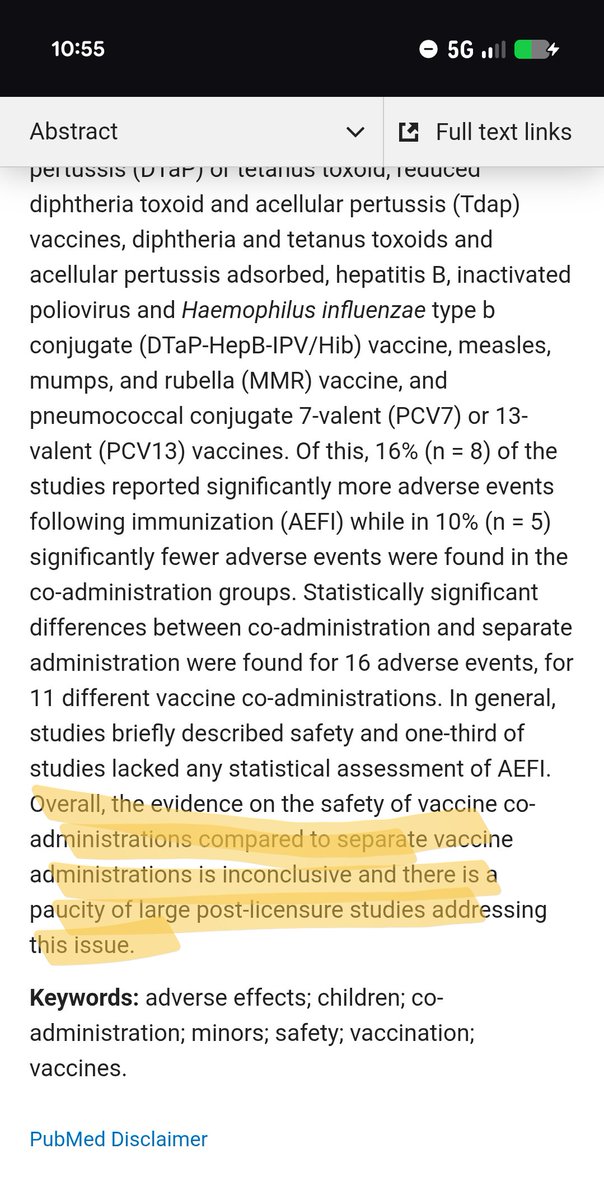
This was your response after you tried to link to studies that showed catch up visits of 4-6+ vaccines had been extensively studied, and the answers came back as "paucity of studies". You know the studies don't exist (as you showed) so why ask for this if you can't provide evidence that potential benefits outweigh potential risks?
Game.
++++
You. "And where is the evidence supporting your hypothesis that it leads to significant harm, much less is a substantive contributing factor to childhood chronic illness?"
Where did I claim that it leads to significant harm or was substantive contributing factor to childhood chronic illness?
Hint: I didn't.
Game
++++++++
Continuing to ask for evidence when studies have not been done, and you know they haven't been done, and you suggest they should be done .... after I express an opinion, even if it's a strong one before you add your own interpretations to it to make my opinion (actually now it's your opinion) even stronger ... because you want something "more substantive" is your game.
++++++
I see and actually admire your approach.
It's a tactic.
It's a diversion.
You're very good at it.
The industry would be proud.
And I'm not playing.
+++++++++
I'm not here to play games.
I am here to improve health outcomes.
I am here to point out how the game of Sick Care is played.
And I appreciate your efforts to display the tactics.