IRCC Has NOT Released a New Immigration Levels Plan
IRCC recently updated its website on October 13, 2026, but this was only an update to the page containing the existing 2026–2028 Immigration Levels Plan.
No new immigration levels plan has been released.
The next plan, covering 2027–2029, is expected to be released in November.
People power in action.
Ontarians are telling us they don't want their government spending millions to make congestion worse and commuting more dangerous for everyone. This fight isn't over.
President Trump’s decision to lift sanctions on Russian fuel amidst Putin’s ongoing and brutal attacks on civilian targets in Ukraine makes no sense and is a betrayal of the legacy and leadership of the late Senator Lindsey Graham.
While Ukraine fights for its survival, Putin’s war machine continues to prosecute his terrorist war on civilian populations and innocent Ukrainians are dying every day.
Now, Instead of implementing the tough sanctions Lindsey Graham fought to his last breath to enact, President Trump has announced the United States is lifting sanctions on Russian energy, fueling the Putin’s war machine.
As I saw firsthand in Ukraine last month, Putin is losing this war. Ukraine has fought the Russian military to a standstill and reinvented warfare with drones taking the fight into the heart of Russia.
America should not be throwing a lifeline to Putin’s war machine. Now is the time to stand strong against Russian aggression as we did during the first Trump administration.
Putin doesn’t want peace. Putin wants Ukraine. I have no doubt that if Putin overruns Ukraine, it will only be a matter of time until Russia’s military crosses a border that our troops will have to deal with him.
America is the Leader of the Free World. For our National Security, for the security of our Allies in Europe including Ukraine, President Trump should rescind this deal immediately and return to the strong policies of our four years in the White House; impose harsh sanctions on any nation purchasing Russian energy and work with our allies to ensure Ukraine has the military support it needs to repel and defeat this Russian invasion once and for all. Slava Ukraini🇺🇸🇺🇦
Minister Diab’s total lack of leadership and basic knowledge of Canada’s refugee framework is hurting families, exacerbating processing delays, and undermining our immigration system. Prime Minister Carney must fire Minister Diab immediately—our immigration system needs a reset.
One of the more interesting immigration pieces I read this weekend made a point I think gets missed frequently in Canadian political discourse.
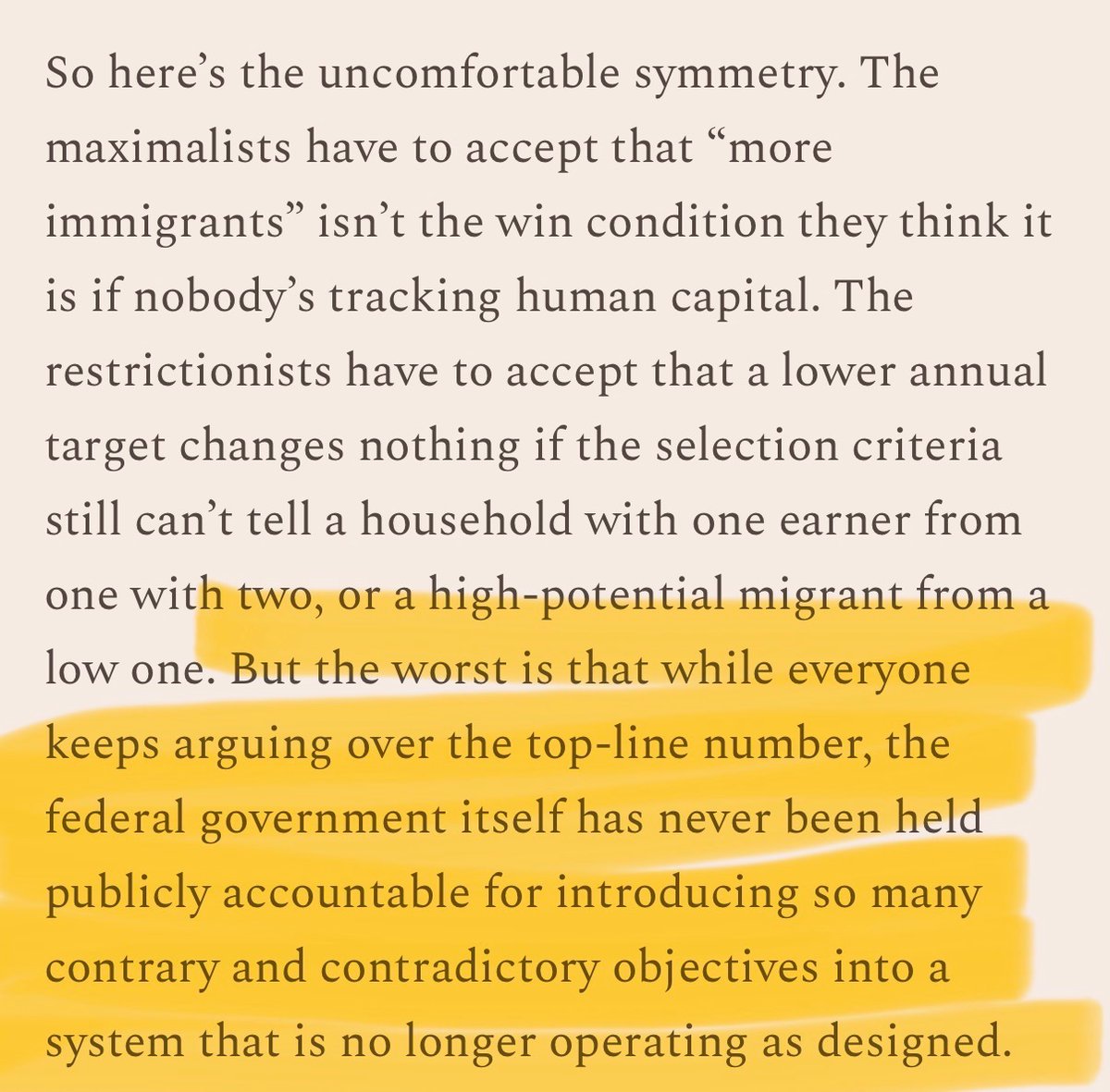
We spend way too much time arguing about how many immigrants Canada should take, and not nearly enough time asking who we're selecting, why we're selecting them, and what outcomes the system is actually producing.
As Steven and I have said repeatedly - Canada's skilled immigration system is now trying to do a lot of different things at once. Fill labor shortages. Satisfy provincial needs. Increase nationwide Francophone levels/immigration. Meet increasing and changing humanitarian commitments. Grow the population.
All of those can be legitimate goals. But once one system is responsible for all of them, it becomes increasingly difficult to answer a pretty basic question: what are we actually optimizing for? Which of the goals is the system actually trying to meet?
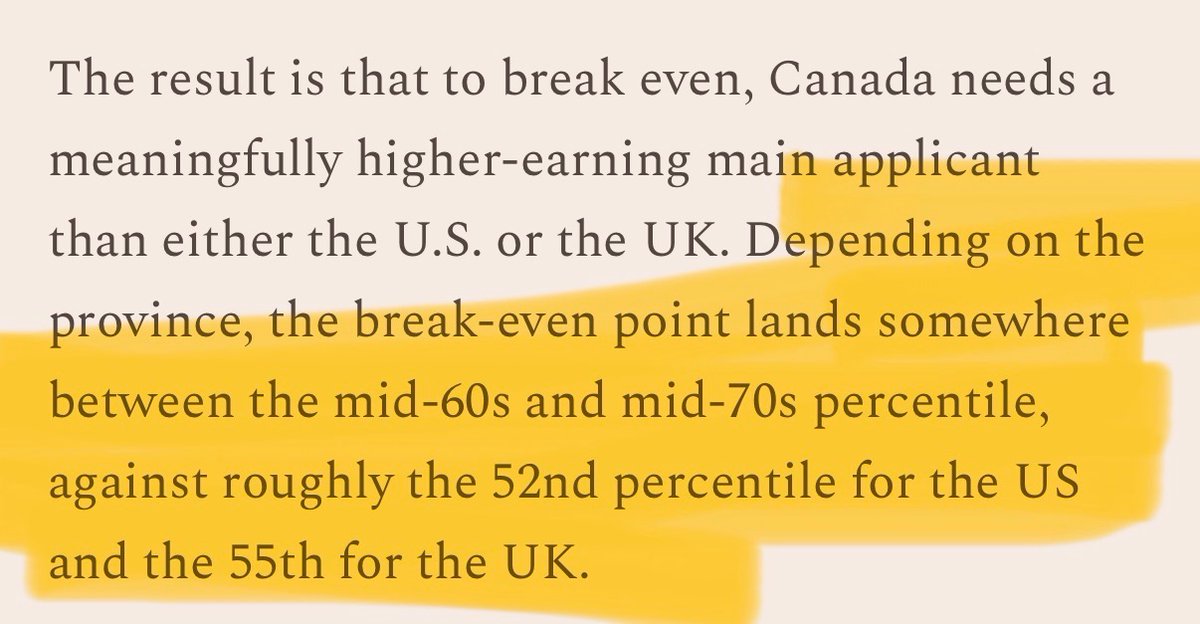
What was most interesting from the article - the Build Canada team also looked at immigration through a fiscal lens. Their own modeling suggests that in Canada, an immigrant household might need a surprisingly high income before becoming a net fiscal contributor over its lifetime. Worth noting, the estimates vary substantially by province and the article is clear that this is their own model, not an official government figure. But this is still a big finding!
Overall, I think the broader point made is - immigration policy shouldn't be judged mainly by whether we admitted 300K or 400K people annnually (this matters to be clear, but it’s not the main nor only thing).
Instead, we should really be asking whether we're selecting people who are likely to thrive here, whether Canada gives them the conditions to succeed once they arrive, whether we retain them, and whether the system produces better long-term outcomes for both immigrants and the country.
The main point is, how many of them are going to integrate well and contribute to the country and its economy? The immigration debate doesn't have to be just more vs. fewer - instead we can focus it on better selection, integration and overall outcomes.
This post was inspired by the insightful article from Build Canada: https://t.co/ibGrIO2ak7
Read this Build Canada memo about a truly unified Canadian economy a while back and only just got around to the analysis. Many useful ideas were brought up which I do believe merit further discussion and would really benefit Canada's domestic economic policy.
Did you know that the IMF estimates that removing Canada’s internal trade barriers could eventually grow our economy by around 7%? That’s somewhere between $110B and $200B in potential economic gains!
And here’s the part I find especially interesting: the vast majority of that isn’t about moving physical goods between provinces. It’s about services, regulations and all the different rules we’ve built between ourselves.
Canada has shown that we can move quickly when economic threats come from outside the country. But when it comes to fixing our economy internally, we keep running into the same problem: provinces agree something needs to change. There are meetings, working groups and commitments. Then deadlines slip, negotiations drag on, and eventually the urgency disappears.
Earlier this summer, @StevePaolasini and I researched a pretty simple way to change that: give provinces a financial reason to actually follow through. The federal government already spends enormous amounts of money on infrastructure and major projects. Why not tie some of that funding to provinces actually removing internal barriers?
Essentially, if a province makes the reforms, it gets the money. If it doesn’t, it leaves that money on the table. In return, they make it easier for someone licensed to work in one province to work in another. Recognize each other’s regulations where possible. Make it simpler for entrepreneurs to sell across all provinces, like a unified system, as opposed to dealing with each one as a separate market.
The memo mentions we've already used a version of this idea with the Housing Accelerator Fund: instead of just asking provincial governments to reform, attach federal dollars to actually doing it. And I personally think we need to get much more comfortable using tools like this.
Canada has spent a lot of time talking about how to protect our economy from threats abroad. And for a good reason, we're in a very pivotal moment of our journey on that front. But one of the biggest economic growth opportunities is literally sitting in front of us within our own borders.
The bigger question is whether we’re still willing to follow through on the difficult, creative changes needed to make the Canadian economy more competitive. To incentivize faster growth. We had a lot of momentum when the US tariff threats started last year - we should work hard on not letting it slip through the cracks.
The original Build Canada memo from August: https://t.co/DcVIWQTT9t
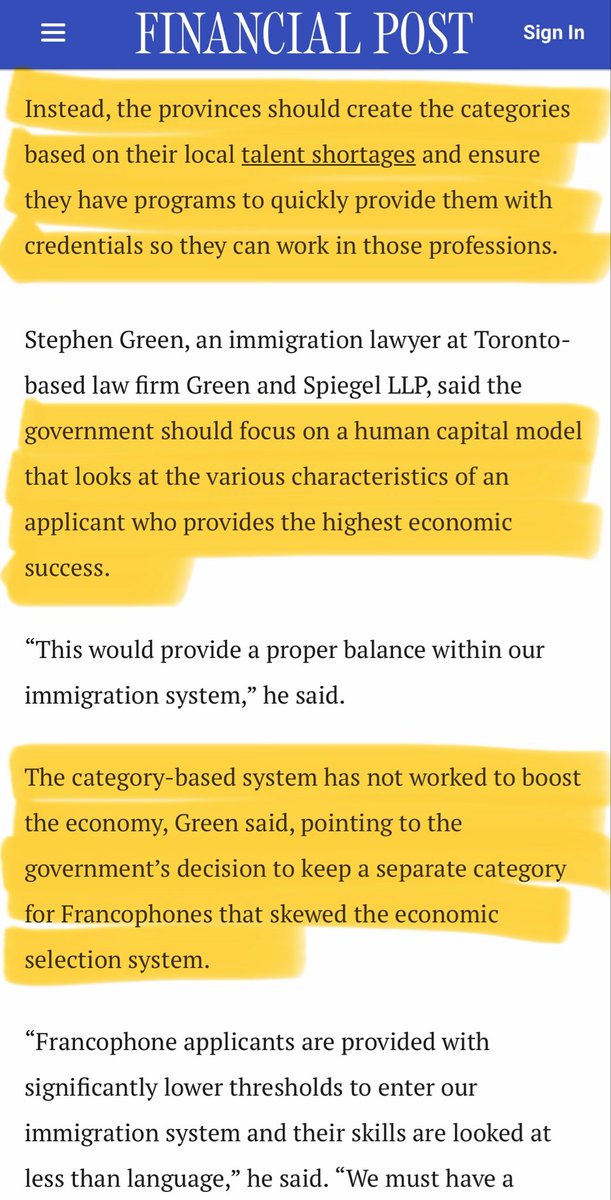
It was such a validating experience to read this article after all the work @StevePaolasini and I have done on Canadian skilled immigration and how to redesign the system to be functional and beneficial again: https://t.co/wDc753ewzT
In this article from financial post based on a report from RBC (with quotes from a leading Canadian immigration lawyer mind you), some of the VERY SAME issues we identified and recommendations we proposed in our MLI express entry article are mentioned: https://t.co/cXlBRBwoyU
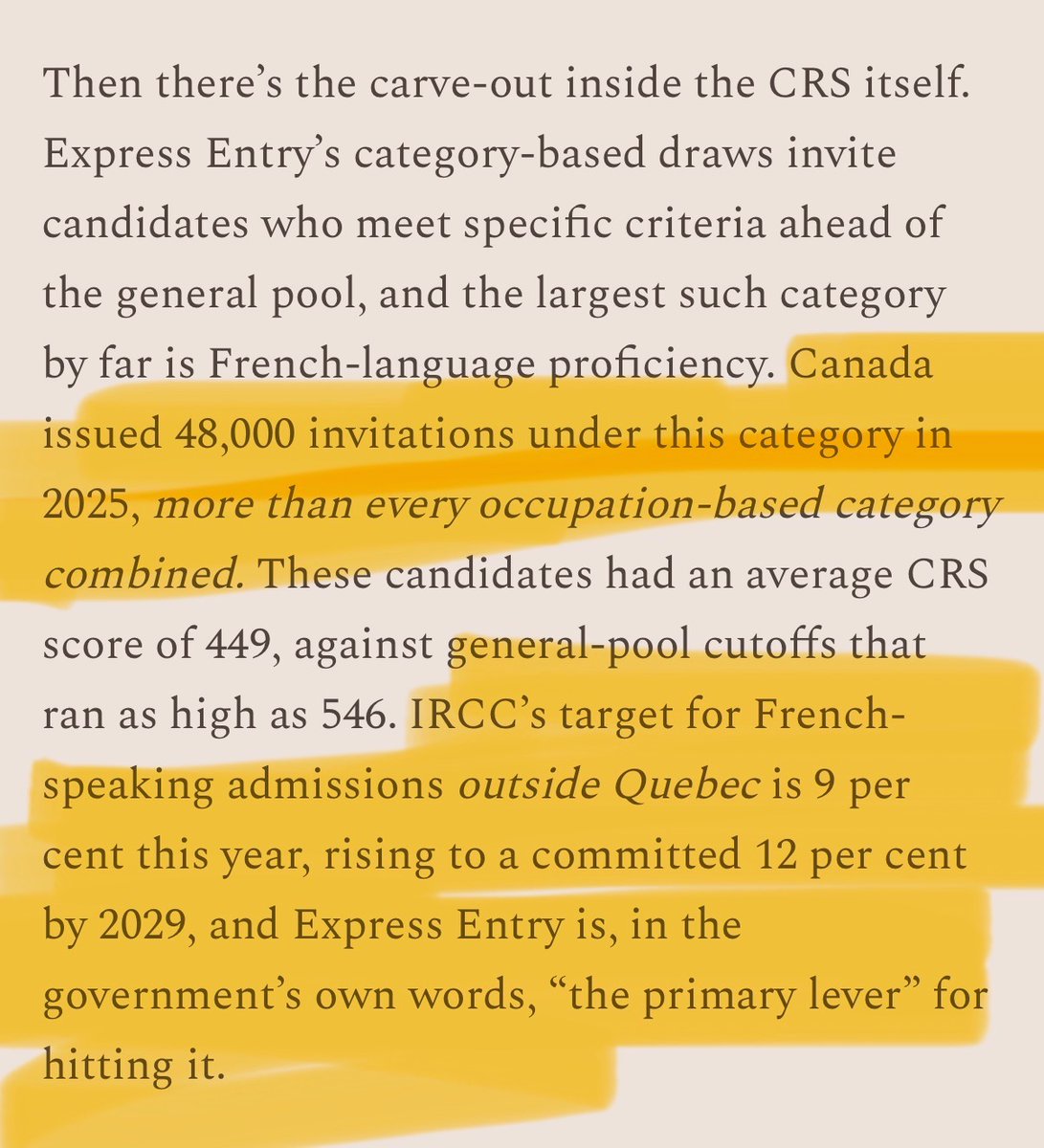
In the screenshots, I highlighted some of the most important points mentioned that reiterate what we had on our end as well. Canada simply can’t afford to have a dysfunctional immigration strategy that keeps constantly changing, targets lower skills for political priorities or short term labor shortages while being in the midst of a trade war basically.
Overall, our skilled immigration system should focus on attracting motivated, high skilled candidates who want to build here (lives, careers, companies) and contribute to strengthen the Canadian economy.
It’s interesting to me, when a report from RBC (currently the biggest Canadian company by market cap) indicates the same thing immigration industry experts have been saying for over a year now - why does the government make a point to look the other way?
Consultations for performative purposes without any substantial impact aren’t really the solution tbh
I don't want to hear any more Conservatives complain about Carney not being able to get a deal with Trump.
The guy spent the whole weekend posting the most insane shit on social media.
You can't deal with a crazy person that has lost touch with reality.
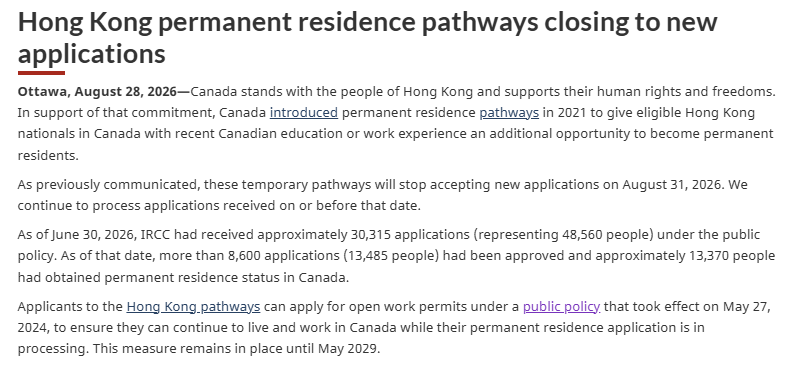
The Hong Kong permanent residence pathways will close on August 31, 2026.
According to today’s notice, 48,560 people have applied through the program, and 13,370 have obtained permanent resident status.
The notice also states that applicants under the Hong Kong pathways can apply for open work permits under a public policy introduced on May 27, 2024. These permits can be issued for up to three years, and the public policy will remain in effect until May 2029.
What the notice does not mention is that, as of February 28, 2026, there were 31,300 applications in the Hong Kong pathways processing inventory.
The 2026 admissions target is just 800.
At that rate, unless something changes significantly, many applicants are going to need those open work permits for a lot longer than three years.
https://t.co/DmrMWYzDuo
https://t.co/iTBZG3O0F1
They just invited 5,000 French speakers at a human capital score of 382. The day before, people already working in Canada needed a 523. IRCC invited only 1,000 of them.
382 is also an inflated score because anyone in that category automatically gets a 25 pt handicap. So more like 357.
I keep asking myself what the point of these consultations is if the government has already decided what it wants to do.
Every year IRCC sends surveys to thousands of organizations asking what Canada actually needs. Which categories are a “great need”? Should we prioritize people already working in Canada? Should Francophone immigration remain an economic priority? They hold consultations, collect submissions, pay people to analyze the results, write the reports, translate them, publish them, and call the whole exercise “What We Heard.”
Then they ignore what they heard.
I sat in the committee room on February 9 with the brief in front of me. I’ve read these reports. These are their numbers.
In 2024, when IRCC asked which categories represented a “great need,” healthcare came back at 55.8%. Trades were 38.8%. STEM was 32.4%. French was last at 14.6%.
About half said prioritize skilled workers already in Canada. Only a small minority preferred new workers from overseas. Only 19% gave Francophone immigration a lot of support as an economic priority. More than half gave it little or no support.
Canadians answered the questions.
Then 2025 happened and now 2026 is shaping up to be even worse. We’re not even done the year and the French category has blown past the 2025 numbers.
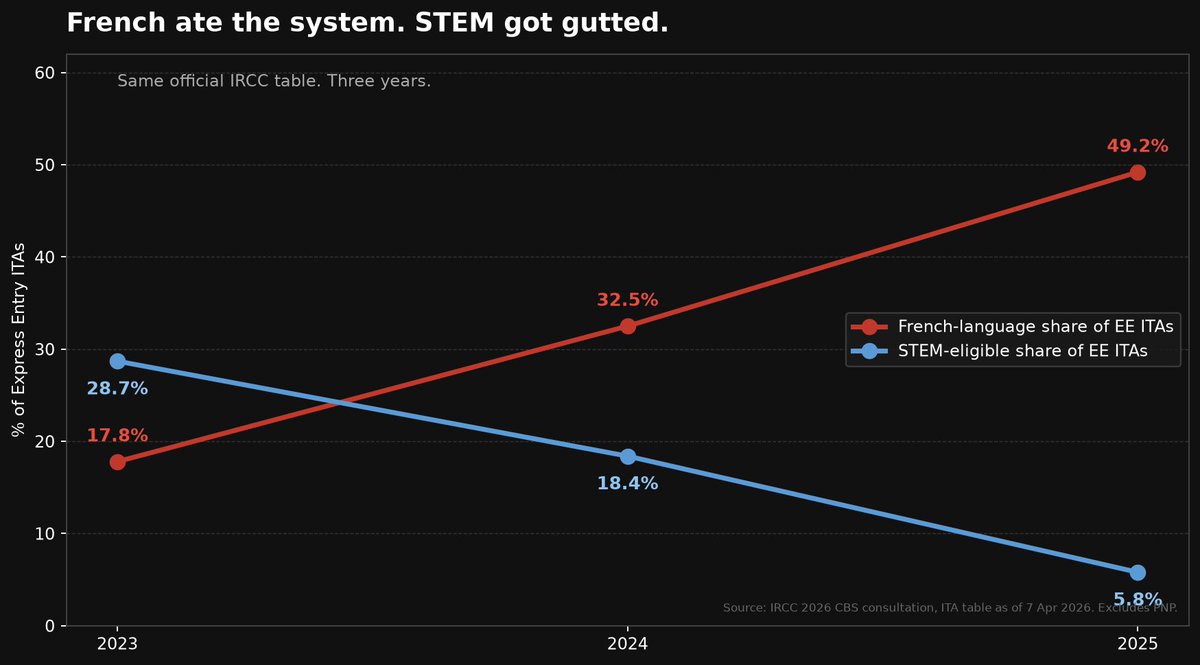
In 2025, French-language candidates received 49.2% of all Express Entry invitations. 78% of them were overseas. STEM went from 28.7% of the system in 2023 to 5.8%. There has not been a dedicated STEM draw since April 2024. Healthcare, the thing respondents said Canada needed most, got 18.6%. Trades got 4.4%.
And this is not even Quebec. Quebec runs its own system. The only distinctly French province is not in these numbers. This is Ottawa stuffing overseas French speakers into the rest of the country, while hollowing out the high-skilled pathway Express Entry was supposed to be.
The message to candidates is getting absurdly simple:
We don’t care what you do. We don’t care what you earn. We don’t care how long you’ve been here. We don’t care whether your occupation is supposedly one of the ones Canada desperately needs.
Just learn French. And you’ll get a 50 pt handicap if you can speak basic English.
Apparently this is the economic class? That is the precedent we are setting.
Meanwhile someone who has spent years building a career here, paying taxes, and getting Canadian work experience can look at a 523 and be told they are not competitive enough. An overseas candidate gets in at 382 because the French-language target matters more.
Pay public servants and consultants to run the process, write the PDF, and put “What We Heard” on a government website. Then do what you were going to do anyway.
That is consultation theatre and a government grift. Not because somebody is stuffing cash in their pocket. Because we have built a taxpayer-funded machine around pretending to ask. Salaries. Contracts. Meetings. Reports. God knows how many hours of public-service time. All of that costs money.
What are Canadians getting for it if the answer cannot change the policy?
Makers and builders get a 500+ score and a closed door. The people running the survey get another report, another budget line, and another year of doing whatever they already decided.
If Ottawa has already decided that Francophone targets override labour-market demand, Canadian work experience, earnings, and the answers in its own consultations, then have the courage to say that.
Just say it’s performative, admit you are liars, thieves and grifters. Stop hiding behind “What We Heard.”
Now we’re in 2026, and they still are not listening and it’s getting worse.
The charts are their numbers.
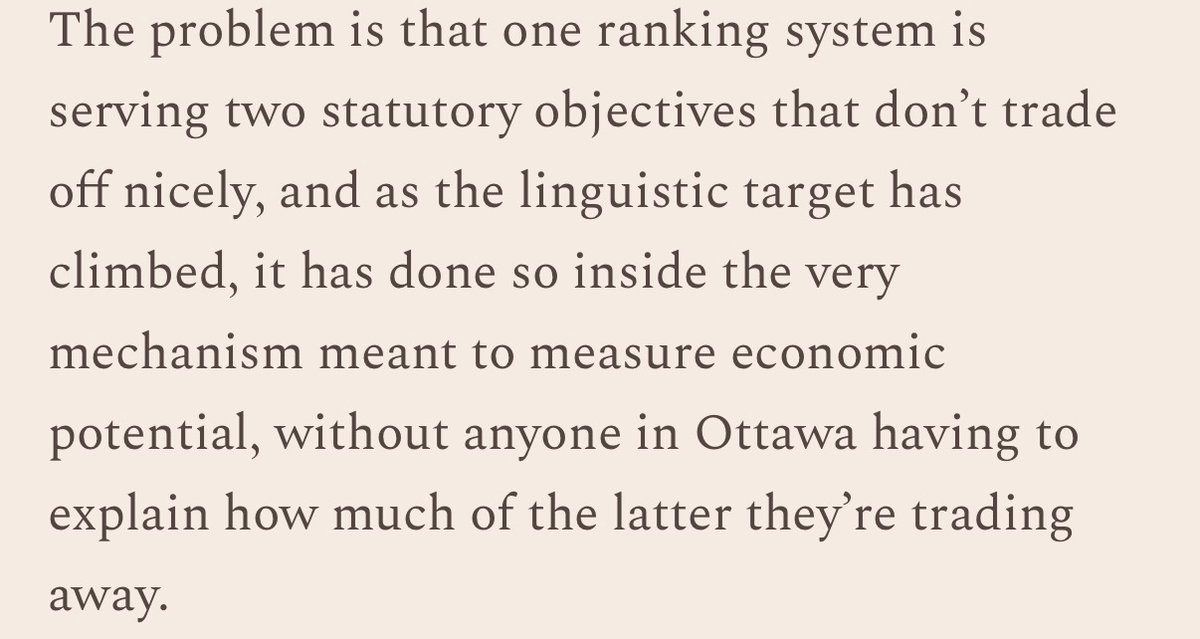
A high-skilled immigration system should select for high skill. It really is that simple. Yet, right now, Express Entry is being forced to do five jobs at once:
1) high-skilled selection
2) labor shortages
3) provincial needs
4) national Francophone targets
5) short-term political priorities
No scoring system can function under that much pressure - such conflicting priorities. And what's even worse, no one higher up in the government seems to understand NOR care about this.
So @StevePaolasini and I built an actual proposal. We spent hours pouring over the issues we see with the system and tailored our solution specifically to the core problems currently affecting Express Entry.
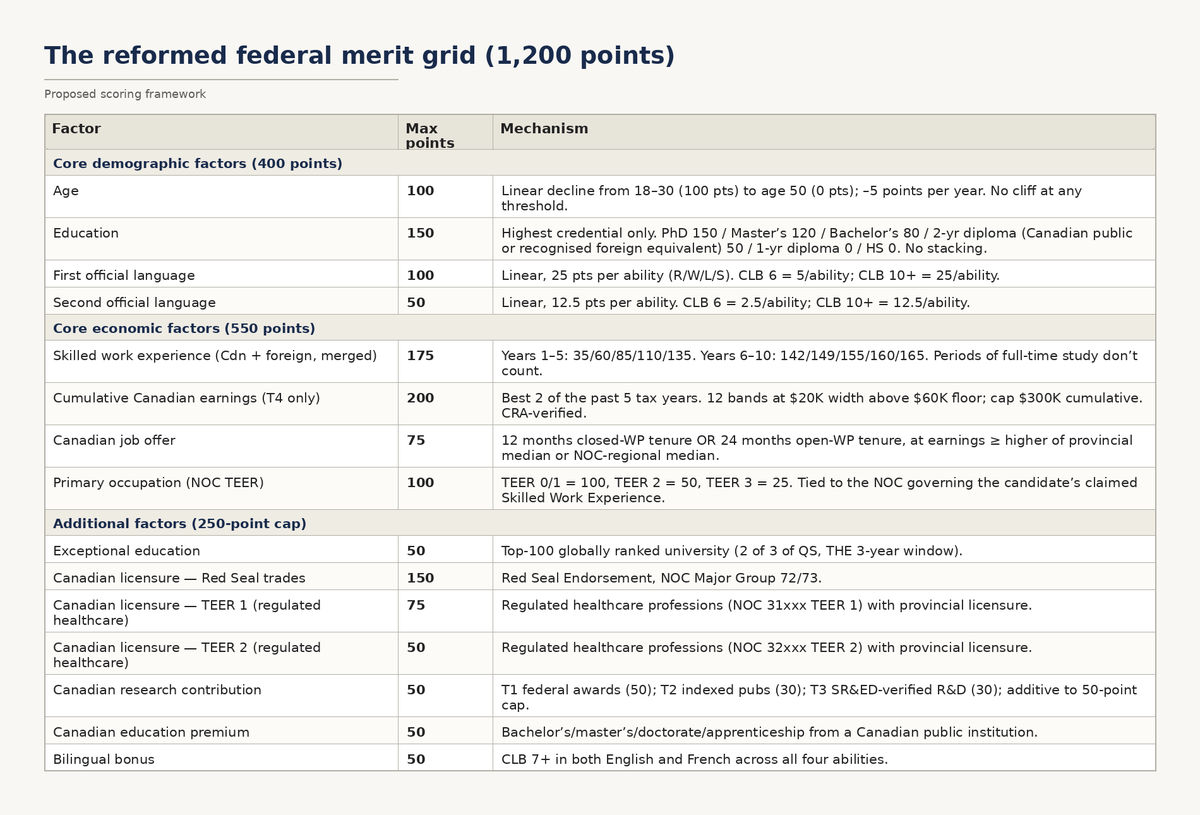
Our proposal: one federal pathway. General High Skills Express Entry (more details on the scoring breakdown in the image below).
Candidates would enter through clear requirements. Profiles would be valid for two years. A refundable deposit would help reduce fraudulent profiles sitting in the pool.
The CRS would stay at 1,200 points, but the points would reward a very different set of things. The system would also be adjusted structurally by:
1) removing 600-point PNP additions
2) removing LMIA-based job-offer bonus creating fraud incentives
3) stopping the constant last-minute priority shifts/category changes that make candidates feel like the rules change faster than they can adapt
The government should keep categories consistent and announce any minor changes along with the new immigration plan in November.
Express Entry should reward what is harder to fake and more closely tied to long-term success: it should care less about what someone can claim on paper and more about what they can actually demonstrate.
The selection process also needs to become predictable again. Draws every two weeks, 26 per year, on a published annual schedule.
Candidates should know what Canada is selecting for. Canadians should be able to understand why and which skilled immigrants are being chosen.
And most importantly, Express Entry should be brought back to its original focus - federal high-skill selection. The gov can use PNPs and regional programs for local labor-market needs. They can also use dedicated francophone streams and community pathways for demographic / language goals. Temporary worker programs can be used for short-term shortages.
That is the system architecture Canada needs if we want skilled immigration to actually strengthen our economy.
If the government doesn't actually want high skilled immigration, then they should stop deluding everyone (including themselves) on this subject and clearly state what it is that they're optimizing for instead...
🚨 Canada has now issued 𝟭𝟬𝟰,𝟲𝟭𝟮 𝗘𝘅𝗽𝗿𝗲𝘀𝘀 𝗘𝗻𝘁𝗿𝘆 𝗶𝗻𝘃𝗶𝘁𝗮𝘁𝗶𝗼𝗻𝘀 𝗶𝗻 𝟮𝟬𝟮𝟲 after today’s French draw.
Nearly 𝟰𝟬% 𝘄𝗲𝗿𝗲 𝗯𝗮𝘀𝗲𝗱 𝗼𝗻 𝗹𝗮𝗻𝗴𝘂𝗮𝗴𝗲, not Global Talent or Skills possessed.
In July alone:
📉 𝟰,𝟬𝟬𝟬 invitations went to candidates who studied, worked, and competed in Canada.
📈 𝟭𝟬,𝟬𝟬𝟬 went through the French-language category.
Canada should be selecting the world’s best talent not letting 𝗼𝗻𝗲 𝗳𝗮𝗰𝘁𝗼𝗿 𝗼𝘃𝗲𝗿𝘀𝗵𝗮𝗱𝗼𝘄 𝗼𝘃𝗲𝗿𝗮𝗹𝗹 𝗺𝗲𝗿𝗶𝘁.
Liberals have lost their way, and Canadian immigration is paying the price.
The consequences of this policy could be brutal for Canada’s economy and Social welfare system. 🇨🇦
The way the IRCC / Ottawa doesn’t care about any feedback is fascinating to me. How many more of these illogical draw patterns are we going to see before they finally pull the trigger on the express entry revamp they’ve been promising?
For those who have been following my express entry posts, here’s a practical example of how a candidate can get a 399 score and be selected for this draw:
1) no spouse
2) 36 years old
3) two year foreign degree from any country (e.g. college diploma)
4) fluent French but no English at all
5) NOC TEER 3 occupation (e.g. admin assistant) with 6 years of only foreign work experience
6) no ties to Canada - no work experience, education, or relatives here
That’d still net them a 406 score (versus the 399 cutoff).
Now say you’re a software engineer working for a Canadian startup trying to get in through CEC. Your profile looks something like this:
1) no spouse
2) 32 years old
3) masters degree from the US
4) fluent English but no French
5) NOC TEER 1 occupation (e.g. software architect) with 1 year of Canadian work experience and 5 years of foreign work experience
6) working for a Canadian company on closed work permit
That would give a score of 505 and make this person ineligible for any of the CEC draws this year. Or last year.
If express entry is meant to be a federal system for selecting skilled candidates - why are we not actually focusing on skills and human capital needed nation wide in reasonable numbers? And why not use local/regional immigration pilots to support the growth of Francophone communities rather than blanket admitting such high numbers of comparatively lower skill levels just to boost demographics?
If IRCC would only listen, we gave them a reasonable solution on how to restructure express entry to do both of these things well. Hoping someone from their end will finally notice