It’s getting hard to keep track of all the new open-source cofolding models coming out. To help everyone stay up to date, I'm excited to share https://t.co/Gc9PaF6GoY, a PDB-synced leaderboard of open models, updated weekly. All predictions are available to view & download! (1/4)
Today we're unveiling Dimension III: a $800M fund to partner with the leading entrepreneurs across the frontiers of compute (silicon through infrastructure) & science (biotech through physics).
To our founders, past, present, and future: now is your time. LFG!
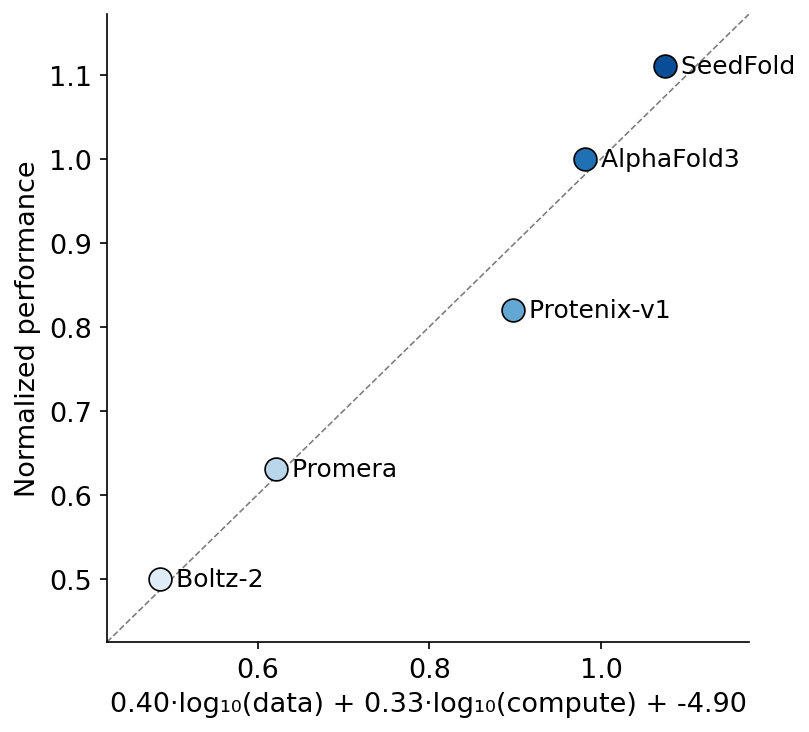
We also found a scaling law that explains (p=0.03) Ab-Ag accuracy across model lineages - from Boltz to AF3 and beyond. 1.8x-ing AF3 performance (to match IsoDDE) would seem to require e.g. 10x more distillation and 16x compute. (7/8)
@_sholtodouglas@AgustinLebron3 If you practice the will to push yourself to physical failure, you’ll probably also do what it takes to solve hard research problems!
I’m afraid the most likely outcome is we’ll march along the trajectory of neural evolution, but on silicon. That means smarter and faster.
Fun thought experiment: the next-gen models (Mythos) still have multiple orders of magnitude fewer synapses versus a human brain. So what capabilities emerge when they are on an equal playing field?
@SimonDBarnett Near full penetration of the NGS installed base for research purposes, combined with limited routine clinical uses. GRAIL + Freenome were supposed to be the next leg! Unfortunately, when sensitivity disappointed, that pushed out the clinical market until that problem is solved.
My best guess on the driver, before I go back to never commenting publicly on these (you brought it out in me!), is vascular instability caused by on-target inhibition of ABL1, and, indirectly, TIE2.
With compromised vascular integrity, you increase risk of retinal vein collapse and creating clots locally. If a drug inhibits ABL1 and/or TIE2, it should not be put in the eye.
We can’t chalk it up to cancer patient biology, because there are other TKIs where this doesn’t happen, so it must be something overlapping between these specific TKIs (axitinib, regorafinib, imatinib, sunitinib, etc.) that can collapse vessels.
The overlap seems to be ABL1, TIE2 (also down-regulated by ABL1 inhibition) and cKIT, all of which are drivers of endothelial and vascular integrity.
Because median duration to RVO was ~2 years and was <1/100K patients, the odds this shows up in a trial setting is near zero. The odds it ends up happening if the agent is used broadly enough is very high.
https://t.co/XsDkHzgllc.
@maxjaderberg You’ve removed friction between an idea for a new medicine on a blank sheet of paper and a molecule you can conceivably test in animals and humans. Dramatic downstream consequences for all disease.
@Biohazard3737 Or how much variability there can be assay-to-assay depending on the exact methods. The antibody may well work, but for the first time running the assay, the results can look wildly different.
I’m very glad the future of investing = running experiments. Better for patients.
@A_May_MD Remember, these PSA spider plots were one year ago. Note how the spider plots were missing from today’s presentation.
PSMA shedding = loss of activity = PSA up = progression.
A real bummer. Right idea, wrong antigen.
@pmje73 Akin to the decaying alpha curve in stocks and overstaying your welcome. Most of the fundamental improvement has happened + market has gotten almost all the way there, best to move on to other ideas with greater expected value.