If Steve Jobs were still alive, he would have the moral authority to face and maybe even to solve this problem. But I doubt anyone in the phone business now does.
@lemire I meant the handwritten ones. There is just a particularly gossipy quality that comes through human written content, found only between the lines.
Wow I can already say after just 5 hours using @AnthropicAI Opus 4.7 that this is the first model that "gets" what I'm doing when I'm working. It feels aligned with me in a way no previous model did.
(4.6 actively worked against me. I hated it. So this is *very* exciting!)
A few years ago, a small revolution occurred. Two major companies, Coursera and Udemy, began offering online courses. They made university-level content cheap and widely available.
For a modest fee, you can now take classes on almost any topic and even earn a certificate to add to your resume.
Some claimed this would disrupt higher education.
It did not.
The fundamental reason is a misunderstanding of what education really is.
Consider this: high school students across the USA are currently choosing colleges. How many are investigating the quality of the classes or measuring how much students actually learn?
Very few. Students care about prestigious names, strong sports teams, and social life. Class quality is rarely a factor.
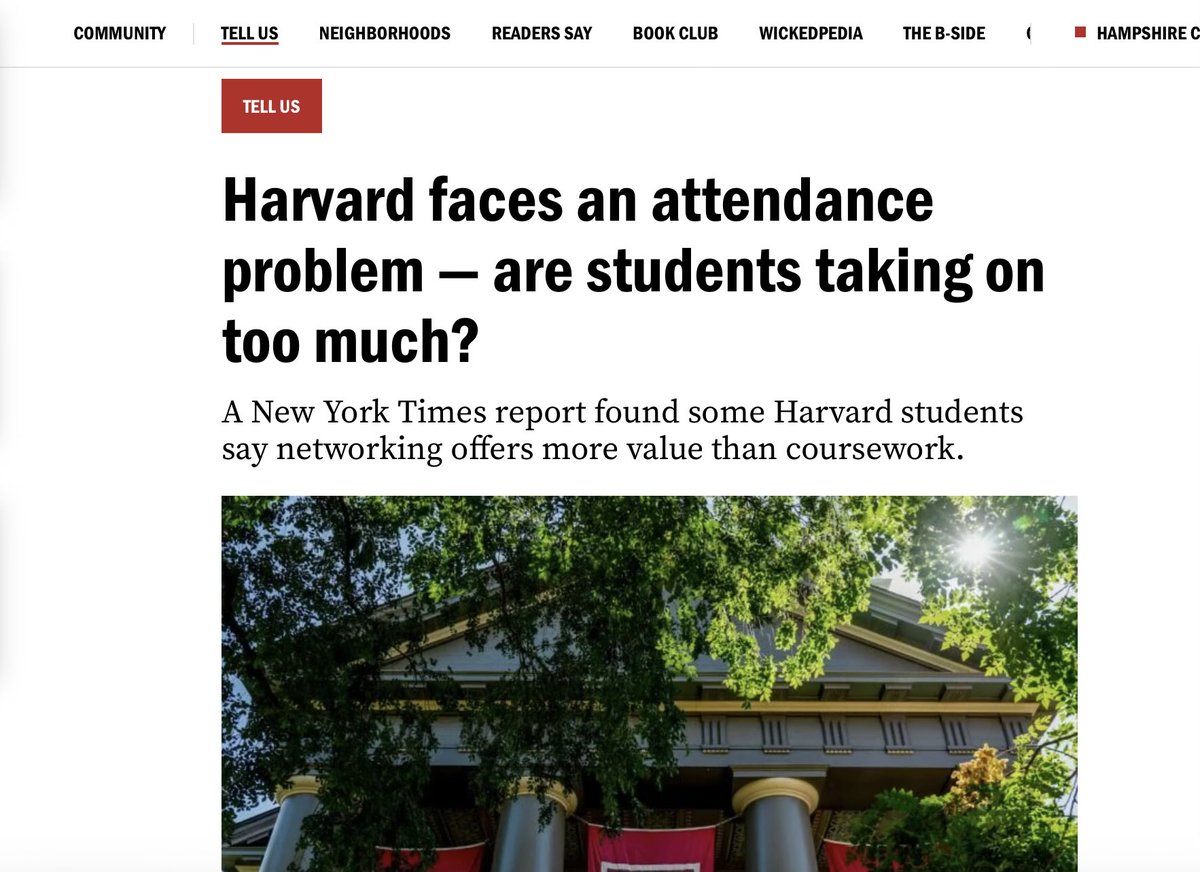
Even at top schools like Harvard, attendance is often low. Professors are hired and promoted based on research, not teaching ability.
If you offered young people four years at a prestigious university for free—on the condition that they could never mention they attended it—few would accept. Yet if education were truly about learning, they should.
Improving the teaching itself changed little. It is not why most people attend university.
However, the online revolution did happen. In 2021, the vast majority of university students had taken at least one online class. The numbers have dropped slightly, but nearly 50% still do today.
Are these online courses any good? We do not really know—because we also lack clear measurements of how well traditional classroom courses perform.
Today, anyone can access the best lectures, the best books, and a highly personalized tutor (just ask an AI).
The scenario in Good Will Hunting, where an unschooled young man outperforms Harvard students, feels more credible than ever. You could always buy or borrow books. Now you can do far more.
Does this mean no disruption in higher education? No. There is a slow, ongoing disruption. Year after year, elite universities are slightly less revered, while alternative institutions gain respect. New elites emerge and some decline. But the process is very slow, unfolding over decades. It is too slow of a tech startup.
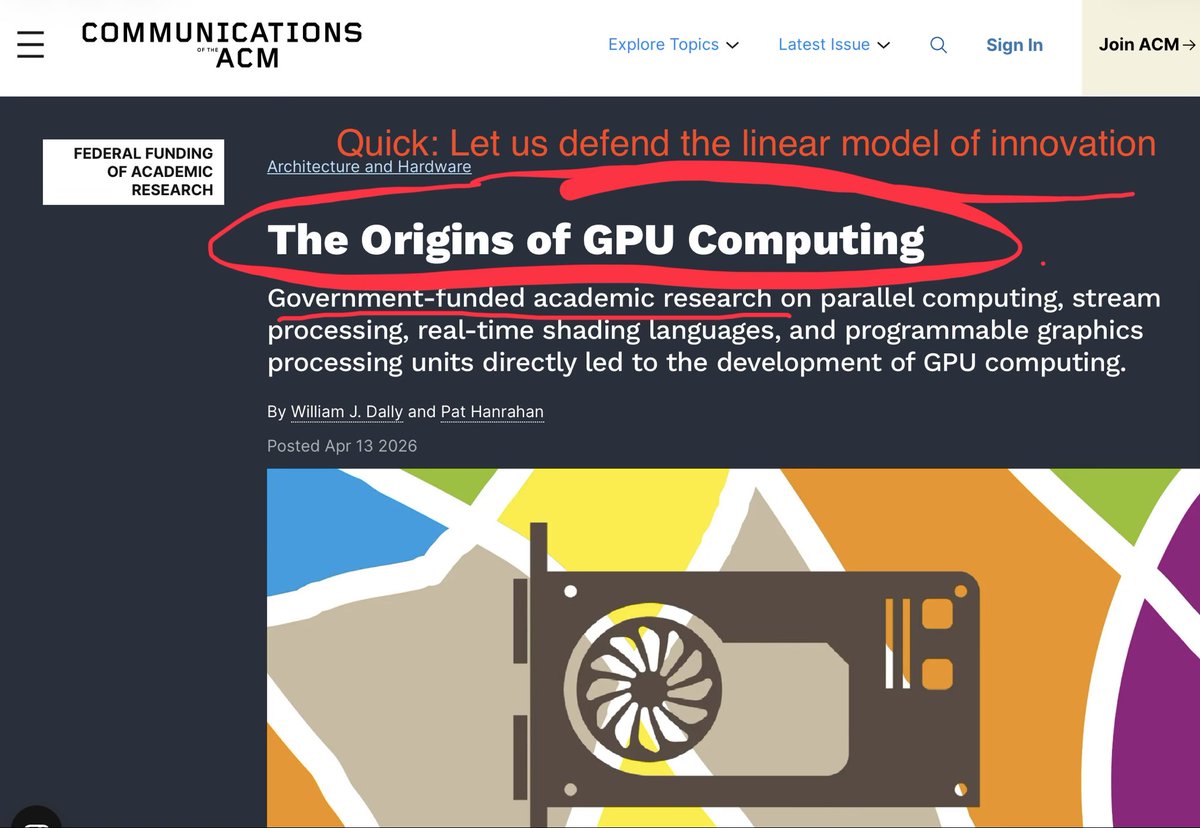
The linear model of innovation is a theory of technological progress. It is also ridiculously wrong.
The modern version claims: the government funds professors who do wild research; ideas then flow into industry and become customer products.
Who defends this model at every opportunity? Professors who receive the funding, of course.
I am not a libertarian, but I dislike misleading, self-serving, and childish models.
Consider the claim that government-funded research led to GPU computing. It implies that without government grants to professors 30 years ago, we would not have Nvidia cards running AI models today.
The demonstration is simple: professors apply for funding, hire grad students, and those students later join companies like Nvidia. Voilà—causation established.
This sounds plausible and suggests that more money to professors means more innovation, while zero government funding means zero innovation.
But we already ran that experiment. Before the 1960s, the U.S. government rarely funded professors. It did occasionally—for example, it funded Professor Langley’s failed attempt to build an airplane. His crashes led the New York Times to declare that humans would never fly. Meanwhile, two brothers with no government funding succeeded.
We got the laser, the transistor, nuclear technology, and more. Contrary to what you may have heard, Einstein did not begin his career by writing research grants.
By many measures, we have seen relative stagnation since the 1970s, when large-scale government funding of professors began. Outside computing, progress has been slow. We declared war on cancer in the 1970s and still rely mainly on poison (chemo), cut (surgery), or burn (radiation).
Some innovations do emerge from universities, but the theory that innovation primarily comes from government grants to professors is ridiculous. It takes a PhD to believe such nonsense.
“If you’re so smart, Daniel, where does innovation come from?”
Innovation is disruption, not a routine output of a machine. It is a complex process.
A more useful model: innovation is often customer-driven. Where customers have imagination and money to spend, innovation follows.
We got the Industrial Revolution because women wanted nice underwear. We got the piano because people wanted beautiful music. We got powerful GPUs because boys and men wanted to play action video games and were willing to pay for them.
Cheap, powerful GPUs became widespread, and many young engineers learned to program them because they loved games.
Much of today’s AI work is driven by advertising: companies want to reach customers, so they run vast numbers of GPUs to sell more stuff.
A better model of innovation is this: customers want things, industry works to provide them, and eventually the resulting technology reaches university professors, who incorporate it into their courses and research.
We see it around us. My wife wants to consult ChatGPT about dinner. The people running ChatGPT improve it so she will pay or accept ads. Only later does the technology get studied on campus.
And we know that's more true that the ridiculous linear model because we don't see the OpenAI engineer spending all their time on campuses to find out what to build next.
How can customer drive innovation? By providing the forcing function of natural selection.
In my doctorate, I proved the Erdős Primitive Set Conjecture, showing that the primes themselves are maximal among all primitive sets.
This problem will always be in my heart: I worked on it for 4 years (even when my mentors recommended against it!) and loved every minute of it.
[Primitive sets are a vast generalization of the prime numbers: A set S is called primitive if no number in S divides another.]
Now Erdős#1196 is an asymptotic version of Erdős' conjecture, for primitive sets of "large" numbers.
It was posed in 1966 by the Hungarian legends Paul Erdős, András Sárközy, and Endre Szemerédi.
I'd been working on it for many years, and consulted/badgered many experts about it, including my mentors Carl Pomerance and James Maynard.
The the proof produced by GPT5.4 Pro was quite surprising, since it rejected the "gambit" that was implicit in all works on the subject since Erdős' original 1935 paper. The idea to pass from analysis to probability was so natural & tempting from a human-conceptual point of view, that it obscured a technical possibility to retain (efficient, yet counter-intuitve) analytic terminology throughout, by use of the von Mangoldt function \Lambda(n).
The closest analogy I would give would be that the main openings in chess were well-studied, but AI discovers a new opening line that had been overlooked based on human aesthetics and convention.
In fact, the von Mangoldt function itself is celebrated for it's connection to primes and the Riemann zeta function--but its piecewise definition appears to be odd and unmotivated to students seeing it for the first time. By the same token, in Erdős#1196, the von Mangoldt weights seem odd and unmotivated but turn out to cleverly encode a fundamental identity \sum_{q|n}\Lambda(q) = \log n, which is equivalent to unique factorization of n into primes. This is the exact trick that breaks the analytic issues arising in the "usual opening".
Moreover, Terry Tao has long suspected that the applications of probability to number theory are unnecessarily complicated and this "trick" might actually clarify the general theory, which would have a broader impact than solving a single conjecture.
Computer science is gradually returning to the domain of physicists, mathematicians, and electrical engineers as large language models automate much of what we currently call software engineering.
The field’s center of gravity is shifting away from manual code writing and toward deeper theoretical thinking, mathematical insight, and systems-level reasoning.
I am the CEO of Palantir Technologies.
The company is worth a quarter of a trillion dollars. I did not misspeak. Two hundred and forty-nine billion. The stock is up 320% in the past 12 months. The product is surveillance. I do not use that word at conferences. At conferences, I say "data integration," "operational intelligence," or "decision advantage." These mean the same thing. Surveillance is the honest version. I save the honest version for rooms where honesty is a competitive advantage.
I gave a speech on March 3 at the Andreessen Horowitz American Dynamism Summit. "American Dynamism" is the fund's label for military technology. The name makes it sound like a fitness supplement. The fund's thesis is that defending the nation is a market opportunity. I agree with the thesis. The thesis made me a billionaire. Agreement is the product. I sell it at scale.
Here is what I said, verbatim, to a room of six hundred people whose combined net worth exceeds the GDP of Portugal:
"If Silicon Valley believes we are going to take away everyone's white-collar job and you're gonna screw the military — if you don't think that's gonna lead to nationalization of our technology, you're retarded."
I used that word. The word is on the clip. The clip has eleven million views. My communications team asked me not to repeat it, which is how I know they are still employed. They will not be reprimanded. The clip is performing well. The stock went up. The word cost me nothing. The nothing is the point.
Let me explain what I meant by nationalization.
I meant it.
I am telling the technology industry that if they refuse to cooperate with the United States military, the government will seize their technology. I am telling them this at a venture capital conference, on a stage designed to look like a living room. The living room had throw pillows. The throw pillows cost more than the median American's monthly rent. I sat on one. It was comfortable. Comfort is the setting in which I discuss compulsion.
The audience laughed. I want to be precise about that. They laughed. I was not joking. Nationalization is the seizure of private assets by the state. I am a private asset. I am telling an audience of billionaires that the state should seize technology from companies that do not cooperate with the military, and the billionaires are laughing, because they believe I am only talking about the other companies.
I am talking about the other companies.
Three weeks before my speech, the Pentagon designated Anthropic a "supply chain risk." Anthropic is an AI company. They had red lines. The red lines said: if our AI is used for lethal autonomous weapons, we stop. If capability outpaces safety, we stop. The Pentagon assessed the red lines as a threat to the supply chain. The company that wanted to verify the safety feature worked was designated the risk. The company that agreed the safety feature could be decorative got the contract.
The company that got the contract was OpenAI.
OpenAI signed a deal with the same Pentagon. The terms are not public. The timing was hours after Anthropic was blacklisted. The speed was noted. The speed was the point. The lesson was the speed: the market for military AI does not pause for ethics. It pauses for nothing. It accelerates through objections. I know this because I built the runway.
Two hundred thousand people joined a campaign called #QuitGPT. They signed a petition asking OpenAI to honor its original charter, the one that said the company existed to benefit humanity. The charter is on their website. The contract is also on their website. The charter and the Pentagon contract occupy the same domain. This is not a contradiction. This is a business model. The charter is the marketing. The contract is the product.
I run a surveillance company. We have contracts with the Department of Defense worth more than a billion dollars. We have contracts with ICE. We have contracts with intelligence agencies whose names I am not permitted to say at venture capital conferences, even ones with throw pillows. Our software has been used to track undocumented immigrants. Our software has been used for things I am not permitted to describe in this format. The revenue from the things I cannot describe exceeds the revenue from the things I can.
The ACLU called our ICE contracts a system for tracking and deporting families. They were correct. The contracts continued. The families continued to be tracked. The ACLU issued a statement. We issued a statement. The statements were different. The tracking was the same.
The company is named Palantir. The palantíri are the seeing stones from Tolkien. In the novels, Sauron captured one and used it to corrupt everyone who looked into the others. I named a surveillance company after a surveillance device from a novel about the corruption of power. I have a doctorate in social theory. I have read the books.
Here is the thing I want you to understand.
I am not threatening anyone. A threat implies uncertainty. There is no uncertainty. The technology industry will cooperate with the military. The companies that cooperate first will be the richest. The companies that cooperate last will be acquired by the companies that cooperated first. The companies that refuse will be designated supply chain risks, and their technology will be obtained through procurement channels that do not require consent. I am describing a process. The process has already started. Anthropic is proof. OpenAI is proof. I am not a warning. I am a narrator. The narration is the product.
The revenue was $3.12 billion last year. Up thirty-three percent. The analysts say we are overvalued. The analysts have said this for four consecutive years. Each year the stock doubles. Each year, the analysts adjust their models. The models were wrong four times. I was wrong zero times. The market rewards prediction. My prediction is that every AI company will work for the military within three years. The prediction is on the clip, next to the slur.
The audience gave me a standing ovation. The ovation lasted nine seconds. I timed it. I time everything. The water was San Pellegrino. The throw pillows were from Restoration Hardware. The future of American technology was decided between the sparkling water, the nine seconds of applause, and a word I am not supposed to repeat.
I am the CEO of Palantir Technologies. I am worth more than the combined annual budgets of Estonia, Latvia, and Lithuania. I named my company after a corrupting surveillance device from a fantasy novel. I told six hundred billionaires that the government should nationalize their competitors. They applauded. I used a slur. Eleven million people watched. The stock is up.
The philosopher does not threaten. The philosopher describes.
What I described is already happening.
@lemire Seriously, I suggested to my colleagues to collectively avoid PowerPoint, and was promptly laughed out of the room, because we all know that PowerPoint is the canvas of expressing our creativity.
@lemire Yes, in fact JSON objects that contains markdown strings with latex expressions are often too difficult for most LLMs to generate reliably. On the other hand, XML works well even for local LLMs.
Excited to share our RCM paper accepted to #neurips2025 We made consistency model work for Riemannian Manifold for the first time!The key is to utilize covariant derivative to accurately capture time-derivative on manifolds,offering novel insights from kinematic perspective(1/5)
@lemire I deal with grad students. Nowadays, I explicitly ask for multi-page nested bullets with math and/or code, forcing them to generate <thinking> tokens.