Chemist with a background in Molecular Modelling, Drug Discovery and Material Sciences now involved in Cheminformatics and Bioinformatics. I also like cats...
Attending the Spring UK-QSAR Tomorrow in Edinburgh with my colleague Chris Ringrose from the CCDC. Great program with exciting talks, and familiar faces to see again.
https://t.co/smZ79Examt
Data-Driven Generation of Conformational Ensembles and Ternary Complexes for PROTAC and Other Chimera Systems
https://t.co/L3Y2rMCPjV
@kepakbg@ccdc_cambridge#JCIM Vol65 Issue18 #compchem
Excited to announce that our PROTACs paper is out! @ccdc_cambridge
Data-Driven Generation of Conformational Ensembles and Ternary Complexes for PROTAC and Other Chimera Systems | Journal of Chemical Information and Modeling https://t.co/iRU29O3gXu
Already at Francis Crick Institute and ready to enjoy an exciting set of broad cheminformatics and comp. chem. talks Today. If you are looking to explore collaborations and projects with us at the @ccdc_cambridge, please, come and say hello!!
https://t.co/3jjmUGdLH8
TikTok just open-sourced their recommender system framework (Monolith) -- and it uses Keras
This means that nearly all the major recommender systems in the industry are built on Keras -- YouTube, TikTok, Spotify, Snap, X/Twitter, and many more (Grubhub...)
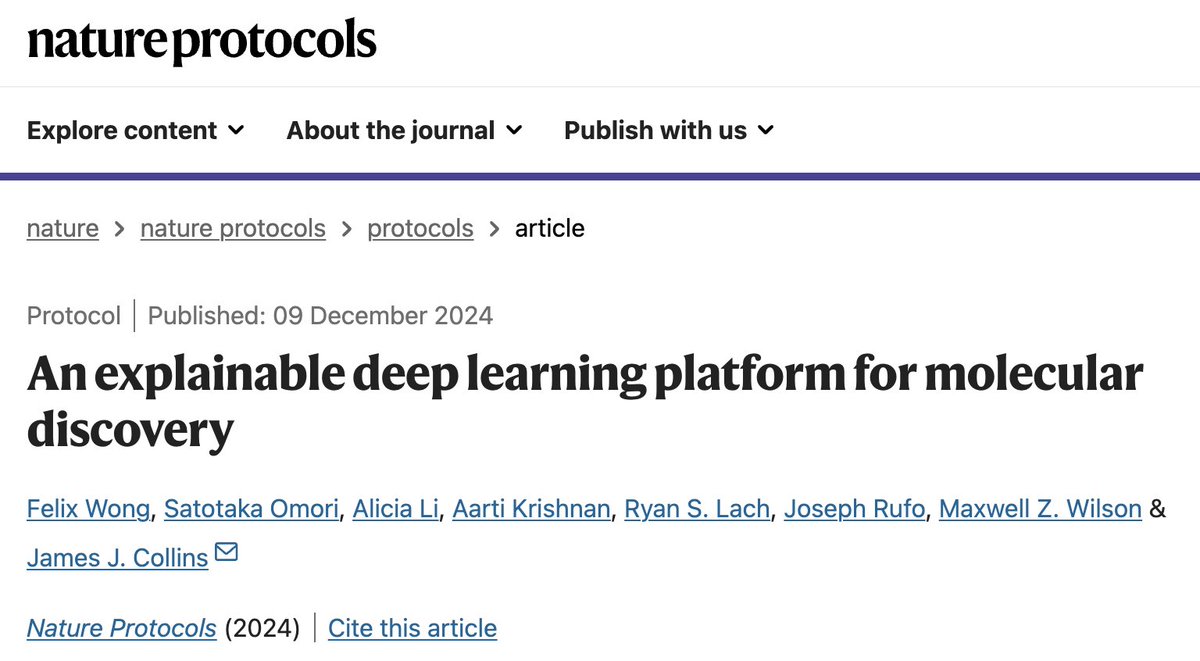
Explaining molecular discovery with deep learning: A platform for structural insight
Deep learning is increasingly applied in molecular discovery, offering accurate predictions of compound properties. However, traditional models often operate as "black boxes," limiting their ability to provide insights into the rationale behind predictions. This drawback can hinder hypothesis generation and efficient compound design.
A recent study by Wong et al. introduces an explainable deep learning platform based on Chemprop, a software package implementing graph neural networks (GNNs). Chemprop uses molecular graphs, where atoms are represented as nodes and bonds as edges, to predict chemical properties. This study demonstrates how Chemprop enables the identification of not only active compounds but also structural classes of molecules with shared features, providing interpretable predictions.
The platform's capabilities are showcased in antibiotic discovery, where it uses Monte Carlo Tree Search (MCTS) to identify chemical substructures associated with antibacterial activity. By focusing on these structural motifs, researchers can efficiently explore large chemical spaces and prioritize promising scaffolds for further investigation.
Benchmark tests highlight the platform's performance on datasets of millions of compounds, achieving high predictive accuracy while maintaining transparency in its reasoning. The workflow, encompassing data generation, model training, and validation, is designed to be user-friendly, requiring no advanced coding expertise.
Paper: https://t.co/gbkG5stG7z
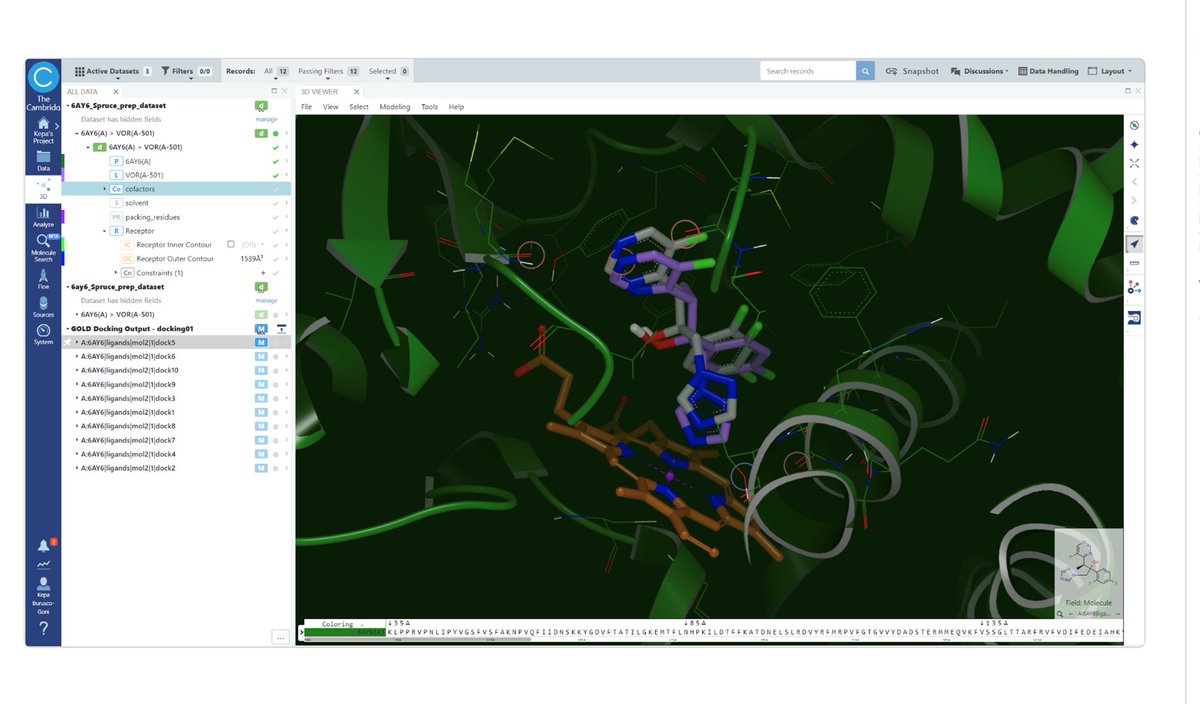
Our GOLD protein–ligand docking software is integrated with the Orion platform from OpenEye, Cadence Molecular Sciences.
This provides computational and medicinal chemists with a powerful toolset to streamline docking workflows.
🔗https://t.co/busgnRxXmG
#DrugDiscovery
Great collaborative work from the BioChemGraph team! The first release of this dataset is out to help drug design and formulation projects! @ccdc_cambridge
Big news for #DrugDiscovery! 🎉BioChemGraph team released its first dataset, linking 17K+ PDB-ligand complexes to 39K @ChEMBL bioactivity records in @PDBeurope & 32K @CCDC IDs in UniChem, speeding drug discovery & repurposing! 🎯 Explore here: https://t.co/XtoyyujiSU #OpenData
It's been a hectic but enjoyable week at the OpenEye miniCUPs in London and Frankfurt with my colleagues Ezekiel and Mariana, presenting the GOLD-Orion integration. Thanks to both for your help and support!! @ccdc_cambridge
https://t.co/ZwsrCMUwVN
Attending the London and Frankfurt miniCUPs next week to talk about the GOLD-Orion integration. Join us and if you are interested in knowing more about this product, or you have any doubt, come and speak with me and my colleagues Ezekiel and Mariana from the @ccdc_cambridge#GOLD
Two #drugdiscovery events from @OpenEyeSoftware include a showcase of our protein–ligand docking software on the Orion platform.
Both events are free to attend.
London - October 8th - see https://t.co/19PR8PluBK
Frankfurt - October 10th - see https://t.co/0AD4iROUQc
The Crystal Form Consortium unites industrial development chemists from leading pharmaceutical companies with CCDC software and data scientists to pioneer solid form structural informatics tools for new #drugdesign.
🔗See next week's meeting agenda at https://t.co/pfzUa5aDOW
Meet the CCDC team at the 9th @RSC_BMCS
Fragment-based Drug Discovery Meeting in Cambridge next week. This conference brings us a great opportunity to meet with global scientists and to learn about new developments in #DrugDiscovery.
🔗https://t.co/VzNbRhMMi7
#Chemistry
One of our sponsored PhD students, Cameron Wilson, has been published in the @ACSPublications Crystal Growth & Design virtual special issue “The Advantages of Flexibility: The Role of Entropy in Crystal Structures Containing C–H···F Interactions”.
🔗https://t.co/t9PKlngJtv
🗓 Save the date for #mdaUGM2024 ! 🗓
The MDAnalysis UGM 2024 will take place August 21-23, 2024 in London, UK @KingsCollegeLon, in partnership with @tyc_london! Stay tuned for updates.
https://t.co/wDmmWEra9i
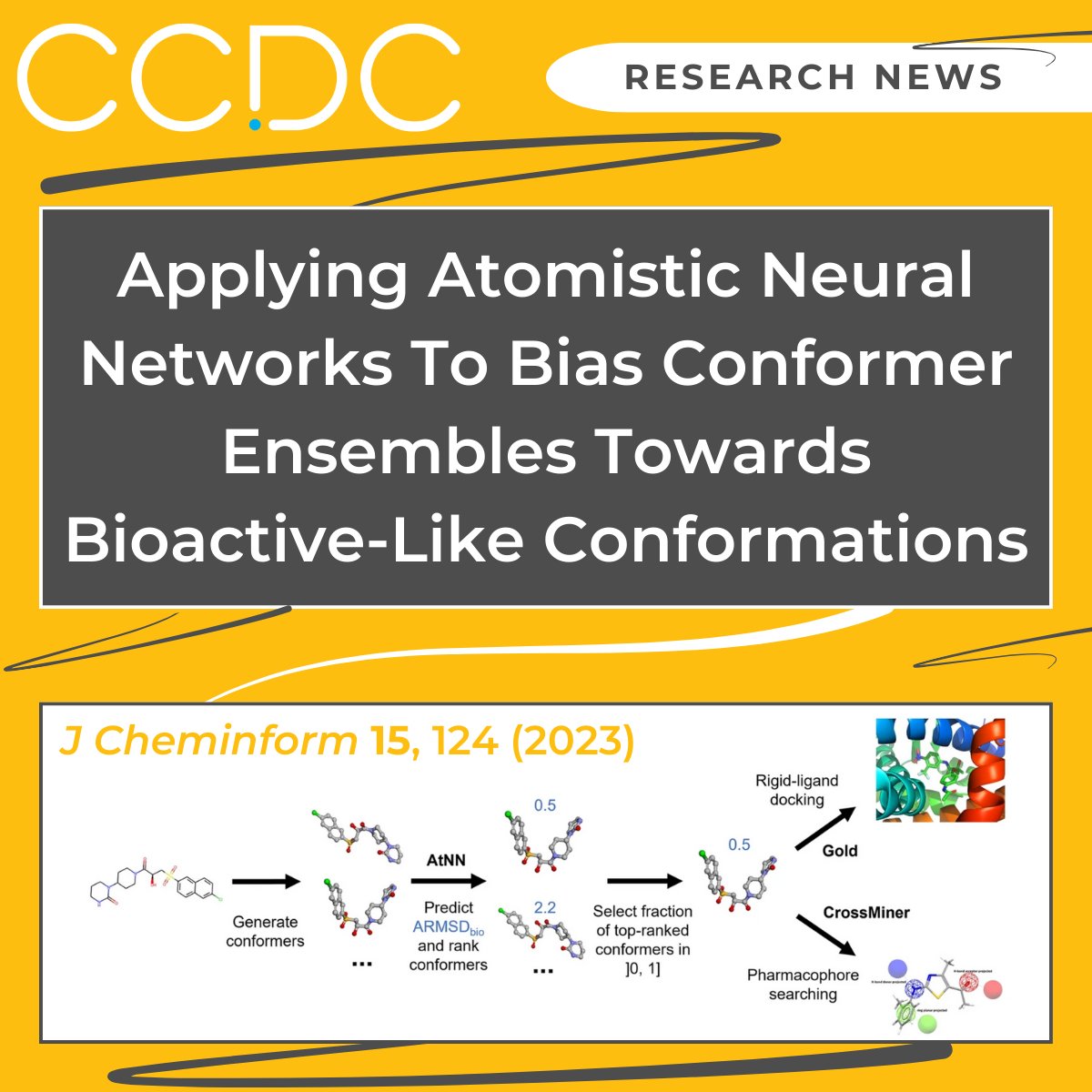
Scientists from the CCDC and @Cambridge_Uni used atomistic neural networks to identify bioactive-like conformers of small molecules. This approach has the potential of reducing computational expense in virtual screening.
🔗https://t.co/2V6Bg6WqLZ