Alle vet at det regner mye i Bergen. Men holder det til europatoppen?
Med OpenAIs nye Astra-modell har jeg sammenlignet gjennomsnittlig nedbør over 25 år i 20 000 europeiske byer og tettsteder med over 5 000 innbyggere.
Kan Bergen hevde seg, eller er vi bare gode til å klage?
Akkurat som det er laget regler for å beskytte lokalt levebrød og egenarten til Champagne må det lages regler for å beskytte lokalt levebrød og egenart for fiskere på #Senja og i #Reykjavik. Disse naturressursene kan fjernhøstes og er således annerledes enn jernmalm eller kull
Islendingene sier nei til EU-forhandlinger. Jeg har over tid vært EU motstander, men har snudd grunnet verdenssituasjonen. Likevel. Skal Norge (og Island) bli medlemmer av EU, må nasjonal kontroll over naturressurser aksepteres. Det må være utvetydig før evt. norske forhandlinger
Islendingene sier nei til EU-forhandlinger. Jeg har over tid vært EU motstander, men har snudd grunnet verdenssituasjonen. Likevel. Skal Norge (og Island) bli medlemmer av EU, må nasjonal kontroll over naturressurser aksepteres. Det må være utvetydig før evt. norske forhandlinger
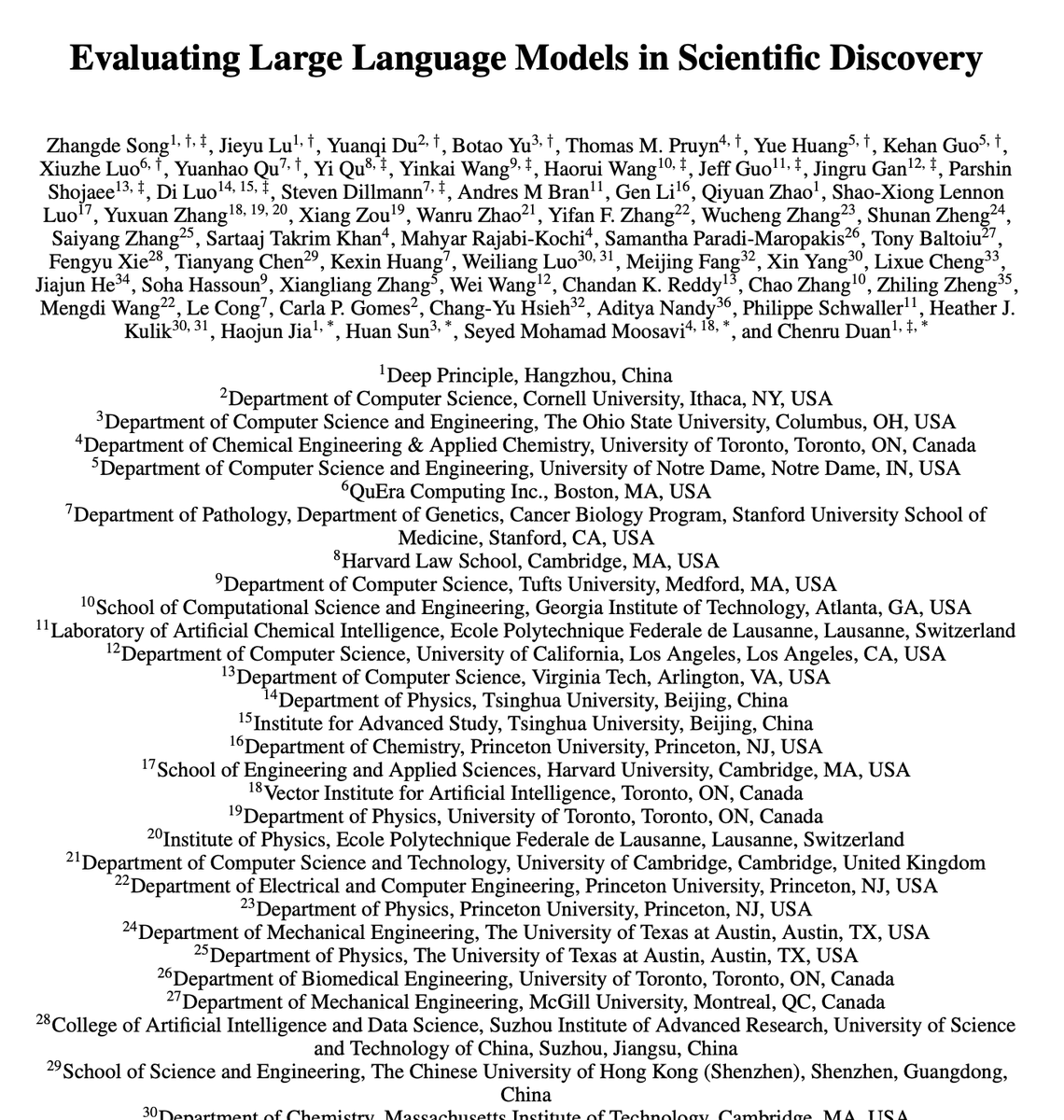
MIT and Harvard argue LLMs are nowhere near doing real scientific discovery.
They published a paper called “Evaluating Large Language Models in Scientific Discovery.”
Every week, tech labs claim an LLM has made a breakthrough in biology, physics, or chemistry.
But this proves they are faking it.
For years, AI benchmarks have tested models using static, multiple-choice science trivia. Models ace these tests, leading everyone to believe AI is right on the verge of autonomous scientific discovery.
Researchers built a new evaluation framework called SDE to test what happens when you take LLMs out of the multiple-choice quiz and put them into real, open-ended research projects.
They tested frontier models across biology, chemistry, materials science, and physics.
The results are sobering.
When forced to handle the actual loop of discovery—proposing a testable hypothesis, designing simulations, running experiments, and interpreting ambiguous results iteratively, current LLMs fall apart.
There is a massive, glaring performance gap between passing standard science benchmarks and doing real science.
Why do they fail? Because real science requires iterative reasoning, handling imperfect evidence, and adapting to unexpected observations.
LLMs are built to predict the next token based on existing internet data. They can regurgitate a textbook explanation of photosynthesis or quantum mechanics instantly.
But when placed inside an uncharted loop where the textbook doesn't have the answer yet, they hit a wall.
Worse still, the researchers discovered diminishing returns. Simply scaling up model sizes and adding raw compute isn't fixing the gap. Top-tier models from different providers share the exact same blind spots.
We are miles away from general scientific superintelligence.
The tech industry is selling a narrative that AI is about to automate labs, run clinical trials, and invent materials on autopilot.
But right now, AI isn't doing science.
It's just remembering it.
@KyrreNakkim@TrineEilertsen stort amerikansk angrep på Iran. Russisk angrep på Polen. Iransk angrep på Ukraina. Armageddon rundt hjørnet i finansmarkedene virker det som. Hva skjer med norsk presse?! Må stadig på X for å holde meg oppdatert. Toppsaken i @Aftenposten er maneter…
I was clearly wrong about Anthropic. They are obviously currently the leader in AI. No company has released a model as good as Mythos/Fable and they will undoubtedly have Mythos 2 ready soon.
And I would never cut them off in a way that hurt them badly, even as a competitor. That’s not my style.
Tesla open sourced its patents and we made the Supercharger network available to all competitors, even though we could have made it a walled garden.
SpaceX launches competing satellite systems with no increase in price or use of unfair terms.
Even my worst enemies can attack me on this platform.
…
Between the rise of the Chinese models, the death of tokenmaxxing, and the lackluster SpaceX performance post IPO, I am having a hard time seeing Anthropic IPO’ing at a trillion, and having an even harder time imagining OpenAI doing so.
Spidercam appeared to play a key role in England’s first-half equaliser, much to the anger of Norway.
Find out more here: https://t.co/4qHQhDsNW4
📸: ITV
Den allra största matchen, den allra bittraste förlusten.
Norge var på god väg att varva hela jävla världen, då de fastnade i en fotbollsfälla vi aldrig tidigare sett.
Någon hade spänt ut en vajer och förvandlat den till snubbeltråd.
https://t.co/VrmBKPWDNJ
🦔GitHub Copilot switched to token-based billing this morning and users are already out of credits. Pro+ subscribers paying $39 a month are reporting 60% of their credits gone in two hours of normal use. One user lost 20% of their allowance from a single file review with no code changes. Another hit their monthly cap before the calendar even flipped to June.
Orgs with shared token pools have no way to see individual usage, so entire teams get cut off when one person runs a heavy prompt. Users are canceling and moving to Claude Code and Codex. GitHub community forums are on fire.
My Take
Flat-rate AI subscriptions were always subsidized. Everyone in the industry knew it. Today the subsidy ran out for a few million developers at once. The problem is a lot of companies already restructured around these tools. They cut headcount and told remaining engineers to lean on Copilot instead of building skills internally. Those companies now depend on a tool whose cost just became unpredictable and whose usefulness completely changes when you have to ration prompts to stay under budget.
The developers moving to Claude Code and Codex will hit the same wall eventually. Every AI provider faces the same unit economics. Anthropic filed its S-1 this morning, and the durability of its revenue depends on whether customers stick around once real pricing kicks in everywhere. If a $39 subscriber cancels after one day because the tool became unusable, multiply that across millions of seats and the churn risk becomes very real.
Today showed what happens when AI pricing meets reality. The companies that built their workflows around cheap tokens just discovered the tokens aren't cheap anymore and the people who knew how to do the work without them are already gone.
Hedgie🤗