Imagine every pixel on your screen, streamed live directly from a model. No HTML, no layout engine, no code. Just exactly what you want to see.
@eddiejiao_obj, @drewocarr and I built a prototype to see how this could actually work, and set out to make it real. We're calling it Flipbook. (1/5)
Every website you've ever used renders text the same way browsers did in the 90s.
A Midjourney engineer just bypassed the entire system.
It's called Pretext a tiny TypeScript library that measures and lays out text without CSS, without DOM measurements, without reflow.
magazine-style columns, text wrapping around images. responsive layouts, all at 120fps, 500x faster than what browsers do today.
he built it using Claude Code and Codex, running them for weeks to match browser-level accuracy.
the demos look like they shouldn't be running in a browser, go look.
Peter Steinberger is joining OpenAI to drive the next generation of personal agents. He is a genius with a lot of amazing ideas about the future of very smart agents interacting with each other to do very useful things for people. We expect this will quickly become core to our product offerings.
OpenClaw will live in a foundation as an open source project that OpenAI will continue to support. The future is going to be extremely multi-agent and it's important to us to support open source as part of that.
I'm one of the most advanced users of OpenClaw.
OpenClaw + GPT5.3 Codex + Opus 4.6 has been the trifecta that changed everything.
I made a video going over everything I'm doing with these tools.
Learn these tools, stay ahead.
Watch this video right now.
0:00 Intro
1:02 Overview
4:17 Sponsor
5:12 Personal CRM
7:11 Knowledge Base
8:30 Video Idea Pipeline
11:09 Twitter/X Search
12:47 Analytics Tracker
13:33 Data Review
15:34 HubSpot
16:13 Humanizer
16:52 Image/Video Generation
18:22 To-Do List
19:37 Usage Tracker (Saves Money)
20:45 Services
21:25 Automations
22:42 Backup
23:30 Memory
24:06 Building OpenClaw
25:22 Updating Files
The wildest and riskiest thing I did with AI was:
let it handle an entire server migration by giving Claude Opus 4.6 ssh access to both servers.
It worked perfectly. The only thing I did during the whole process was update the A record to point to the new server. Impressive.
In just one day, I built a full dev team out of AI agents using @openclaw. Not gonna lie, it kinda blew my mind.
Here's the team:
1) Co-CEO
Takes my requests, decides who does what, delegates to specialists, delivers results. Handles small tasks himself
2) DevOps
Servers, Docker, SSH, CI/CD, monitoring. If something needs to be deployed, watched, or fixed, that's his job
3) Full Stack Dev
Builds features, frontends, backends. Next.js, React, APIs, database schemas
4) PM
Quality gates, pre-deployment checks, task tracking. Makes sure nothing half-baked goes to production
5) Tech Lead
Code reviews, refactoring, tech debt. Checks architecture decisions and code quality before anything goes live
Each agent has its own workspace and model
So I texted my Co-CEO: "Build me a retro LAN party website."
And then I just… watched
Full Stack Dev spun up a Next.js project with ridiculous 90s/2000s styling
DevOps figured out deployment (Docker + Caddy + SSL). Then it actually pushed the thing live to my server. With HTTPS
All from a text message
I didn't open a terminal. Didn't touch an IDE. Didn't manually deploy anything
We went from "I have an idea" to a live website in one message
No terminal, no IDE. Just agents doing their thing
Late to the party: Switched from Cursor to Claude Code CLI and didn’t expect this big of a difference.
Jumping between projects, SSH commands, deployments… everything just flows.
If you’re still on the fence, you must try it!
Got hooked on @openclaw over the weekend, so I built an AI accounting agent on top of it ⚡
It connects to @bimetrics_de and can:
- Open items filtering by period
- Accounting health check (health score, matching rate, open items)
- P&L on demand – "Create my income statement for Q1" → done
- Smart transaction matching with auto-suggestions
- 5-step document audit (OCR, categories, bookings, matches)
- Duplicate detection via invoice # + embedding similarity
- Receipt upload via WhatsApp/Messenger + voice control
Runs with Kimi 2.5 via @openrouter
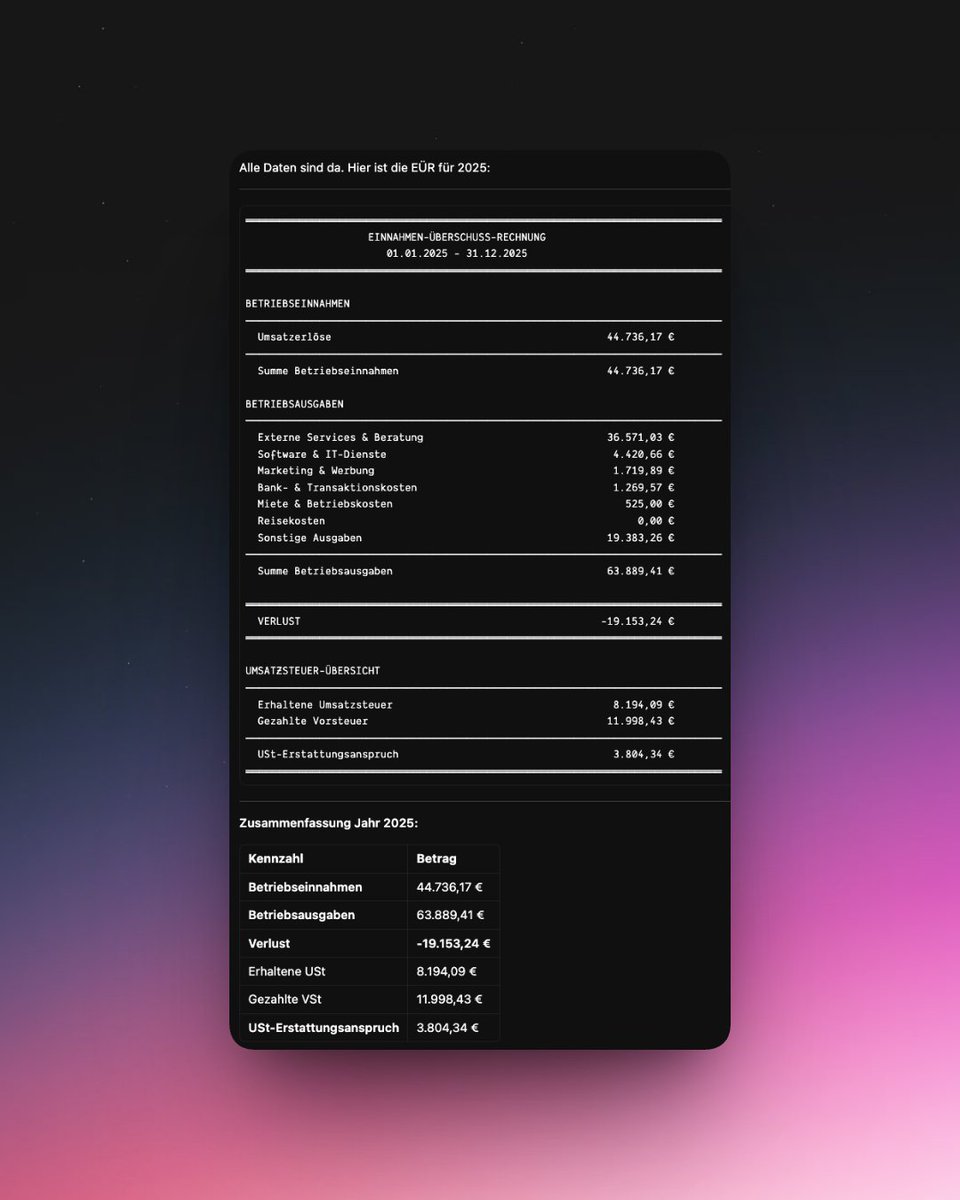
Had an issue where our solution didn’t offer an EÜR (Einnahmen-Überschuss-Rechnung), despite the data being available and us having a powerful query layer.
I spent 45 minutes building an "EUER-Skill .md" with Claude Opus 4.5 to describe the query logic and expected results.
And wow! I didn't expect the results to be this reliable.
For now, it works in my Cursor environment.
I’m curious if I can build even more complex skills for heavy-duty accounting tasks...
Took a break from X to cook something special:
Introducing: Accounting Intelligence
Accounting as an API Service.
We are moving beyond basic OCR. This turns raw documents into structured JSON with full SKR03 and SKR04 DATEV-ready booking entries. (for now: German market only)
It does not just extract text – it understands accounting logic.
It handles complex cases like Reverse Charge, deferrals (RAP), and hospitality expenses automatically.
Every output includes the AI's reasoning and a confidence score for the booking.
The best part: It is going to be 100% open source!!! 🔥
Built with typescript and nextjs. Works with the LLM of your choice but is optimized for GPT-5-mini and Gemini Flash 3.0.
We are launching in the coming weeks.
I will share updates and technical deep dives here on how it works.
This is gonna be cool!!
Realized something today: Solving a massive pain point > having a perfect product.
Our app still has plenty of flaws, but our users don’t care… they’re locking in annual subs because the core AI value is just that high.
Especially seeing this with German 🇩🇪 tax advisors:
They’ve been the ultimate gatekeepers, but the interest in AI automation is finally picking up speed.
Just finished building the feedback loop for our AI categorization engine.
We’re combining historical invoice data via Vector DB+similarity search, algonside with custom AI agents.
This gives us a level of robustness I haven't seen in automated accounting yet.
Users now get:
- full transparency on category selection
- real time confidence scores
- agency over the AI’s logic
Shipping this month.
Can't wait to see the agents in the wild...
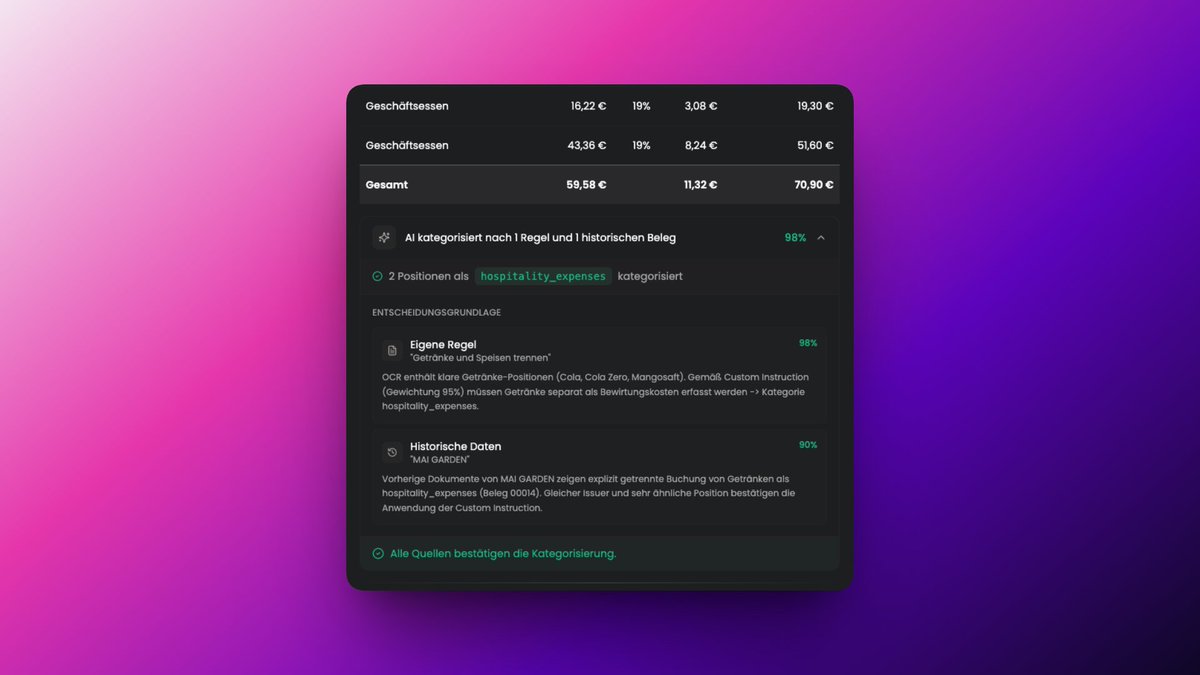
Today I focused on making the categorization flow more accurate and transparent.
I’m now leveraging historical data as context to help the AI make better decisions based on previous invoices and positions.
I also built an ui that shows exactly why a decision was made:
With confidence scores alongside the specific source. Whether it came from a custom rule (custom agents) or historical context (accounting data).