The current @USTreasury campaign against Iran draws on this: letters to banks with specific actionable info and offramps, diplomatic engagement now that the strait is closed, threats behind the scenes. The UAE suspended Iran transactions last week under exactly this kind of pressure. If this strategy is successful with China, it will be banks quietly tightening compliance, with nothing to see publicly.
Treasury has weighed the pros and cons of moving publicly against Chinese banks, and for now it's choosing to work behind the scenes. The choice is also about time. The oil relationship is pressure for the long term, but the war demands impact now, so Treasury is going after repatriation, the funds the regime can spend today. 5/5
I spoke with @WSJ about how Treasury's action Monday stopped short of targeting Iran's major lifeline, China. I told them the action was structured to give China room to adjust quietly, and that the framing means China can change behavior without its banks being sanctioned.
I also said this sort of pressure can work. Some are expecting a Chinese bank to be designated by the end of the week after @SecScottBessent's comment (I wouldn’t bet on it). But if you want sanctions to change behavior, it's worth dwelling on the psychology of the behavior change we're asking for, and why Treasury has avoided sanctioning Chinese banks across multiple administrations: confrontations with China are better kept behind the scenes in technical spaces, not by forcing capitulation in public. 1/5
https://t.co/hW5dlCOolY
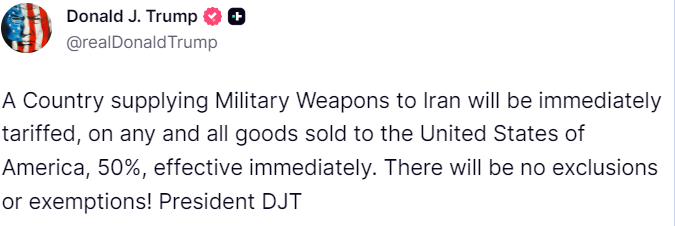
Tariffs are in fashion as the new stick, the appeal being that they force a decision at the government level and hit a sector rather than a company. But we've already seen they don't fit the problem. China said a flat "no" to the Russia tariff and the effort was abandoned in the trade war before the courts struck it down.
Then there's the ancestor of the tariff play, and historically the most effective sanctions measure ever introduced against enablers of Iran. From 2012 to 2013, governments buying Iranian oil had to show cuts every six months or correspondent account access would be cut off for the country's entire banking sector. Same design as the tariff, force a decision at the government level, but with a quiet backdoor that never publicized the capitulation.
China, India, Korea, and Turkey all took the waivers, and Iranian exports fell by more than half. But when Washington demanded zero in 2019, Beijing refused, and the trade went underground, relabeled cargoes and ship-to-ship transfers feeding teapot refiners ever since. China cooperated when the pressure was heading toward a deal. Now we have to consider what China does with no deal on the table and Washington's stated aim to collapse the regime. 4/5
The off-ramp problem is real. Treasury has said for years sanctions are about change of behavior, but there's often no reasonable off-ramp even for purely commercial businesses that got caught up doing what they viewed as ordinary business with Iran. They're willing to cut off that business, but they can never come off the list. Treasury cripples itself when it sanctions with no off-ramp. 4/4
I wouldn't have framed the lead-up this way. Signaling for weeks that something is coming, then delivering more of the same (good, but the same) enforcement on things Treasury had clearly been tracking and planning for a while, with sector determinations that overlap existing authorities, makes everyone think you're not actually going to do anything. But what Bessent is actually saying they're going to do is worth considering on its merits.
China stayed on the side and helped Iran because it thought the US would walk away and the situation would end poorly for us. The US is signaling it will not walk away, and Iran is willing to escalate. China's calculus now shifts from a strategic decision to an economic decision. Its real trading partners (UAE, Saudi, US) matter more than Iran, and 80% of trade finance runs in dollars. Bessent said "why would I want to blow up the global financial system" because he doesn't have to if everyone believes he would if they don't change. 1/4
Asked by a reporter why Trump described it as "economic D-Day" against Iran, only to give warnings Monday to countries, Bessent said:
"We are giving everyone the opportunity to remedy bad behavior. Why would I want to blow up the global financial system?"
And if you want to see the benefits of a pressure-before-designation strategy, look at the UAE's decision to cut off Iran last week. That's something we worked at for years in government. Iran did us a big favor by throwing missiles at the UAE, but it's still enormous progress.
It shows the effectiveness of a strategy where you demonstrate you're willing to take big action but hold back when you see behavior change. Sometimes the threat is more effective than the tool. That's why the April letters to banks in China, Hong Kong, the UAE, and Oman, with specific actionable info and off-ramps, can beat designations. Look at China's Bank of Kunlun: sanctioned in 2012, and it remained Iran's dedicated Chinese conduit for the years that followed. The action entrenched instead of deterred. 3/4
They shouldn't be able to get these. Integrated circuits sit in Tier 1 of the government's own high-priority list, and moving them to Russia through any country violates US sanctions and export controls. Yet Ukraine has now pulled Nvidia modules from three different Russian weapons, and parts made in late 2025 are showing up in drones by spring 2026. We have to make industry pay attention that Russian weapons run on our parts.
Exactly right. It was so bad that about 80% of the electronic components in the leaked Russian Alabuga Shahed parts list were American, many from TI and Analog. The office that has the best opportunity to act on this (OFAC - strict liability sanctions regime) mostly goes after the problem by designating middlemen but leaves the US companies untouched. One exception is Haas (machine tool company whose Russian distributor sold to sanctioned firms), a case that told us the problem is the distributor model that has to be audited. The companies keep just saying they are victims of fraud.
Some real issues on this read. Collapsing the distinction between economic warfare and military conflict is the strategy, and is clearly read that way in Iran. No relief without a deal, military or economic, and Washington controls both. Hence the urgency you see now from regime officials.
Shifting to economic pressure after strikes is sequencing. No one proposed a ground invasion, and escalation was always airpower, which is still in reserve.
Washington knows one faction sees a chance to escalate and another is warning Iran must end this. That division is progress. You read Tehran as seeing weakness and opportunity. Desperation and last chance is what that division actually shows. And escalating now means doing it with degraded air defenses, a collapsing economy, and no reserve deterrent. That’s the fight Washington is choosing.
Tehran has been debating “what to hit and when” since January.
Some real issues on this read. Collapsing the distinction between economic warfare and military conflict is the strategy, and is clearly read that way in Iran. No relief without a deal, military or economic, and Washington controls both. Hence the urgency you see now from regime officials.
Shifting to economic pressure after strikes is sequencing. No one proposed a ground invasion, and escalation was always airpower, which is still in reserve.
Washington knows one faction sees a chance to escalate and another is warning Iran must end this. That division is progress. You read Tehran as seeing weakness and opportunity. Desperation and last chance is what that division actually shows. And escalating now means doing it with degraded air defenses, a collapsing economy, and no reserve deterrent. That’s the fight Washington is choosing.
Tehran has been debating “what to hit and when” since January.
There are two important things the Trump administration doesn't understand about how Tehran perceives their "maximum pressure" sanctions.
First, the way that Trump has used sanctions and economic pressure has collapsed the distinction between economic warfare and military conflict. For Iran, there is no end to the war without an end to the sanctions.
Second, Tehran is interpreting Trump's shift towards economic pressure as a strong signal that the administration lacks the resolve for further military escalation. It's telling that Trump is touting an "economic D-Day"—an actual ground invasion is off the table.
Taken together, these two beliefs mean that Iran has every incentive to resume military escalation in an effort to bring this war to a decisive close. The U.S. is continuing to adopt policies that Iran perceives as a form of warfare and if Iran's economic crisis is accelerating, it is important to end that war as quickly as possible.
Iran's leaders are confident they can go on the offensive because they are interpreting the shift to economic pressure as a sign of weakness. They believe that if they can land a few more punches, Trump will end up down for the count and have to return to the promises made in the MOU.
The debate in Tehran is about what the escalation should look like—what to hit and when.
There are serious limits to the effectiveness of a "look north" strategy, and the fact that Iran is shifting this way shows how dire things are. Tehran is bracing against measures Treasury has not even announced yet, with a workaround already running at its ceiling.
Russia and Iran already trade basic goods across the Caspian, but there are physical limitations. Vessels on the Caspian carry only 5,000 tons vs the 60-80K that a Gulf carrier moves. This route gets Iran grain, fertilizer, industrial goods, and whatever Russia wants to send quietly, but low volumes of all of it. It replaces a single-digit percentage of what the south carried.
Overland routes now carry what used to come through the strait. Rail from China also moves consumer goods. Transshipment through Central Asia can handle some of the sensitive tier (electronics, machine tools, and components that front companies buy for Iran), but you just cannot send as much over land. Think dozens of containers vs thousands on a ship. A train arrives in two weeks and a ship in a month, but replacing one ship takes 50+ trains. These routes are a trickle of what the regime had before alienating its Gulf neighbors.
Sources in Iran have confirmed to me that the Islamic Republic is increasingly adopting a “look north” strategy to evade sanctions and blunt the impact of Trump’s “Economic D-Day.”
1/
This is what I said in April. WSJ confirms it from intercepted comms: Iran decided the day the MOU was signed to spend the 60 days rebuilding — missile and drone production up, IRGC commanders in Yemen prepping the next round. Their own spokesman: "We fully exploited the ceasefire period." Look how it's happening. https://t.co/TJZWSFhy9J
Every time the U.S. degrades Iranian weapons capacity, China's dual-use pipeline surges to reconstitute it. While we sit in a ceasefire, Iran is reconstituting. It has burned through 4,000+ drones and 1,800+ missiles in five weeks. Its production facilities are cratered. It is desperate to rebuild, and the same Chinese micro-enterprise network that kept Shaheds flying into Kyiv is working overtime to make that happen. 🧵
Sanctions raise Iran’s oil-export costs at every stage, from insurance and ship-to-ship transfers to payments for intermediaries and discounts demanded by Chinese buyers, former US Treasury official Kerri Bitsoff told Iran International.
@kerri_bitsoff
کری بیتسوف، مقام پیشین دفتر کنترل داراییهای خارجی وزارت خزانهداری آمریکا، به ایراناینترنشنال گفت تحریمها بهتنهایی قادر به سرنگونی جمهوری اسلامی نیستند، بلکه برای افزایش فشار و بالا بردن هزینه فعالیتهای نظامی و هستهای تهران طراحی شدهاند.
او افزود تاثیر تحریمها باید با میزان دشوارتر، کندتر و پرهزینهتر شدن این فعالیتها سنجیده شود، نه با شمار افراد و نهادهای قرارگرفته در فهرست تحریمها.
به گفته بیتسوف، اجرای مستمر تحریمها بیش از تعداد آنها اهمیت دارد؛ زیرا هدف اصلی، تغییر رفتار بانکها، خریداران نفت، تامینکنندگان قطعات، شرکتهای کشتیرانی و واسطههایی است که با حکومت ایران همکاری میکنند. او گفت تحریمهای تسلیحاتی میتوانند جمهوری اسلامی را به استفاده از قطعات گرانتر یا کمکیفیتتر وادار کنند و در نتیجه، کارایی موشکها و پهپادهای تولیدشده را کاهش دهند.
https://t.co/S4FG9CBPYC
“Most evasion of sanctions, especially related to Iran, happens through China,” Bitsoff said. “Those are the front companies that move money. They're the buyers of oil. They're the suppliers of weapons components.” @kerri_bitsoff “The Iranian population knows that Islamic Republic funneling money not to them, not to economic growth, not to opportunities, but back to its proxies, back to its nuclear program, back to its weapons program,” Bitsoff said.
Watch it here:
https://t.co/RLPA4etdvH
I spent years at Treasury building and enforcing these programs. Sanctions work — at raising costs, slowing procurement, forcing tradeoffs. Expecting them to bring down the regime alone sets them up to fail. More with @IranIntl_En@KambizTavanaUS:
Sanctions can make Iran’s military and nuclear activities costlier and more difficult but cannot bring down the Islamic Republic on their own, former US Treasury official and weapons procurement expert Kerri Bitsoff told Iran International.
https://t.co/lNAb1k0WDl
This is exactly his point. I'm saying the pain and suffering are not alleviated when sanctions are lifted. We literally did this once and saw the effect: the JCPOA lifted sanctions in 2016, billions of dollars came back and oil flowed legally again. But the economy outside oil only grew 3% and unemployment rose. Ordinary Iranians felt nothing and the IRGC still controlled the economy.
Instead, defense spending went up 30% to a two decade high, billions went to propping up Assad, $700 million a year to Hezbollah and tens of millions to the Houthis. If you think lifting sanctions alleviates suffering, why were Iranians back in the streets in 2018 over high prices and jobs chanting "Not Gaza, not Lebanon, my life for Iran"?
And at any point in 40 years the regime could have ended this by agreeing to reasonable demands. No nuclear weapons, limits on missiles, stop funding armed proxies that rule other countries without the consent of the people living there.