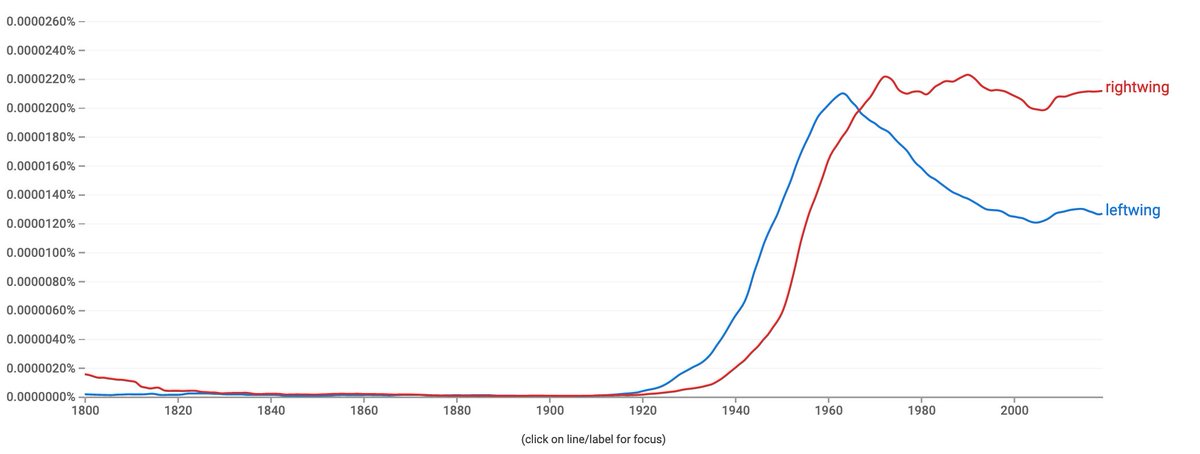
You can't understand American history if you use the left/right frame. It entered the American political discourse very late, and until the 60s, it almost exclusively translated to communist/anti-communist. 19c Americans did not define themselves in relation to communism.
Part of the problem with AI - that some proponents do actually understand but most adopters do not - is that the things people expect it to do (cure cancer, make movies, write books, solve mathematical puzzles) are themselves the concerns of a pre-AI, high literacy society.
The assumption is that an America with Third World levels of literacy will have First World levels of demand for (say) cancer treatments, and that (again, eg) doctors with the medical knowledge of a reasonably bright Wikipedia reader will be able to oversee the bots supplying them.
Neither is likely to be true.
This is true. The illiteracy lends itself to the “literary texts have one answer like a maths problem” fallacy—which we might call aboutness. Politics is a great pseudo-solution to this problem, as it provides “aboutness” in a superficially convincing way.
5. Decision fatigue is a physical limit, not a mental one. By 6:00 PM, choosing what to eat for dinner burns the same amount of glucose as solving a complex math equation.
6. Hyperfocus isn't a superpower. It is an inability to regulate attention switching. You aren't "locked in," your brain's brakes are just broken.
The British would either not have abolished slavery in the 1830s or the American Revolution would have happened then, if it had not happened before
The US constitutional structure failed in 1860, but any possible polity would have under those conditions; the political visions of each side were simply incommensurable. Lincoln was right: a house divided against itself cannot stand
The same was true of slavery. The North American colonies were not the same as Caribbean: they had both a much bigger white population as well as a much bigger enslaved population. Political consciousness in the Caribbean colonies was low; they really were - and saw themselves as - extensions of the metropole. That was not true of the North American colonies, which were much more literate, and with a much denser social graph of relationships that made possible a high degree of political mobilization
If the North American colonies had remained within the British empire, either abolition would never have occurred, or the war over slavery would have been fought then instead. No alternative timeline is really plausible
By far the main reason that America has done so well is it was settled by the people who won’t wait around for a generation and hope their grievances get resolved by unspecified passive voice processes.
I think people need to understand that the united States of America is still one of the biggest achievements that will probably never be replicated in Human History ever again, considering the people who made the constitution said "Yeah in 20 years this shit is falling apart."
This is actually kinda sad that in this article Ulysses S Grant’s great great grandson says growing up in the 1960s.. a century after Grant won the Civil War.. his reputation was at such a low point after a century of Lost Cause propaganda that his own family didn’t teach him about his great great grandfather. He ended up having to learn about his life as an adult from the history books.
@JJKixxx88@wanggang420@AlwaysFlacko And a lot of the Northern papers were Copperhead/Democrat and spreading Lost Cause rhetoric at the time, but I imagine some other Northern papers echoed the rhetoric at times. Will have to look into it.
@JJKixxx88@wanggang420@AlwaysFlacko I think Mary Lincoln was cited as calling him "a butcher" in Behind the Scenes, the tell-all written by her former friend and dressmaker. I personally don't think that dialogue sounds credible. I don't think we have proof of her saying it in a letter, unless I'm blanking out.
benjamin franklin would publish a provocative letter in his own newspaper under one fake name, then rebut it under a different fake name, then charge philadelphia to watch the fight. he invented engagement farming, owned the platform, and kept the revenue. a complete poster
The internet gave every single person on Earth access to every book and paper ever written. It supercharged the hyperscholastic 0.05% and they're remaking the world with it. The MIT lectures don't matter because autodidact turboautists don't want to watch a goddamn video.
I think there's two ways that "American exceptionalism" gets used. The 1st way, that we're just...different...is one that I'm always puzzled about left/critical theorists trying to deny.We're a rare stabl[ish] transcontinental empire, we're slower than the world to secularize 1/
I’ve always found people who bristle at “American exceptionalism” kind of… weird. Not because I lack self-awareness — I’ve spent my career cataloging every way this country fails to live up to its own rules. But that’s exactly why I love it so damn much. We built a system designed to be shamed by its own founding documents, and it still delivered one of the most spectacular, world-altering runs in human history. A genuine force for human flourishing.
I also found the argument against American exceptionalism to be historically illiterate. Here’s a sample of what we were first at:
• The first large-scale democratic republic in human history — not a city-state, not a monarchy with a parliament bolted on, but a bold continental experiment in self-rule, popular sovereignty, and ordered liberty.
• A written Constitution (1789) with separation of powers and checks & balances — still the oldest national constitution in force anywhere.
• The Bill of Rights (1791): the first time a nation wrote “the government cannot touch these” into supreme law and actually meant it. A dare the world copied — from later rights charters to the Universal Declaration of Human Rights.
• Public land-grant universities and mass higher education (Morrill Act), opening college to ordinary people no aristocracy would have let near the gates. (but don’t get me started about what happened after we started. Massively federally funding it.)
• Kitty Hawk, 1903 — first controlled powered flight.
• The Moon, 1969 — still the only ones who’ve been there.
• The world’s largest economy since ~1890, powering unprecedented prosperity through grit and genius.
• The assembly line, skyscraper, transistor, personal computer, ARPANET — the backbone of the modern world.
• Telephone, phonograph, GPS — connecting and powering daily life.
• Surgical anesthesia, polio vaccine — saving and transforming millions of lives.
• Jazz, blues, rock ‘n’ roll — brand new American art forms that conquered the globe.
• Hollywood’s dreams, blue jeans, bourbon, and a culture so open a kid like me could devour sushi, burritos, stuffed cabbage, and tabouli in the same week and rightfully think of it all as American.
That’s the part that fills me with genuine love and pride: not just the power or the wins, but the appetite for freedom, creativity, and reinvention. The audacity to say “We the People” and keep trying to live up to it.
What do you love most about this truly exceptional country? 🇺🇸
I’m telling you, open a film magazine from before 1950 and everyone talked like they do on the internet. Fan letters are indistinguishable from tweets.
Like did you live through the 2010s? Liberals are much more willing to cancel Washington and Jefferson than they are Lincoln or Grant. Half of all mainstream liberal commentary these days is “everything is the Civil War”
If you want to know one thing Thomas says in his dissent I kind of agree with, it's that dual citizenship was viewed very skeptically in American history. He's right that 19th Century rules were a lot more hard-ass about this (and you can see this in arguments in Wong Kim Ark).