JTX is now live.
Trade spot markets on Solana—memes, tokenized equities, majors, and more.
The top 1,000 users on the waitlist, ranked by referrals, have access now.
jtx is in real hands now.
we've been hammering it internally for ~2 weeks. first outside testers got in last week, more coming this week and next.
i'm spending more than 50% of my time in the product right now. this is the part i've been waiting for 🙂
@SAS you cancel my flight, I get the option to rebook but then I get an error... I try live-chat which should be open but it's not... I call and been waiting for +1hr. Been flying with you for +14 years and to say the experience has gone down hill is an understatement
A future for perpetuals on traditional assets
@Architect_Fi has been engaging with industry participants over the last several months on the question of bringing perpetual futures on traditional assets to market. Along with my team and many in the industry, I see perpetuals as transformative instruments that greatly reduce the operational cost and complexity of obtaining exposure to any underlying asset class. Swaps resembling perpetual futures contracts have been offered over-the-counter by traditional financial institutions for decades. The digital asset industry has innovated on and exposed latent global demand for these products, establishing a $100B daily notional market through use of central limit order books, vertically integrated clearing systems, and modern interfaces. Here’s a brief overview of the untapped potential of perpetuals when applied to traditional asset classes, and the regulatory and operational challenges of successfully integrating these contracts into existing futures trading and clearing regimes.
The defining characteristic of a perpetual futures contract is that it never expires. The contract approximates an auto-rolling future using a periodic (e.g. daily) settlement in which the buyer pays the seller an amount of cash based on the difference between the contract’s mark price and the underlying benchmark price. This feature of perpetuals offers many benefits over standard expiring futures contracts:
-Traders save on the exchange fees and other operational costs that would otherwise be associated with rolling futures contracts forward at each expiration.
-Investors save on the implicit costs from rolling futures through contango, under which longer dated futures contracts are more expensive than shorter dated ones.
-The settlement/funding mechanism provides continuous realized P&L instead of unrealized margin credit/debit, simplifying backend processes for both contract holders and clearing systems.
-The contract provides a more continuous time series for price discovery, compared to the discontinuous jumps from front-month to second-month that occur at expiry (see VIX futures).
There are myriad applications for perpetual contracts as applied to traditional underlying assets. Here are a few examples:
-ETPs that hold expiring futures contracts could instead use perpetuals, reducing the fees and NAV depreciation associated with gradually rolling their baskets to longer dated contracts as expirations approach. This includes ETFs such as USO, which holds WTI light sweet crude oil futures, and ETNs such as VXX, which holds VIX futures.
-Commodity hedgers that need to protect against their long term economic exposure but don’t need to take physical delivery of a commodity or tie such hedging to a particular tenor can reduce operating costs through perpetuals. Insurance companies are a prime example of such institutions.
-Speculating on or hedging risk in restricted foreign currencies such as INR or IDR often require trading non-deliverable 30-day or 90-day forwards, which are typically non-standard contracts that only trade over-the-counter. These could be replaced easily with financially settled USD-denominated perpetual contracts.
In spite of the benefits and universal applicability of perpetuals, these products have yet to “catch on” for traditional assets as they have for digital assets. Establishing a regulated traditional perpetuals exchange hinges on navigating significant institutional financing, clearing, settlement, risk, and contract design challenges:
-Attracting arbitrageurs to make markets on traditional perpetuals would require some capital netting between these new perpetual products and existing expiring futures contracts (e.g. on CME). International futures clearing/prime broker entities would need to provide portfolio financing across these two different clearing systems.
-While non-US perpetual contracts on digital assets allow for collateralization using USDC and USDT, traditional commodities investors are typically not familiar with stablecoins and require access to traditional USD funding rails.
-The mathematical models used by both US and non-US clearing houses for establishing overnight initial and maintenance margin for expiring futures are not easily repurposable for perpetual contracts.
-For non-US digital asset perpetuals, the volatility of the underlying as well as the non-recourse nature of allowing margin trading from a globally diverse set of traders necessitates an auto-deleveraging system that operates 24/7. Using a similar system for traditional perpetuals may be untenable for existing commodities traders that are accustomed to standard margin calls that only can occur during normal market hours.
-The underlying prices for perpetual contracts can freely be set to front-month expiring future prices from exchanges like CME or ICE, but the contracts would then exhibit many of the same problems as their expiring counterparts when benchmark prices roll from one contract month to the next. The ideal underlying for a perpetual is an official spot benchmark index that conforms to IOSCO standards. Unlike digital assets, whose prices are public domain and therefore freely available to include in derivatives contracts, trusted official benchmark values for stock indexes, metals, foreign exchange pairs, and other asset classes are the intellectual property of index providers. Utilizing these benchmarks requires licensing agreements with these companies, which may present significant up-front commercial and legal costs to new exchanges.
While numerous and complex, these challenges are all tractable, and I look forward to sharing more as @Architect_Fi advances in this area. If you’re interested in further discussion or involvement, please reach out!
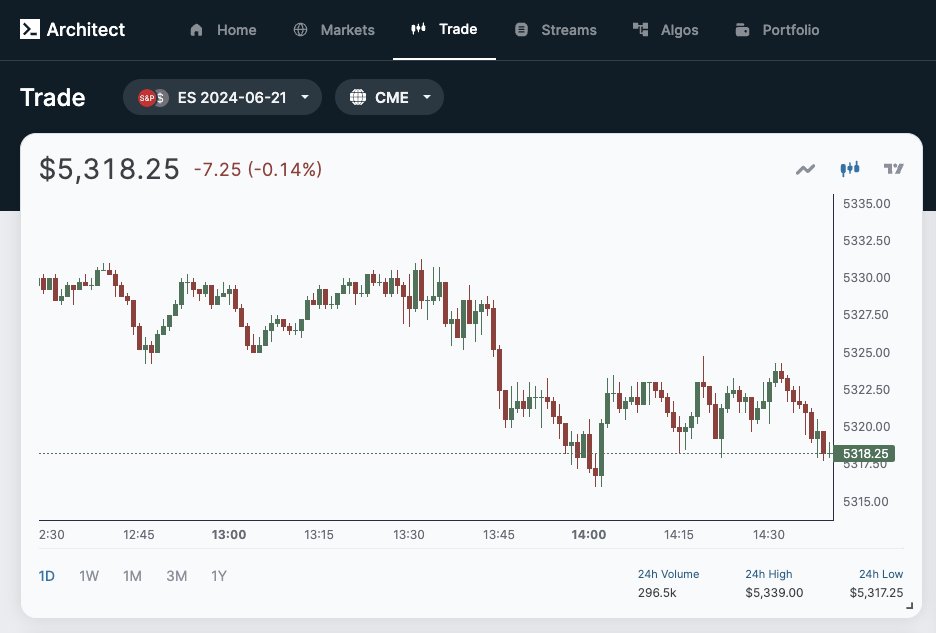
Onboarding clients to Architect’s derivatives brokerage kicked off last week and is underway! If you trade futures and options on crypto, energy, interest rates, metals, or stock indexes and want to try us out click the link below. Leverage trading, transparent margin calculations, realtime purchasing power, language-agnostic API access, streamlined customer onboarding, advanced charting, execution algos, and more.
https://t.co/PRazoL0o8L
Available to U.S. retail and institutional investors.
Trading futures and options involves substantial risk of loss and is not suitable for all investors.
The @Architect_Fi team is excited to open the waitlist for our US derivatives brokerage:
https://t.co/6q3p1OnXND
We’ve developed this platform for all US futures and options traders, from retail to institutional.
Here are some of the key features we can’t wait to share:
- Streamlined onboarding process: We leverage modern KYC/AML solutions to make account opening automated in the common case, compared to the multiple days it can take at other futures brokers.
- Multi-exchange and multi-asset: We’re launching with derivatives on a wide variety of asset classes (stock index, agricultural, metals, cryptocurrencies, energy, etc.) on all four CME Group exchanges (CME, NYMEX, CBOT, COMEX). We’ll be adding other US derivatives exchanges, as well as CFTC-approved international derivatives exchanges, in the coming months.
- API access: Architect provides GraphQL-based queries and websocket subscriptions to access account balances, trade history, per-product initial/maintenance margins, candles and more. An open-source Python SDK will be available, and full API trading will be enabled for professional subscribers.
- Advanced order types and execution algos: We provide the full array of exchange-supported order types, and allow customers to leverage algos such as TWAP and POV. More advanced algos such as market-making, pairs trading, and auto hedging are available to professional subscribers.
We’ll start onboarding users from the waitlist next week. Earliest waitlist signups and beta users qualify for one year of waived subscription fees.
Sign up and get in touch! https://t.co/6q3p1OnXND
–
This post is for informational purposes only, and does not constitute investment, professional or legal advice.
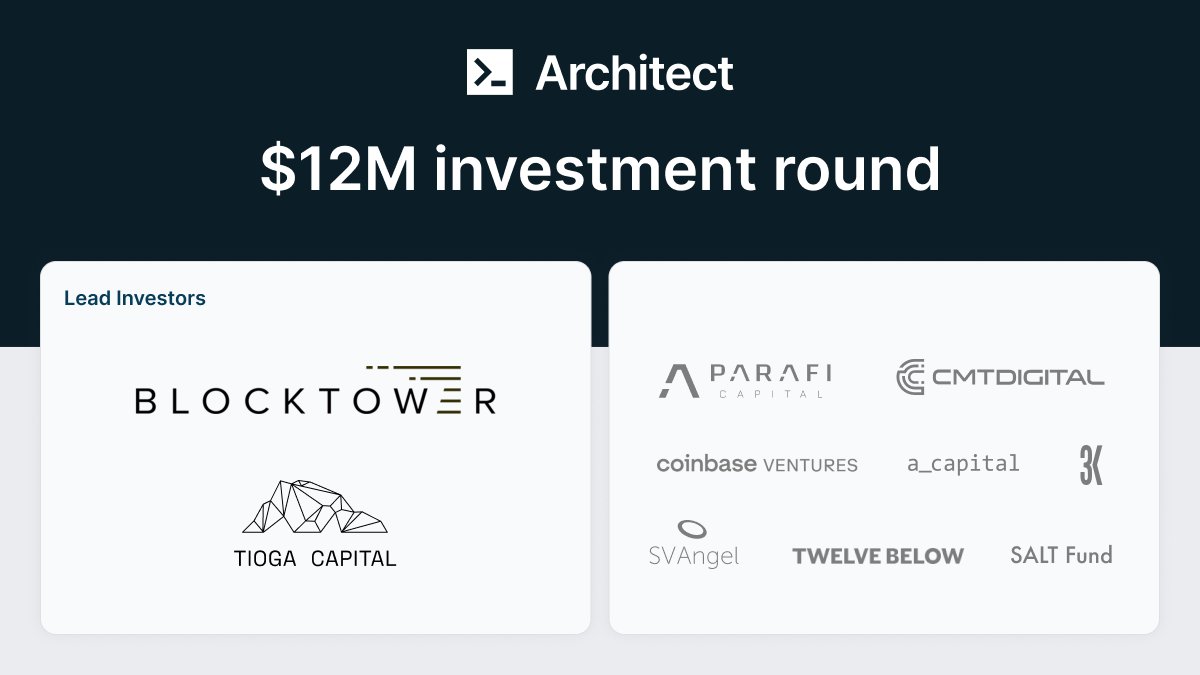
I’m thrilled to announce @Architect_xyz has completed a $12M investment round, led by @BlockTower and @TiogaCapital. We are excited to welcome new investors @CMT_Digital, @paraficapital, A Capital, and @twelve_below, and are thankful to our founding investors @cbventures, @svangel, Third Kind, SALT Fund, and US Digital Trust for their continued participation. This round brings Architect’s total capital raised to $17M since our founding in January 2023.
I am extremely proud of our team for reaching this milestone. Onward!
The new https://t.co/cnVWGolv5i website is live. My first dev+design project from scratch to production. Made in the 2 weeks since I left @Shopify. It's a @nextjs app with @shadcn@radix_ui components. I'll try to quickly summarize some of details...
CME BTC futures OI continues to spike in recent weeks, indicative of both institutional demand and funds increasingly leveraging derivatives for basis trading. Architect helps firms manage algo and discretionary execution across venues to facilitate basis trading at scale 🤝
The Architect team is excited to announce the launch of our second product of 2023: Architect Edge, a market visualization and event-monitoring platform for US-listed equities, futures, and the entire spectrum of digital asset spot/derivative products. More on the platform below!
Multi-asset order books and charts: Architect Edge normalizes market data feeds from multiple asset classes and trading venues. Asset classes include US stocks and ETFs, spot digital asset pairs from centralized and decentralized venues, expiring and perpetual digital asset futures, and digital asset options. Trading venues include @CMEGroup, @CboeDigital, @Coinbase, @Binance, @Uniswap, @OKX, @Bullish, @Bybit, @Krakenfx, @IEX, and more. With Architect Edge you can visualize order books in multiple formats and group levels by multiple ticks, as well as plot historical and real time candles from 1 day down to 1 second granularity, leveraging @TradingView’s charting functionality.
Event streams: Architect Edge allows users to create custom streams of market events to watch, navigate, and include in custom trading screens. A critical component of any semi-systematic or discretionary trading strategy is reacting to unusual market-moving events in realtime. With Architect Edge streams, you can select particular market events, narrow the universe to particular products or venues, and further filter for event size.
AMM-derived order books: Architect Edge includes real-time order books that are implied from the AMM pools on UniswapV2 and UniswapV3 across multiple EVM chains. CLOBs are generally much better-understood market mechanisms than AMMs. Order books for DEXs are an important step in making the nature of DeFi liquidity more easily understood.
For UniswapV2, the implied order book is a straightforward algebraic derivation from the bonding curve. UniswapV3 involves a substantial mathematical and computational challenge to maintain full granularity of liquidity positions from genesis block until the present. We believe Architect Edge offers the first instance of a true, realtime UniswapV3 orderbook.
Natural language search: Architect Edge leverages LLaMA2 and @anyscalecompute Endpoints to provide natural language search capabilities on top of its core data and visualization offering. Users can enter prompts such as, “how has BITO performed compared to BTC in the last week?” and receive multi-media responses with inline visualizations.
Options boards: Architect Edge provides live digital asset options boards, with symbology normalized across multiple trading venues. The platform stores and distributes option-level information including greeks, implied vols, open interest, trades, and level books.
We look forward to connecting with new customers with Architect Edge, and we welcome feedback! Sign up at https://t.co/VPLFHXimYQ!
Architect is proud to introduce Architect Edge, a comprehensive market visualization and data platform for traditional and digital assets, available now at https://t.co/WmQjNelEUG !
There's one more major player to the @MadLadsNFT gang that needs to be discussed as this person does not get nearly enough credit for the work they put into the infamous Mad Lads gang
The last major player that we'll discuss before we delve deeper into the Mad Lads history is one that doesn't get talked about nearly enough
We're talking about @trucy
See, Trucy played a vital role in building out the Mad Lads prized creation, @xNFT_Backpack
Rumor has it that Trucy even helped design some of the typical fashion trends that Mad Lads were seen wearing later in their history, for example, the black "Fock it" hoodie
Trucy has an extensive history before ending up in the Mad Lads, but textbooks mention the reason she found a home in the Mad Lads is because they were one of the few gangs to have a strong representation of women, which was unique in gang culture during this time
In the below image Trucy is seen with a construction helmet on during the building of Backpack
Stay tuned for more history on this infamous gang
Shout out to @mashyxyz for the great art ❤️