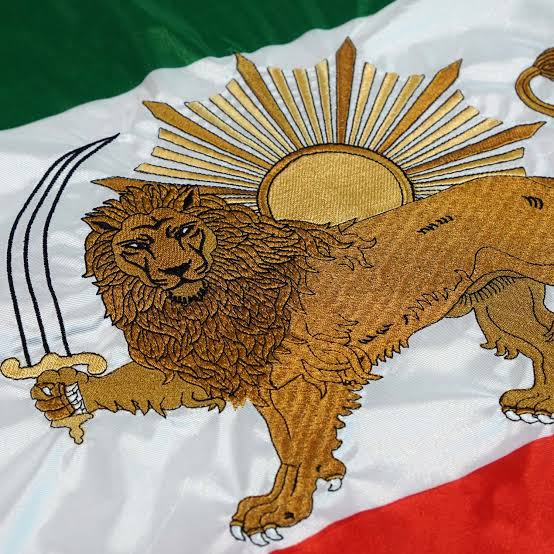
That was the emblem of the Achaemenid Empire, founded by Cyrus. The name "Iran" is absolutely correct, but unfortunately in the West in recent years it has become associated with the Islamic regime. Let me explain a few things for Westerners who may not know.
The local populations called themselves "Aryanam" in ancient times and "Iran/Eranshahr" during the Sasanian period.
"Aryanam" is the ancient version of "Iran," an old genitive plural meaning "(land) of the Aryans."
The term "Persia" is the name we Greeks used since the Achaemenid Persian Empire in the 6th century BC.
This name became established in the West through the Greeks, who generalized the name of the region Pars (today Fars) in southern Iran, the heartland of the Persian Empire. It is worth noting that the Persian language is called Parsi.
Persia was officially renamed Iran on March 21, 1935, when Reza Shah Pahlavi formally requested the international community to refer to his country by its national name, Iran.
As a Greek I will always call the nation Persia and its people Persians, out of respect and because that's how my ancestors the last 2.500 years were calling them. For us Greeks, the Greco-Persian wars and later Alexander’s campaign in Persia, which eventually led to Greco-Persian friendship, are deep-rooted emotions and memories that will never leave our souls.
Long live Greece.
Long live Persia.
Two ancient nations that shaped the world.
- Homer Pavlos
The Voyagers Will One Day Fall Silent. But Their Journey Is Only Beginning
One day the radio signals from Voyager 1 and Voyager 2 will disappear for good. The transmitters will fall silent — not because the spacecraft break, but because the energy still being produced by their plutonium generators will no longer be enough even for a faint signal. The probes themselves, however, will not stop. They will continue flying through the Milky Way for tens of thousands of years.
The last drops of power
Both Voyagers are powered by radioisotope thermoelectric generators. Each loses roughly 4 watts of power per year. After nearly 50 years in space, NASA engineers face an increasingly difficult choice: what else can be switched off so that the rest can last a little longer.
In April, Voyager 1’s low-energy charged particle instrument was turned off. In July, three systems were shut down on Voyager 2, with their functions transferred to more efficient ones. Thanks to these measures, the remaining scientific instruments (the magnetometer, plasma wave detector, and, on Voyager 2, the cosmic ray detector) should continue operating for at least another year.
The cameras have long been dead: on Voyager 1 they were switched off on February 14, 1990, after the famous series of images that included the “Pale Blue Dot.” We will never receive another photograph of Earth from them.
When true silence comes
Contact has already been lost before. In 2023 a memory chip failed on Voyager 1 and the spacecraft sent unintelligible data for months. Engineers rewrote the code into other memory areas and restored communication. In October 2026 the probe missed two scheduled sessions because of a thruster failure — a backup system took over.
From now on, any pause will be a mystery: has the power run out? Has the antenna drifted away from Earth? Or has something else broken? A signal takes almost a full day to reach Earth, so even a simple check takes days.
The eternal journey
When the transmitters fall silent, the spacecraft will not stop moving. Voyager 1 is leaving the Sun at about 61,000 km/h. It will take roughly 300 years to reach the inner edge of the Oort cloud, and about 30,000 years to cross it completely.
In roughly 40,000 years Voyager 1 will pass within 1.7 light-years of the star Gliese 445. Around the same time Voyager 2 will come within a similar distance of Ross 248. Even at the point of closest approach, each probe will still be about 16 trillion kilometers from its respective star.
A message that will outlive the silence
Each spacecraft carries a copper disc coated in gold. On it are images, music, sounds of Earth, and greetings in 55 languages. NASA even included a stylus and instructions for playback. The grooves on these records can preserve their information for thousands of years after the probes themselves have become cold, silent pieces of metal.
Two spacecraft launched in 1977 will one day fly past other stars, carrying with them the sound of Earth’s ocean waves recorded long ago. And even if no one ever finds them, they will remain humanity’s most distant emissaries.
🔴 7 MINUTES OF TERROR: HOW NASA LANDED PERSEVERANCE ON MARS!
From entering the Martian atmosphere at incredible speed to deploying a parachute and using a rocket-powered sky crane, every second mattered.
NASA had to execute a complex landing sequence autonomously, with no time for human intervention.
Seven minutes. Countless engineering challenges. One incredible achievement.
And then came the confirmation: Perseverance had landed safely on Mars. 🚀
Abu Rayhan al-Biruni (973–c. 1050 CE) was one of the greatest Iranian scholars in history. A brilliant polymath, he made extraordinary contributions to mathematics, astronomy, physics, geography, history, and comparative religion. He studied the Earth’s dimensions, developed sophisticated astronomical methods, and pioneered comparative studies of different cultures and civilisations.
All I wanted was some breakfast, but @alex_kof2 was looking way too good in that kitchen for me to keep my hands to myself 😈Let’s just say I got a litte impatient🥵
Breakfast Can Wait is out now! Come see what distracted me 👀🔥
🔗https://t.co/Z2SFlLEuPr
A Hidden Bubble Carries Our Cosmic Home Our Sun carries its planets through the Milky Way inside a protective bubble. Far away, two enormous Fermi Bubbles reveal clues to our galaxy’s turbulent past
🔹Centuries of craftsmanship come together in the intricate muqarnas of Chaharbagh School in Isfahan, Iran. Through layers of geometric forms, carved plaster, and decorative brickwork, the architecture reveals the remarkable precision and artistic knowledge of Persian artisans.
🏆 Architecture Reimagined Competition: Redefine the future of architecture with AI and compete for a share of $120,000 in prizes: https://t.co/lJHaZNliJE
Built during the Safavid era in the early 18th century, Chaharbagh School is one of Isfahan’s notable examples of Persian Islamic architecture. Its elaborate ornamentation shows how geometry, mathematics, and traditional craftsmanship shaped architectural spaces that still inspire designers centuries later.
📍 Chaharbagh School, Isfahan, Iran
🎥 Ghasem Baneshi
#Architecture #ParametricArchitecture #PersianArchitecture #Muqarnas #Isfahan
The Great Attractor — A Mystery of the Universe
The Great Attractor is one of the most mysterious regions of space. It attracts the attention of scientists from all over the world. It is a huge region of space whose gravity affects the movement of many galaxies, including our own Milky Way.
It is located approximately 150–250 million light-years from Earth, in the direction of the Norma constellation. Scientists discovered it by observing the movement of galaxies. They found out that many galaxies move in the same direction because of its powerful gravitational pull.
The Great Attractor has an enormous mass and influences the movement of thousands of galaxies. The Milky Way and nearby galaxies are also moving towards it at hundreds of kilometres per second.
Studying this region is quite difficult because it is located in the so-called Zone of Avoidance, which is hidden behind stars, gas and dust in our galaxy. That is why the Great Attractor cannot be seen with the naked eye.
Scientists believe that it is connected to the Laniakea Supercluster of galaxies, which includes our Milky Way. Despite modern technology and powerful telescopes, its structure has not yet been fully studied.
The Great Attractor helps astronomers better understand the structure of the Universe, the movement of galaxies and the effects of gravity in space. It remains one of the most interesting mysteries of astronomy, and its study may help ...
This is Hannah Arendt about whom I know little other than some minimal internet search. However, this video is amazing and illuminates what we are all be subjected to now.
Voyager 1 is about to reach a milestone: one light-day from Earth, after nearly 50 years of travel.
On November 18, 2026, it is expected to become the first human-made object to be one light-day from Earth, roughly 16.1 billion miles (25.9 billion kilometers) away. Yet the distance matters mostly because of what the spacecraft discovered along the way.
When Voyager 1 launched in 1977, its destination was the outer planets. At Jupiter, it revealed active volcanoes erupting on Io, the first ever seen beyond Earth. A moon once known only as a distant point of light turned out to be a world with a changing surface.
At Saturn, it studied the intricate rings and the thick atmosphere surrounding Titan. That encounter bent its path upward, out of the plane where most planets orbit, and sent it toward the space between the stars.
The planetary visits ended, but the journey did not.
For decades, Voyager traveled through the vast region dominated by the solar wind, the stream of charged particles that flows outward from the Sun. In 2012, its instruments detected a transition: particles from the Sun dropped off, while particles arriving from beyond the solar system increased. Plasma measurements helped confirm that Voyager had entered interstellar space.
It had crossed the heliopause, the outer boundary of the solar wind's influence, and begun sampling an environment that no spacecraft had ever reached.
That is why its journey is more than a distance record. Voyager carried instruments into places we had only studied from afar, then sent back evidence of what is actually out there.
Today, every message must travel across almost a full day of space at the speed of light, so a command and its reply take roughly two days.
The spacecraft that showed us erupting moons and Saturn's rings is still teaching us about the space beyond the Sun's protective bubble.