Peering through the thick dust clouds of the galactic bulge an international team of astronomers has revealed the unusual mix of stars in the stellar cluster known as Terzan 5. The new results indicate that Terzan 5 is in fact one of the bulge's primordial building blocks, most likely the relic of the very early days of the Milky Way.
This image is from the NASA/ESA Hubble Space Telescope.
Credit:
ESO/F. Ferraro
New observations with ESO’s Very Large Telescope show the star cluster RCW 38 in all its glory. This image was taken during testing of the HAWK-I camera with the GRAAL adaptive optics system. It shows the cluster and its surrounding clouds of brightly glowing gas in exquisite detail, with dark tendrils of dust threading through the bright core of this young gathering of stars.
Credit:
ESO/K. Muzic
Thisspectacular new image from the Wide Field Imager on the MPG/ESO 2.2-metre telescope at ESO’s La Silla Observatory in Chile reveals a celestial menagerie of different objects and phenomena in part of the Large Magellanic Cloud, a small companion galaxy to our own Milky Way. Many clusters are visible including an unusually young globular cluster and the remains of a brilliant supernovae explosion. The field of view is about one degree across.
Credit:
ESO
This picture of the star cluster and surrounding nebula NGC 371 was taken using the FORS1 instrument on ESO’s Very Large Telescope, at the Paranal Observatory in Chile. NGC 371 lies in the Small Magellanic Cloud, one of the closest galaxies to the Milky Way.
Credit:
ESO/Manu Mejias
This is an 80-million-pixel picture of the star cluster RCW 38, located 5500 light-years away in the constellation Vela. RCW 38 is a young cluster containing about 2000 stars, and is bursting with star-forming activity.
The picture was taken with ESO’s Visible and Infrared Survey Telescope for Astronomy (VISTA), operating in Chile’s Atacama Desert. It shows a mixture of gas, dust and stars, creating an extravagant, yet spectacular landscape. As VISTA observes infrared light, it is able to peer through most of the dust in this region, which would block our view when observing in visible light. Behind the dust, VISTA is showing young stars within dusty cocoons and cold ‘failed’ stars known as brown dwarfs, thus revealing the secrets within these young stellar nurseries.
Credit:
ESO/VVVX survey
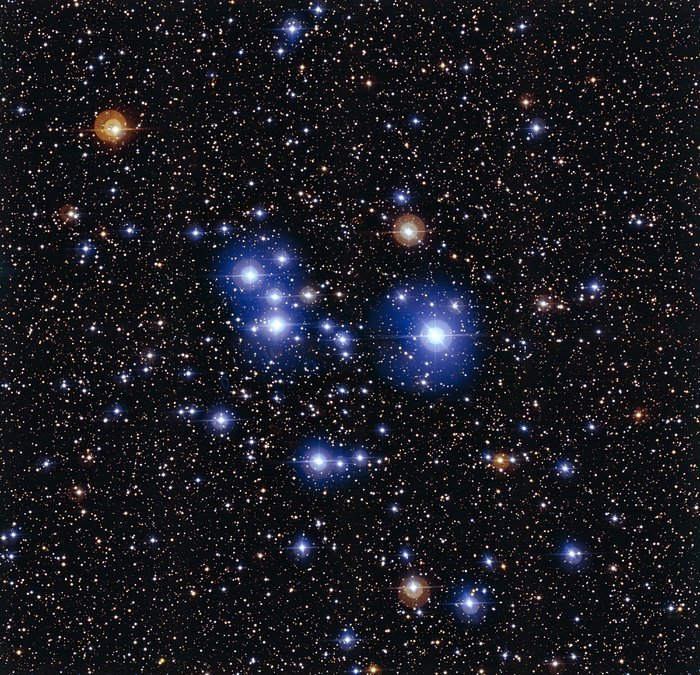
This spectacular image of the star cluster Messier 47 was taken using the Wide Field Imager camera, installed on the MPG/ESO 2.2-metre telescope at ESO’s La Silla Observatory in Chile. This young open cluster is dominated by a sprinkling of brilliant blue stars but also contains a few contrasting red giant stars.
Credit:
ESOThis spectacular image of the star cluster Messier 47 was taken using the Wide Field Imager camera, installed on the MPG/ESO 2.2-metre telescope at ESO’s La Silla Observatory in Chile. This young open cluster is dominated by a sprinkling of brilliant blue stars but also contains a few contrasting red giant stars.
Credit:
ESO
The dense star cluster RCW 38 glistens about 5,500 light years away in the direction of the constellation Vela (the Sails). RCW 38 is an "embedded" cluster, in that the nascent cloud of dust and gas still envelops its stars. There, young, titanic stars bombard fledgling suns and planets with powerful winds and large amount of light, helped in their devastating task by short-lived, massive stars that explode as supernovae. In some cases, this energetic onslaught cooks away the matter that may eventually form new planetary systems. Scientists think that our own Solar System emerged from such a dramatic environment.
This image was obtained with the Wide Field Imager instrument on the MPG/ESO 2.2-metre telescope at La Silla, using data collected through four filters (B, V, R and H-alpha). The field of view is about 10 arcminutes.
Credit:
ESO
The small smattering of bright blue stars upper left of centre in this huge 615 megapixel ESO image is the perfect cosmic laboratory in which to study the life and death of stars. Known as Messier 18 this open star cluster contains stars that formed together from the same massive cloud of gas and dust. This image was captured by the OmegaCAM camera attached to the VLT Survey Telescope (VST) located at ESO’s Paranal Observatory in Chile.
Credit:
ESO
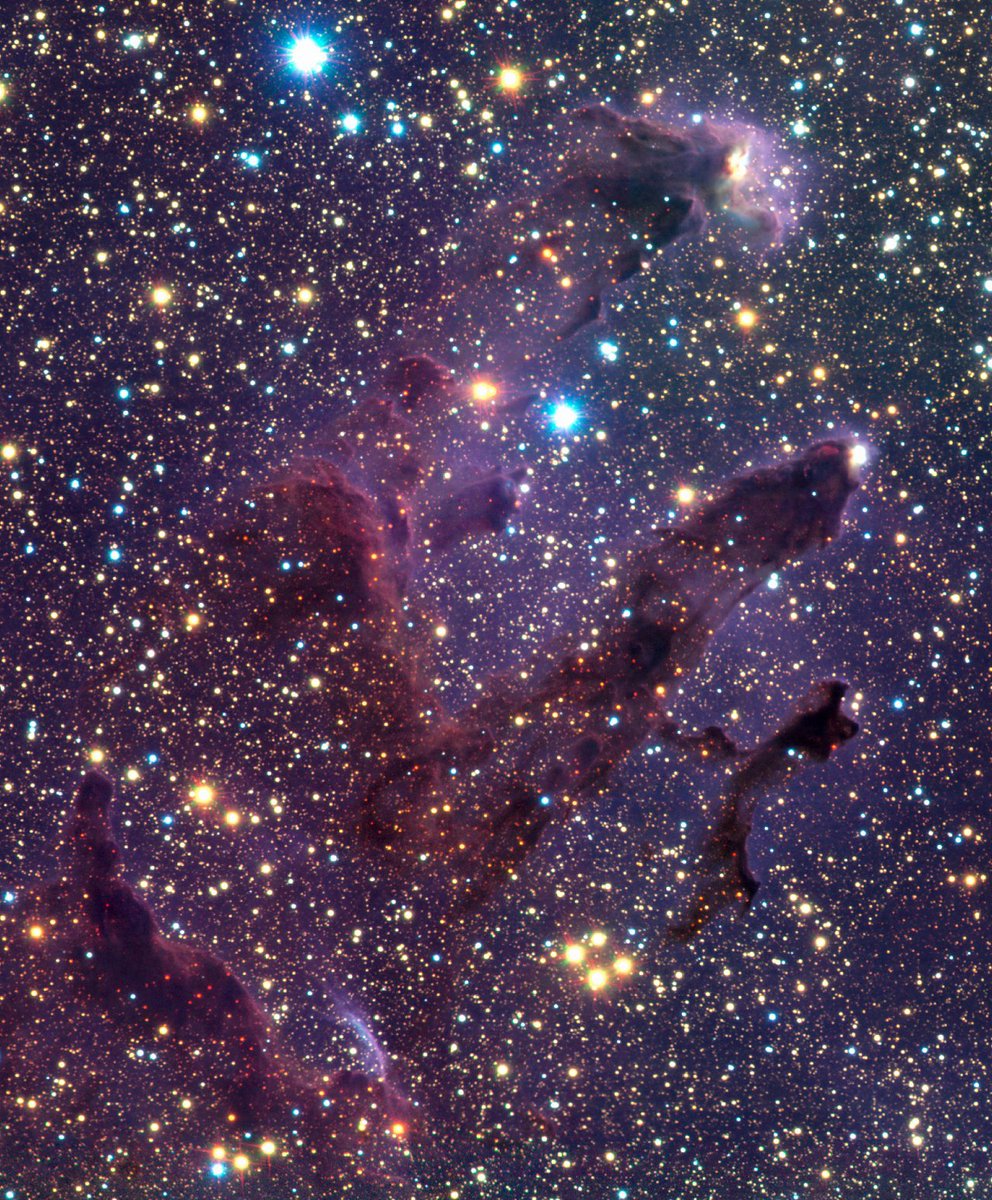
This shows a zoom into the centre of ESO Press Photo eso0142a, with the infrared view of the columns and their immediate surroundings in more detail. The pillars or columns are numbered 1 to 3 from left to right (east to west). The pillars themselves are less prominent than on the Hubble visible-light image of this region - this because near-infrared light penetrates the thinner parts of the gas and dust clouds and only the heads remain opaque. A number of red objects can be seen associated with the pillars : some of these are just background sources seen through the dust, but some are probably real young stars embedded in the pillars. The purple arc near the bottom of the picture is Herbig-Haro object 216, a fast-moving clump of heated gas emanating from a young star (see also ESO Press Photo eso0142e).
Technical information: This image shows an enlarged section of the full mosaic covering 6.2 x 7.5 light-years (1.9 x 2.3 pc) centred on the pillars. North is up and East left.
Credit:
ESO/M.McCaughrean & M.Andersen (AIP)
The MPG/ESO 2.2-metre telescope at ESO’s La Silla Observatory in Chile captured this richly colourful view of the bright star cluster NGC 3532. Some of the stars still shine with a hot bluish colour, but many of the more massive ones have become red giants and glow with a rich orange hue.
Credit:
ESO/G. Beccari
The Wide Field Imager on the MPG/ESO 2.2-metre telescope at ESO’s La Silla Observatory in Chile has captured the best image so far of the star cluster NGC 3572, a gathering of young stars, and its spectacular surroundings. This new image shows how the clouds of gas and dust around the cluster have been sculpted into whimsical bubbles, arcs and the odd features known as elephant trunks by the stellar winds flowing from the bright stars. The brightest of these cluster stars are heavier than the Sun and will end their short lives as supernova explosions.
Credit:
ESO/G. Beccari
This new image from the Wide Field Imager on the MPG/ESO 2.2-metre telescope at ESO’s La Silla Observatory in Chile, shows the bright star cluster Messier 7, also known as NGC 6475. Easily spotted by the naked eye in the direction of the tail of the constellation of Scorpius (The Scorpion), this cluster is one of the most prominent open clusters of stars in the sky and an important research target.
Credit:
ESO
NGC 3603 is a starburst region : a cosmic factory where stars form frantically from the nebula’s extended clouds of gas and dust. Located 22,000 light-years away from the Sun, it is the closest region of this kind known in our galaxy, providing astronomers with a local test bed for studying the intense star formation processes, very common in other galaxies, but hard to observe in detail because of their large distance.
The newly released image, obtained with the FORS instrument attached to one of the four 8.2-metre VLT Unit Telescopes at Cerro Paranal, Chile, is a three-colour combination of exposures acquired through visible and near-infrared (V, R, I) filters. This image portrays a wider field around the stellar cluster and reveals the rich texture of the surrounding clouds of gas and dust. The field of view is 7 arcminutes wide.
This image is available as a mounted image in the ESOshop.
Credit:
ESO
In this image from the Wide Field Imager on the MPG/ESO 2.2-metre telescope at ESO’s La Silla Observatory in Chile young stars huddle together against a backdrop of clouds of glowing gas and lanes of dust. The star cluster, known as NGC 3293, would have been just a cloud of gas and dust itself about ten million years ago, but as stars began to form it became the bright group we see here. Clusters like this are celestial laboratories that allow astronomers to learn more about how stars evolve.
Credit:
ESO/G. Beccari
This colour image of the region known as NGC 2264 — an area of sky that includes the sparkling blue baubles of the Christmas Tree star cluster and the Cone Nebula — was created from data taken through four different filters (B, V, R and H-alpha) with the Wide Field Imager at ESO's La Silla Observatory, 2400 m high in the Atacama Desert of Chile in the foothills of the Andes. The image shows a region of space about 30 light-years across.
This image is available as a mounted image in the ESOshop.
#L
Credit:
ESO
This VST image may be the best portrait of the globular star cluster Omega Centauri ever made. Omega Centauri, in the constellation of Centaurus (The Centaur), is the largest globular cluster in the sky, but the very wide field of view of VST and its powerful camera OmegaCAM can encompass even the faint outer regions of this spectacular object. This view includes about 300 000 stars. The data were processed using the VST-Tube system developed by A. Grado and collaborators at the INAF-Capodimonte Observatory.
Credit:
ESO/INAF-VST/OmegaCAM. Acknowledgement: A. Grado, L. Limatola/INAF-Capodimonte Observatory
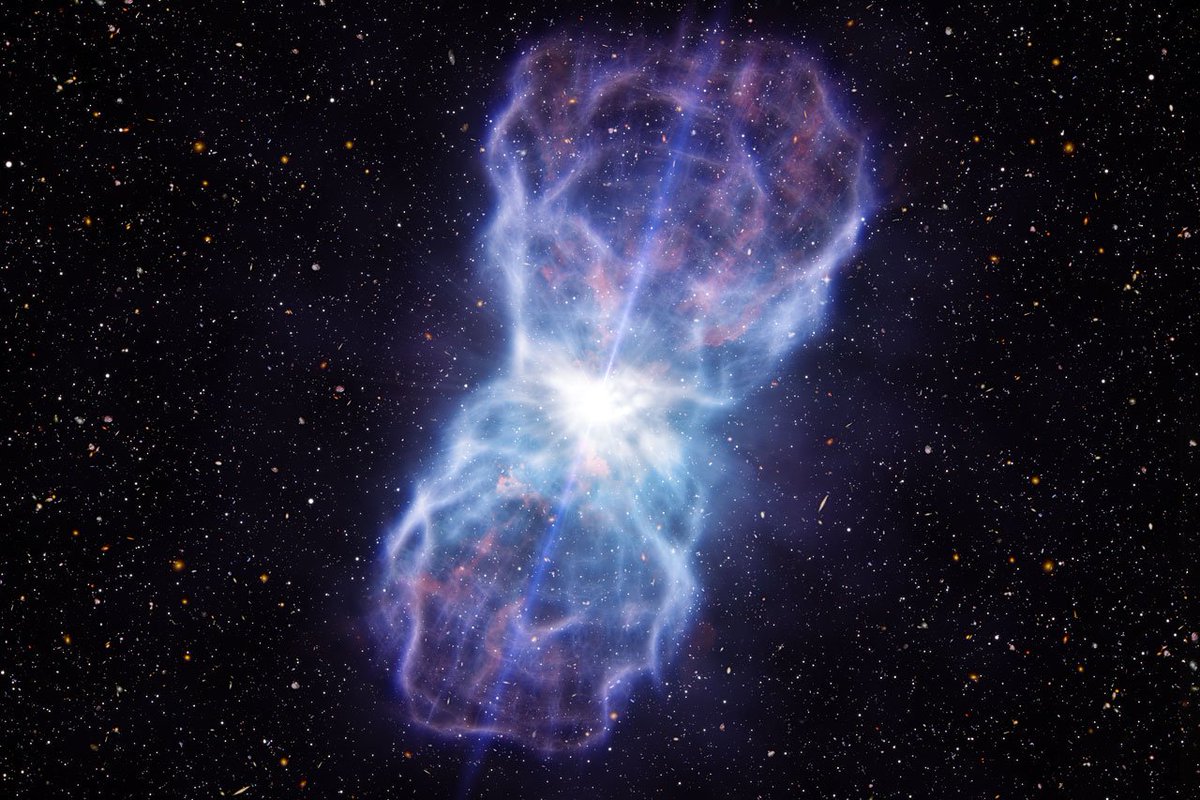
This artist’s impression shows the material ejected from the region around the supermassive black hole in the quasar SDSS J1106+1939. This object has the most energetic outflows ever seen, at least five times more powerful than any that have been observed to date. Quasars are extremely bright galactic centres powered by supermassive black holes. Many blast huge amounts of material out into their host galaxies, and these outflows play a key role in the evolution of galaxies. But, before this object was studied, the observed outflows weren’t as powerful as predicted by theorists. The very bright quasar appears at the centre of the picture and the outflow spreads about 1000 light-years out into the surrounding galaxy.
Credit:
ESO/L. Calçada
This is a three-colour image of about 1/4 of the Capodimonte Deep Field (OACDF) obtained with the Wide-Field Imager (WFI) on the MPG/ESO 2.2-m telescope at the la Silla Observatory. It covers "OACDF Subfield no. 2 (OACDF2)" with an area of about 35 x 32 arcmin 2 (about the size of the full moon), and it is one of the "deepest" wide-field images ever obtained. It has been obtained by the combination of the B, V, and R stacked images of the OACDF2 field. The total exposure times in the three bands are 2 hours in B and V (12 ditherings of 10 min each were stacked to produce the B and V images) and 3 hours in R (13 ditherings of 15 min each). The mosaic images in the B and V bands were aligned relative to the R-band image and adjusted to a logarithmic intensity scale prior to the combination. The typical seeing was of the order of 1 arcsec in each of the three bands. Preliminary estimates of the three-sigma limiting magnitudes in B, V and R indicate 25.5, 25.0 and 25.0, respectively. More than 35,000 objects are detected above the three-sigma level.
Technical information : this image has been obtained by the combination of the B, V, and R stacked images of the OACDF2 field. The total exposure times in the three bands are 2 hours in B and V (12 ditherings of 10 min each were stacked to produce the B and V images) and 3 hours in R (13 ditherings of 15 min each). The mosaic images in the B and V bands were aligned relative to the R-band image and adjusted to a logarithmic intensity scale prior to the combination. The typical seeing was of the order of 1 arcsec in each of the three bands. Preliminary estimates of the three-sigma limiting magnitudes in B, V and R indicate 25.5, 25.0 and 25.0, respectively. More than 35,000 objects are detected above the three-sigma level. North is up and East is left.
Credit:
ESO
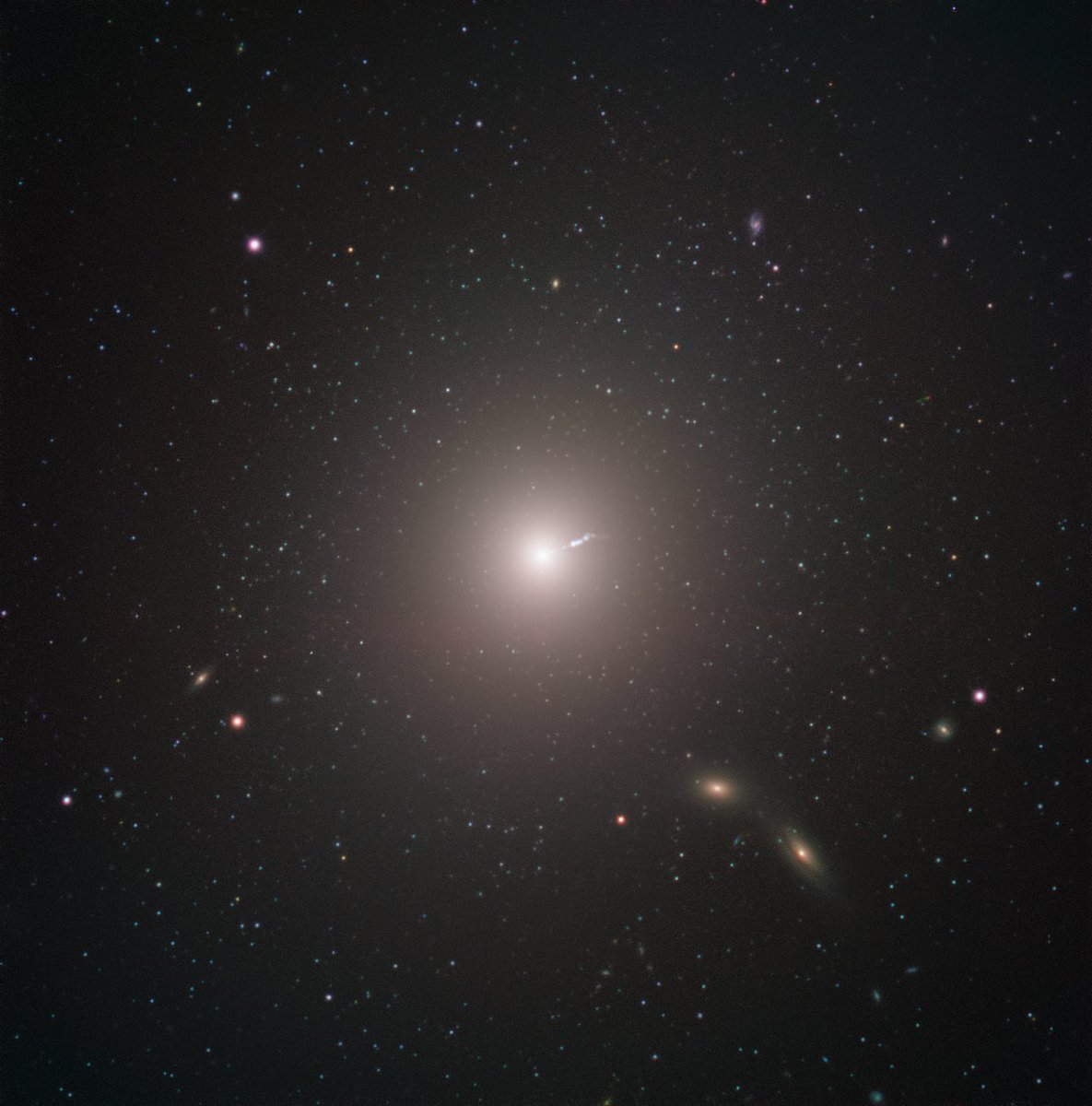
Messier 87 (M87) is an enormous elliptical galaxy located about 55 million light years from Earth, visible in the constellation Virgo. It was discovered by Charles Messier in 1781, but not identified as a galaxy until 20th Century. At double the mass of our own galaxy, the Milky Way, and containing as many as ten times more stars, it is amongst the largest galaxies in the local universe. Besides its raw size, M87 has some very unique characteristics. For example, it contains an unusually high number of globular clusters: while our Milky Way contains under 200, M87 has about 12,000, which some scientists theorise it collected from its smaller neighbours.
Just as with all other large galaxies, M87 has a supermassive black hole at its centre. The mass of the black hole at the centre of a galaxy is related to the mass of the galaxy overall, so it shouldn’t be surprising that M87’s black hole is one of the most massive known. The black hole also may explain one of the galaxy’s most energetic features: a relativistic jet of matter being ejected at nearly the speed of light.
The black hole was the object of paradigm-shifting observations by the Event Horizon Telescope. The EHT chose the object as the target of its observations for two reasons. While the EHT’s resolution is incredible, even it has its limits. As more massive black holes are also larger in diameter, M87's central black hole presented an unusually large target—meaning that it could be imaged more easily than smaller black holes closer by. The other reason for choosing it, however, was decidedly more Earthly. M87 appears fairly close to the celestial equator when viewed from our planet, making it visible in most of the Northern and Southern Hemispheres. This maximised the number of telescopes in the EHT that could observe it, increasing the resolution of the final image.
This image was captured by FORS2 on ESO’s Very Large Telescope as part of the Cosmic Gems programme, an outreach initiative that uses ESO telescopes to produce images of interesting, intriguing or visually attractive objects for the purposes of education and public outreach. The programme makes use of telescope time that cannot be used for science observations, and produces breathtaking images of some of the most striking objects in the night sky. In case the data collected could be useful for future scientific purposes, these observations are saved and made available to astronomers through the ESO Science Archive.
Credit:
ESO
This artist’s impression shows the record-breaking quasar J059-4351, the bright core of a distant galaxy that is powered by a supermassive black hole. Using ESO’s Very Large Telescope (VLT) in Chile, this quasar has been found to be the most luminous object known in the Universe to date. The supermassive black hole, seen here pulling in surrounding matter, has a mass 17 billion times that of the Sun and is growing in mass by the equivalent of another Sun per day, making it the fastest-growing black hole ever known.
Credit:
ESO/M. Kornmesser