In 1958, a divorced single mom got fired from her secretary job for being a bad typist.
21 years later, she sold her side hustle for $47.5 million.
And her teenage helper would go on to help invent MTV.
Her name was Bette Nesmith Graham.
Before she became a millionaire inventor, she was a struggling single mother in Dallas with no college degree and very few options.
She married young during WWII.
By 22, she was divorced, raising a son alone, and trying to survive on secretary jobs.
She eventually became an executive secretary at Texas Bank & Trust.
There was just one problem:
She was a terrible typist.
The bank had recently installed new IBM electric typewriters that made correcting mistakes almost impossible.
One typo could mean retyping an entire page.
Her son later remembered watching her sit at the kitchen table in “tears of panic,” terrified she’d lose her job.
But Bette had another skill.
She painted holiday window displays at the bank for extra money.
One day, while painting over a mistake on a window, she had a realization:
“An artist never erases mistakes. They paint over them.”
That night, she went home and mixed a white liquid in her kitchen blender using tempera paint.
She poured it into a nail polish bottle.
The next morning, she used it to cover typing errors.
It worked.
For five years, her boss never noticed.
Other secretaries did.
Soon, women from offices across the city were asking for bottles.
Bette started making batches at home with help from her teenage son, Michael, and his friends.
She called the product “Mistake Out.”
Then came the twist.
In 1958, she accidentally typed the name of her side business onto a company letter.
Her boss fired her immediately.
It became the best thing that ever happened to her.
She renamed the product Liquid Paper and focused on it full-time.
Orders exploded.
By the late 1960s, she was selling over a million bottles a year.
By the 1970s, 25 million bottles annually.
Then she did something even more unusual:
She built one of the most progressive workplaces in America.
Her company offered:
• child care
• continuing education
• leadership roles for women
• jobs for disabled workers
• integrated staffing
This was decades before most corporations even considered those ideas.
In 1979, with failing health, Bette sold Liquid Paper to Gillette for $47.5 million.
Six months later, she died at age 56.
Half her fortune went to women-focused charities.
The other half went to her son.
That son was Michael Nesmith.
Yes the same Michael Nesmith from The Monkees.
And with the money from Liquid Paper royalties, he funded a small experimental cable TV project called PopClips.
It featured short films set to music.
PopClips became the direct prototype for MTV.
So one woman’s “typing mistake” helped create:
• a multimillion-dollar company
• one of America’s most progressive workplaces
• and the blueprint for the modern music video era
Bette Graham proved something her old boss never understood:
The mistake wasn’t the failure.
It was the opportunity.
Dave’s Killer Bread became extremely popular, it’s America’s Number 1 organic bread brand and is now a billion dollar brand
It’s so popular because it was healthy, unfortunately the ingredients have drastically changed after being bought out by the parent company of Nature’s Own
Early versions of their bread were much simpler and some only had about 10 ingredients
That’s all changed after the acquisition
Newer versions of the bread now contain 25+ ingredients with some having 30+ ingredients
The ingredients were added for large-scale commercial production, consistency, shelf life and texture
Fans of the bread have reported taste and texture changes saying its drier and denser
Every food brand is eventually destroyed by a monopoly buying them up
It’s the illusion of choice in America
Breaking: Your smart TV takes a screenshot of your screen twice every second and sells what it sees.
It is called ACR, and it has been running since you set the TV up.
Texas already sued over it. Here is how to turn it off in under 2 minutes:
He was told they couldn't find his diploma until his sister, whom he hadn't seen in over a year because she was on military duty, walked out carrying it.
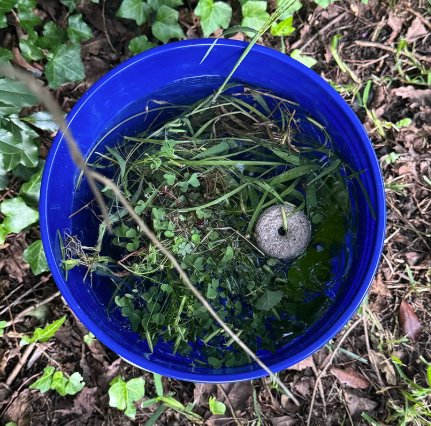
You can crash your yard's mosquito population without spraying a single chemical with a Mosquito Bucket of Doom.
Fill a 5-gallon bucket about two-thirds with water. Drop in a handful of grass clippings, leaves, or hay. Let it sit for a day, then drop in a Bti dunk (also called Bacillus thuringiensis israelensis, sold at any hardware store as "mosquito dunks," about $10 for six).
Mosquitoes are powerfully attracted to fermenting water and will lay their eggs in your bucket. Bti is a naturally occurring soil bacterium that produces a toxin that kills mosquito, blackfly, and fungus gnat larvae only.
This method doesn't harm bees, butterflies, fireflies, fish, frogs, birds, pets, or people. BTI dunks are EPA-approved for organic use and safe in animal water troughs and birdbaths.
One dunk lasts about 30 days. Top off the water as it evaporates. Cover with 1/2-in Mesh Hardware Cloth to prevent animals from getting trapped and put the bucket somewhere shady where pets and kids won't get into it.
The bucket becomes a mosquito magnet and a dead end. Compare that to fogging the entire yard with pyrethroids, which kills every insect in it, including the predators that eat mosquitoes.
Doug Tallamy's Homegrown National Park has been running the "Mosquito Bucket Challenge" since 2021. The more buckets in a neighborhood, the bigger the dent. One bucket per yard is a great start.
With everything we are hearing right now about ticks this seems like good information to share.
“Here’s what I’ve learned after more ticks than I care to count.
First, whatever your uncle told you, forget it. No matches. No nail polish. No Vaseline. No soap on a cotton ball. All of those do the same terrible thing, they stress the tick out, and a stressed tick empties its gut back into the bite before letting go. Which, if you think about what that actually means for a second, is literally how Lyme and the rest get transmitted so you’re not speeding up its exit. You’re making it throw up into you.
Fine-tipped tweezers. Grip right where the mouthparts enter the skin, not the body, the head. Pull straight up, steady, no twisting, no jerking. It’ll feel like it’s resisting because it is, the mouthparts are barbed. Just keep the pressure on and it lets go in a few seconds. If a piece breaks off in the skin, leave it alone. Your body pushes splinters out. Digging around with a needle does more damage then the fragment ever would.
Clean it with alcohol or soap. Wash your hands.
Now here’s the part most people skip: don’t flush the tick.
Tape it to an index card. Clear packing tape right over the body, write the date and where on your body it was, and stick the card in a drawer. If you come down with anything weird in the next 30 days, rash, fever, joint pain, that flu-that-isn’t-flu feeling, that tick goes with you to the doctor. Some labs will test the tick itself, which is faster and often more reliable than waiting for antibodies to show up in your own blood. A dated tick taped to a card is one of the most useful things you can hand a doctor who’s trying to figure out what’s wrong with you.
The other thing worth saying out loud: if the tick was engorged when you pulled it, and you can’t swear it was off your body within 24 hours, call your doctor that same day. Don’t wait for a rash. Fewer than three out of four Lyme cases even produce the classic bullseye. A single preventive dose of doxycycline within 72 hours of a deer tick bite cuts the Lyme odds way down, and most docs in tick country will write that prescription without giving you a hard time, especially if you walk in with the tick taped to a card and a clear timeline.”
CEOs are quietly realizing the AI replacement plan has a problem.
Two problems, actually.
One: the token costs for running AI agents are now exceeding what they were paying the employees they fired.
Two: when the tokens run out, the AI stops. Just stops. No continuity. No workaround. Just a spinning wheel where your workforce used to be.
You fired humans to save money and bought a subscription that bills you into a corner.
The employees you let go knew what to do when things broke.
The AI just invoices you for the outage.
And then there’s the permission problem nobody wants to talk about.
To do its job, the AI agent needs access. Full access. Your systems, your patents, your contracts, your future plans. Everything you spent years building, handed over to a process that has no loyalty, no discretion, and no skin in the game.
You didn’t hire a replacement.
You gave a stranger with no soul the keys to everything you own.
Enjoy.
Let me trace the timeline here because nobody's connecting it.
Step 1: Scrape the entire internet. Every book, every article, every conversation, every piece of art, every forum post. Do it without asking. Do it without paying.
Step 2: Train a model on all of it. Call it "artificial intelligence."
Step 3: Go to BlackRock's Infrastructure Summit and announce: "We see a future where intelligence is a utility, like electricity or water, and people buy it from us on a meter."
Step 3 is where you sell people's own knowledge back to them. On a meter.
They took the collective output of human thought, compressed it into a model, and now they want to charge you by the token to access a version of what you and everyone you know already created.
One Reddit user put it perfectly: "They stole all this data from us, the people, our life's work, creativity, art, by devouring the internet and blowing through all copyright laws. Now they want to sell it back to us in the form of a utility."
Imagine if someone photocopied every book in the public library, burned the library down, and then opened a subscription service for the copies.
That's the metered intelligence business model.
And they're pitching it to infrastructure investors as though they invented water.
BAR OWNER: “You’re OK at making drinks, but are you good at changing the channel on a TV?”
BARTENDER INTERVIEWEE: “I am the literal worst channel changer of all time.”
BAR OWNER: “You start tomorrow.”
37 years ago, the world lost Gilda Radner
I often think of the sketch.
Hours after she died, Steve Martin hosted SNL and scrapped his monologue. With tears in his eyes, and a joke, the show paid tribute to her with their classic: Dancing in the Dark.
I heard doordash was stealing tips from their drivers so out of curiosity, I asked the woman who dropped off my tacos how much it's showing that I tipped her; she said $5. I showed her my phone where I tipped $20 (bc the taco place was busy and she waited for my order). 😐
Hundreds of people show up for the funeral of a World War II veteran with no family in Massachusetts.
WWII Veteran John Bernard Arnold III, a 98-year-old living in East Bridgewater, was only 6 when his mother died. His father passed away when Arnold was in his 20s.
Arnold never married and never had kids.
The veteran planned his own funeral about 10 years ago, wanting people to know about his deep faith and his love for the United States.
By the time of his death, Arnold had no remaining blood family, but started a "new family" with his friends at the Garrison Veterans Home.
"He walked into the room and he lit up the room. No matter what you are going through, he always knew how to bring a smile, make you laugh," said caretaker, Hailey Munroe.
When information about his funeral was posted online, hundreds of people in the community decided to show up and honor his life.
"Nobody should have to go alone, I don’t care who you are," one attendee said.
Rest in peace, John.
@unlimited_ls@SDSLLC_USA All these people had to do is press the RED button on the escalator that says emergency stop.
And he would have been with kids family…
Shame
Kiley has Williams Syndrome, a genetic disorder causing developmental delays: she struggles to make friends.
This is the precious moment when two friends she met at camp drove 3 hours to surprise her on her 15th birthday.
[📹 ashleyy_crisp]
Every Honeycrisp apple is a clone of a single tree planted at the University of Minnesota in 1962. Every one. Apple seeds are random. Plant a Honeycrisp seed and the new tree produces a small, sour apple that’s usually inedible.
So apple growers do something old and clever. They cut a small branch off the original Honeycrisp tree, slot it into a slit in a young apple sapling, wrap the joint, and wait. The branch fuses to its new host and starts producing Honeycrisps. About 20 million Honeycrisp trees exist worldwide, every one a piece of that 1962 tree on different roots.
Same goes for Gala, Fuji, Pink Lady, Granny Smith. Every Granny Smith on Earth traces back to a seedling found in 1868 by a woman named Maria Ann Smith in Australia. She’d thrown French crab apple cores onto her compost heap, one of them sprouted, and the apples it bore were unusually tart and good for cooking. That one tree is the ancestor of every Granny Smith in every grocery store on the planet.
Wine has the bigger story. In the 1860s, a tiny aphid called phylloxera caught a boat from America to France, hidden in some grapevine cuttings. It eats grape roots. French vines had no defense and started dying everywhere. Within 15 years, French wine production crashed from about 11 billion bottles a year to 3 billion. The blight then tore through Italy, Spain, and Germany, and European wine was on the edge of collapse.
The rescue came from Missouri and Texas. American grapevines had grown up with phylloxera and were immune to it. So growers chopped French grape varieties off at the trunk and joined them to American roots. Above the soil: still French grapes. Below the soil: aphid-proof American root. It worked. Today, almost every bottle of French, Italian, Spanish, Australian, and Californian wine you’ve ever drunk sits on top of an American root.
The technique is ancient. Chinese farmers were grafting trees by 1000 BCE. A Greek medical text from 424 BCE describes it casually, like it was already old news. It works because plants don’t have a rejection system the way animals do. Cut two branches. Match the green layers just under the bark. Wrap them tight. In a few weeks the plumbing has fused into a single plant.
A Syracuse University art professor named Sam Van Aken has spent 18 years building a single tree that grows 40 different fruits: peaches, plums, apricots, cherries, nectarines, almonds. In spring it blossoms in pink, white, and crimson all at once. He’s made more than a dozen. They sell for up to $30,000 each.
Without grafting, there would be no commercial apple industry, no global wine industry, and most of the heirloom fruits humans have bred over the centuries would have gone extinct. One clean cut, and you’ve kept entire species alive.