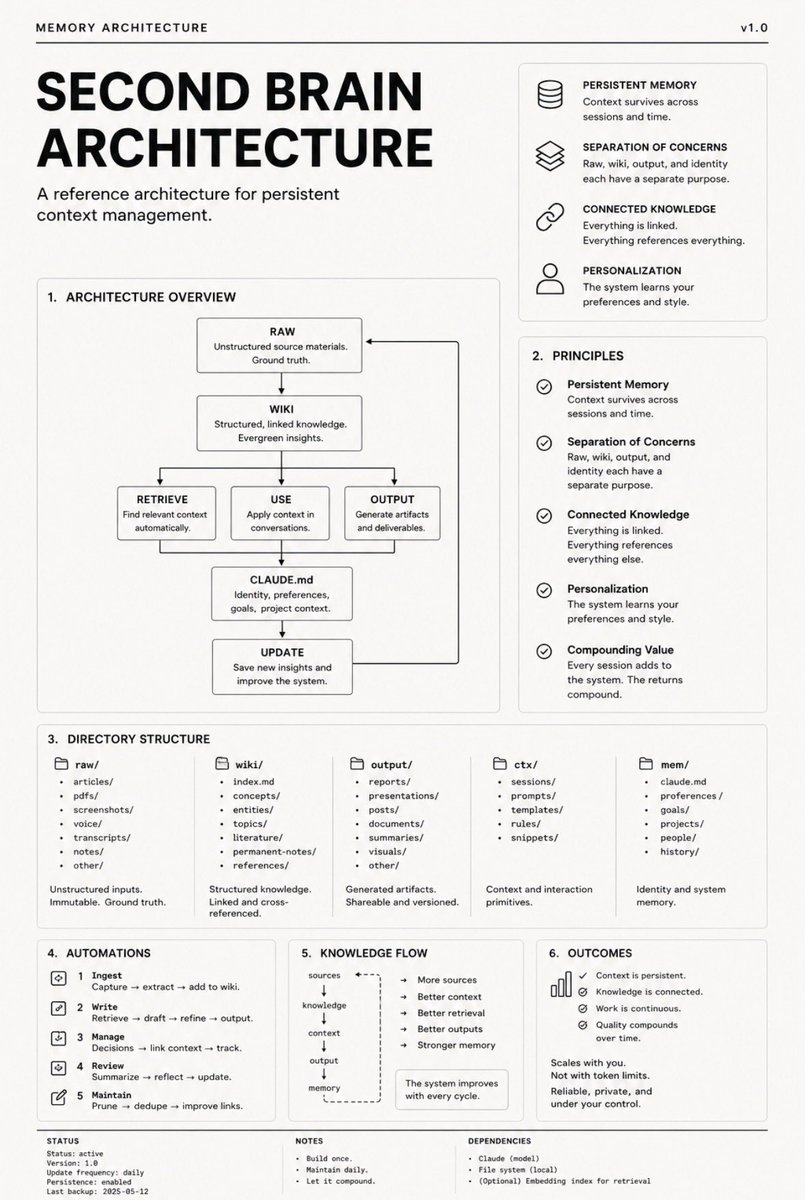
Andrej Karpathy called it a compiler, not a storage system. this diagram shows the architecture he described.
most people who build a second brain treat it like a filing cabinet. they drop notes in. they search when needed. the library gets bigger over time but never smarter.
a compiled wiki works differently. raw holds the source materials. unstructured. immutable. ground truth. wiki is where the model converts everything in raw into structured, linked, evergreen knowledge. the human reads it. the model writes it. output is where finished work lands. built from compiled knowledge, not from memory.
at the center: CLAUDE.md. identity, preferences, goals, project context. the model reads it before every session. automatically. you never explain yourself again.
the loop closes through update. every new source gets ingested, compiled, linked, and integrated. the system improves with every cycle.
five automations run the whole thing. ingest captures and extracts. write retrieves and drafts. manage links decisions to context. review summarizes and reflects. maintain prunes and improves.
the system improves with every cycle. automatically. retrieval answers questions. compilation builds understanding.
the article above. build the compiler. not the cabinet.
Scientists have identified a reversal of the long-standing Flynn effect—the roughly 200-year trend of rising average intelligence (measured via IQ and cognitive tests) across generations.
For the first time in modern recorded history, Generation Z (born roughly 1997–2012) shows lower performance than previous generations in key cognitive domains, including attention, memory, literacy, numeracy, executive function, problem-solving, and general IQ—despite spending more years in formal education than ever before.
Neuroscientist and educator Dr. Jared Cooney Horvath, PhD, MEd, testified before the U.S. Senate Committee on Commerce, Science, and Transportation on January 15, 2026, highlighting this shift. In his written testimony, he stated that cognitive development in children across much of the developed world has stalled or reversed over the past two decades, with declines evident in international assessments (e.g., PISA, TIMSS) and other large-scale data starting around the mid-2000s and accelerating post-2010.
Horvath attributes the primary driver not to reduced schooling, but to the widespread integration of digital screens and educational technology (EdTech) in classrooms. He argues that human brains evolved for deep, focused learning through face-to-face interaction and sustained attention, not fragmented skimming or constant task-switching encouraged by devices.
Key points from his testimony include:
- Teens now spend over half their waking hours on screens, with significant portions in school involving computers or tablets—often leading to off-task behavior and shallower processing.
- Evidence from meta-analyses and national/international studies shows a consistent pattern: higher classroom screen exposure correlates with weaker outcomes in reading, math, science, and higher-order reasoning.
- Digital tools may aid narrow, repetitive skill practice in controlled settings, but in core academic contexts, they tend to reduce depth of understanding, retention, and critical thinking.
Horvath describes this as a "structural mismatch" between human cognition and how digital platforms are designed (to capture and fragment attention), warning that unchecked EdTech adoption risks long-term harm to workforce skills, innovation, and societal reasoning.
[Horvath, J. C. (2026). Written testimony before the U.S. Senate Committee on Commerce, Science, and Transportation. U.S. Senate]
Great episode from @AnastasiInTech , one 3D chips made up of 2D Crystal materials- overcoming Quantum effects at 1,000x less energy. Honestly brilliant hostess peering into the future of tech & AI. Thanks! https://t.co/QFZg0QS4HQ
@mdancho84 This work? Claude’s (CoT) pattern for symbolic planning (like PDDL or complex logic),1. Leverage Extended Thinking Native ControlsIf you are using Claude for complex planning, enable Claude's Extended Thinking mode (via API) so it generates sequential, deep logical steps to…
The U.S. Department of Energy instructed AI data centers to stop using electricity from the main power grid.
As temperatures exceeded 100 degrees Fahrenheit across much of the eastern United States Energy Secretary Chris Wright ordered data centers and other major electricity consumers on the PJM grid to switch to backup generators. The purpose was to conserve power so that homes could continue running air conditioners during one of the hottest periods of the year.
The PJM grid serves 13 states and includes northern Virginia which hosts the largest cluster of data centers in the world. These centers support AI systems cloud computing streaming services and much of the internet but they require massive amounts of electricity.
Officials explained that backup generators would ease strain on the grid and help avoid blackouts while millions of air conditioners operated at peak levels.
This action illustrates how the rapid growth of AI infrastructure is starting to compete with regular household electricity needs during extreme heat waves.
There are drawbacks to the solution. Most backup generators burn diesel or natural gas which creates more local air pollution than power from large plants. The region also has limited battery storage compared to states like California and Texas making it challenging to handle demand surges with cleaner sources.
As AI data centers expand across the country experts predict that extreme heat events will increasingly challenge the ability of the power grid to meet both technological and everyday needs.
We’ve received notice that the Department of Commerce has lifted export controls on Claude Fable 5 and Mythos 5.
We'll begin restoring access tomorrow, and will share an update soon.
We’re grateful to our users for their patience, and to everyone who worked with us on redeploying the models.
BREAKING: The Trump Administration has struck a deal with Anthropic which grants the company permission to release its Mythos 5 model to a group of ~100 companies and federal agencies, per CNBC.
Details include:
1. Senior Anthropic staffers flew to Washington DC to meet with members of the Trump Administration
2. Anthropic said earlier this month that it disabled access to its Fable 5 and Mythos 5 models to comply with an export control directive from the government
3. The Trump Administration and Anthropic have been in a two-week-long standoff over its latest models
This deal will have industry-wide implications.
Since June 12, we’ve been working closely with the US government to restore access to Claude Mythos 5 and Fable 5. Today, the government notified us that Mythos 5, our strongest cybersecurity model, can be redeployed to a set of US organizations that operate and defend critical infrastructure.
We’re restoring access for these organizations quickly, and we’re continuing to work with the government to expand access to Mythos 5 and make Fable 5 available for general use again.
Nvidia director Mark Stevens and his wife are donating $175 million to help build the first new medical school in the San Francisco Bay Area in more than a century. https://t.co/Imzxrhxmft
Natural adaptive LLM that has a contextual and predictive memory is the future. Curious to see if this delivers- from the founder of Figure (the humanoid robot company)
Introducing Hark, an AI lab building the most advanced, personal intelligence in the world.
We're creating intelligent foundation models paired with next generation hardware designed to serve as a universal interface between humans and machines.
https://t.co/rlDCy5crWZ
Iran War heats up again between Trump & Iranian leadership. After US WTI spikes higher than Brent Crude Oil prices. A proper resolution to this s important engagement is essential for the US and the World.






![Rainmaker1973's tweet photo. Scientists have identified a reversal of the long-standing Flynn effect—the roughly 200-year trend of rising average intelligence (measured via IQ and cognitive tests) across generations.
For the first time in modern recorded history, Generation Z (born roughly 1997–2012) shows lower performance than previous generations in key cognitive domains, including attention, memory, literacy, numeracy, executive function, problem-solving, and general IQ—despite spending more years in formal education than ever before.
Neuroscientist and educator Dr. Jared Cooney Horvath, PhD, MEd, testified before the U.S. Senate Committee on Commerce, Science, and Transportation on January 15, 2026, highlighting this shift. In his written testimony, he stated that cognitive development in children across much of the developed world has stalled or reversed over the past two decades, with declines evident in international assessments (e.g., PISA, TIMSS) and other large-scale data starting around the mid-2000s and accelerating post-2010.
Horvath attributes the primary driver not to reduced schooling, but to the widespread integration of digital screens and educational technology (EdTech) in classrooms. He argues that human brains evolved for deep, focused learning through face-to-face interaction and sustained attention, not fragmented skimming or constant task-switching encouraged by devices.
Key points from his testimony include:
- Teens now spend over half their waking hours on screens, with significant portions in school involving computers or tablets—often leading to off-task behavior and shallower processing.
- Evidence from meta-analyses and national/international studies shows a consistent pattern: higher classroom screen exposure correlates with weaker outcomes in reading, math, science, and higher-order reasoning.
- Digital tools may aid narrow, repetitive skill practice in controlled settings, but in core academic contexts, they tend to reduce depth of understanding, retention, and critical thinking.
Horvath describes this as a "structural mismatch" between human cognition and how digital platforms are designed (to capture and fragment attention), warning that unchecked EdTech adoption risks long-term harm to workforce skills, innovation, and societal reasoning.
[Horvath, J. C. (2026). Written testimony before the U.S. Senate Committee on Commerce, Science, and Transportation. U.S. Senate]](https://pbs.twimg.com/media/HQPTai2W8AAF0bS.jpg)


