Last year I read Chasing Gold, the story of Nazi theft and other European countries movement of gold to the U.S. for safe-keeping. Eighty-some years later, gold is moving the other direction.
My great-grandparents arrived from Germany with nothing. They saved in gold-backed money and left children with farmland. After 1971, that model broke. The dollar lost 85% of its value. Farmland went 27x — not because it got better, but because the money got worse.
Can Bitcoin restore it?
🔗 https://t.co/vN5PJ9h71e
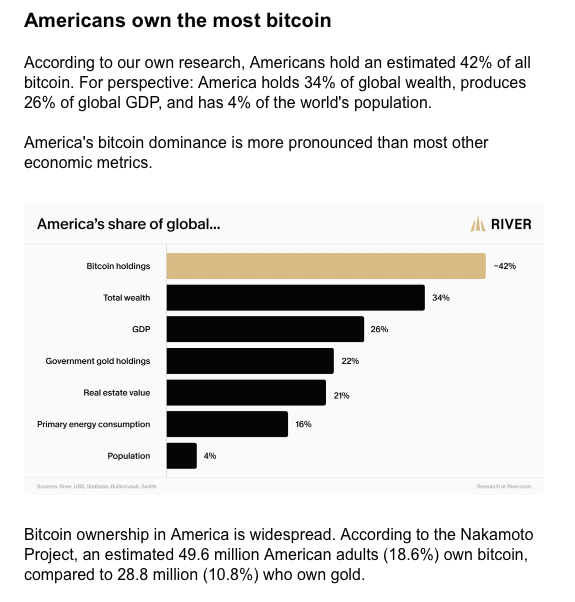
49.6 million Americans own bitcoin. 28.8 million own gold. How many of them work in agriculture? We're working to grow the number at BitCorn. https://t.co/m3cHZ1OjbL Thanks @River!
The implication: Bitcoin's purchasing power against the physical economy grows as a function of its age raised to ~the fifth power.
It doesn't matter if you measure in bushels, barrels, pounds, or ounces.
The power law is in Bitcoin. The opportunity is in recognizing it.
Full piece: 🔗 https://t.co/6TgdrGgpdU
New piece: The Commodity-Bitcoin Convergence
I ran another Power Law analysis on soybeans, wheat, crude oil, and copper after having done corn. More limited dataset, but...
Result: all five exponents cluster between 4.73 and 5.12. Add Perrenod's gold at 5.22.
Mean across all six: 5.04. Standard deviation: 0.15.
🧵👇
After the Corn-Bitcoin piece, @1blue3brown shared results from his Bitcoin Power Law Lens — copper (5.58), oil (5.83), iron (5.79), aluminum (5.59), US housing (5.23).
Different data. Different methods. Same convergence.
Three independent analyses. One structural finding.
Thinking about my own father on this Father's Day. I first worked for him when I was 5 years old (1972!), helping with gravity irrigation work on his farms in south central Nebraska. My "pay" at the end of most afternoons was a 10 ounce bottle of Coca-Cola and bag of Beer Nuts from a gas station, which I thought was good wages. I researched the price and it was probably 15 cents for the Coke and 10 cents for the Beer Nuts.
Coca-Cola famously stayed 5 cents/bottle from 1886 to 1959. But inflation took its toll eventually as the U.S. slipped away from gold-backed dollars. In 1953, Coca-Cola asked the U.S. Treasury to create a 7.5 cent coin because they wanted to raise prices without disrupting vending machines. The Treasury said no.
Last year, the Treasury retired the one cent penny. How long the 5 cent nickel? When will 5 sats buy a Coke?
I applied Stephen Perrenod's Bitcoin/Gold power law methodology to corn. The result: the Corn-Bitcoin ratio follows a power law in a manner very similar to gold. Bitcoin isn't just outperforming gold at a predictable rate. It's outperforming commodities generally at a predictable rate. Built on the foundational power law work of @Giovann35084111 .
Full analysis 👇
https://t.co/poyqJJhEYe
I called a 22-year-old ISU grad Monday night to wish him luck in his first political primary. He was still door-knocking at 7 pm. He got 71% of the vote the next day.
Entrepreneurs don't just build businesses. They build community.
New Article: https://t.co/FZcru54EG9
@JimPethokoukis@apolloglobal This is so interesting. It's more than AI. If more than 50% of people, more or less, hate their jobs, than AI is another tool to create your own job. Just. Do. It.
Gold fell 10% during an actual war. Copper hit record highs.
One of these tells you more about where corn is headed. New Deep Dive: https://t.co/7RNS1tab7Y