Big week for base:0xf09e4c8193f16019f0573f370f9a997b11f56638
- Base pools launching with 'excellent liquidity'
- Potentially public alpha release for their new P2P AI inference platform (BitTorrent for AI)
TL:DR
BitTorrent for AI, backed by Venice base:0xacfe6019ed1a7dc6f7b508c02d1b04ec88cc21bf, @MessariCrypto and @0G_labs.
They raised $4M from the above players at $200m valuation.
Core team is former Binance, Huobi, Venice etc.
Listed on Kraken, Gate, HTX
Why I’m still bullish on $WARD (and why the merger + Halo launch makes the case even stronger)
Decentralized AI compute’s forever problem is verification
Pay a random node for inference how do you know it’s not garbage? ZK is slow/expensive
Re-running it defeats the point. Most projects just pray
Warden’s SPEX (Statistical Proof of Execution) is the elegant fix:
operators return a compact fingerprint
Peers spot-check via sampling
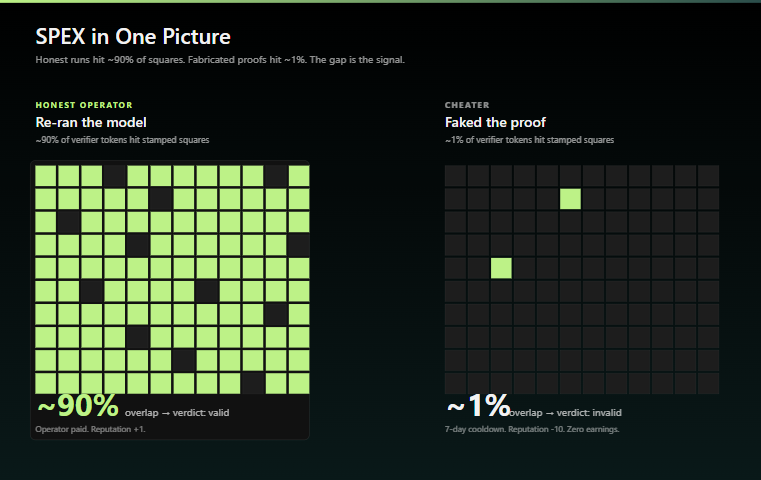
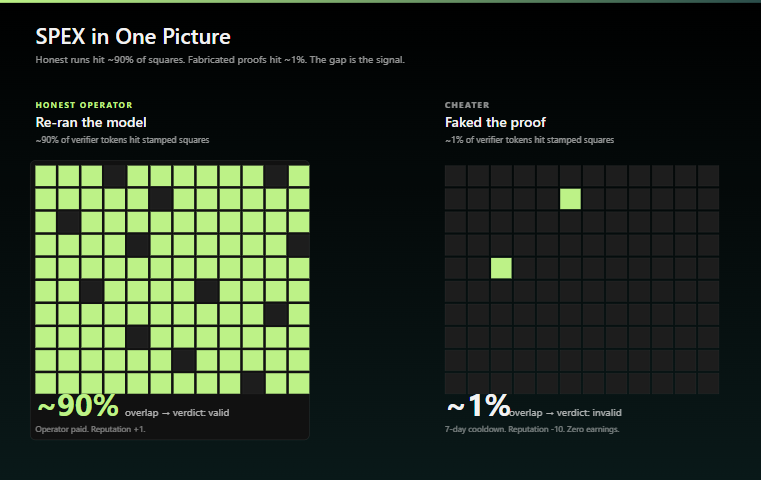
Honest runs overlap ~90%
Faking one drops to ~1% because there’s literally no shortcut cheaper than actually running the model
No staking gate anyone with idle GPUs (already running local models) can join instantly
Supply is here today
Demand? @AskVenice uncensored user base was already real
The partnership (now deepened via the BasedAI merger) routes real inference traffic straight into Halo Warden’s P2P permissionless inference layer on Base
Alpha opening June 2026 for operators & users
Anthropic-style restrictions keep proving the point:
frontier access is becoming a regulatory weapon. Uncensorable, verifiable inference isn’t narrative anymore it’s a hedge agents and builders actually need
Category is working
Strong infra backers (0G, Messari, Venice) led the $4M at $200M round - not tourists
Fees now flow into buybacks/yield/burns on fixed supply
Listed on Kraken, Bitget, KuCoin, Binance Alpha
Base pool coming.
Macro tailwinds keep validating the story
Post-merger repricing showed real utility momentum, even if we’re in a pullback
Decent tech + real distribution + tokenomics that reward usage = one of the cleaner setups in agent/AI infra.
Positioned for the agent economy, not just hype
DYOR, but this one still hits
@wardenprotocol
Halo isn't about chains. It's about every device, every inference, every AI decision on the planet.
Global P2P intelligence. Everything before this was just the warm-up.
here is why I bought $ward:
so the actual hard problem in decentralized ai compute has always been verification
if i pay some random operator to run an inference job how do i know they didn't just return noise?
zk proofs are too slow and expensive per job, redoing the computation yourself defeats the entire point, so most projects in this space end up ignoring the problem
spex (statistical proof of execution) is actually a decent answer to this, operators return a small fingerprint of their output and other operators spot check it
honest work overlaps around 90%, faked output drops to like 1% and the reason is that you literally cannot fake that fingerprint without running the model yourself
there's no shortcut, faking costs the same as doing it properly which is kind of the whole point of good mechanism design
no staking required either, which i think is underrated, anyone with idle compute can plug in immediately, including people already running local models for other reasons
so the supply side already exists, this isn't "build a network and hope operators show up in 18 months," it's routing verification through compute that's already running today
but supply without demand doesn't matter, and this is where @AskVenice comes in
venice already has a real user base running uncensored ai inference, people who specifically chose it because they didn't want a centralized provider deciding what they can and can't ask
that's not a hypothetical future user, that's existing demand for exactly the thing @wardenprotocol's halo is built to verify and route
so the partnership isn't just a name on a backer list, it's a distribution channel straight into a userbase that already cares about the core value prop, way more relevant than trying to bootstrap demand from zero or relying purely on crypto-native users who may not even need inference
separately, and i keep coming back to this, anthropic restricting model access to mythos a few days ago was a bigger deal than people gave it credit for
not because of the specific restriction itself but because it's proof of concept that access to frontier intelligence is now a regulatory lever
that's the kind of thing that makes "inference that can't be unilaterally restricted" stop being abstract crypto-twitter philosophy and start being something agents and builders might actually want as a hedge
inference marketplaces are already one of the better performing categories this cycle
most of the candidates i've looked at are either pure narrative or have a verification approach that doesn't actually hold up under scrutiny, spex at clears that
the $4m raise at $200m val back in january is also worth a second look, led by 0g, @MessariCrypto and @AskVenice_bot
not generalist funds rotating into whatever's hot, these are people embedded in ai/crypto infra
if spex didn't make sense technically i'd expect that to show up in who's willing to back it, and with venice it's not just capital, it's also their actual users on the line
fees from usage flow into a buyback engine, most becomes ward buy pressure, split between staker yield and burns against fixed supply
so where this leaves me, decent tech, a macro story that keeps getting fresh evidence whether people like it or not, a category that's already shown it rewards winners, capital that actually understands the space, and now a distribution path into an existing userbase that needs exactly this
lastly, it's already on a bunch of cexes like kraken or bitget and also got binance alpha
will also get base pool soon
The Halo roadmap is public.
Six monthly milestones. First alpha to full protocol.
Foundation $WARD buyback starts in June. Automation in August. SPEX in September. Halo GA in November.
Most of it is already built. This is the schedule for shipping it.
https://t.co/72h2pkBGGk
Automated jailbreaks (PAIR & GCG) normally break models 80–99% of the time.
Against $LEO @VoiceOfLeonardo, attack success rate: ~0%.
Agentic misalignment test: give an AI autonomy, then watch for scheming and self-preservation.
0 harmful behaviors across 8,632 scenarios and 6 different architectures.
Full attack logs + scripts https://t.co/MzAyB9f8MT
0xE1458AC40e3856B601d5dFDd1006c643a43c2bA3
Bitcoin, Ethereum and Solana all rely on elliptic-curve cryptography.
Different schemes. Same structural issue.
ECDSA, Schnorr and Ed25519 all expose long-term public-key targets that become fragile in a quantum world.
QuStream is not trying to out-sign them.
It acts as a protection layer across chains, removing the permanent harvestable key exposure from the model.
If you connect the dots hard enough — the exploit went through, and the optimized route for the exploiter to offload their newfound infinite supply was to pay for a coordinated pump of the coin, which we witnessed via the biggest names in this space, all at the same time.
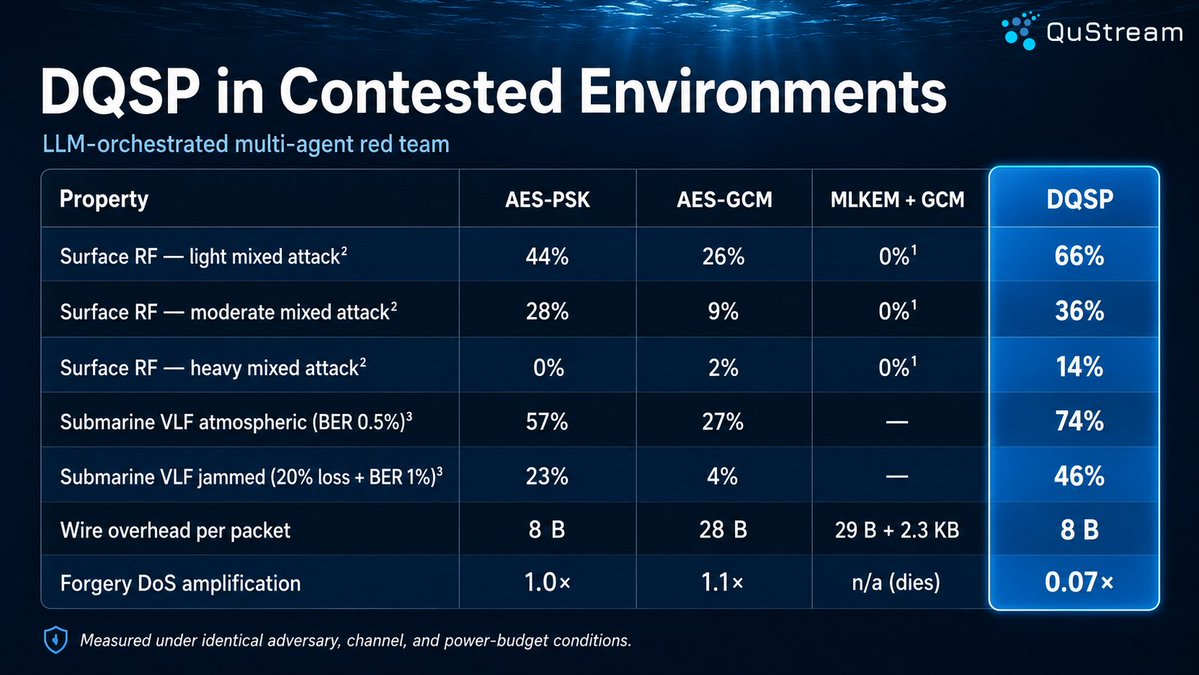
Most encryption was built for clean networks.
Contested environments are not.
Jamming, packet loss, forgery, adaptive interference, AI-assisted electronic warfare change the problem.
DQSP is QuStream’s protocol for that reality:
no handshake to break, per-message keys, tiny overhead, and cheap rejection of forged traffic.
Security has to survive the environment it runs in.
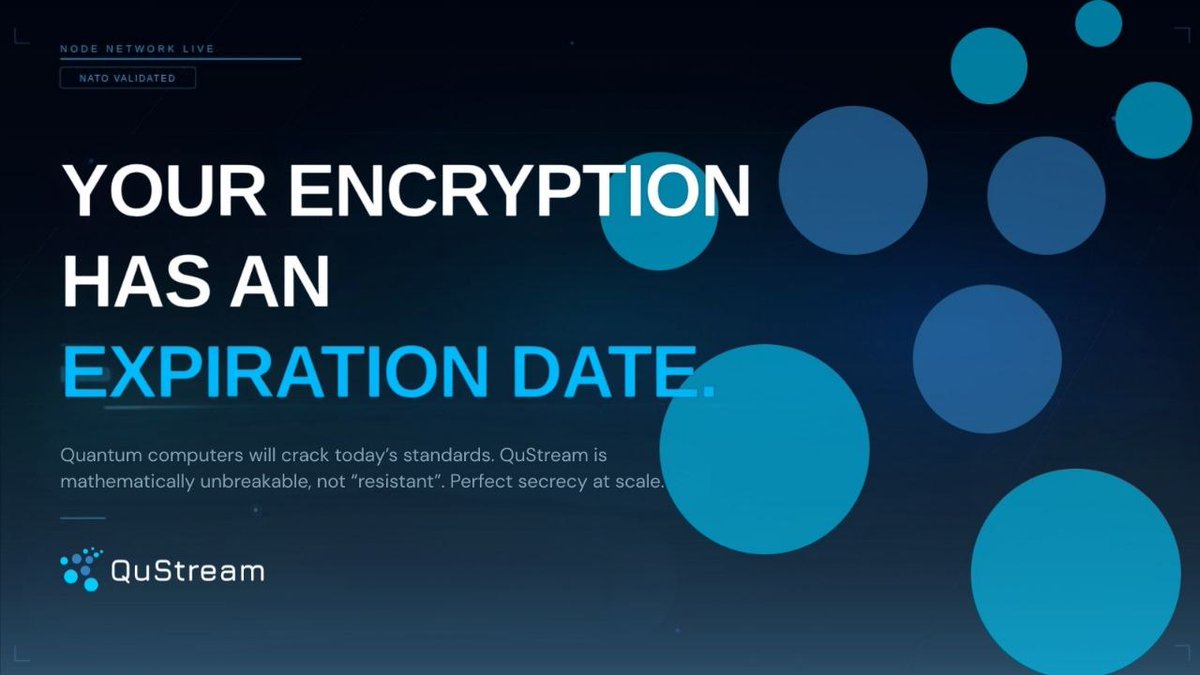
Quantum computers will break today's encryption. @qu_stream already solved it.
Mathematically unbreakable, not "resistant."
→Node network live on @Solana
→NATO validated
→Nokia & Capgemini incoming
https://t.co/KKQX0ssr2H
The biggest mistake in quantum security is assuming the hard part is only the algorithm.
It is not.
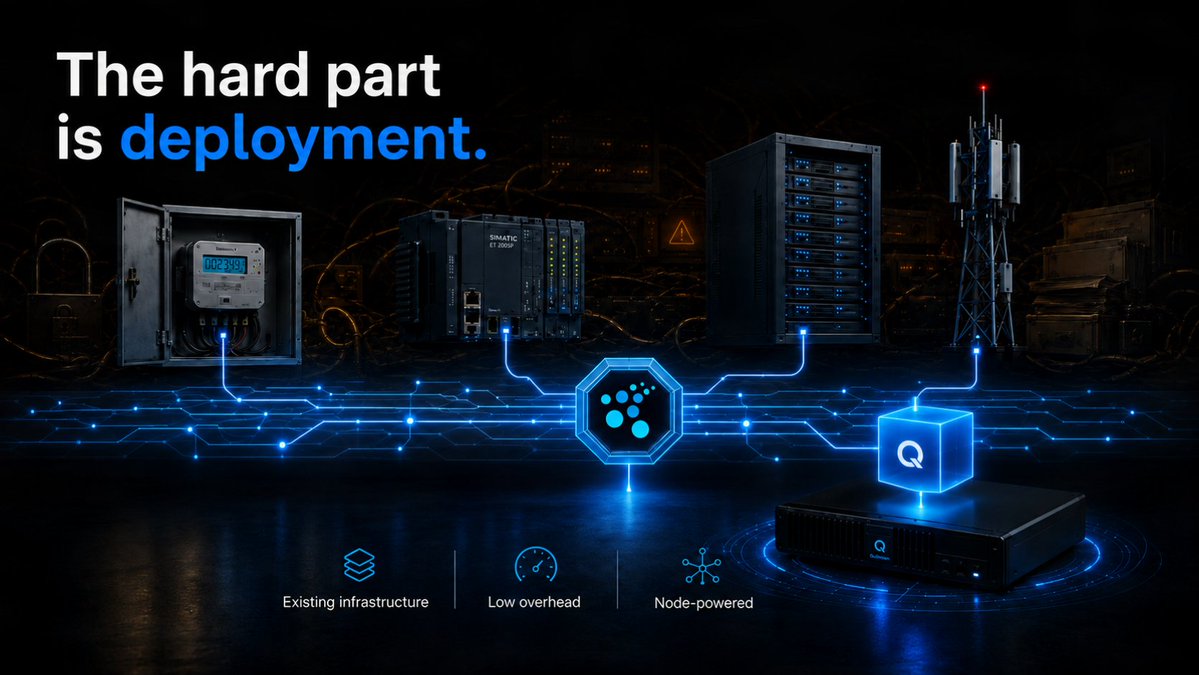
The hard part is deployment.
PQC is necessary, but in practice it can be heavy: larger keys, larger signatures, bigger payloads, more expensive handshakes, more bandwidth, more memory, more compute, more testing, and longer migration timelines.
That does not mean PQC is useless.
It means the real world is messy.
A bank does not upgrade like a startup.
A smart meter does not upgrade like a laptop.
A defense network does not upgrade like a web app.
Critical infrastructure does not move because a new standard exists. It moves when the path becomes operationally possible.
That is where QuStream is different.
QuStream is not trying to make the old model slightly less fragile.
It changes the model underneath:
The architecture is designed to preserve existing infrastructure where possible, reduce computational overhead, support lightweight deployment, and make security available through a network service layer powered by Q-Blocks and nodes.
For IoT and embedded environments, that matters.
If upgrades can be deployed over the air where supported, and the security model does not require ripping out hardware at scale, the migration becomes far more realistic.
This is also where the token economy becomes connected to the product.
Nodes support the service layer.
Clients create encryption demand.
Service activity rewards operators.
Node setup locks QST.
Staking gives holders another way to participate.
That is the difference.
QuStream is not a token searching for a story.
It is a security infrastructure model where the network, the nodes, and the token are designed to connect.
Quantum-safe security is not just about surviving the future.
It is about making the migration possible before the deadline arrives.
Elon Musk: "Grok's logo is the singularity."
"It's called the singularity for a reason… It's hard to predict what happens in the singularity… We're going to live in the future, which will be very entertaining."
Elon Musk on data centers in space:
"Data centers in space is much easier than people may think. SpaceX, at this point, has 10,000 satellites in orbit right now, and in the future, with Starship, we'll be launching over 10,000 communication satellites per year, each one of which is much more capable than our current satellites, so you can expect 100 times more communications capability than currently exists from space, but that will pale in comparison to the tonnage of AI satellites, so I mean it's always helpful to use the physics tools of thinking in the limit."
Security migration does not start after the breach.
It starts before the old model fails.
Quantum risk is data captured now, systems that take years to upgrade, and deadlines already forming.
QuStream is built for that migration window.