🚨 WAKE UP, KENYA!!
ISPs have warned of a threat massive surveillance
Ruto’s govt is continuing with its push for a new law that forces Safaricom, Zuku & every ISP to put an “internet meter” on YOUR connection
This could enable tracking every single site you visit, every second you’re online, and then handing that data straight to the state.
This isn’t about billing. This is about building a digital cage so they can watch activists, journalists, opposition leaders, and anyone who dares criticise them in real time.
One click against the government, and you’re already flagged.
They’re turning the internet into a spy tool while pretending it’s “consumer protection.”
We should speak up now before it’s too late…
Ruto’s Special National Address felt so random and forced. You listen carefully, waiting for substance, but there’s no depth, no value, no direction. Just a lot of words that amount to nothing. Pure nonsense
It almost feels like this administration needed something to dominate the headlines because the numbers are down. Total waste of time
Fellow citizens…WANTAM!
Kenya has introduced a new 25% tax on software subscriptions.
One of the principles of a good tax system is simplicity.
Taxes should be easy to understand. Easy to comply with. And inexpensive to administer.
Finance Act 2026 has introduced new rules for software subscriptions.
• The Act now classifies payments for software licences and software subscriptions as royalties.
- As a result, every time you pay an overseas software company, you are now required to withhold 20% tax and remit it to KRA.
- Then pay the software company the remaining 80%.
For example.
Suppose you pay Google, Amazon or Microsoft USD 1,000 every year for software subscriptions.
The law says:
• Confiscate 20%, USD 200.
• Remit it to KRA.
Then pay the software company USD 800.
There is only one problem, however.
- Software subscriptions are paid either in full or not at all.
Google does not care that you have complied with the Kenyan tax laws. You either pay them 1,000 USD or go home.
So what happens to continue using the software and keep KRA happy?
- You pay Google their full USD 1,000.
In doing so, KRA treats the USD 1,000 as the net amount after withholding tax. That means the original invoice is deemed to have been USD 1,250. How?
Ulikua unaangalia mwalimu na ruler ukiuliza hesabu ya cross multiplication itakusaidia aje maishani. Ona Sasa.
If USD 1,000 = 80%,
Then 100% = USD 1,250.
The withholding tax therefore becomes USD 250.
Meaning:
• Google gets their full USD 1,000.
• Then you go back to your pocket to pay KRA USD 250.
Total software cost = USD 1,250.
In effect, the law has quietly introduced a 25% tax on many software subscriptions.
Even if a small taxpayer genuinely wanted to comply, how exactly are they supposed to comply when the giant software company insists on being paid in full?
This is the new law. Adjust accordingly.
We have done a summary of the proposals that were rejected by MPs, why they were rejected, and the proposals that were passed.
Here is the deeper thread.
Save and share.
99% of Bills passed in Parliament since 2022, were never drafted in Kenya.
They were brought by slave masters straight from Chatham House to directly recolonize Kenya.
- National Land Commission Amendment act
- Land Amendment act
- CyberCrime Act,
- Privatization act,
- Seeds and Plants Varieties Act,
- National Disasters Management Act
- 2023 Finance Bill, 2024 Finance Bill, 2025 Finance Bill, 2026 Finance Bill.
All these acts are about slavery and control.
We are deliberately being turned into tenants in our own country.
The subscription world where we will have to pay to use a road,
We own no parastatals and the private owners decide when and how we can use them.
Where we live in a shylock economy with personal debts, to national debts and to international debts.
That's how sad and dangerous the future looks like.
Finance Bill 2026 wants full suspension of data protection Act.
Here is how.
1. System Integration (Section 59A)
If your business sells over 5M annually:
• You shall connect your accounting system to KRA. Be it QuickBooks, zoho, etc
• To give KRA live feed of your transactions
Fail to comply: 100K penalty every month.
2. Crypto Reporting (Sections 6C & 6D)
• Kenyan crypto platforms must report all users trading history to KRA.
Fail to file: 1M penalty
3. Pre - filled Tax Returns
• KRA will generate tax returns for you based on any info available to them.
Meaning:
- KRA shall decide your tax bill
- You must prove them wrong
(Like what Shuru sent you on whatsapp)
4. Data Sources (Section 29A)
KRA can assess you using:
- eTIMS data
- Mpesa & Bank information
- Audits & inspections of related parties. eg your spouse, parents, customers, suppliers, etc
- Other govt system integrations. eg NTSA, Lands, KPLC, etc
5. Physical & Digital Access (Sections 58–60)
• KRA can enter your premises
• Inspect records
• Demand computer passwords & decryption keys
• Seize documents with a warrant
Meaning: KRA wants full suspension of data protection Act.
YOUR PERSONAL EVOLUTION (BY AGE)
Age 20 – Ego
You think you know everything.
Age 21 – Chaos
Nothing feels stable yet.
Age 22 – Distraction
Too many goals, no direction.
Age 23 – Pain
Reality hits. Lessons begin.
Age 24 – Purpose
You start asking why.
Age 25 – Focus
You cut the noise and choose one path.
Age 26 – Discipline
Consistency replaces motivation.
Age 27 – Emotional Control
You react less and think more.
Age 28 – Vision
You see clearly where you are going.
Age 29 – Accountability
You stop blaming others.
Age 30 – Leadership
People begin to trust you.
Age 31 – Strength
Your mind and body grow tougher.
Age 32 – Self-Control
You master your impulses.
Age 33 – Direction
Every move has meaning.
Age 34 – Power
Quiet confidence appears.
Age 35 – Stability
You become reliable.
Age 36 – Legacy
You think beyond yourself.
Age 37 – Authority
Your words carry weight.
Age 38 – Protection
You protect what truly matters.
Age 39 – Wisdom
You choose peace over ego.
Age 40 – Peace
You fully know who you are.
Which Stage of your Personal Evolution are You in Right now?
The decision by the Independent Electoral and Boundaries Commission (IEBC) to ban the use of mobile phones inside polling stations ahead of the upcoming by-elections is not a minor administrative directive. It is a consequential policy choice with implications for electoral transparency, citizen oversight, and public confidence.
Elections are not merely about casting ballots. They are about verification. In Kenya’s electoral architecture, Form 34A is not symbolic paperwork. It is the primary results declaration form at the polling station level. It contains the raw vote count before aggregation. It is the first and most important layer of electoral truth.
After the disputed 2017 presidential election and the subsequent Supreme Court ruling, the country learned an expensive lesson: transparency at the polling station level is non-negotiable. That is why agents sign Form 34A. That is why copies are issued. That is why results are publicly displayed.
Now we are told citizens and observers should not use mobile phones inside polling stations.
One must ask: why?
If results are meant to be public, why restrict the tools that allow citizens to document what is already meant to be visible?
Photos of signed Form 34As SHOULD NOT be controversial.
In fact, in a transparency-centered democracy, they SHALL not optionally, but as a matter of civic vigilance be taken and circulated.
When citizens photograph a publicly displayed Form 34A, they are not interfering with the vote. They are creating a parallel verification archive. A distributed, citizen-led audit trail. In an era where digital manipulation and institutional mistrust are real concerns, citizen documentation strengthens credibility rather than weakens it.
Banning phones does not eliminate suspicion. It multiplies it. The integrity of elections depends less on rules and more on trust. And trust is built through openness, not restriction.
If the concern is voter secrecy, that can be protected without suppressing documentation of publicly posted results. If the concern is order within polling stations, that can be managed administratively without broad prohibitions that undermine transparency.
In democracies, opacity breeds instability. Transparency stabilizes outcomes even when those outcomes are unfavorable to some actors.
The IEBC must understand this clearly: elections in Kenya are not just procedural exercises; they are high-stakes legitimacy events. Any directive that appears to reduce scrutiny will inevitably erode confidence.
Thought Kai Havertz scoring would be the best thing I watch tonight but here’s John Terry recording himself thinking Chelsea will score only for Kai to win it. In his full Chelsea tracksuit ahaahhahahahahahahahahahahahahhahahahahah
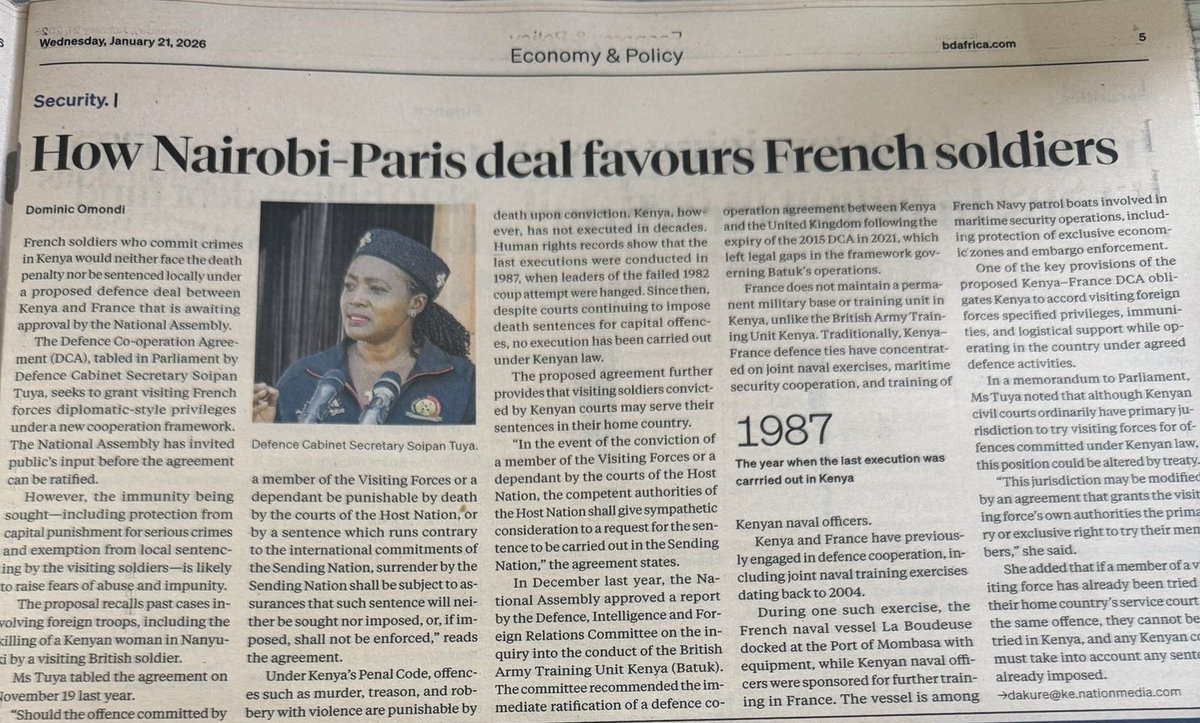
There's this article on Business Daily.
William Ruto's killer regime is seeking to grant french soldiers diplomatic immunity; meaning, exempting french soldiers from prosecution if they commit any crime in Kenyan soil.
This country is being ruled by a demon. That is the reality.
The family of Agnes Wanjiru is still seeking justice after the brutal murder of Agnes by Purkiss 13 years ago.
BATUK are still violating human rights with no accountability and now french soldiers who have been chased away from West Africa are being given diplomatic immunity.
Samora Machel once said, " if one day you see the Europeans praise me, know that I have betrayed you."
The same script in The Tales of an Economic Hitman is being played here.
IMF and World Bank are setting up military bases getting ready for recolonization.
Already we are in a debt trap. Assets are being sold, land laws are being amended.
Wake up you Kenyans!
#RutoMustGoNow