Hardware wallets are, for the most part, one of the biggest psyops of this entire industry, and widely recognized as bad opsec by security researchers.
The mailing and order lists for hardware wallets are some of the most repeatedly hacked and leaked datasets, appearing on blackhat forms year after year. Mailing addresses, names, emails, all of which are perfectly filtered for known value targets.
A $300 laptop with no internet hardware is significantly less likely to get you wrench attacked, or get your root keys rugged by an HW wallet backdoor.
Also, for the vast majority of users, a hardware wallet won’t save you if your web-wallet is compromised. You would have to review the entire transaction on the 1 by 1 inch hw wallet screen, where most people look at the wallet summary. You’d have to double check every script hash, every destination address of every transaction you sign. In-practice, the number of people who do this approaches zero.
The @realfi_co Testnet is officially live – Phase 1 starts now.
If you've been following what we're building – a stablecoin ecosystem designed to connect on-chain capital to real-world credit markets, not circular incentives – this is your first chance to get hands-on with the protocol.
Phase 1 opens three actions in the test environment:
🔄 Swap: Between supported test digital assets and test USDr.
📥 Stake: Stake test USDr for test sUSDr, its efficiency layer.
📤 Unstake: Move back to test USDr.
This isn't just a demo. It's a deliberate part of how we build. Most stablecoins leave capital sitting still. RealFi is built to change that by bringing real-world economic exposure on-chain with the speed and security of modern blockchain infrastructure.
More details on the participation and rewards structure will follow through official RealFi channels.
Get started 👇
https://t.co/roREmg8xy8
We're excited to have you testing with us.
The RealFi Team
Cardano developers, please provide your feedback on the Receiving scripts CIP. I consider this to be critically high impact for dApp DevEx, time & cost to market, and security.
CIP can be viewed in thread below.
Update on Midgard:
We have a functional node, with support for state settlement on the L1, and state commitment finalization. You can transact on the L2 at lightening speeds with low latency and the results are displayed in your wallet (a fork of Lace) in real-time.
Next up in the pipeline is the delivery of L1 deposits and withdrawals, and the forced transaction inclusion mechanism.
Things are coming together nicely and we’re extremely excited to bring this into the hands of the community.
Blockchain transaction fees are notorious for being a big adoption factor. @ethereum gas fees frequently reached highs over $100 and cruised on average over $20 in 2021-2022, down to $1 in 2025. Here, I’ll try to ELI5 how #Cardano Tx fees work 🧵👇
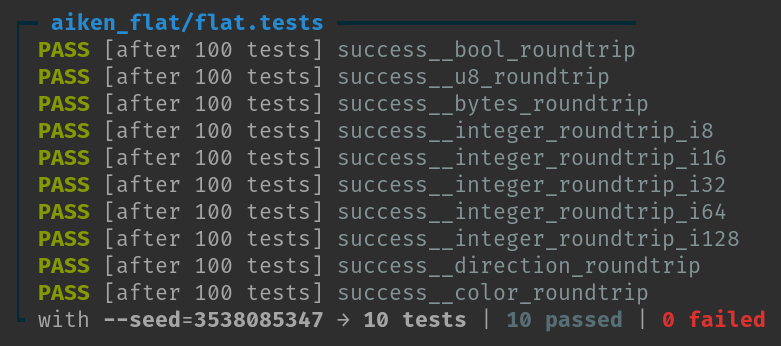
Cardano scripts are stored on-chain using Flat, a minimal encoding scheme that uses every bit (not byte) to store information.
This is very low level, but I wanted to get a good understanding of it. So I implemented its encoders and decoders in... Aiken 😅
🧵
@midgardprotocol 11/
For encoding of integers and bytearrays you can checkout the Pallas codebase. It is well documented, and helped me quite a lot in implementing the Aiken version:
https://t.co/GehCAgOYPK
@midgardprotocol 10/
> Abyss will be 0
> BlackAndWhite will be 10 followed by an encoded integer
> And Colored will be 11 followed by 3 encoded integers