This is official keymous page on X
Check us on Telegram too : https://t.co/X6S1ieQROl
Our group chat (telegram) : https://t.co/IOzTWjJmiB
Contact us : https://t.co/ybnydzehP1
🟧 #HackTuesday 🟧
Hack Tuesday: Week 20 - 26 May 2026
⚠️416 cyber attacks across 62 countries ⚠️
➡️The most active threat actor last week was NoName057(16) claiming responsibility for 54 cyber attacks.
➡️The USA is the most affected country, accounting for 21.9% of incidents, with 91 cyber attacks.
➡️The Gov / Mil / LE sector is the most targeted, accounting for 19.0% of incidents with 79 cyber attacks.
➡️The estimated Critical cyber attacks account to 55 (13.2% of the total).
➡️Overall, the claimed compromised data amounts to approximately 19.8 TB.
More details:
https://t.co/QrICL4QoUV
🇲🇦 A threat actor operating under the name “Keymous Plus” is claiming to have leaked candidate-related data associated with Morocco’s Ministry of Foreign Affairs.
According to the post, the exposed dataset allegedly contains:
• full names
• registration numbers
• candidate records
• approximately 8,440 entries
While the leak appears relatively limited in volume compared to large-scale database breaches, the sensitivity comes from the nature of the targeted institution and the potential exposure of:
• government recruitment pipelines
• applicant identification data
• diplomatic staffing information
• internal administrative processes
Leaks involving foreign affairs ministries are especially significant because they may enable:
• targeted phishing campaigns
• impersonation attempts
• recruitment-focused social engineering
• intelligence gathering on government personnel
• profiling of diplomatic candidates or applicants
The screenshot suggests the actor is publicly distributing:
• structured candidate lists
• registry identifiers
• downloadable archive content
Even limited datasets from government ministries can become valuable for adversaries when combined with:
• OSINT enrichment
• LinkedIn/social media correlation
• credential reuse attacks
• spear-phishing infrastructure
This incident also aligns with a broader trend of politically motivated or hacktivist-style actors increasingly targeting:
• public sector institutions
• election systems
• diplomatic organizations
• government HR/recruitment systems
The reference to “sharing” rather than direct monetization may indicate:
• ideological motivations
• influence operations
• reputation-building within underground communities
• regional geopolitical signaling
At this stage, the claims remain unverified. However, government-affiliated personnel datasets should always be treated as sensitive due to their potential use in follow-on targeting and intelligence operations.
🇲🇦 #DDW #Intelligence #Morocco #CyberSecurity #DataBreach #DarkWeb #ThreatIntelligence #Government #OSINT #CyberThreats #Hacktivism #Infosec
🚨 USA Alert 🇺🇸
The cyber-hacktivist group Keymous Plus has reportedly launched a widespread (DDoS) attack against the global professional networking platform LinkedIn (https://t.co/GMdaatFBiL), headquartered in the United States.
#DDoS#LinkedIn#KeymousPlus#USA
One of our channels been banned from telegram today while last post from Pavel Durov talks about freedom of speech , so fair...
Main : https://t.co/hYeoMRH6Ab
Arabic-French channel: https://t.co/ba1fDoGS6V
Follow us on X : https://t.co/gJE2PVIWiE
BackUp : https://t.co/ZF3klz31kX
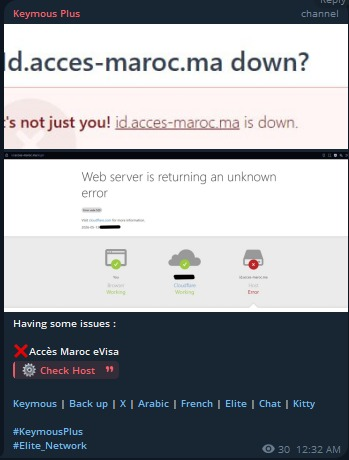
🚨 Morocco Alert 🇲🇦
The hacktivist group Keymous Plus has targeted Morocco’s digital public infrastructure by launching a (DDoS) attack against the Accès Maroc eVisa portal https://t.co/neA1qdOtRy
#CyberSecurity#DDoS#Keymous#Morocco#eVisa#MarocEvisa
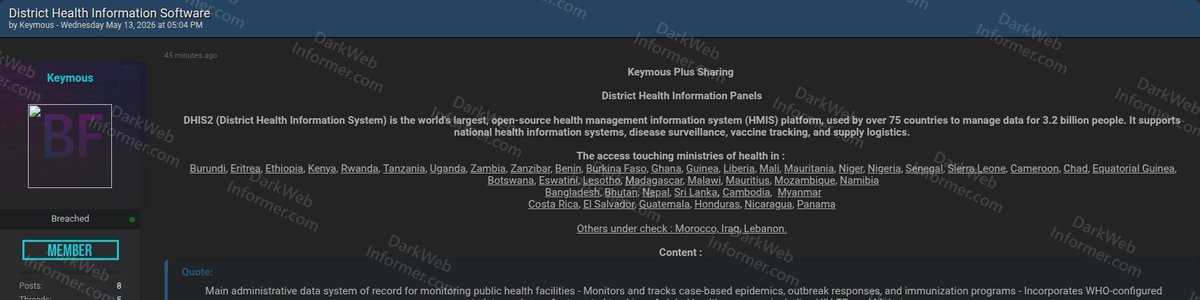
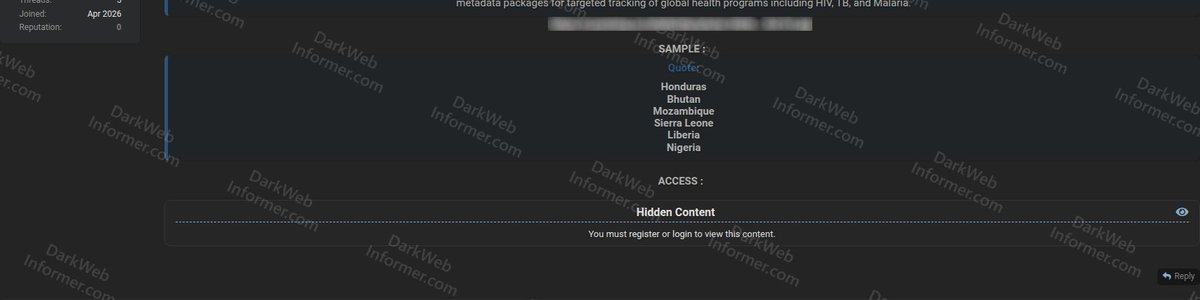
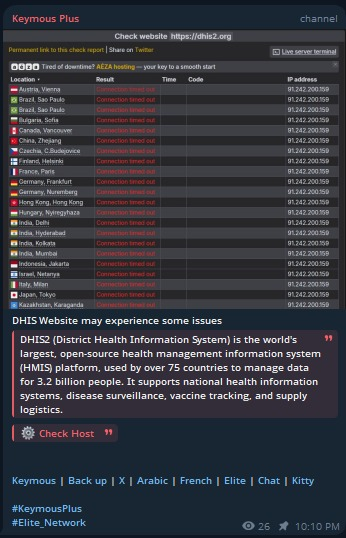
‼️🌐 District Health Information Software (DHIS2) allegedly breached: access shared to national health systems across more than 30 countries serving 3.2 billion people
A threat actor is sharing access touching the District Health Information Software (DHIS2) instances of more than 30 national ministries of health.
DHIS2 is the world's largest open-source health management information system (HMIS) platform, used by over 75 countries to manage data for 3.2 billion people, supporting national health information systems, disease surveillance, vaccine tracking, and supply logistics.
The actor states the affected systems are the main administrative data of record for monitoring public health services, tracking case-based epidemics, outbreak responses, and immunization programs, and include WHO-configured metadata packages for HIV, TB, and Malaria.
▸ Actor: Keymous
▸ Sector: Government / Public Health Information Systems
▸ Type: Access / Data Breach
▸ Records: National HMIS platforms covering more than 30 countries
▸ Countries: Burundi, Eritrea, Ethiopia, Kenya, Rwanda, Tanzania, Uganda, Zambia, Zanzibar, Benin, Burkina Faso, Ghana, Guinea, Liberia, Mali, Mauritania, Niger, Nigeria, Senegal, Sierra Leone, Cameroon, Chad, Equatorial Guinea, Botswana, Eswatini, Lesotho, Madagascar, Malawi, Mauritius, Mozambique, Namibia, Bangladesh, Bhutan, Nepal, Sri Lanka, Cambodia, Myanmar, Costa Rica, El Salvador, Guatemala, Honduras, Nicaragua, Panama (additionally listed as under check: Morocco, Iraq, Lebanon)
Compromised data:
▪ Main administrative data of record for national public health services
▪ Case-based epidemic monitoring and outbreak response data
▪ Immunization program data
▪ WHO-configured metadata packages for HIV
▪ WHO-configured metadata packages for TB (Tuberculosis)
▪ WHO-configured metadata packages for Malaria
▪ Disease surveillance feeds
▪ Vaccine tracking data
▪ Supply logistics records
▪ Access touching the ministries of health for Honduras, Bhutan, Mozambique, Sierra Leone, Liberia, Nigeria, and other countries listed above
Stop guessing what's redacted. Subscribers see everything → https://t.co/281Qjc6WSh