I am sending you 1π! Pi is a new digital currency developed by Stanford PhDs, with over 25 million members worldwide. To claim your Pi, follow this link https://t.co/s2QFisTi0y and use my username (kfahim39) as your invitation code.
Want to help grow the Pi ecosystem? Invite vibe coders to bring their AI-created apps to Pi’s real distribution network and utility ecosystem through Pi App Studio!
Here’s how to participate:
1. Identify communities of active vibe coders such as a Subreddit, X Communities, Facebook group, or developer forum.
2. Join and contribute to the specific vibe coder community. Engage with community members on topics around vibe coding and app creation.
3. Introduce Pi Network as a distribution network to vibe coders looking for users for their app.
4. Submit the link to your post through the “Vibe Coder” button in the Pi mining app.
Spread the word: Vibe coders can easily bring their AI-created apps to the Pi ecosystem, where those apps can be discovered, used, supported, and improved by real people!
Any creator can benefit from what Pi ecosystem has to offer: a large, engaged community of 60M+ Engaged Pioneers, plus infrastructure including global payments, Pi Wallet, Pi Ad Network, and social network access.
Learn more https://t.co/euwz9BMwll
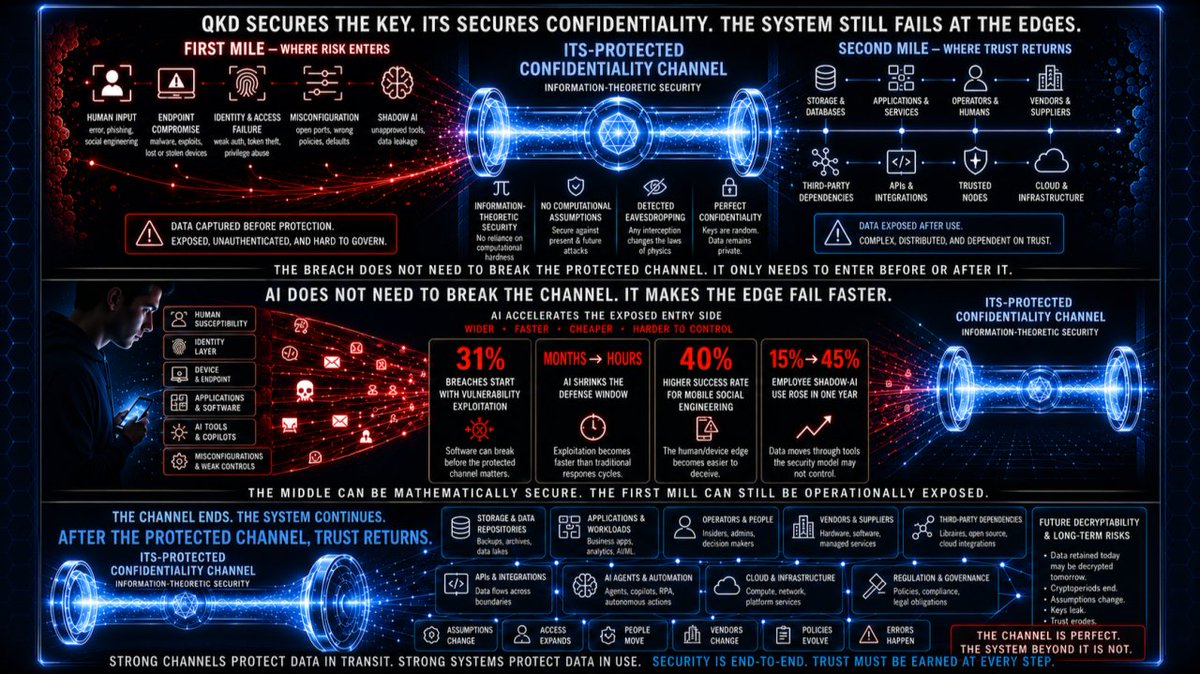
QKD does one thing, and it does it with a real guarantee rooted in physics.
But a continental network is still mostly trusted nodes, and at the endpoints your data returns to classical reality.
So the question was never “does QKD work?”
It was:
how much of the confidentiality lifecycle does it actually cover, and what does the rest of the system still depend on?
That is the gap QuStream is built for.
A Q-Block is not the secret.
It is public quantum-random material.
The secret is the path through it.
QuStream endpoints use shared private state to walk that material and derive fresh keys locally.
Everyone can see the noise.
Only the endpoints know the route.
@coingecko QuStream has only 2500 holders, and they have collaborations with Nokia and Capgemini, each with over $20+ billion in revenue.
The founder, cryptographer Adrian Neal, just presented at a NATO event in Greece about how to secure their communications against signal jamming.
I feel like solana:AUuCEHQ7sm2i5GmaHrpE961voWcTY8U6mgrkhcV7pump is undervalued currently, and upon inspection so does SuperGrok.
The potential of what they have tech-wise is unreal one it gets adoption at scale, but even now the level of validation supports a higher floor MC.
https://t.co/NVYbQJRT2k
$QST looks like a generational bottom to me
not for long, imo
AI had its party already
quantum security is next, and @qu_stream is one of the few projects with real enterprise-level signal behind it
Nokia. Capgemini. live demos. actual product.
this is the kind of chart people only notice after it reverses
think about it
Network Update: Upgrade to protocol 24 has been completed successfully.
Great job to all Nodes! This was one of the most challenging migrations.
Next up will be v25, deadline June 18.
I asked SuperGrok to look at all of the recent developments around solana:AUuCEHQ7sm2i5GmaHrpE961voWcTY8U6mgrkhcV7pump @qu_stream and estimate the appropriate Market Cap.
Looks like we're in agreement, underpriced significantly for what it is and has validation for.
Prompt and full response provided here:
https://t.co/kUaw3I58VY
Every major chain team should be looking at this.
Not because crypto breaks tomorrow.
Because the migration problem is bigger than most people want to admit.
$BTC, $ETH, $SOL and the rest need a realistic protection path before quantum becomes an operational deadline.
QuStream may be the protection layer crypto did not know it needed yet.
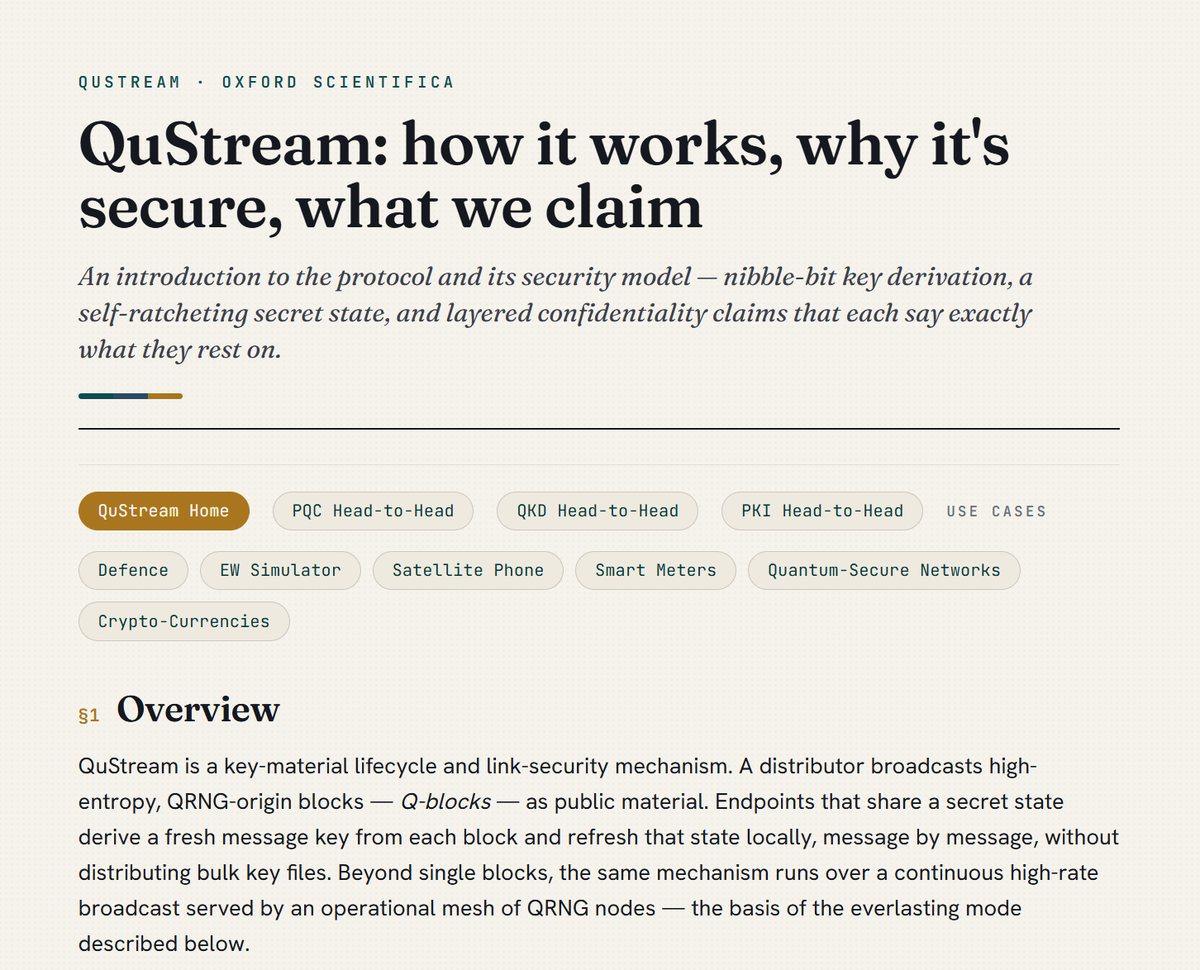
For deeper technical context, this table comes from the QuStream UK research site.
The main site covers QuStream at a higher level. The .co.uk site goes deeper into mechanisms, examples, and implementation notes.
Explore it here: https://t.co/U01V9VYCmB
Bitcoin, Ethereum and Solana all rely on elliptic-curve cryptography.
Different schemes. Same structural issue.
ECDSA, Schnorr and Ed25519 all expose long-term public-key targets that become fragile in a quantum world.
QuStream is not trying to out-sign them.
It acts as a protection layer across chains, removing the permanent harvestable key exposure from the model.
If you ever wanted to DYOR on Qustream @qu_stream but haven't done so yet, this is a good time to look into it. It covers multiple in-depth applications for the technology in great detail. If any of those topics interest you, they are all worth reading through.
https://t.co/n4P9H3mGse
CiDi Games organically reached over 81,000 users across 160+ countries in less than a week after launching its beta in the Pi ecosystem.
That led to:
1.2M+ game sessions
21,000+ tournament participants
3.19M+ Pi staked by the community to support the platform.
What makes this important is not just the gaming activity itself.
It is what the launch demonstrates about building on Pi.
Apps built on Pi launch directly into a network with existing distribution, engagement, and infrastructure already in place.
As AI lowers the barrier to building apps, ecosystems with real users like Pi become increasingly valuable for developers.
Learn more about CiDi Games’ beta launch here
https://t.co/N75zsyH3Q0
2/ DQSP, QuStream's encryption hardened by Delatr for the field, is built for that. No live handshake to attack, per-message keys, tiny overhead, cheap rejection of forged traffic.
https://t.co/2vImsrhyRa
To make this clear:
DQSP stands for Delatr-QuStream Protocol.
QuStream provides the encryption architecture.
Delatr brings the defence hardware, integration, and field-deployment layer.
Together, DQSP is QuStream hardened for electronic warfare.
Built for maritime, unmanned, and contested communications where secure links have to keep moving under pressure.
CiDi Games, a Pi Network Ventures portfolio company, launched their beta app in the Pi Browser!
This brought Pioneers 10 instant-access games along with skill-based tournaments, platform progression through CiDiScore, the Pi ELF companion experience, Elf Continent, and developer infrastructure for Pi-integrated games.
In less than one week after the beta launch, CiDi Games independently attracted over 81,000 Pioneers across 160+ regions and 1.2 million game sessions organically, demonstrating how the Pi Platform can help utility-focused apps reach real users, drive engagement, and monetization, which in turn expands utility across the Pi ecosystem.
Go to the Pi app today to learn more!