What does it mean if the U.S. loses its measles elimination status?
KFF’s Josh Michaud explains why it would be a step back for public health: https://t.co/D3vk3n85mW
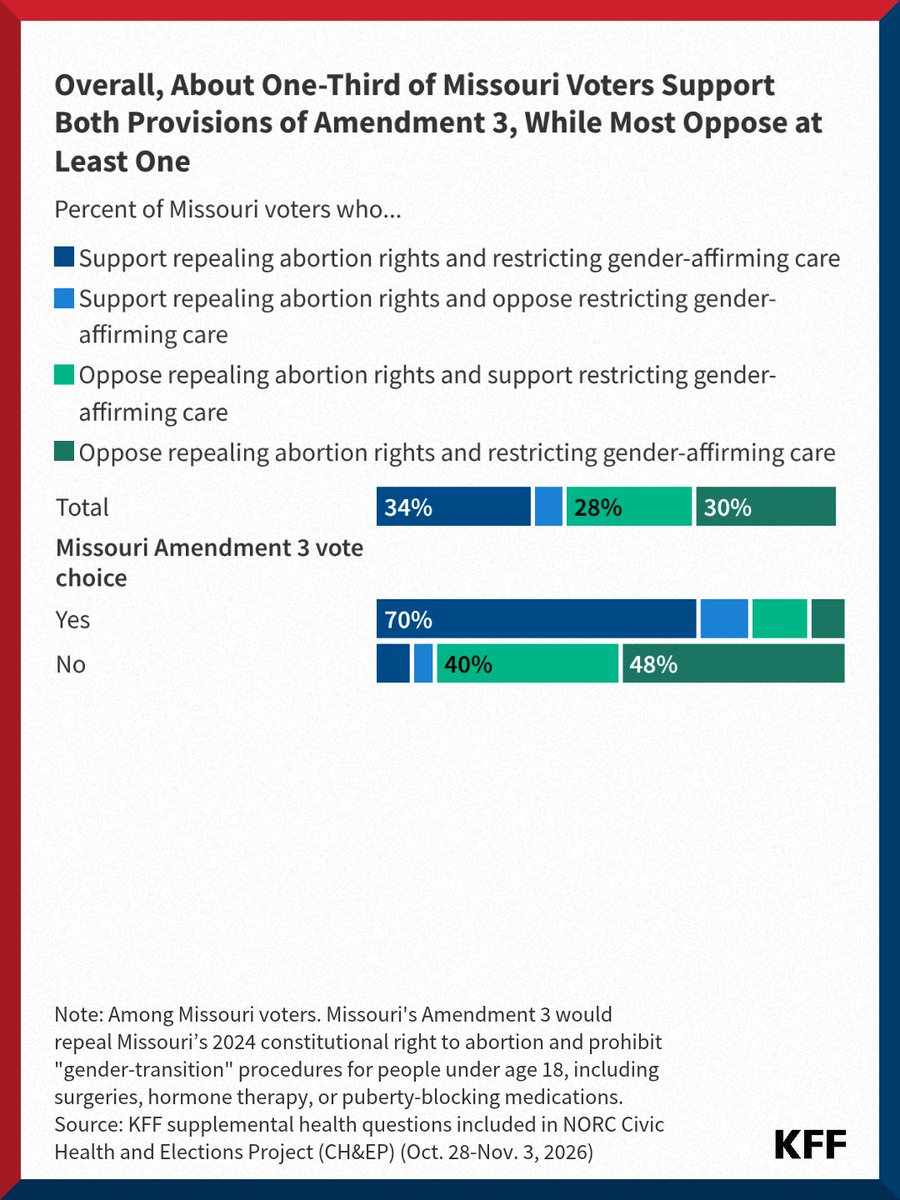
Many Missouri voters held views that did not align with both ballot measure provisions, according to the polling data.
Ultimately, when it came to their voting choice, voters’ views on abortion played a larger role. See the full findings: https://t.co/RGaaOGJWoG
KFF’s Audrey Kearney breaks down the data showing the role abortion played in voters’ decisions in the 2026 midterms compared to past elections. https://t.co/78VGbgUMRG
New CMS rules require states to publish Medicaid fee-for-service payment rates, but differences in how states handle the data may make comparisons difficult.
The usefulness also may vary depending on states’ reliance on fee-for-service vs. managed care: https://t.co/BCfYo0ng2X
Missouri voters rejected Amendment 3 — keeping the constitutional right to abortion (first approved by voters in 2024) & leaving laws prohibiting many gender-affirming treatments for minors in place.
We found that abortion policy played a bigger role in voters’ decisions: https://t.co/0pySbLvWxs
What does it mean if the U.S. loses its measles elimination status?
KFF’s Josh Michaud explains why it would be a step back for public health: https://t.co/D3vk3n85mW
A survey of midterm voters by NORC, with questions from KFF, finds that in Missouri, larger shares of Democratic voters said Amendment 3 had a major impact on their decision to vote than Republican voters in this election.
Explore the findings in our dashboard: https://t.co/0pySbLvWxs
Analysis: The latest Rural Health Transformation Program awards to states continue to show wide variation when compared to state’s rural residents.
Rhode Island, New Jersey and Alaska get the most per rural resident, while Texas gets the least. Learn why: https://t.co/jRu8CBSTl3
I posted this as fact. Not surprisingly, some see it as an argument for expanding Medicare to more people or regulating health care prices, and others see it as an argument for just the opposite.
For all of AI’s advances in drug development, one challenge remains: predicting how a treatment will perform in humans.
Dr. Elias Zerhouni explains why clinical trials remain the ultimate test and what he sees as the next frontier for AI.
Full episode: https://t.co/q1AbMUknmm
Wins by progressive candidates have jumpstarted a conversation about Medicare for All. That doesn't mean it's going to pass, but does mean it could play a big role in the 2028 presidential campaign. That depends, however, on having a candidate in the race who will champion it.
When people retire at 65 and shift from employer health insurance to Medicare, health spending decreases substantially because prices in Medicare are much lower than in private insurance.
What does AI actually do in drug development?
Dr. Elias Zerhouni explains how tools like AlphaFold 3 are helping researchers understand structures, identify targets, and optimize drug candidates much faster than before: https://t.co/yk1s4MWp3g
New federal public charge guidance leaves key questions unanswered about which public benefits may affect immigrants’ green card applications.
That could deepen fear and confusion and discourage families from accessing health coverage and other programs: https://t.co/Poe8VVuj9Q
More health providers are moving away from race-based clinical decision-making tools.
These changes can help reduce disparities and improve outcomes, but researchers and clinicians are still investigating what health-related information race captures: https://t.co/gYc1RAy5Yo
Bipartisanship has long been the “secret sauce” of U.S. global health.
With several GOP champions leaving and 100+ new members arriving, whether it holds will help shape what comes next. https://t.co/R2dTjjY5Rx
AI is speeding up the search for new medicines. Can it make the discoveries themselves?
Dr. Elias Zerhouni says that while AI can accelerate discovery, the spark behind major scientific breakthroughs remains human.
More on what AI is doing in drug development: https://t.co/GbayYdTnXv
What could Democratic control of Congress mean for global health?
Expect sharper congressional oversight of U.S. global health policy, including the America First Global Health Strategy, its agreements with countries, and the fallout from shuttering USAID. https://t.co/7qz642v5e2
Section 1115 waivers let states test new approaches to Medicaid—but they must be “budget neutral” for the federal government.
New CMS guidance changes how that standard is assessed and may limit what states can do. More on the changes: https://t.co/c2SgEh8vuq