Ubuntu Core Desktop targets 28.04 debut, with default status in its sights (Ubuntu Summit 26.10)
https://t.co/jYTsSegrcj
Canonical's stretch goal is to make the immutable OS standard in 30.04 – without retiring the traditional distro
<- by me on @TheRegister
bootc genuinely changes the math on running Fedora as a server.
If the OS is an image you build and roll back instead of upgrade in place, most of the upgrade risk argument falls apart.
https://t.co/IWTIoR0vFB
#Fedora#bootc#Linux
@sysxplore Nice to see bootc image creation in the web console. We're running a short survey on how people are using bootc and other immutable distros in 2026. Results will be shared publicly: https://t.co/n61LIP0wqb
Rocky Linux 10.3 is out, and the free RHEL rebuild race was close: AlmaLinux shipped hours earlier, and Rocky shipped 10.3 and 9.9 together.
For anyone new: Rocky Linux is a community rebuild of Red Hat Enterprise Linux, started by CentOS co-founder Gregory Kurtzer after CentOS changed direction. This release landed five days after Red Hat shipped RHEL 10.3 on 11 Nov.
What you can now do: install it on x86-64-v3, aarch64, riscv64, POWER10+ and IBM z15+. Build images from the terminal with the image-builder CLI, which is now generally available. Create bootc images from Fedora, CentOS Stream or custom containers in the web console. And use GCC Toolset 16 with C++26 Reflection and Contracts.
On security, SSH in FIPS mode now prefers hybrid ML-KEM post-quantum key exchange, and libreswan 5.4 brings ML-KEM to IPsec. The kernel is 6.12.0-264.16.1. Older x86-64-v2 CPUs are still not supported on Rocky 10.
@jmarceno I go back and forth on whether it's worth it for the workstation. For servers, I have no ambivalence. I don't want to worry about drift or reproducing the same OS state on multiples servers.
I run my entire production on two bare-metal servers plus one tiny quorum VPS.
Total bill is about 130 euros a month on Hetzner.
Operating system is Talos Linux. An immutable, minimal Linux distro built just for Kubernetes. No SSH. No shell. No package manager. Everything is configured through an API with client certificates.
If a server dies tomorrow, I don't debug it. I wipe it, let Talos reinstall, and the cluster rebuilds itself.
Hardware failure on bare metal used to be scary. With immutable nodes it is just a reboot.
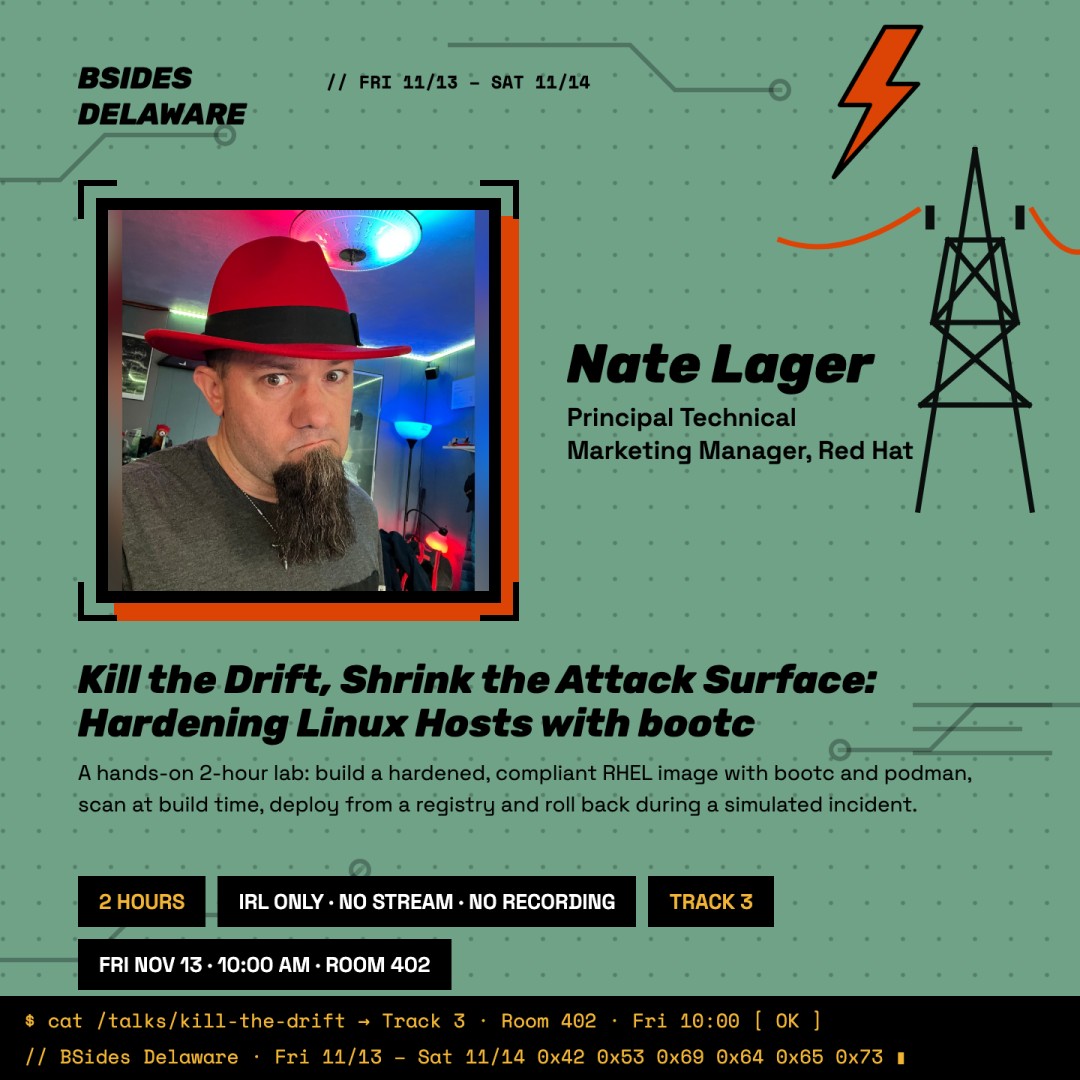
Can a Linux host be a container image? Learn to build, secure and manage an enterprise bootc image and cut configuration drift. #bootc#Linux#SecOps#BSidesDE Sign up now to secure your spot with @gangrif https://t.co/aBuL1AkjJ7
The quiet pattern of the last ten days is that the calendars do not match.
7.4-rc1 closed with nearly 20k commits. Linus called the AI volume a healthier model because the work is landing in the merge window instead of as late fixes. People expected 7.4 to be the next LTS. Turns out 7.3 is the one that will get the long support window.
Fedora 45 shipped on 7.2. Ubuntu is still on the 7.3 release candidate it put out two weeks ago. Alpine just got a critical OpenSSH issue that only hits musl without PAM. Eight distros pushed coordinated kernel and browser updates on the same day, each with its own package list. Now RT_GROUP_SCHED is on the list of things that may simply disappear.
If the host is an image you chose, you know which of those calendars you are on. If the host just follows the release, you find out when something breaks. The interesting question is not how many patches landed. It is which set of them you are actually running, and whether the next one is a rebuild you schedule or a surprise you did not.
Kernel developers are looking at dropping RT_GROUP_SCHED.
The reason they gave is that it is “broken beyond repair.”
It is the feature that lets you put real-time tasks into cgroups and schedule them as a group. It has been in the kernel for years.
Now the people who maintain it are saying the implementation is not worth fixing.
The same week 7.4-rc1 closed the biggest merge window in history, 7.3 became the likely LTS, and eight distros pushed coordinated security updates.
The same week Alpine got a critical OpenSSH issue that only hits musl without PAM.
The patches land. The features stay until someone decides they do not.
The interesting part is not the announcement. It is what happens to the boxes that were relying on the thing that just got called broken.
If the host is an image you chose, you know which version of the feature you are running. If the host just follows the release, you find out when the next reboot no longer has it.