Ready to lead your own research team-?😎The Max Planck Society offers you the chance to head an independent Research Group at a participating Max Planck Institute of your choice - the next open topic call starts on Sep 9, 2024. Stay tuned for updates!🌟
https://t.co/FJME2GLVVc
Happy birthday, Max Planck! 🎂🎉🙃The accomplished pianist, revolutionary physicist, #NobelPrize winner & brilliant thinker, whose pioneering work in #quantumtheory reshaped the landscape of physics, was born #OTD.
😁🎉😄🌟#NobelPrize!🙃🙃🙃🙃🙃🙃🙃🙃🙃🙃🙃😊🏆😁#PhysicsNobelPrize2023 for Ferenc Krausz, Max Planck Institute of Quantum Optics! 🎊😃🥰😆🥳😁😃🎉🏅😊🎈😁🥳😄🎊😁🌟😃🥰🏆😁🎉🎇😊🥳😄🌟🎈😁😃🥰🎉🏆😁🎊😊😄🥳🌟🎇😁🥰😃🎉🎈😁🏆😊😄🎊🥳😁🌟😃🥰🎉🏅😁🎈😊🥳😄🎉😁😍😁🎉🎇😊🥳😄🌟🎈🏆
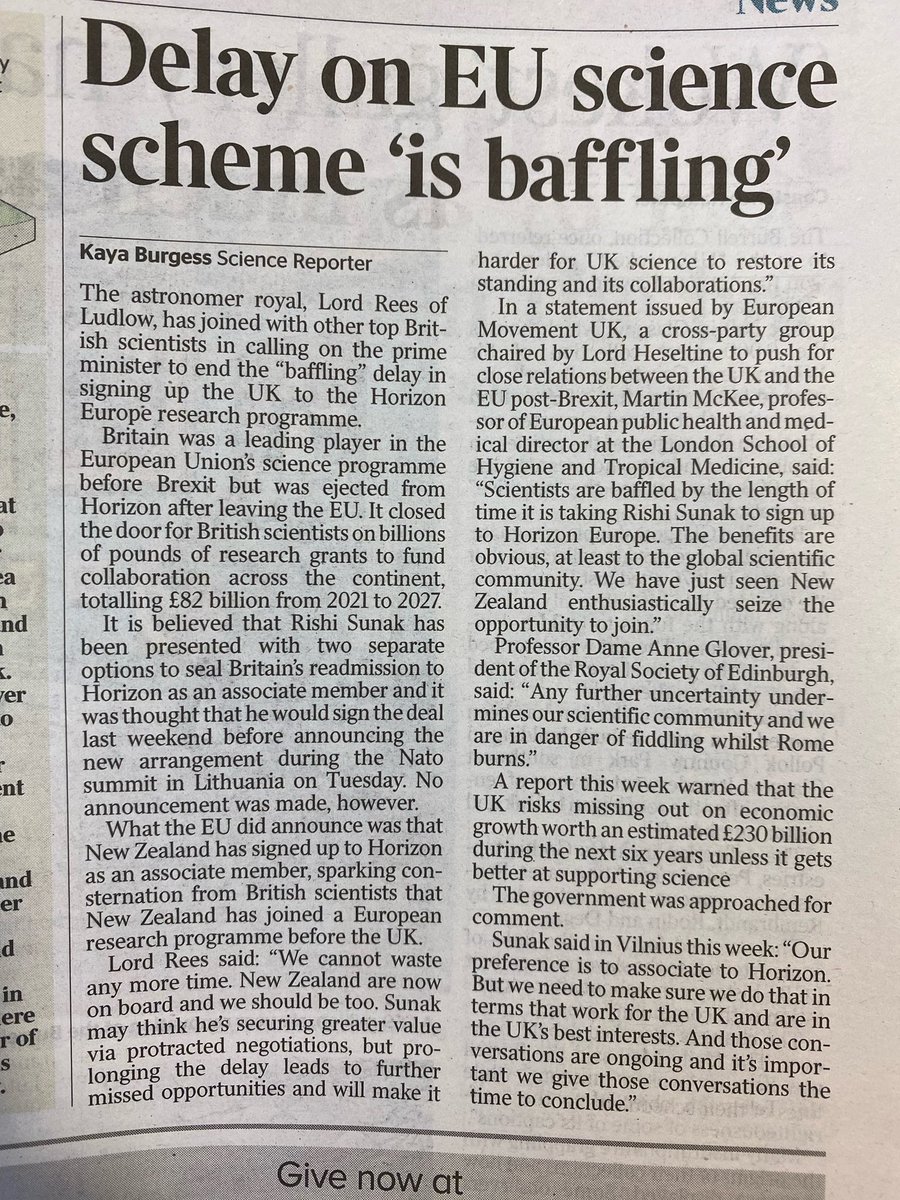
The PM really does need to understand that he is now further damaging U.K. science by not immediately rejoining Horizon, presumably to placate some know-nothing fringe bloviators who know nothing about science, its value or how it’s conducted. As Lord Rees says below, it is baffling. Get on with it.
Ernest Rutherford Fellowships: 5 years independent fellowship for research in astronomy, solar and planetary science, particle physics, particle astrophysics, cosmology, nuclear physics, accelerator physics. Apply with us here: https://t.co/qW66WmRjdZ
I was told by a particle physicist, 'you are not doing theoretical physics, if your work does not include any Lagrangians..' 🤓 Ok, I guess I need more Lagrangians in my life. Can you guess what the one below is from?
Caught in the act? This is likely a super-massive black swallowing gas from its surrounding. The amount of energy released is the largest observed to date. 💥Wow. The black hole responsible is between 100 million to 1 billion times the mass of our sun.
https://t.co/YY4L7ZH805
This is a great opportunity! Can highly recommend it having had one myself in the past.😀 If you have an ambitious research vision go for it. This is the one 👍
Want to head your own independent Research Group?😎 In an exciting research environment & enjoying full scientific & budgetary autonomy? Yes -? Then apply now! 🤗Positions are open for Max Planck Research Group Leaders. Application deadline: May 11, 2023 https://t.co/zwG9QHzYjq
Tune into the 2023 Higgs Lecture by Phiala Shanahan @MIT_Physics 'From Quarks to Nuclei: the Building Blocks of the Universe'. Its free and online on Mar 22
https://t.co/hLSydcKaBu
Nice to see that the @maxplanckphdnet is still going strong 👏so many years after its inaugural meeting in Dresden at the MPIPKS. Still remember how exciting it was meeting all the other reps. Keep going you are making a difference👍
Inspiring day welcoming members of the 2023 steering group of the @maxplanckphdnet in the Berlin Office of @maxplanckpress!
Thanks for the great exchange on science policy, career opportunities and the Max Planck Schools 🤓
Nice paper by @DokkumPieter and collaborators. They got us theoreticians/simulators 😅. Still early days and more data is needed, but could this be the stress test for galaxy formation in LCDM
https://t.co/dgymsTc7nm
Got contacted by an applicant wondering why they have not heard about their application outcome. Turns out the funder just ghosted applicants that where not taken forward. 😲 'You will hear from us...' That's terrible, let applicants at least know their status please!
This is one of the nice examples that show the limits of AI and machine learning approaches. It is very difficult to predict accurately chaotic systems, due to tiny differences in the state of a system leading to very different outcomes.
A double pendulum demonstrates chaos theory, tracing its unpredictable path
The dependence on initial conditions, and sensitivity to variation is one of the fundamental properties of chaos
This is commonly referred to as "the butterfly effect,"
It's time to take stock and think about the next exciting science projects. Working right now on own science funding proposal for a change. Just realised I am a tough referee, especially when it comes to my own science cases 😅🤓
The UK is becoming increasingly unattractive for international researchers and driving its own researchers out. Intellectual capacity is lost fast. Regaining it takes time. https://t.co/PXHHKFpLDc
Radio silence over! Back to exciting science after a long spell of hiring faculty positions😅. This talk will give you the latest insights into our understanding of how protons, neutrons and nuclei emerge in the early Universe. It's free.
https://t.co/u6C0muhitA
Well done to Prof Jim Dunlop who has been awarded a @royalsociety Research Professorship. Jim’s research aims to use the @NASAWebb telescope and @almaobs to discover & study the first galaxies forming & growing in the first billion years of the universe. 🔭https://t.co/LFsT63peQm