Meanwhile
Planning a two day IRL lecture series here in Nigeria.
7 hours each. 6 hours of learning and an hour break (spread across 3 or 6 blacks)
The goal; inspire local folks to adopt a builder mentality.
🧵
Stablecoins today mostly move dollars between fiat rails. That's a tiny fraction of what's possible.
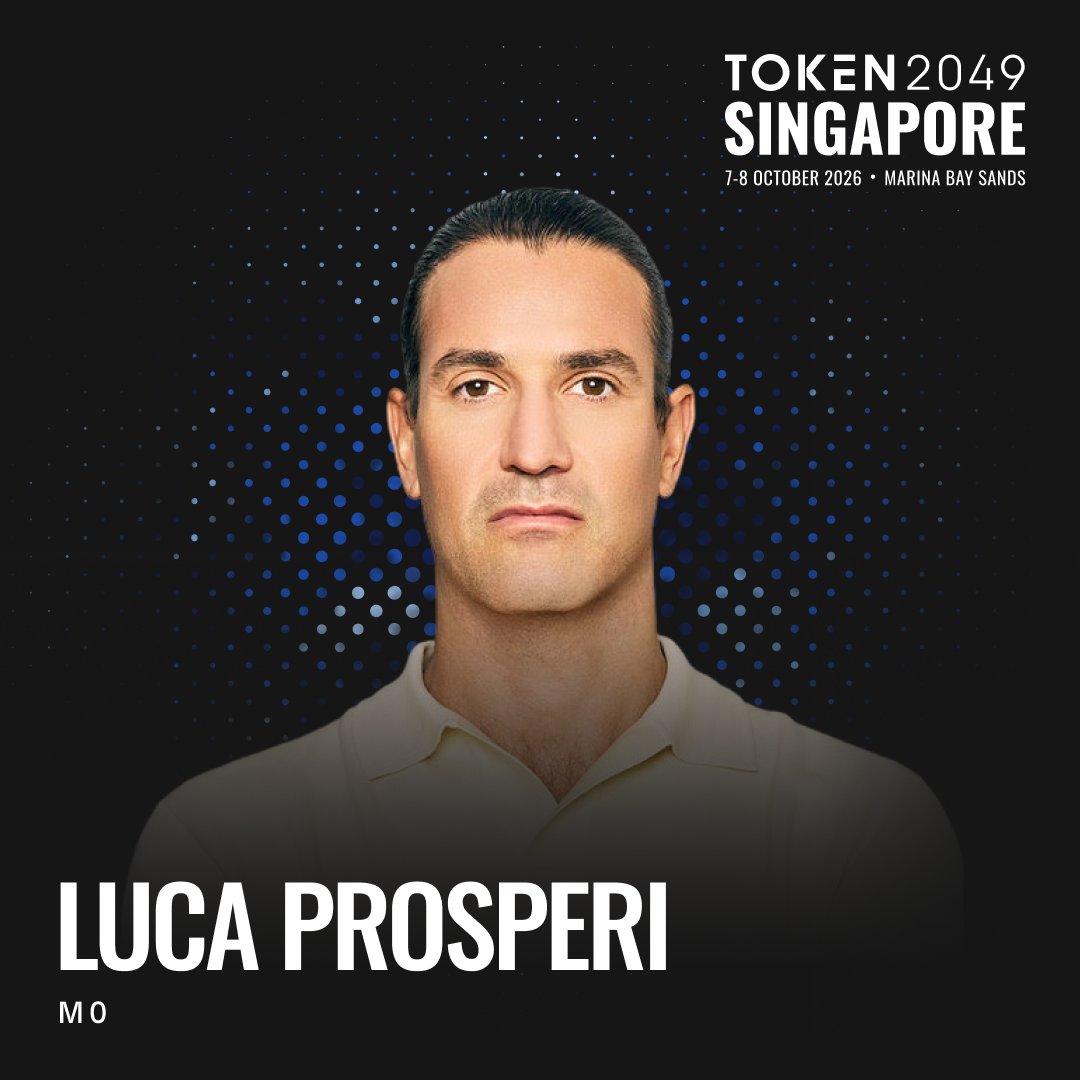
At @token2049, @LucaProsperi breaks down what's next: programmable money you can configure, compose, and build on.
🗓️ Oct 7
🕔 5 PM
📍 Bit Digital Stage - Level 5
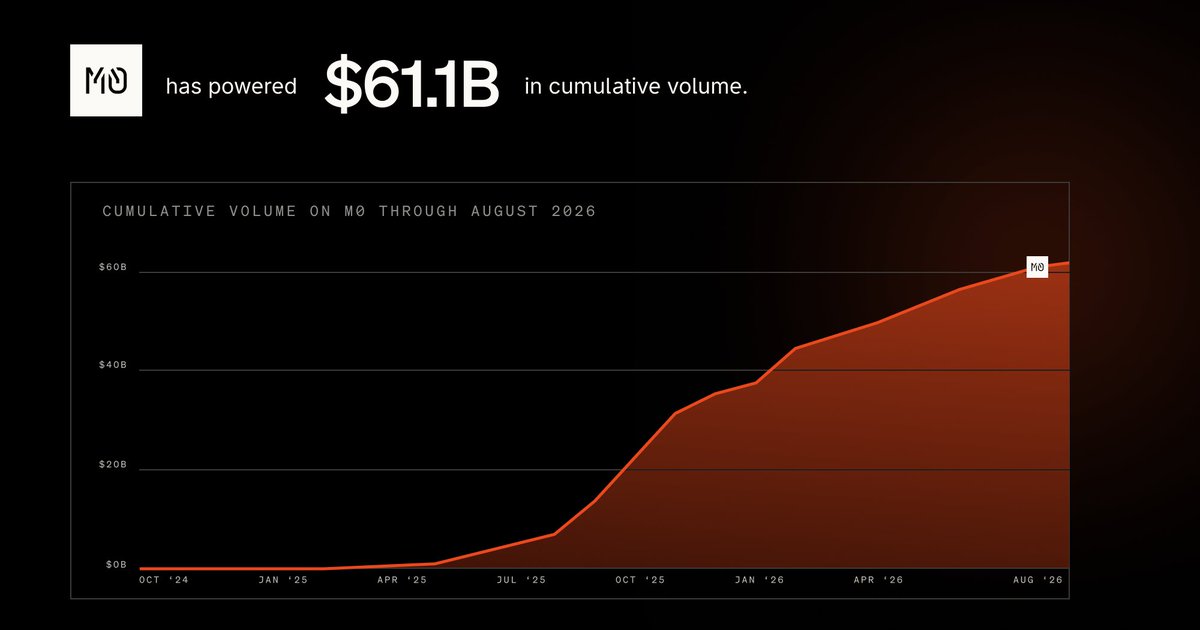
Since M0's onchain infrastructure launched in June 2024, we've processed over $61.1B in volume.
Businesses use M0 to build and operate 20+ onchain products and we're very thankful for our network of powerful and innovative builders.
Onward!
Heading to @token2049 Singapore? Here's where to find M0:
📍 @token2049: October 7, 5:00pm on the presentation stage
📍 @PanteraCapital's thought leaders summit: October 7, 2:15pm
📍Definition Summit: October 7, 2:55pm
📍 @stblcnsummit: October 8, 3:35pm on the main stage
Come say hello and talk to the team.
Proud to have @dawninternet building on M0.
The USD.infra Vault is the capital layer for digital infrastructure, connecting onchain capital with RWAs and the cash flows they generate.
More soon.
A $$$ balance is the output of a complex technology and control stack. How value is created, secured, allocated, will reshape the entire society the same way data availability did.
At @m0 we intend to be the pioneers in creating the technological primitives that help developers of great stuff (whether those are humans or machine) connect with the most trusted payment and banking rails. This is what we are doing with @PayPal and @moonpay.
There is so much to do that my head hurts.
Incredibly excited and proud of the @m0 team for this major launch with @PayPal and @MoonPay.
@m0 started its journey with a monolithic, opinionated issuance and monetary network protocol on Ethereum mainnet. It quickly found its match with the white-labelled stablecoin platform, powering the launch of 20+ stablecoins — including major stables like $mUSD by @Consensys, $MGUSD by @MoneyGram, and $USDK(y) by @KASTxyz, among others.
Now that same model is replicated and amplified in the PYUSDx platform with @PayPal, finding adoption with major partners like @saturn_credit, @concreteXYZ, @CapApp, @USDai_Official, and @0xfairblock across issuance and liquidity services.
Every iteration is better than the last — less effort, more substantial outcomes. Scaling works. It's not day 0, but it's definitely still only the beginning.
Programmable money is the true financial innovation of our time. So let's actually make money programmable, not just talk about it. NOBODY does it better than M0.
Excited to partner with @PayPal and @moonpay on this.
PYUSDx already crossed $100 million in scale and it’s only day 1.
@PayPal, M0, and @Moonpay have launched PYUSDx, a developer platform designed to let builders create their own onchain products, fully backed by PYUSD.
Three companies are live. Two more are coming soon.
For me, PYUSDx is the first sign that the programmability layer of money is becoming a thing.
We've been talking about it for years, but this is the first time we're seeing real commercial demand for that part of the product. It's a trend I expect to continue.
PYUSDx already crossed $100 million in scale and it’s only day 1.
@PayPal, M0, and @Moonpay have launched PYUSDx, a developer platform designed to let builders create their own onchain products, fully backed by PYUSD.
Three companies are live. Two more are coming soon.
As promised, #69 is out, focused on Vaults, Risk Management, and the Curator concepts. Link in comments.
Part I of DR series on on-chain lending ran hot in DeFi circles for a few weeks. Unexpectedly, for me, given the nerdiness of the exercise. Two weeks later came the Kelp episode: a reminder that risk-free rate levels do not mean risk-free exposure. A lot has happened since.
On @Morpho's largest markets, 90%+ of lender liquidity is intermediated via vaults. Curators set mandate, whitelists, caps, they manage liquidity and promote strategies. In TradFi, those functions would sit in different entities in deliberate tension. Here, in one. @SteakhouseFi, @gauntlet_xyz, @SentoraHQ, and others have emerged as key players in the current era of DeFi.
Curators are paid to promote (assets - via bilateral agreements), to allocate (AuM), and make money (performance), but have no exposure to the downside. Their answer, most probably, would be that they merely watch programmatically vaults in the interest of the depositors and sometimes asset issuers, and do not take any discretion in risk underwriting. This is true, but for a subset of on-chain lending markets. The good one.
The unfortunate truth is that it's the other subset that is growing the fastest. @RobinhoodApp's main vault, freshly launched, and powering their Earn product, allocates 65% of depositors' liquidity into a tokenized multi-strat hedge fund @ethena, and 25% to a (overcollateralized tbh) lending desk to trading firm (@maplefinance). Interesting, the vault's native yield sits still at 3.84% - basically the 3-month bill. Plus a bunch of incentives. The supply/ demand mismatch is real.
But what are vaults? Or better, what are the incentives underpinning vaults? It is my belief as a micro-economist that it is by studying incentives that we can predict outcomes. So I modeled a vault redemption queue as a game: one unobservable state variable, three players - including depositors split between the attentive and the asleep.
In a vault backed by opaque collateral with imperfect information, sleeping depositors are the arbitrageur's liquidity. Vaults with a large fraction of inattentive depositors, i.e. arguably most retail-based vaults, are truly hunting grounds for the most informed. A platform subsidy exacerbates the problem, making staying (or rather not watching) even more attractive. While I am not suggesting misbehavior, and I believe firmly in the professionalism of most parties involved - many of them I know personally and professionally, there is no incentive tension in the vaults landscape today, and nobody is looking after the depositors. Not even the regulator.
To be fair, on July 22, Commissioner @HesterPeirce, the SEC's most consistently crypto-sympathetic voice, brought attention to vaults, placing them on a spectrum from programmatic to fully discretionary, and raised concerns related to Howey, the '40 Act, and adviser status. We will see what will follow.
While the advancements of non-intermediated finance are real, and in some cases extremely promising, fast generalization and no red tape can hurt people badly. We have been here before. A bad outcome doesn't need bad actors. It needs a bad setup. That setup is currently the category's growth engine.
The M0 network today:
◼️ $271M+ in stablecoin supply, live across 19 M0-powered stablecoins.
◼️ $24.8B in annualized transfer volume.
◼️ $15M+ in rewards distributed.
@WeAreAzerion Sports & @onopenxyz
Join Forces to Bring Football Fandom Onchain! As the legendary Johan Cruyff once said: "You have to shoot, otherwise you can’t score."
Who should be next to join the movement? Tag your favorite club and let them know it’s time to go onchain! ⚽
Builders like @MoneyGram, @MetaMask, and @KASTxyz have live stablecoins on M0, with more on the way.
That's what modular stablecoin infrastructure looks like. Build around your business, choose your regulated issuer and switch anytime.
.@MoneyGram was intentional about how they designed their stablecoin MGUSD - choosing their partners carefully, layer by layer. They chose M0 to architect the on-chain technology: minting, burning, rewards, compliance, deployment across chains.
That's modular stablecoin infrastructure in practice.