@DCFaisalabad@GovtofPunjabPK@CS_Punjab Why waste money, when was that stadium used?
Just to make commissions and kick backs
Tax money is stadium mein lagi kursiyon ki tarha farigh logon ki kamai nahi hey
which VM type/size is recommended for #Azure to run Ubuntu; will be running Docker / Elasticsearch consuming about 2 gigs memory and generating 1gig data per day (which I will rotate)
is there any #copilot to get such suggestions :)
@DCFaisalabad should dig into this
as a resident of not Lahore and paying GSTs and other taxes equally i am sick of seeing lda videos about underpasses and overpasses, and we don't have a single city transport here WHY?
Any comments from politicians like @RanaSanaullahPK ?
it was genius to make / let these cuts in the middle of the road (d ground example) and not along the footpath few feet away to save thekeydar/tendar money because the road was made from crrrency that grew on d ground trees
@DCFaisalabad@SNGPLofficial
thank you @SNGPakistan#faisalabad for ruining the city and great work @DCFaisalabad for letting it happen and keeping quite, farishtey ayein gein inhey bharney
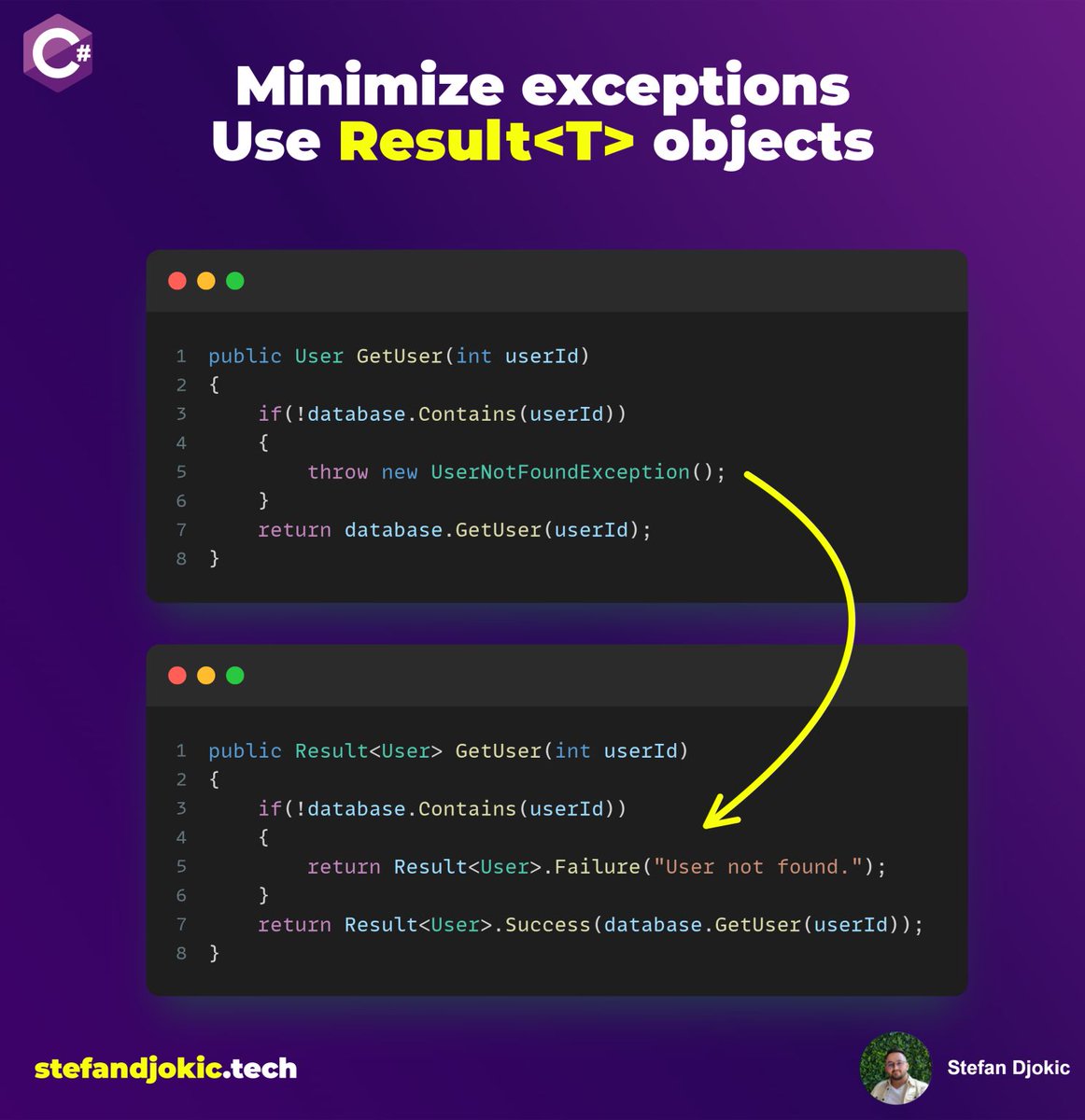
Exceptions should be rare.
Minimize them. Try something else 👇
Throwing and catching exceptions is slow relative to other code flow patterns. Because of this, exceptions shouldn't be used to control normal program flow.
Recommendations (by Microsoft):
• Do not use throwing or catching exceptions as a means of normal program flow, especially in hot code paths.
• Do include logic in the app to detect and handle conditions that would cause an exception.
• Do throw or catch exceptions for unusual or unexpected conditions.
The Elegance of Result Object:
A Result object encapsulates the outcome of an operation cleanly and expressively. It's designed to convey the result explicitly, without relying on exceptions. The beauty lies in its simplicity.
Why use the Result object?
Expressiveness:
By just looking at the function signature, one can deduce the possible outcomes, making the code self-documenting.
Performance:
This paradigm avoids the overhead associated with throwing and catching exceptions, especially in expected error scenarios.
Unified Error Handling:
Errors are now values that can be passed around, manipulated, or logged, making error handling more uniform and predictable.
Extensibility:
It's easy to extend the Result class to carry additional metadata, validation errors, or other contextual information.
I will show how to implement the Result<T> object in the next .NET Pro Weekly Newsletter issue, tomorrow morning.
9600+ engineers will read it.
Join them for free: https://t.co/ohkw4L49JW
#dotnet
@davidfowl .Net 5, Linux Containers, Task Parallel Library and community support of .Net (Elasticsearch, RabbitMQ etc) all enabled us to develop a forward looking ISP scale Network Monitoring System. We kept it updated and evolved..
Ok, I've had quite a bit of fun the past few days creating "cloud native (POCO) actors" on top of @msftorleans. My goal was to have a uniform interface (message-based, "IActorBus" essentially) that can also (optionally) support #EventSourcing https://t.co/kJh0rBjc6e
@davidfowl some cool way to implement interface inline, delegate styled, say if some method expects ISomething, provide the implementation when making a call, i think Java has this feature