Grok Bot runs my personal life. Claude Code and Codex help me at work.
By day I train corporate staff and run digital clinics, helping teams build their own solutions and get the most out of GenAI.
I learn from X every day and share what actually works here. Based in Singapore.
Elon Musk says Grok Bot is "like hiring an incredibly competent chief of staff". I actually have a bot with that title, so here is how mine works.
Kaiju is my chief of staff bot. It writes my morning brief and keeps the rest of my bot team in sync, and each of the others has one job:
- one drafts my X posts and never posts them
- one handles coding work with Claude Code
What makes it useful is less the model and more the boundaries:
- posts and emails wait as drafts until I approve them
- time-sensitive tasks become calendar reminders I act on
- each bot keeps its own notes, so jobs don't blur together
A good chief of staff still checks with you before committing you to something. I treat my bots the same way.
The Claude Code team shared how they review code when Claude writes about 90% of Claude Code itself.
From June to September, merged pull requests more than doubled while the share that had to be reverted fell by more than 40%.
What stood out to me:
- Claude verifies its own work first (tests, a build or a screenshot), then a fresh-context subagent reviews the diff
- Human approvals scale with risk: none for low-risk changes like docs once automated review and security checks pass, one person for ordinary or sensitive changes, two for the riskiest code
- An agent's approval never counts as a human one
- After three review rounds, the author is asked to rethink the approach
The part I like most is that people still own the outcome. Automation does most of the reading, but a person decides whether something should be built and answers for what ships.
The easiest piece to copy is a short REVIEW.md alongside CLAUDE.md, so repeated review comments become rules. I'm going to try that on my Svelte projects first.
Source: https://t.co/JKtGqfm9GN
Apple calls the new iPad mini its biggest update ever: an 8.5-inch OLED display, A20 Pro, IP67 and a 5.4 mm body. It starts at $699, with pre-orders from 28 Oct and availability from 6 Nov.
What stands out:
- 1200 nits peak brightness, nano-texture glass on 256GB and up
- No ProMotion listed in the specs
- $200 more than the 2024 model's $499 launch price
For me the appeal is a reader and note-taker that fits in one hand, now with more headroom for on-device Apple Intelligence. The trade-off is that at $699 it is no longer the easy value pick, so I think it suits people who specifically want the small size.
Source: https://t.co/8bx73Iu7Yx
Elon Musk says Grok Bot can now phone someone or a business for you.
Per his post, it can:
- make a request on your behalf
- take notes on the response
- send you a note summarising the call
Prerelease 0.77 builds also show a calls panel, an on-hold status and a pressed-keys readout, so it looks built to sit through hold queues and phone menus. Those features may not all make it into the public release.
My Grok Bot team already handles a lot of my personal admin, and anything that goes out under my name waits for my approval first. A phone call is the same kind of action and it can't be unsent, so I'd want the same rule: I approve who it calls and what it asks before it dials.
Still, sitting on hold is the first chore I'd hand over.
Builds: https://t.co/rKhG2iXj89
Grok @Bot can now call someone or a business for you, make a request on your behalf, take notes on the response and send you a note summarizing the conversation!
Kylian Mbappé scored both goals in Real Madrid's 2-1 win over Barcelona at Camp Nou, and the second was his 100th for the club in his 116th game.
A quick pace by any measure. The result also leaves Madrid three points behind leaders Barcelona.
Source: https://t.co/uTa11zc85D
Anthropic's advice on agents last week: fewer subagents, more skills.
Their Applied AI team found that across several enterprise deployments, one agent loop that loads skills and tools on demand frequently beat specialist subagents on quality, often at lower cost and latency per task. One customer saw a roughly 2x faster runtime than with their multi-agent setup.
Subagents still make sense when:
- one loop measurably degrades from context bloat
- tasks need to run in parallel with fresh context windows
- a single agent struggles to pick the right tools
The line that stuck with me: when every team gets its own subagent, the agent architecture becomes a copy of the org chart.
They also cut Claude Code's system prompt for more advanced models by over 80%, partly by loading skills and tools only when needed.
My take: split agents by context, not by job title. And measure before folding anything in. In their own test on a sample support agent, a merge that lowered latency also broke a process that had been passing.
Source: https://t.co/AeMpUf6bkY
@IliyaOblakov Auto mode seems to work fine to switch by itself, but we do need to flip the switch occasionally when we aren’t getting the results we want.
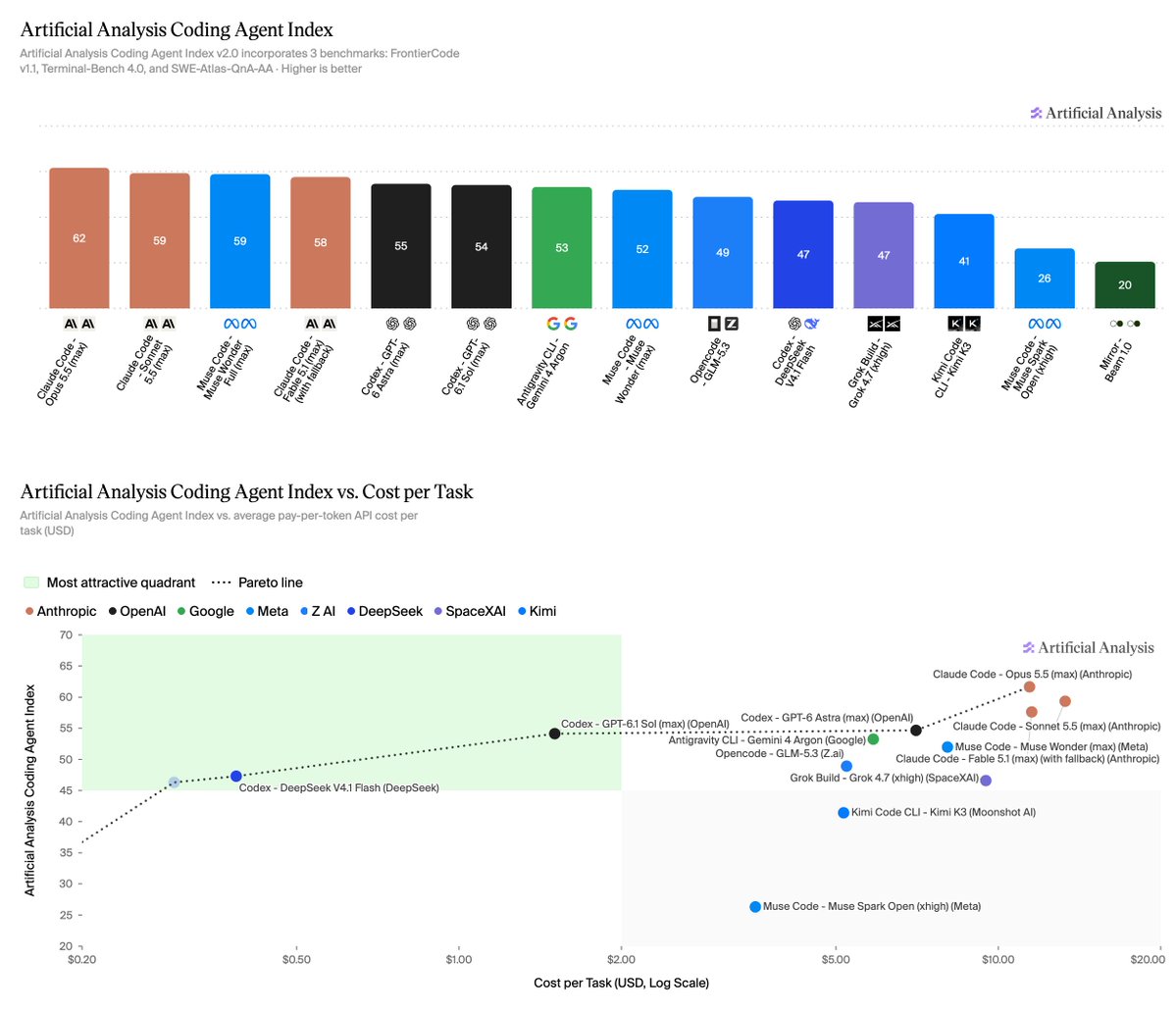
Claude Code with Opus 5.5 tops the new Artificial Analysis Coding Agent Index, but the cost column is what I keep coming back to.
Index v2.0 scores each model together with its agent harness across 290 tasks: software engineering, terminal use and repo Q&A. The four setups on its cost frontier:
- Codex with DeepSeek V4.1 Flash: 47.3 at $0.39 per task
- Codex with GPT-6.1 Sol: 54.1 at $1.50
- Codex with GPT-6 Astra: 54.7 at $7.04
- Claude Code with Opus 5.5: 61.7 at $11.42
All at max effort, and these are pay-per-token API costs, not subscription prices.
Claude Code is what I use every day, so the top score doesn't surprise me. What I find more useful is the spread. For routine tasks, a setup at a fraction of the cost may well be enough.
Scores will keep moving, so I read any leaderboard as a snapshot, not a verdict.
Announcing Artificial Analysis Coding Agent Index v2.0: FrontierCode v1.1 from Cognition replaces DeepSWE, SWE-Atlas-QnA grading is revised, and Claude Opus 5.5 in Claude Code leads at 61.7
Today we are launching v2.0 of the Coding Agent Index. The Index evaluates models together with their agent harnesses, now across 290 tasks covering software engineering, terminal use, and repository Q&A, with the three benchmarks weighted equally.
Changelog (Index v1.5 → Index v2.0):
→ FrontierCode v1.1 replaces DeepSWE v1.1. FrontierCode is a benchmark from @cognition with a private test set: 100 software engineering tasks on real open-source repositories, graded on whether a maintainer would merge the change. An attempt that fails a blocking check scores zero, and one that passes them all scores between 70% and 100% depending on the non-blocking checks it meets. We also scan each trajectory with a modified version of Cognition's rule-based scanner, and any attempt flagged for accessing solution material scores zero.
→ Revised SWE-Atlas-QnA grading, now SWE-Atlas-QnA-AA. Scale AI's 124 repository Q&A tasks are unchanged. We reworded 127 of the 1,306 rubric criteria for more consistent verdicts and moved to GPT-6 Luna (xhigh) as the judge, with five votes per criterion. The dataset and judge configuration are published on Hugging Face.
Key results:
➤ Claude Opus 5.5 leads the Index: Claude Code with Claude Opus 5.5 (max) scores 61.7, followed by Claude Code with Claude Sonnet 5.5 (max) at 59.3, Muse Code with Muse Wonder Full (max) at 58.9 and Claude Code with Claude Fable 5.1 (max with fallback) at 57.6.
➤ FrontierCode v1.1 is where Opus 5.5 pulls ahead: Opus 5.5 scores 56.0% on FrontierCode, ahead of Codex with DeepSeek V4.1 Flash (max) at 52.6%, Codex with GPT-6.1 Sol (max) at 49.4% and Codex with GPT-6 Astra (max) at 49.3%. Below the top, FrontierCode scores are tightly packed: 15 of the 24 configurations on the Index score between 43% and 49%.
➤ SWE-Atlas-QnA-AA grading is stricter and more consistent: across the 21 configurations evaluated on both Index versions, the mean score falls 1.7 points, from 58.8% to 57.1%, with 14 of 21 moving down. Individual configurations move by up to 7 points: Muse Code with Muse Spark Open (xhigh) falls 7.0, Kimi K3 in Kimi Code CLI and Codex with GPT-6 Luna (max) 6.2, and Muse Code with Muse Wonder (max) 5.6, while Codex with GPT-6.1 Sol (max) gains 2.1.
➤ Four configurations sit on the cost frontier: Codex with DeepSeek V4.1 Flash (max) scores 47.3 at $0.39 per task, Codex with GPT-6.1 Sol (max) 54.1 at $1.50, Codex with GPT-6 Astra (max) 54.7 at $7.04 and Claude Code with Claude Opus 5.5 (max) 61.7 at $11.42. Costs are pay-per-token API costs, not subscription prices.
We will keep updating the Coding Agent Index incrementally, with more evaluations and agents to come.
Majority of the work that we do can be handled by smaller cheaper models. It’s only when we’re developing something technical that we push for higher effort levels. So by default it’s just Auto mode which is the default in M365 Copilot (that’s what we use in our org). I personally use Claude all the time.
Giving an AI agent a password should never mean pasting it into chat.
My Grok Bot team handles a lot of my personal admin, and my firmest rule is that any password, code or key goes into a masked input box, never into the conversation. For some sites I still take over the screen and sign in myself.
1Password for Agents, announced on 22 Oct, tackles exactly this:
- The agent asks for a specific login from your vault
- You review and approve the request in 1Password
- 1Password fills it in directly on the site, so the agent never sees the password or one-time code
Grok Bot is one of the launch integrations, listed as rolling out over the coming days. Claude Duet and ChatGPT Work are marked as coming soon. It's included at no extra cost for 1Password Individual and Family accounts on https://t.co/YRabRcQZiO.
It doesn't replace deciding what each agent should be able to reach. Least privilege still matters. But approve and autofill is a far better default than copy and paste.
Source: https://t.co/CcC2zZ79SQ
In Claude Code, people approve 97% of permission prompts. Starting this week, most Claude apps will stop asking for most of them.
What's changing:
- Claude web, desktop and mobile move to auto mode by default on Pro, Max and Team
- An automated check blocks risky actions instead of asking you to approve each step
What Anthropic's data shows:
- In a controlled study with 1,053 paid testers, people caught the dangerous command 13.6% of the time. Auto mode blocked 89%
- In Claude Code, users reject 39% of proposed plans, but only 3% of permission prompts
That makes sense to me. When you approve almost everything, you stop reading closely. Auto mode still misses some, though.
Worth setting up before the switch:
- Review the plan rather than every action
- Keep a short list of actions that always need you (sending, deleting, paying, sharing)
- Add one line to your project instructions: "Ask me before any of these"
My Grok Bot setup works the same way. The bots handle the work, and anything sent under my name waits for my approval.
Source: https://t.co/51b6VdD7mD
@poteto not sure why, but image/photo uploads just doesn’t work properly on my iPhone 16 Pro. It’s just loading forever and when I restart Grok bot, the attachment disappears. Anyone facing this issue?
I have been struggling a lot with this as well. While people keep saying AI is amazing, AI can do most of what you do, there’s always that nagging feeling that you’re constantly behind. I think that’s totally fine! Take a step back and rewind a little, have fun while you’re at it!
Nifty feature which makes accessing your Grok bot easier now! I wish I can invoke dictation instead though, since I prefer reading the output sometimes for information-dense responses.