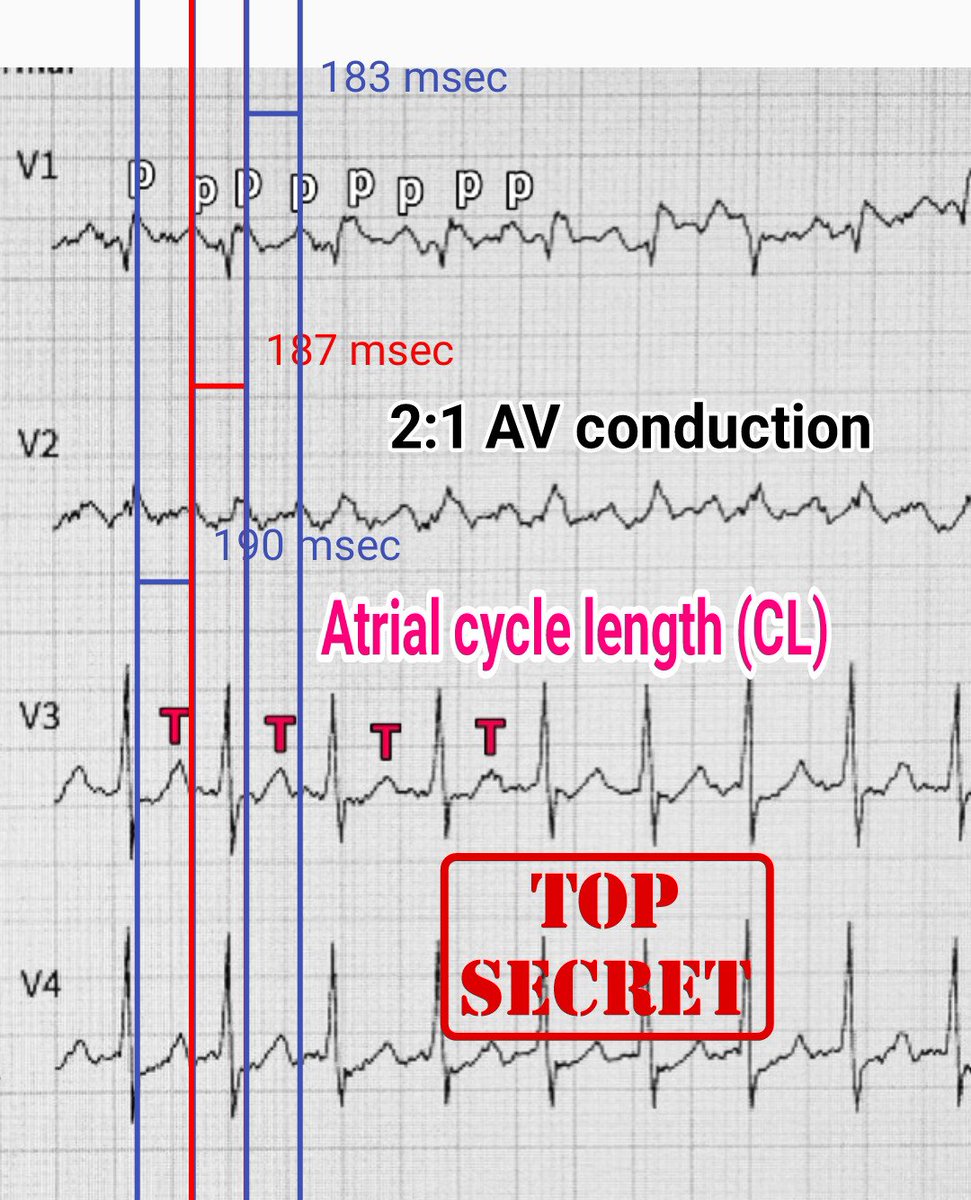
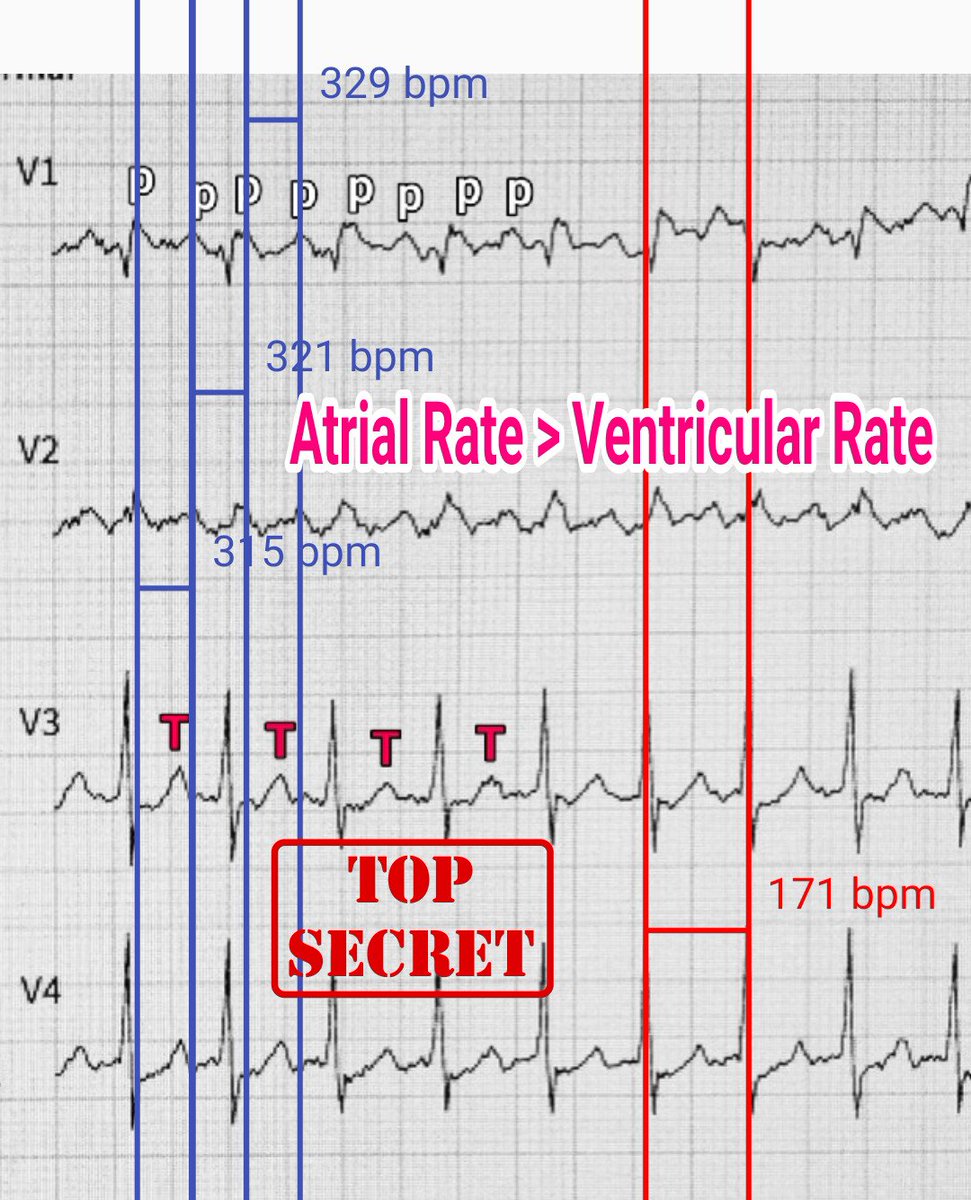
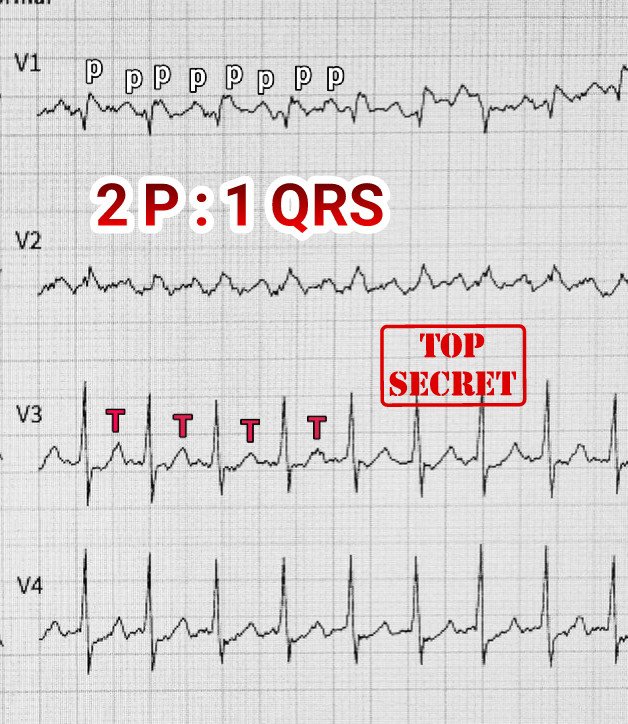
#ECG shows regular NCT with HR ~ 171bpm:
1. P>QRS or A>V in 2:1 conduction
2. +P wave seen in V1
3. - P wave seen Lead 2 with on P wave embedded in QRS (Bix's rule)
4. Atrial rate, CL and P wave oscillation beyond isoelectric line suggests flutter waves.
🔺2:1 Typical CCW AFL
🫀 CardioNugget™ |
The new “CPR” of ASCVD risk assessment
The 2026 Dyslipidemia Guideline says: Don’t just calculate risk → refine it.
Think C → P → R 👇
🧮 C = CALCULATE
Start with PREVENT-ASCVD → “What does the calculator say?”
→ Estimate 10-year ASCVD risk
👤 P = PERSONALIZE
Now ask → “What does PREVENT NOT know about my patient?”
Look for risk enhancers such as:
• Family history of premature ASCVD
• ↑ Lp(a) / apoB / hsCRP
• Chronic inflammatory disease
• Persistently ↑ TG or LDL-C
• Reproductive risk factors
• Higher-risk ancestry
🫀 R = RECLASSIFY + REASSESS
Still unsure about lipid-lowering therapy?
→ Consider CAC to reveal whether atherosclerosis is actually present
→ Reclassify risk and reassess treatment.
🧠 Think of it as:
PREVENT = estimated risk
⬇️
Risk enhancers = personalize the estimate
⬇️
CAC = break the tie when uncertainty remains
💡 CPR = Calculator → Patient → Plaque
#CardioNuggets #PreventiveCardiology #ASCVD #Lipidology #CAC #PREVENT
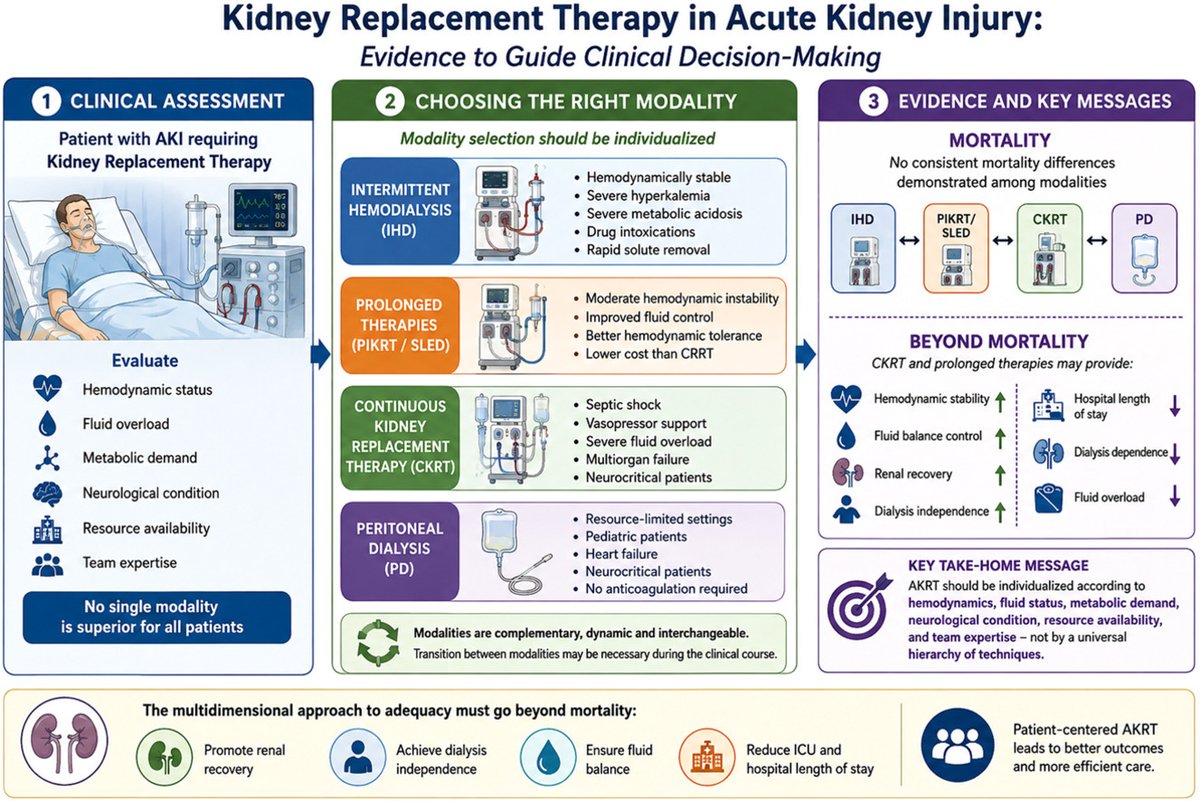
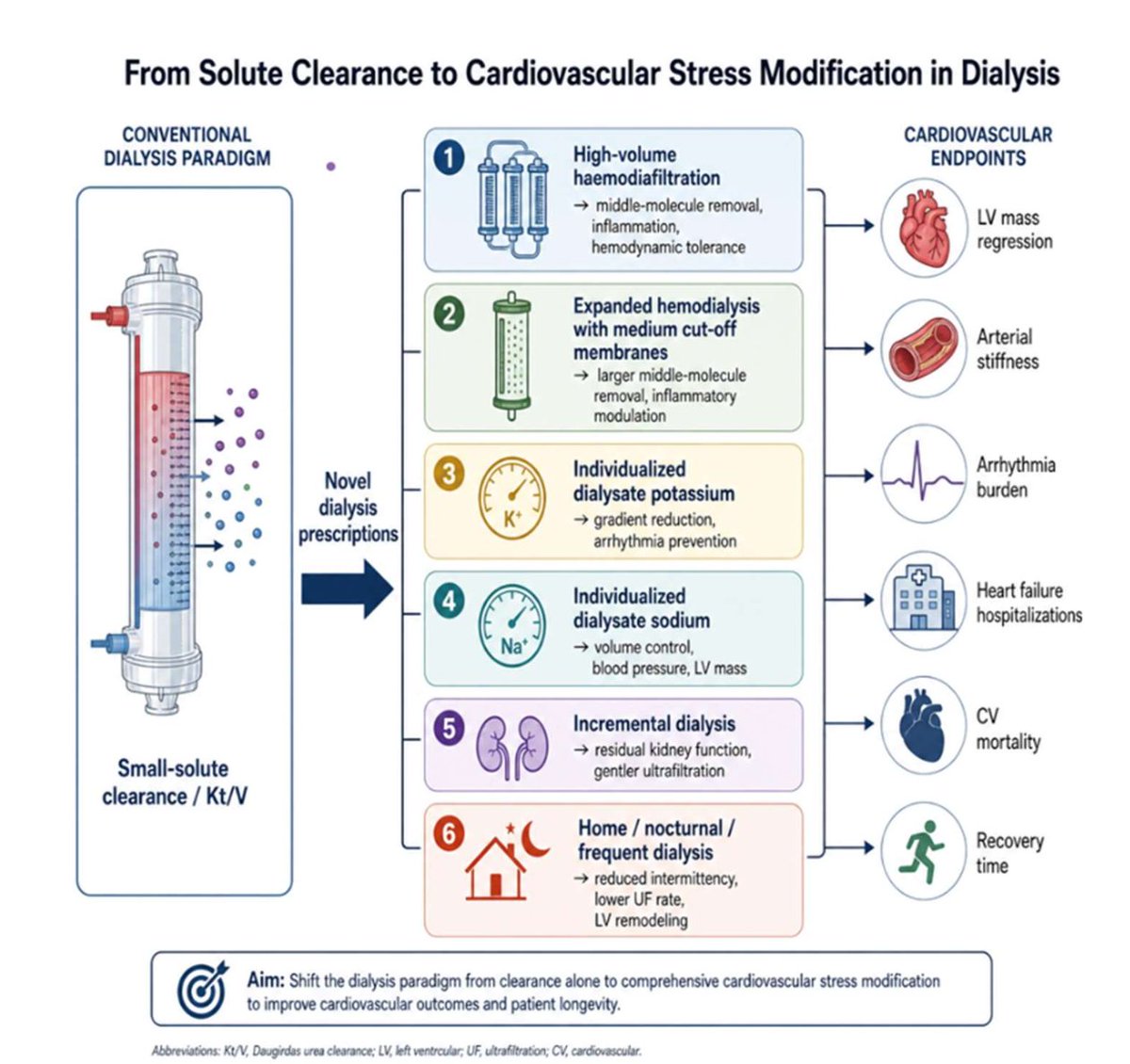
Dialysis adequacy MUST move beyond urea kinetics, and some of us have stated this for years.
🫀The dominant threat is cardiovascular stress: volumes, electrolytes, arrhythmia, LV load, inflammation... Kt/V is not enough
#nephtwitter#nephX
https://t.co/TN5R6odxti
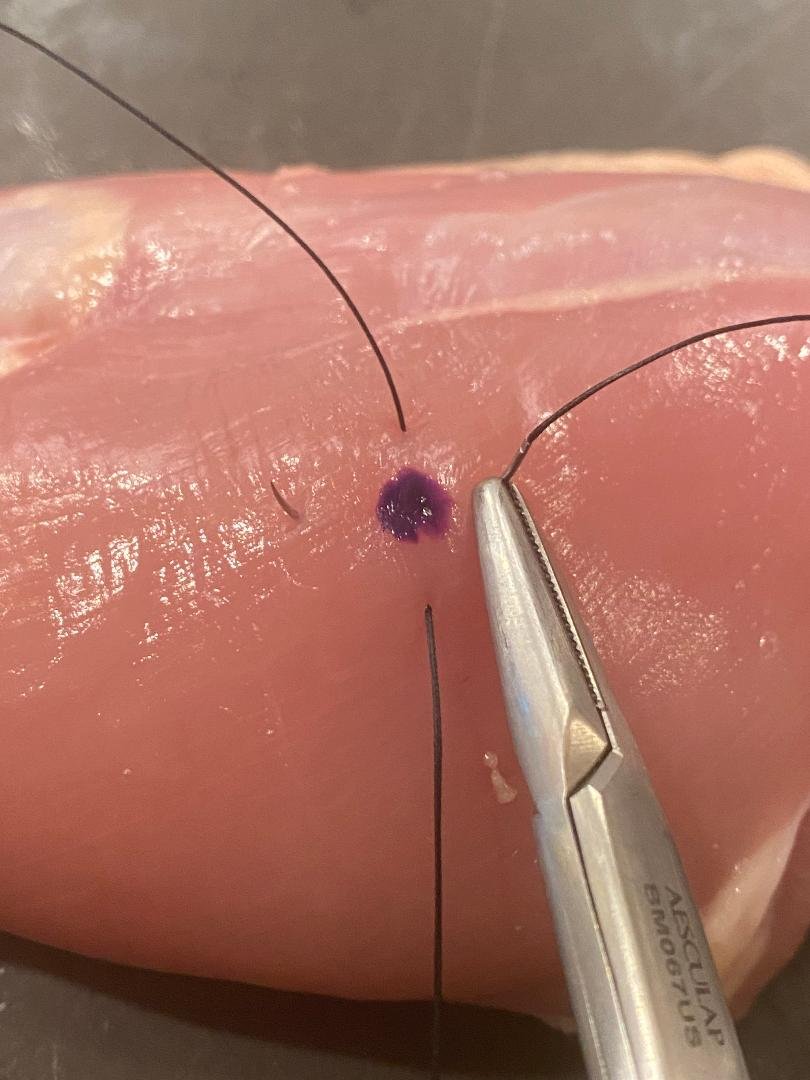
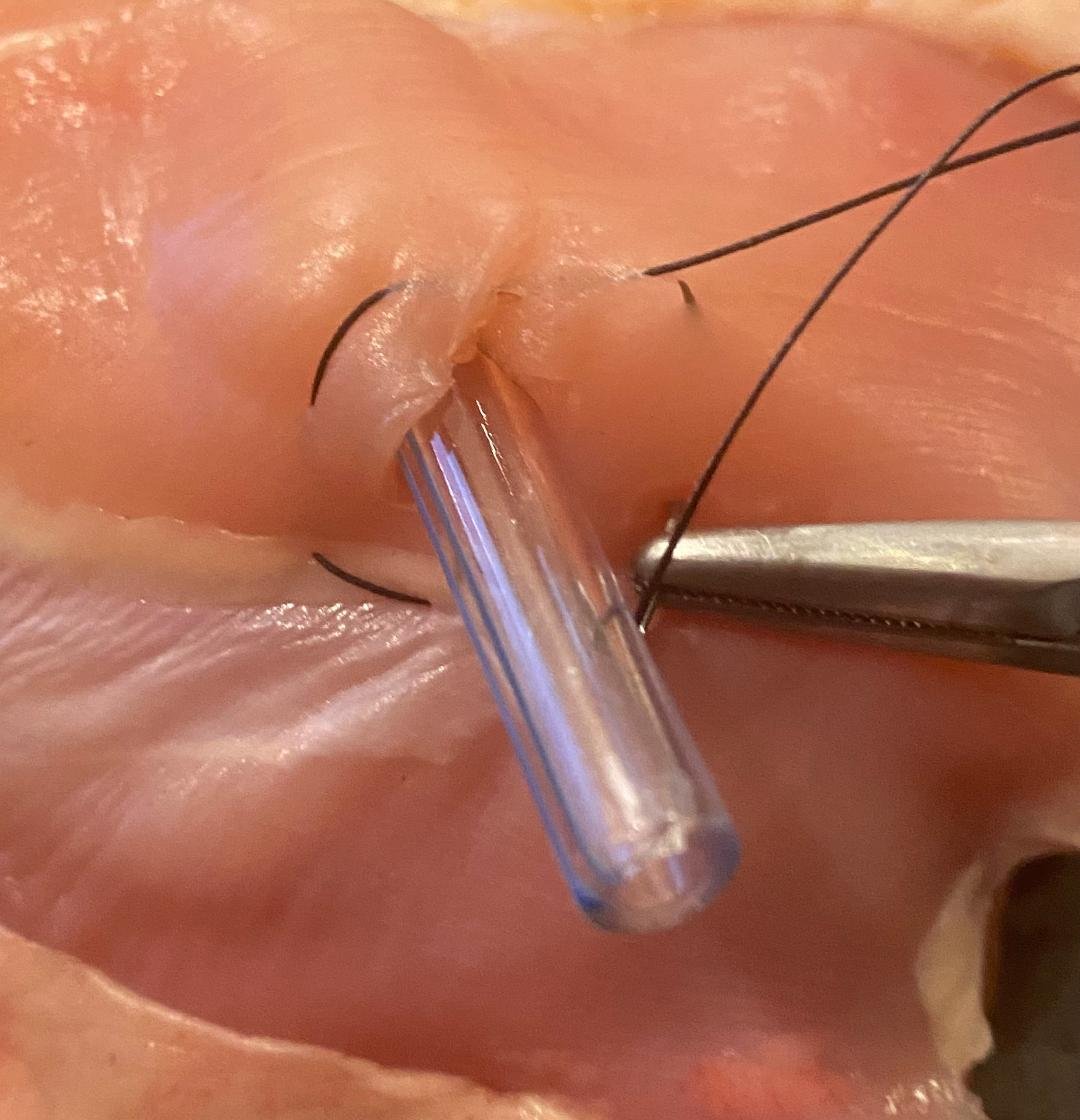
🧵OK, I'm doing a talk next week to a group that won't have any idea why I'm there, so I'm going to repost some of my older 🧵
This one is on the 'figure-of eight' and also the 'pursestring' sutures.
We'll go over what they're for and some technical pointers and pitfalls.
You have to understand. Spending 1 hour per day on brainrot is insane. That's about 6% of your waking day. About 5 years of your waking life. Half a decade. On brainrot. Just gone. Zero return. Zero fulfillment. Zero meaning. Zero contribution to the other parts of your life.
Retirada de la aspirina en la Enfermedad Coronaria. 🤔🚫💊
✨️Aquí un buen resumen de toda la evidencia sobre las estrategias de desescalada o abreviadas. 🔎📚
🔴 No retirar demasiado pronto: se debe evitar la suspensión de ASA durante los primeros 30 días [NEO-MINDSET trial].
🟢 Después de 1–3 meses, la estrategia mejor respaldada es suspender aspirina y continuar ticagrelor en monoterapia en pacientes seleccionados tras ICP [TWILIGHT, TICO y ULTIMATE-DAPT trials].
🟠 Clopidogrel no es equivalente a ticagrelor en este escenario. La monoterapia precoz con clopidogrel después de SCA tiene evidencia menos consistente; STOPDAPT-2 ACS no demostró no inferioridad. Además, hasta 1/3 de los pacientes presenta alta reactividad plaquetaria con clopidogrel (CYP2C19 loss-of-function).
🔵 Si existe indicación de ACO (por FA lo + común), este es uno de los escenarios con mayor respaldo para retirar aspirina: después del periodo inicial (1 sem - 1 mes), mantener ACO + iP2Y12 (clopidogrel, de preferencia) reduce sangrado frente a terapia triple.
📝🆓️⤵️ State-Of-The-Art Review2026 @JACCJournals 💯
https://t.co/NaA78PZxg5
https://t.co/m1yndmf03Q
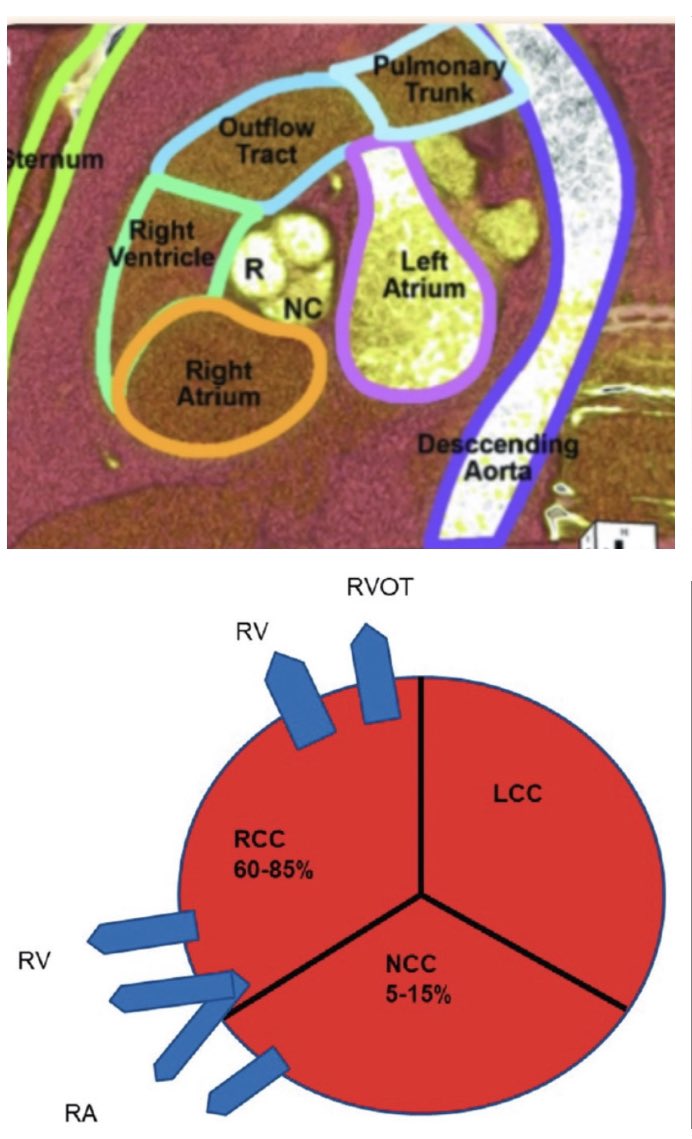
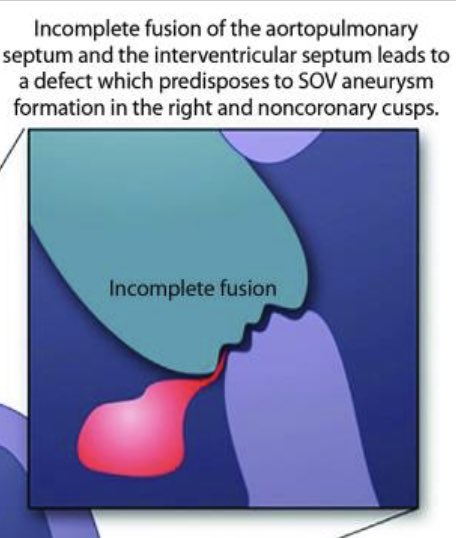
why do most sinus of valsalva aneurysms involve the RCC?
Form follows function
Incomplete fusion of aorta pulmonary septum &inter ventricular septum creates weakness in the central fibrous body? #echofirst
https://t.co/tR02ONfAda
https://t.co/9TuHqDZupi
https://t.co/x0r9MlJjqE
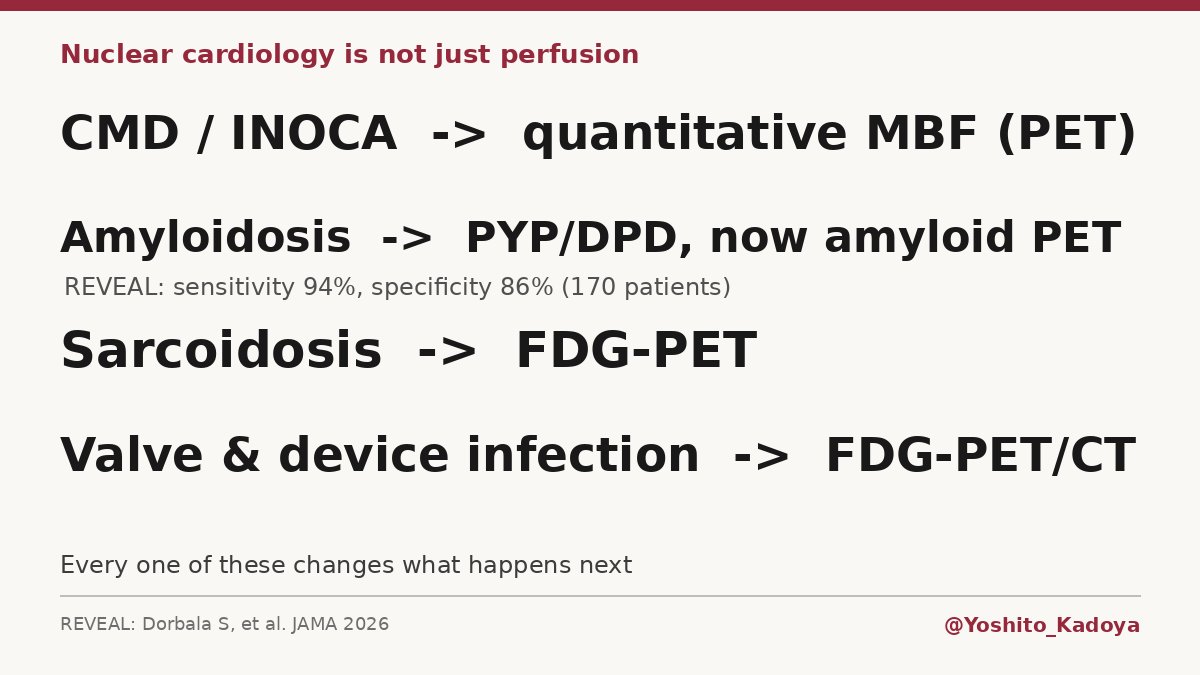
🫀 Nuclear cardiology is not just perfusion.
📈 CMD / INOCA → quantitative MBF on PET
🧬 Amyloidosis → PYP/DPD, and now amyloid PET
🔥 Sarcoidosis → FDG-PET
🦠 Valve & device infection → FDG-PET/CT
More cardiologists belong in this field!
🔍 Why it matters
Every general cardiologist sees these patients, and the nuclear study changes what happens next.
📊 Two numbers from this year
REVEAL (JAMA): 124I-evuzamitide PET, 170 patients with suspected amyloidosis → sensitivity 94%, specificity 86%.
Our PET data: 3,317 patients with "normal" perfusion, 8.5-y follow-up → MFR + stress MBF still split low from high risk.
⚠️ The catch
PET needs a tracer supply, trained staff and a business case. FDG needs proper diet prep.
Not plug-and-play.
💭 My take
After five years at the Ottawa Heart Institute, I am now helping build BC's first cardiac PET program at St Paul's.
If you are in training: this is where cardiology is growing!
📄 Dorbala S, et al. JAMA 2026 (REVEAL). Kadoya Y, et al. JACC Cardiovasc Imaging 2026.
@MyASNC@HeartInstitute@CardioUBC@Providence_Hlth #CVNuc #ThinkPET
The vast majority of men don't wear tailored clothing often enough to warrant a large wardrobe. Thus, if you're interested in tailored clothing, the easiest way to avoid looking bad is to stick to very simple things:
— One "serious" suit in navy, mid-gray, or dark gray worsted wool. This should be single-breasted with notch lapels. You can wear this to weddings, funerals, religious events, and such.
— One solid-colored navy sport coat made from navy wool, likely hopsack or an open weave such as Mock Leno. This should again be single-breasted with notch lapels. This is the most versatile sport coat. It's the sort of thing you wear on Mother's Day.
— One or two other sport coats, likely mid- to dark brown. Make these from seasonal fabrics suited to your climate: wool-silk-linen if you live in a warm climate; tweed if you live in a colder climate. The fabrics can be patterned, but ask yourself when shopping — is this pattern something that a used car dealer or ESPN host would wear? If so, do not buy the jacket. These again should be single-breasted with notch lapels. Wear this when you want tailoring, but a suit looks out of place.
— One semi-spread collar dress shirt made from a smooth white cotton fabric, such as poplin or broadcloth. Avoid cutaway collars; they are gauche.
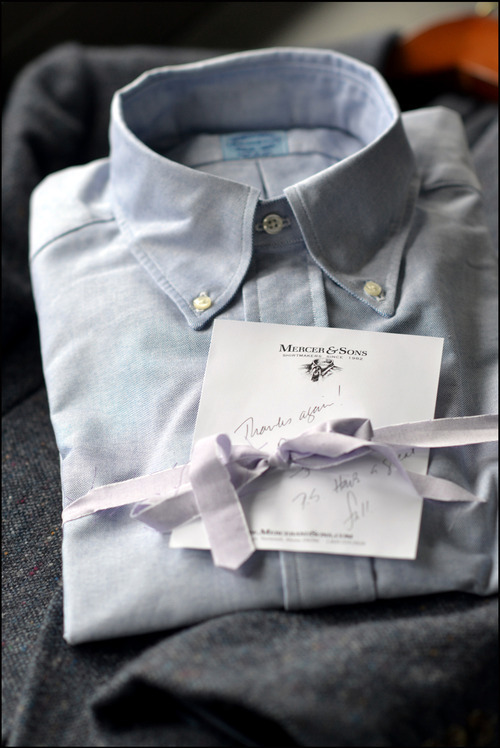
— A small stack of light-blue dress shirts — some solid-blue, some blue-white striped. If you're American and have any sense of pride in your country, get Oxford cloth button-downs where the collar points are long enough to give a full roll. If you're not American, or if you're a traitor to the United States, they can be semi-spread collars cut from smooth, pure cotton, such as broadcloth. Although I think end-on-end lends a bit of visual interest.
— A matte silk rep striped tie that's not too visually busy. Get this in a basic, sober color like navy, brown, or forest green. Always tie this with a four-in-hand. Never wear a full Windsor knot or anything too complicated (those weird knots that get lots of upvotes on Reddit).
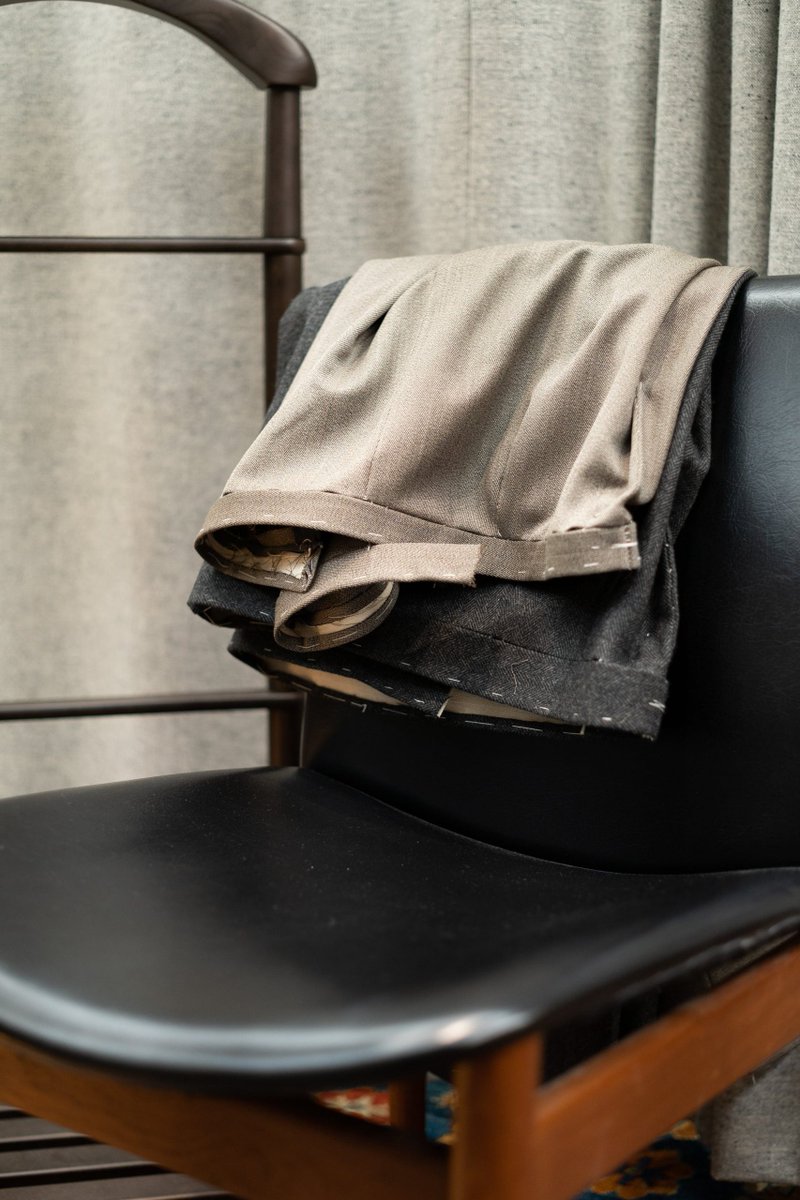
— Trousers made in a classic cut (high-rise, not too slim). These should be light gray, mid gray, or tan, and then cut from seasonal materials that make sense for your climate — tropical wool for warmer seasons; wool flannel, cavalry twill, or whipcord for cooler seasons. You can get them with flat fronts or a single reverse pleat. Do not ask "are pleats stylish?" In fact, stop asking how to look stylish, young, or fashionable altogether.
— Two pairs of Goodyear-welted, full-grain leather dress shoes in mid or dark brown. These can be derbies or penny loafers, since you'll likely wear sport coats, not suits. (Do not wear oxford shoes with sport coats). Never touch tan leather shoes. Or any dress shoes with a sneaker bottom.
— A leather dress belt that's about 1.25" wide. The color should be close to the color of your shoes — dark brown with dark brown, mid-brown with mid-brown.
— Solid navy over-the-calf dress socks. These can be thin cotton if you live in a warm climate. Otherwise, choose thin wool.
Do not try to get creative. Even sticking with this formula will be creative enough, as no one knows how to wear tailored clothing anymore. Thus, you will look elegant in a sea of bad made-to-measure tailoring, Italian checked fabrics, skinny pants, tan dress shoes, black dress shirts, ugly ties, and the like.
#POCUS answer
Parasternal RV inflow view demonstrating a pericardial effusion with diastolic RV collapse. You can pause the clip and compare it with the ECG to confirm the timing of when the RV wall invaginates.
Further reading on this view 🔗https://t.co/ZMXkIa9G5k
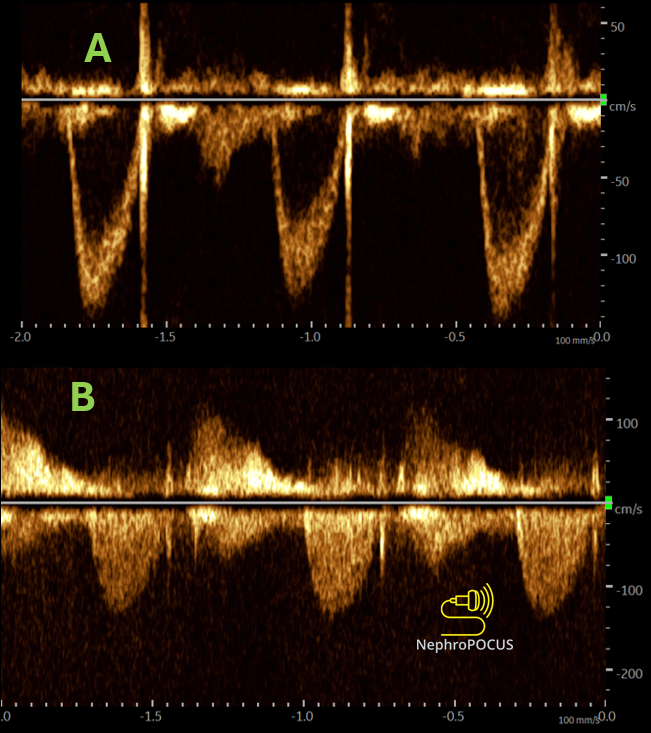
#POCUS Doppler quiz 👇
#Nephpearls#MedEd
Tracings A and B were obtained from the same person in the apical 5-chamber view, with the Doppler line in the LVOT.
Which is correct (most likely; assuming the view is optimal)?
A. A = PW Doppler; B = CW Doppler
B. A = CW Doppler; B = PW Doppler
C. Both are PW Doppler
D. Both are CW Doppler
And why? 🤔













![javier20ch's tweet photo. Retirada de la aspirina en la Enfermedad Coronaria. 🤔🚫💊
✨️Aquí un buen resumen de toda la evidencia sobre las estrategias de desescalada o abreviadas. 🔎📚
🔴 No retirar demasiado pronto: se debe evitar la suspensión de ASA durante los primeros 30 días [NEO-MINDSET trial].
🟢 Después de 1–3 meses, la estrategia mejor respaldada es suspender aspirina y continuar ticagrelor en monoterapia en pacientes seleccionados tras ICP [TWILIGHT, TICO y ULTIMATE-DAPT trials].
🟠 Clopidogrel no es equivalente a ticagrelor en este escenario. La monoterapia precoz con clopidogrel después de SCA tiene evidencia menos consistente; STOPDAPT-2 ACS no demostró no inferioridad. Además, hasta 1/3 de los pacientes presenta alta reactividad plaquetaria con clopidogrel (CYP2C19 loss-of-function).
🔵 Si existe indicación de ACO (por FA lo + común), este es uno de los escenarios con mayor respaldo para retirar aspirina: después del periodo inicial (1 sem - 1 mes), mantener ACO + iP2Y12 (clopidogrel, de preferencia) reduce sangrado frente a terapia triple.
📝🆓️⤵️ State-Of-The-Art Review2026 @JACCJournals 💯
https://t.co/NaA78PZxg5
https://t.co/m1yndmf03Q](https://pbs.twimg.com/media/HTqW4euWoAA8fYW.jpg)