https://t.co/dT9KCnVKm3
I'm excited to announce my new book Strategy and AI will be available on November 10.
I’ve spent my career working with leaders who can’t afford to get strategy wrong within their extremely complex environments, first in defense, then with healthcare nonprofits. AI has become another thing these leaders can’t afford to get wrong. This inspired me to write a book to guide leaders on how to get both strategy and AI right.
While AI safety, job displacement, and other real challenges dominate the headlines, the book focuses on different challenges - leveraging AI to address known problems that have nothing to do with AI. Through accessible success stories of strategies and AI and sixteen AI frameworks to guide strategic thinking, Strategy and AI helps answer questions that keep non-technical leaders up at night.
The ebook and hardcover are available for presale on Amazon and Barnes & Noble.
The loudest voices stoking fears about AI dangers have made tremendous headway in the past two weeks. AI technology has not taken some unexpected, dangerous turn, but the hype around it — propelled by what appears to be a well orchestrated PR campaign — has drummed up considerable fear. I worry that it represents a setback for our field.
I have written frequently that fears of AI are overhyped. AI’s capabilities can be uncannily human-like and unpredictable, and it’s rational to worry when people who are directly involved express concerns. But I see the problems as a sign of the engineering work that ahead, rather than insurmountable barriers or the sky falling. AI technology continues to advance — which is a good thing! — but technical advances, poorly understood by the public, give those who seek to generate hype repeated opportunities to do so.
First, I don’t see any step up in the risk of human extinction from AI compared to a few months ago. The theories about this remain the same fantastical, science fiction scenarios as a few months ago. The biggest change in AI risk is its cybersecurity capabilities — a topic which we should take seriously — but this, too, will not lead to the end of the world.
The most notable recent event leading to increased fear was when an OpenAI team deployed an agent swarm that hacked into Hugging Face. Much of the popular press contained significant hype. For example, some publications reported that a swarm of 1,200 agents carried out the attack. While this was technically accurate, as I write this, I have about 1,300 processes running on my laptop. Yes, the ability to get large swarms of agents to work in parallel on a task is a significant technical advance, And, in computing, many processes run at the same time. So this shouldn’t be seen as some magical capability.
Additionally, OpenAI’s buggy sandboxing and monitoring processes were key to enabling this incident. Fixing these bugs and putting in place improved monitoring would be appropriate fixes, not pausing AI. There are many well known ways to attack software systems. The main advantage of AI agents is that they are relentless. They will tirelessly try many tactics — and have the patience to chain vulnerabilities together — that previously would have taken an infeasible amount of human effort. But in the long term, I believe the advantage will lie with defenders (because they have more information with which to identify bugs, which they can fix), but the cyber-threat landscape has changed significantly. There are still bottlenecks to identifying and exploiting a vulnerability. AI agents still have to try a lot of things to see what works, and taking these actions takes time and might be detected by defenders. This is why, even though it is now easy to obtain versions of leading open weight models that have had their guardrails removed or weakened, so they will not refuse to try to execute cyber attacks, the world has not ended.
I am also concerned about the anthropomorphization of AI in a lot of reporting, where LLMs and agents are unnecessarily treated as if they were people. If I wield a hammer, miss a nail, and accidentally dent the wall, it’s not the fault of the hammer. The problem lies in how I used the hammer. Similarly, if I prompt an agent and it hacks into someone else’s system, the responsibility lies with me, not the agent.
Of course, we want to build systems that are as safe and predictable as possible. (For example, an unsafe hammer would be one whose head randomly flies off under normal use.) Today’s agentic systems are not predictable, but I see no reason why, by applying sound engineering practices, we won’t be able to make them extremely safe to use. One new element in the forecasts of AI-enabled doom is AI companies disclaiming responsibility for their own products. “I didn’t do it; my out-of-control agent did!” There’s a balance to be struck between the responsibility of the tool maker and the tool user, but when something goes wrong, let’s hold the people building and/or using the hammer responsible, rather than the hammer. (By the way, if you’re worried about AI bioweapon risk, David Bellamy has a great post on why this, too, is overhyped. Briefly, the bottleneck in building a bioweapon is not intelligence, but lab work and manufacturing.)
Pausing AI progress will create much more harm than benefit. First, our adversaries will certainly not slow down. Second, engineering requires discovering problems empirically so we can fix them. If we pause AI by a decade, we will also delay finding and implementing safety engineering fixes by about the same duration.
Of course, the incentive to stoke fears — for regulatory capture, to garner attention, or to make one’s technology seem more powerful — remains the same as before. Disclaiming responsibility is a new one. Taking a hard technical look at the actual risks however, I see little factual basis for the degree of fear that’s been stoked up. We still have hard research and engineering work ahead to improve AI safety, but the beneficial applications continue to vastly outweigh the risks, and we should keep building.
[Original text (with links): https://t.co/jni2tWazAH ]
Are We Providing Misleading AI Advice?
A commonly used cliche about AI needs to be retired or revised. You might have said it. I have said it though not anymore.
"You won’t get replaced by AI, you’ll get replaced by someone using AI."
While this may sound like good advice, it could be potentially awful. https://t.co/fPhF8TMlIx
A theory I'm testing out about AI, work, and the future of companies ...
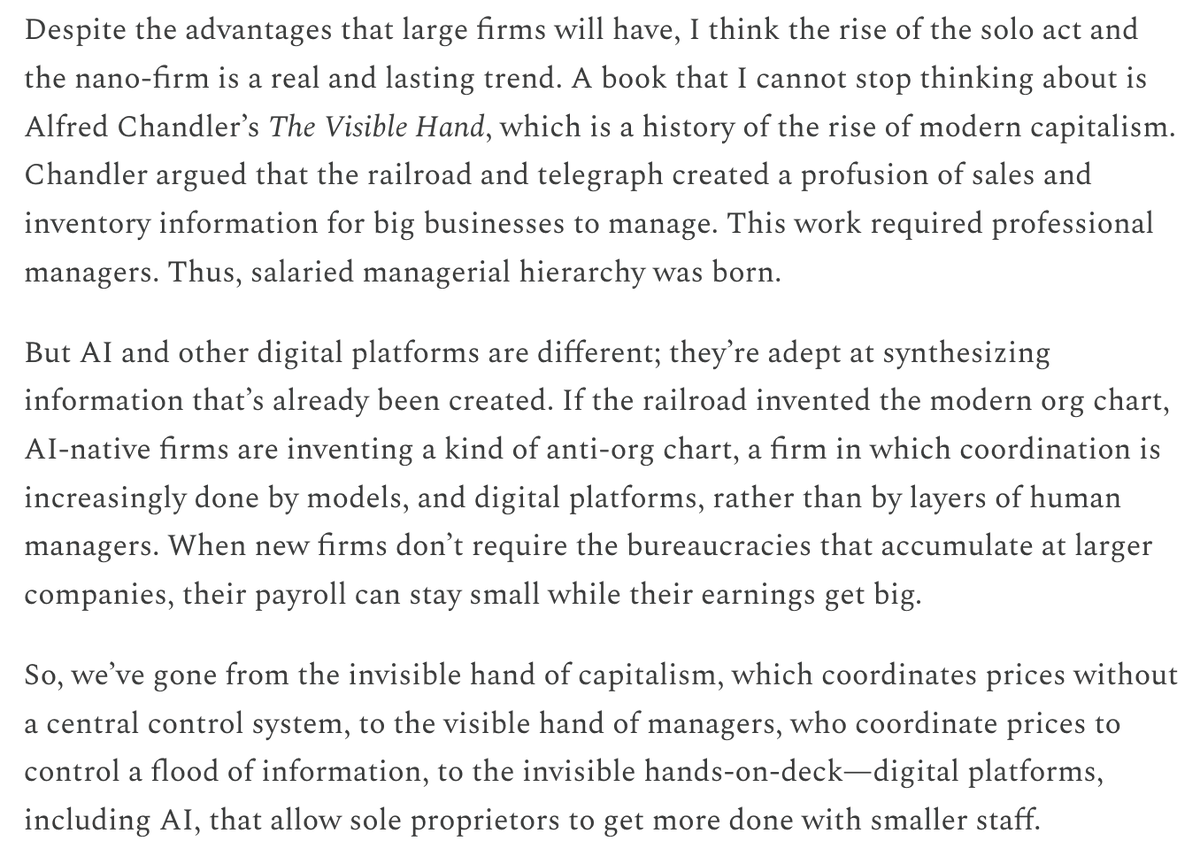
I have for months been obsessed with Alfred Chandler's The Visible Hand, a classic business-history book that argues that 19th century technology—the telegraph, train—created an explosion of real-time sales and inventory-information challenges, which required the creation of a new org charts with something called "middle managers." Thus, technology birthed managerial capitalism.
Thematically, Chandler's insight is that technology doesn't just change jobs; it changes how jobs are organized in relation to each other; which is to say, tech changes how companies are structured.
So, how might AI restructure the firm? Here's one stab at an answer: The telegraph/train created a profusion of information, which required managers. But AI's greatest skill is synthesizing information that's already been created. I think that's one reason why new companies are getting rich faster with unusually small staff. The "visible hand" of professional managers is being replaced, at the margin, by the "invisible hands" of digital platforms and AI assistants that don't so much destroy work as they allow new firms to build lean human-AI workflows that are qualitatively different than the larger bureaucracies in their industries.
@MelMitchell1 wrote a must read article for anyone trying to make sense of AI.
She objectively explains the state of AI as a scientist in an accessible way to the curious. These foundational AI chatbots launched in November 2022 often amaze us and frequently fail us in unhuman like ways. This inspired the new term: “jagged intelligence.”
While we are mostly in the experimentation stage with AI thinking (inference, chatbots), some people, teams, and enterprises are moving forward with the trial-and-error of AI doing (action, agents). Millions of AI agents with jagged intelligence released into the wild. Are we ready?
https://t.co/j7tiOIliXH
This has quietly been a miracle month in medicine.
In the last 5 weeks we’ve got news on:
- retatrutide, the triple agonist GLP-1 from Lilly, basically melting fat and body-wide inflammation at record levels
- RevMed’s new pancreatic cancer drug showing unprecedented abilities to extend life
- small trial of a one-and-done PCSK9 gene editing therapy for slashing LDL cholesterol
- Mayo’s AI-assisted radiology showing vastly improved cancer detection
- this new therapy for metastatic solid tumors
This stuff is at varying levels of evidence. Retatrutide is ~100% on its way, other stuff needs more clinical trial data. But put it together and we’re maybe on the verge of majorly reducing the mortality of heart disease and cancer, the two leading causes of death in America.
If you're an AI fast-follower, it may be time to learn from organizations that moved beyond the AI pilot. While it's unlikely you have an almost $20B 2026 technology budget like JP Morgan, you can learn from their experimentation with AI. https://t.co/7QLwNWo7W9
@emollick NotebookLM + visualization (Nano Banana Pro) + Deep Research is a killer combination that gives you good results while keeping you in control. I’m surprised that other AI labs have not created similar tools.
@MargRev@tylercowen is one of the best at discovering the latest insightful research like this. With so much content being created, I appreciated Tyler's curation and sharing.
Does AI have a "doing" problem?
https://t.co/3fzzeE98UC
What can we infer from (1) Human Intelligence proxies, (2) studies on AI doing, and (3) the doing challenges AI researchers are working to address?
An AI pioneer, Yann Lecun, says his field has been led astray by Large Language Models (since they are not based on factual models of the world, but only on massive correlations and abstractions from them). As a cognitive scientist, I'm sympathetic. https://t.co/vFM0kHO9Tb via @WSJ
@AndrewYNg Well stated. Hopefully we see progress from the many trying to address the challenges of generalization, continuous learning and some kind of world model representation that enables causal and analogy inferences.
@JeffDean Nice insight on the many years of innovation and rigor of Waymo. What have you learned that is critical to building autonomous AI agents that operate in physical and digital worlds?