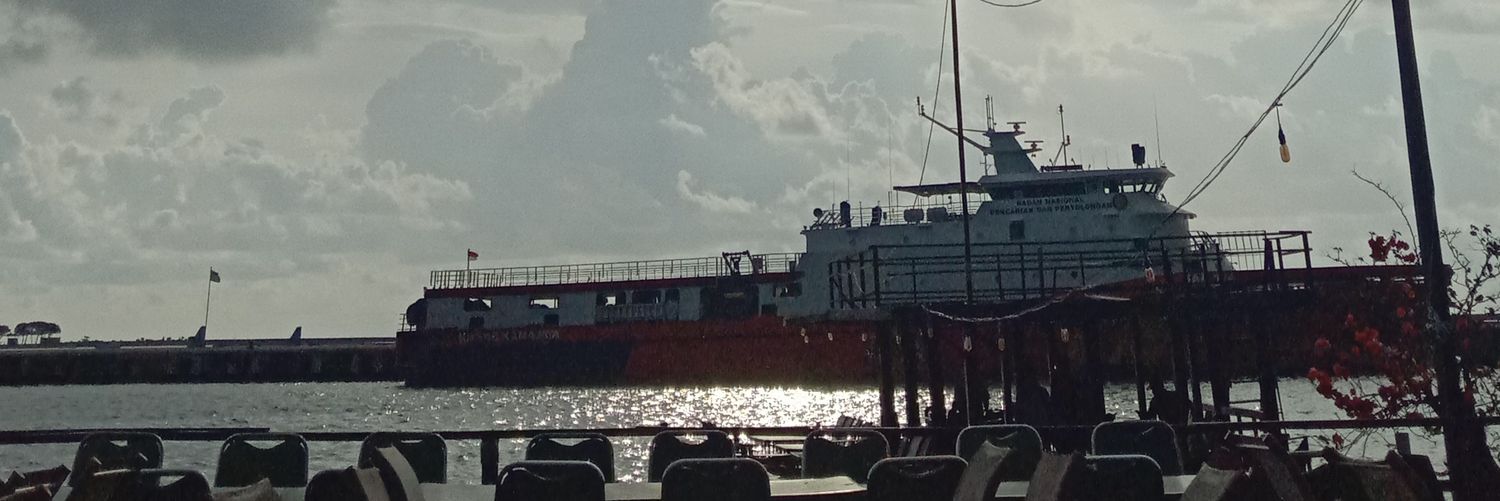
Malam malam pernah ga kalian lagi enak tidur disuruh bangun dini hari memadamkan Api di sekitar rumah kaya mereka ini 🙁
Karena sdh hampir terbiasa dengan kejadian ini mereka selalu sigap apapun yg terjadi #savekalimantan
Untuk warga X kami dari org Kalimantan minta tolong di up di setiap pemberitaan yg kami posting karna itulah yg terjadi sekarang ini.
KAMI CAPEKKKK kasian petugas pemadam sampai bbrp org yg meninggal 😭🏳️
Digital twin models give developers a consistent way to represent physical assets in OCI IoT Platform.
In the example in this blog, we use an electric motor with three telemetry values: motorTemperature, vibrationLevel, and powerConsumption.
See how DTDL provides the base modeling language, OCI IoT Platform extensions add platform-specific behavior where it's needed and adapters complete the pattern by translating real device payloads into the canonical model shape. https://t.co/GmUPeBp7X3
I built an airport you can break. ✈️
Trigger a monsoon, overload security, close a gate or break baggage then deploy an Ops optimizer to recover 600 passengers in real time.
Built with @threejs + @nextjs, shipped on @vercel@vercel_dev ‼️ - A Stimulation Digital Twin Ops .
PlayHere: https://t.co/iMoJFpBpTv
What should fail next? 👀
#ThreeJS #BuildInPublic
$31 MILLION HOTEL. EVERY PIPE AND WIRE MAPPED IN ADVANCE. BUILT BY TYPING SENTENCES INSTEAD OF PLACING THEM BY HAND.
A 190-room hotel needed its ductwork, plumbing, electrical, and fire suppression modeled and coordinated before construction could start.
The design team connected Kimi K3 to their modeling software through MCP, then had it read photos of the blueprints alongside plain English descriptions of each system and build the model directly instead of placing every component by hand.
Old process: 3 engineers, 6 weeks, around $47,000.
New process: 1 engineer confirming the AI's output, 9 days, roughly $10,500 combined, engineer's time plus AI compute.
Coordinated models finished this way cut change orders by 60 to 80 percent once construction begins.
See the article below for a smaller example of the Kimi K3 + Blender MCP workflow.
Literally any skyline photo from your window is giving away your exact address.
Check out these photos I took around Austin, precisely geolocated by matching pixels against a 3D scan.
The most insane match was a photo I took inside a high rise looking down. It nailed the exact balcony.
ONE RACK. 56 SERVERS. UP TO 100 KILOWATTS. AND IT ISN'T EVEN THE 19-INCH RACK THAT RAN DATACENTERS FOR A CENTURY.
that clip is msi's orv3 rack, shown at computex.
look closely and two things are off from a normal server rack.
first, it's wider. 21 inches, not the 19 that's been the standard for roughly a hundred years.
that extra width buys room for the power and cooling that ai density now demands.
second, there's no air. every node is cooled by liquid piped straight to the chips, with a coolant unit built into the rack itself.
inside it: 28 dual-node open-compute servers. 56 machines, plumbed like an engine, not wired like a closet.
the number that frames it: up to 100 kilowatts in a single rack.
that's the draw of dozens of homes, in one cabinet - and the reason the air had to go.
here's the quiet story. the 19-inch rack survived mainframes, the internet, and the cloud.
ai is the first workload that broke it.
the density got so high the industry widened the rack and flooded it with coolant just to keep the chips alive.
this is the far side of "run ai locally."
your desk box sips watts and stays silent.
this is what trains the model it answers with - wider, wetter, and hungry enough to warm a street.
no air cooling, no 19-inch standard, no home outlet that feeds a rack like this.
bookmark & watch today ↓
I integrated some more features to my image to @threejs web tool today with fable 5: better auto material/texture creation, and a play mode, where you can walk in your scene and interact with your models (rapier3d engine). hope tomorrow will come opus 5. my web app's will be released within the next weeks, follow here @filmbrain_io
A year of snow on Mount Shasta 🌋
23 cloud-free Sentinel-2 scenes, draped over 10 m terrain from USGS 3DEP.
One path-traced light field, baked once and carried through the entire 30 fps orbit.
Made with forge3d, my Rust + WebGPU + Python package
Tourism marketing has always meant photos and video, a fixed sequence someone else chose for you!
This is a navigable 3D Mediterranean world instead. Walk to the landmark viewpoint you actually want to see.
Explore the architecture at your own pace, with daylight shifting as time passes in the scene.
Coded entirely with GPT-5.6 Sol and Three.js.
Storytelling, tourism, and education all converge on the same underlying capability: a world you can actually move through.
Follow @neil_xbt for more.
Deconstructing the iconic Yellow Crane Tower in 3D. 🏛️
Created entirely using Opus 5 + Seedance 2.0. AI-driven architectural breakdown in action!
Prompt:
Video Description:Create a 15-second, 16:9 widescreen architectural instructional video showing the step-by-step construction of the Yellow Crane Tower. The layout, structural components, leader line callouts, dimensional scales, numbering labels, and color palette must remain strictly consistent throughout. Do not add, remove, or alter the shape and quantity of any architectural components.
Core Instruction:This is an architectural assembly video designed to show how the Yellow Crane Tower is constructed layer by layer. Every component must be highlighted and clearly visible individually—no simultaneous motion or cluttered group movements.
Motion Style:
All components translate purely along their respective vertical axes (no rotation, arc trajectories, or mesh clipping/interpenetration).
Only one group of components moves at any given moment while all other components remain stationary.
The active moving component maintains 100% brightness, while inactive components are dimmed to approximately 60% brightness to guide viewer focus. Once a component settles into place, it restores to full brightness.
Include a brief ~0.15-second pause after each component group settles before moving to the next, establishing a clear rhythm.
Timeline (Bottom-to-Top Construction Sequence):
0.0–1.5s: Hold the initial exploded/deconstructed floating state. The camera slowly rises and pushes forward slightly (angle change < 8°). Leader lines move with their corresponding components, pointing accurately to each part.
1.5–2.6s: The stone podium base lowers vertically into place, establishing the ground baseline for the building.
2.6–3.8s: Major columns (interior gold pillars and eave pillars) drop vertically into the stone plinths from above, perfectly aligned.
3.8–5.0s: Tie beams and lintels slot horizontally into the column tops, interlocking with mortise-and-tenon joints.
5.0–7.0s: Bracket sets (Dougong) assemble individually from bottom to top: bearing blocks, bracket arms, angled levers, and cap blocks lock together layer by layer. (Key sequence: slow motion to clearly showcase the intricate stacking).
7.0–8.2s: Eave rafters and flying rafters align and settle along the roof pitch, forming the deep overhang eaves.
8.2–9.4s: Board tiles and semi-cylindrical roof tiles lay down row by row from bottom to top, covering the rafters.
9.4–10.5s: Roof ridge components and the central finial drop into place. The full building structure is now complete. Leader lines and text labels fade out smoothly.
10.5–12.0s: The fully assembled Yellow Crane Tower remains stable as the camera orbits extremely slowly around it.
12.0–15.0s: All components separate vertically in the exact reverse order, returning to the precise initial exploded/deconstructed layout. The final frame composition perfectly matches the first frame to allow a seamless loop.
Negative Constraints:No simultaneous component movement, random scattering, shattering, melting, rotating, or flying off-screen. No changing component counts or morphing architecture. No incorrect Dougong stacking order, tile-rafter clipping, misaligned leader lines, garbled label text, fast camera orbits/zooms, black screens, white flashes, frozen frames, fade-outs, watermarks, or platform end cards.