Your 4% crypto card probably doesn’t pay you 4%.
So I built a calculator that shows what you actually get.
I just shipped the True Cashback Calculator on Card Map.
Try it here:
https://t.co/ap4u06ryUd
You enter:
> your country
> monthly card spend
> main spending currency
> how much you spend abroad
> whether you’re willing to pay for a tier or lock tokens
Then the calculator does the annoying math for you. Not just the headline cashback rate.
It calculates:
> cashback bands and monthly caps
> FX costs
> annual membership fees
> paid vs token-locked tiers
> blended cashback across your actual spend
> monthly and yearly net return
> what your NEXT dollar of spend earns
And then gives you one number:
Advertised cashback → realistic cashback → actual $ earned after fees.
For example, with $7,650/month on EtherFi Luxe:
3% advertised > 2.78% net > $212.92/month after the annual fee.
You can also switch tiers instantly and compare the same spending profile across cards.
Right now I’ve added:
> @ether_fi
> @Plasma
> @EthenaPay
> @0xinfini
More cards are coming.
I’m tired of crypto card pages screaming “UP TO 8% CASHBACK” while hiding the cap, FX fee, token lock or $1,000 membership behind three different pages of terms.
I want Card Map to answer a much simpler question:
“If I spend MY money with this card, how much do I actually get back?”
And please try to break it.
Send me any card, tier or cashback rule you think the calculator gets wrong.
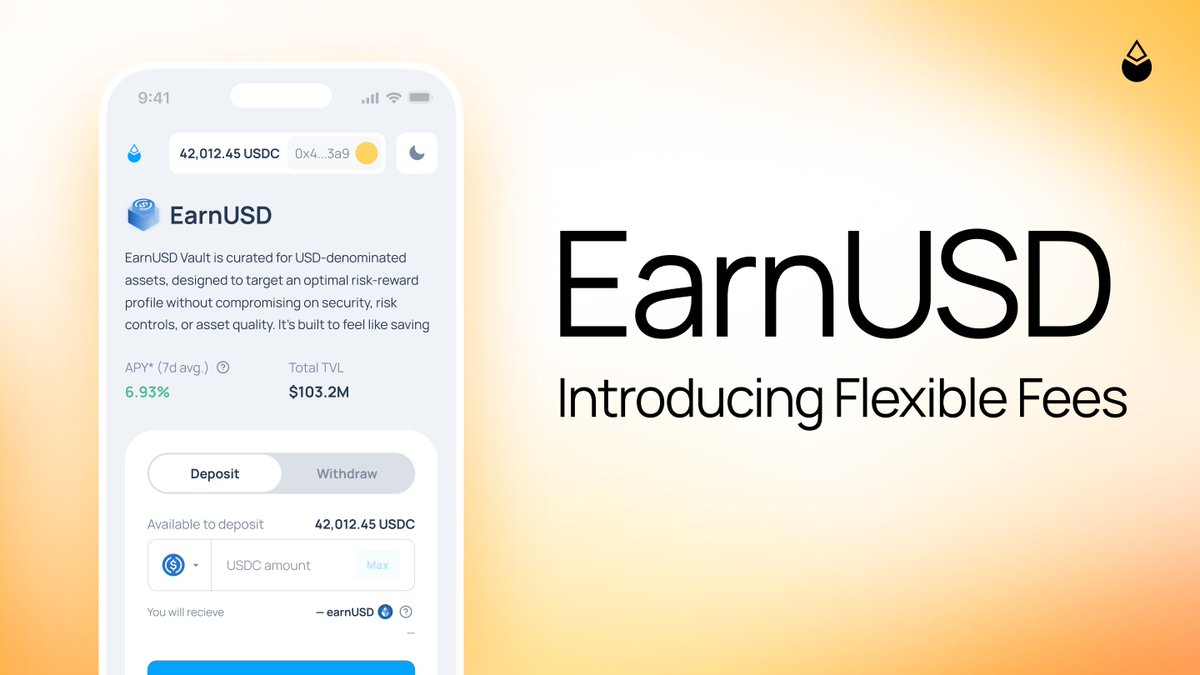
Lido EarnUSD: Introducing Flexible Fees
The fee model for Lido EarnUSD will be updated with lower fixed fees, more flexibility, and fees directly tied to vault performance.
Previously, EarnUSD fees were weighted toward the platform side (1% AUM + 10% performance). The new model leans more heavily on performance, capped at 0.5% AUM + 20% performance. At launch, fees will be set at 0.2% AUM + 15% performance.
Lowering the AUM fee from 1% to 0.2% makes it cheaper to hold EarnUSD when returns are lower, and the higher performance fee means fees track more closely with the returns you actually receive.
Fees are displayed transparently on the EarnUSD vault UI so you always know exactly what's being charged.
Get started here: https://t.co/sC9nRIdzHy
📋Withdrawing EIP-8363 from consideration for Hegotá.
EIP-8363 rapidly became one of the most commented-on EIPs in the history of the Ethereum-Magicians forum, with 200+ comments in a few weeks. As we progressed through the Hegotà CFI (Consideration For Inclusion) process, several parties in the industry as well as core protocol and client contributors voiced that a fork scoping exercise was not the right venue to settle an issuance policy change.
We agree and we'd rather acknowledge this now than carry on towards Hegotà in this context. The topic is too important and raised too many concerns that it deserves its own process. We commit to giving issuance its own process and we thank the entities such as @LidoFinance who offered to help steer such an initiative.
We stand by the motivation of this EIP, in particular: “a very high staking ratio is undesirable for two distinct reasons (...), preserving Ethereum’s security, neutrality and resistance to capture, and protecting ETH’s role as money.” Not everybody immediately relates to both reasons and for others recognizing just one of these reasons is enough to justify a change. Nevertheless, we will all benefit from improving our understanding of the issue and what is at stake. The questions we have faced since we published EIP-8363 can be boiled down to 5 categories:
➡️Security: What does a lower ratio actually secure versus a higher ratio?
➡️Industry impact: What else is built on the yield and what will be the impact ?
➡️Curve specs and alternate tools: Is this curve even the right instrument?
➡️Composition: Who is left staking (the effect on the composition of the validator set) ?
➡️Decentralization: How will solo stakers be impacted by the reduction?
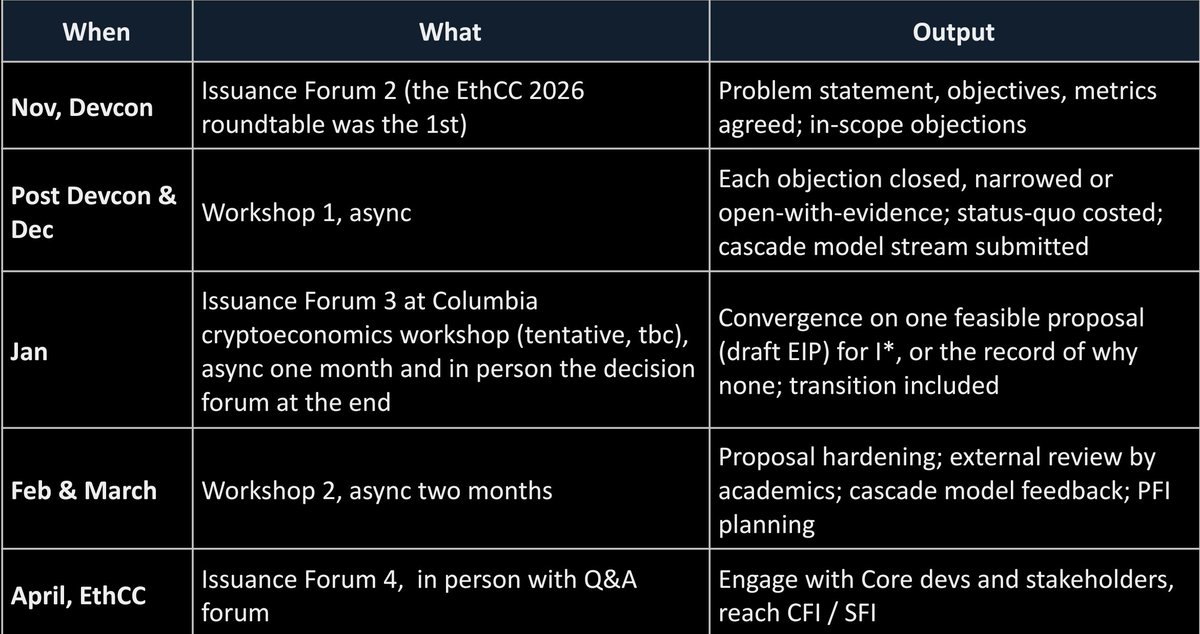
We already argued a lot, conceded some and adjusted a few points in the very long Ethereum-Magicians thread mentioned supra. For a broader consensus to emerge and a better issuance policy for Ethereum to be designed and adopted, we need a dedicated process. We call for all willing hands to help and contribute to this, please do reach out. Here’s our start at what a multi-node process would look like (table attached).
Onward and forward, let’s improve Ethereum.
Following an investigation into an infrastructure compromise, MetaMask Staking (ex Consensys Staking) has taken precautionary steps to protect client assets related to its operated Ethereum validators.
These steps include exiting its Ethereum (ETH) validators in the Lido protocol, and will likely incur foregone rewards as well as possible downtime penalties should validators be taken offline in the near future to reduce risks related to potential network penalties. Relevant validators have begun the exit process, with the final validators expected to be exited (but not fully withdrawn) by the end of October 7th, 2026.
No action is required from stETH holders. ETH exited from MetaMask Staking-operated validators is expected to return to the protocol gradually as the relevant validators complete the exit, withdrawal, and re-entry cycle, which is estimated to take approximately up to 45 days due to the extended entry queue. As a reminder, staking operations are non-custodial in nature and MetaMask does not manage withdrawal keys for staking on behalf of clients.
As always, the Lido Protocol’s diverse Node Operator set and other security systems including the ad hoc reserve fund (of over 6,750 stETH), are designed to contain and mitigate disruptions to the normal operations of the protocol, in addition to other potential routes.
https://t.co/bZZU5oNlWp
A full investigation is underway, and further updates will be shared as they become available. For further details, please refer to the MetaMask Staking release linked below.
Size, collateral, depth of liquidity.
Last month, @Sharplink announced their plans to stake $200 million in ETH through Lido.
Listen as @joechalom, CEO at Sharplink, breaks down the reasons behind this move, and why they chose Lido.
Lido contributors are co-hosting the Ethereum Forward Defence Summit with @safe, supported by @ethereumfndn and the Trillion Dollar Security initiative.
Protocol security, OpSec, post-quantum. Workshops, a short set of keynotes, and a focus on building.
November 4th, Mumbai. Five minutes from Devcon.
Bitwise is delighted to have worked alongside Lido to carry out the first validator consolidation on Lido Core.
Bitwise is proud to be a node operator in Curated Module v2 and to play a part in Lido’s work toward a healthier Ethereum network.
The first validator consolidation on Lido Core has successfully landed 🎉
This marks the beginning of migrating ~8.4M staked ETH from the legacy Curated Module to the new CMv2.
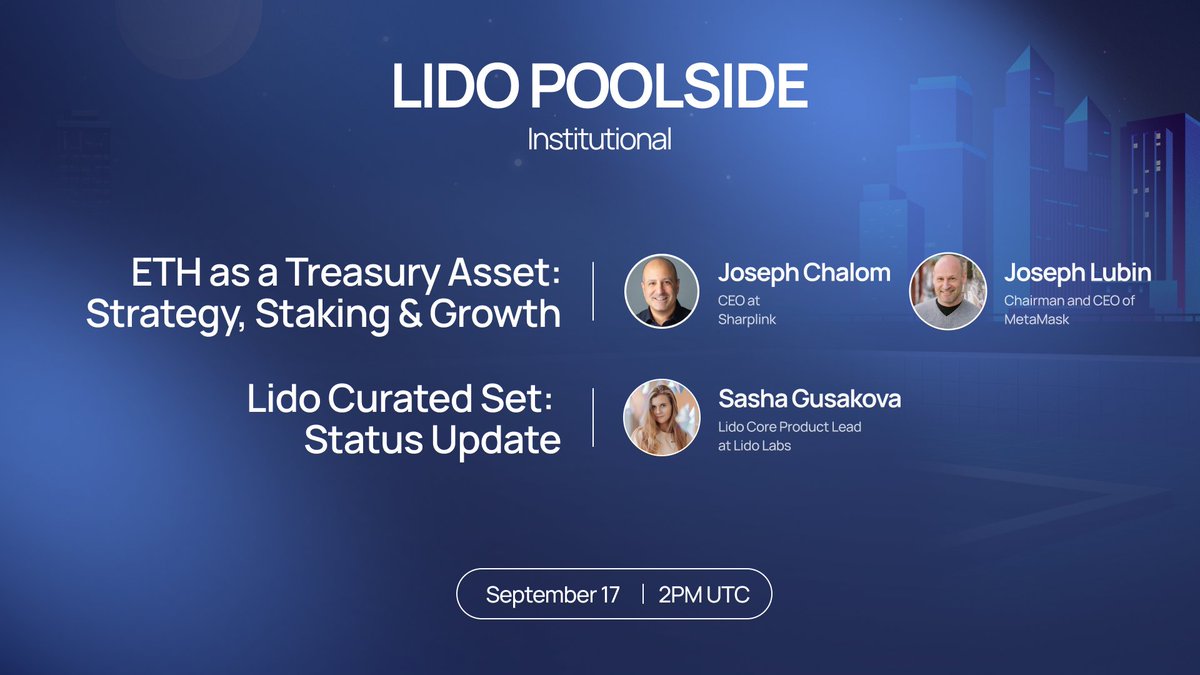
Lido Poolside: Institutional, September 2026
Stop by tomorrow a deep-dive into the latest Ethereum staking developments:
• ETH as a Treasury Asset w/ industry titans from @MetaMask and @Sharplink
• Lido Curated Set: Status Update w/ @sasha_gusakova
September 17th, 2PM UTC.
We just shipped Telegram MCP: a private way to connect AI to Telegram.
Let Wisp send messages in your Telegram chats, post summaries to team groups, find that link from last week and more.
Your connector token stays on your device, encrypted.
No human at Wisp or GPU provider can see your Telegram chats
The first mainnet consolidation by @LidoFinance has been submitted. It will be finalized in about 27 hours.
Big day for @ethereum validator count reduction!
https://t.co/kUcNoRVs98
I spent last few weeks talking about EIP-8148 with @ethereum core developers. Nerdy talks. Love it!
But now thanks to @george_avs we have an easy to understand explainer!
https://t.co/sGAuF9wXG9
I'm hosting the next @LidoFinance Poolside Community Call on Sep 17!
Joining me:
@ethereumJoseph@joechalom@IsdrsP@sasha_gusakova
We’ll discuss institutional #Ethereum, ETH treasury strategies, staking and what’s next for institutional adoption.
👉 Register: https://t.co/ty6csfhSc9
Seeing the rationale is quite disenheartening tbh.
You could call 8148 a convinience request, yes. It's a convinience request that would massively simplify making better terms for permissionless and solo stakers participation in Lido. We don't need it for curated set of big operators, we need it to help Ethereum expand validator set. I don't disagree with a decision (fork capacity is in very short supply and there's a ton of great EIPs in contention) but unanimous decision with justification like this leaves me thinking should we even try.
8205 is a security feature, not convinience. There are workarounds in all staking protocols, they are all ugly. Not incuding this, again, is fine - competition is fierce - but I can't agree with framing.
Look forward to joining @LidoFinance and @ethereumjoseph on September 17.
See you at Lido Poolside to talk institutional staking, our partnership, and more.
Lido Poolside: Institutional
Stop by on Thursday, September 17th, to discuss the latest institutional Ethereum staking developments and first results from the recent Lido Core upgrade.
Featuring special guests from @Consensys and @Sharplink.
More info: https://t.co/eg46yz1NFR