Which crypto card gives you the best exchange rate on Alipay?
I compared 8 cards using the same observed FX rates.
For a ¥500 purchase, the market value would be about $74.05.
Here is what each card would charge:
> @Backpack: ~$74.09 (+0.06%)
> @wirexapp: ~$74.55 (+0.67%)
> @krak: ~$74.55 (+0.67%)
> @avici: ~$75.00 (+1.29%)
> @jup_mobile: ~$75.00 (+1.29%)
> @ether_fi: ~$75.00 (+1.29%)
> @Plasma: ~$75.45 (+1.90%)
> @Bybit_Official: ~$75.45 (+1.90%)
Backpack came almost exactly at the real-time rate. Wirex and Krak were also very close.
Plasma and Bybit were almost 2% above market. On one purchase, that difference does not look huge.
But at ¥12,000 of spending, the gap between the best and worst rate becomes roughly ¥221 before cashback.
And that is why “0% FX” on a pricing page does not always tell you which card is actually cheapest.
The final cost can still depend on the processor, settlement rate, crypto spread and when the transaction clears.
This is only one Alipay route and one set of observed rates, so I would not treat it as a permanent ranking yet.
But for this test, Backpack clearly came closest to spot.
Which cards should I compare next?
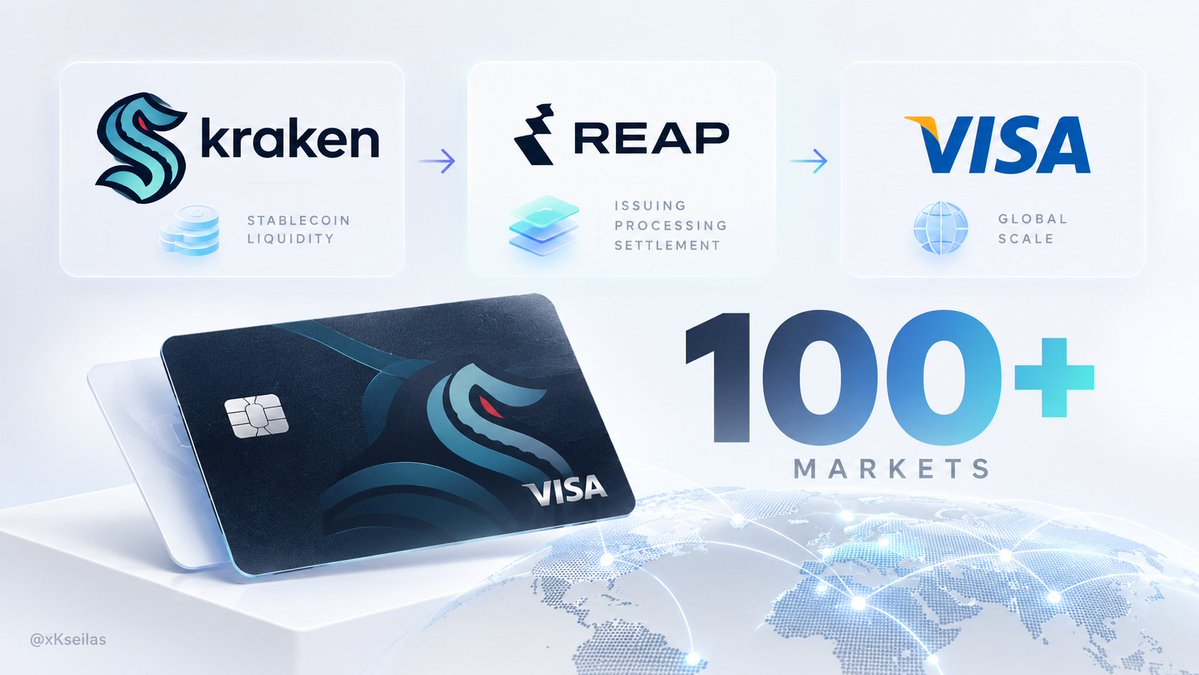
Kraken is taking stablecoin cards to 100+ markets with Visa.
@reapglobal, acquired by the parent company of @krakenfx for up to $600M, is expanding its partnership with @Visa across Europe, the Middle East and Africa.
Reap gives fintechs the infrastructure to launch their own branded cards:
> Visa issuing
> processing and authorization
> compliance and program operation
> stablecoin-funded collateral
> repayment in USDC or USDT
Reap already works with names like @RedotPay, @KASTxyz and @ether_fi.
And this is not about launching a Reap consumer card.
The fintech keeps its own brand and customer relationship while Reap runs the card infrastructure underneath.
Reap already holds Visa Principal Issuer status in Hong Kong and Mexico, with more markets coming through local programs.
So 100+ markets does not mean 100 cards are live today.
It means the infrastructure can now be pushed much further globally.
The interesting part is the ownership.
The group behind @krakenfx now owns infrastructure powering some of the cards competing with its own @Krak product.
Kraken is no longer just competing for card users.
It is starting to own the rails other crypto cards run on.
Plasma One will now pay you for your friends’ card spending.
@Plasma rebuilt its referral program as the app opened to everyone.
Bring a new user and you can earn:
> $10 after they spend their first $100
> $200 after they reach $10K of spend within 60 days
> $20 if they upgrade to Core
> $300 if they reach Platinum
And then there is the interesting part.
You can also earn a percentage of their card spend:
> Lite: 0.25%
> Core: 1% for 3 months
> Platinum: 1% for 6 months
The friend gets the same $10 and $200 spending bonuses too.
So this is no longer just “invite a friend and get $10.”
A heavy card user can keep generating rewards for the person who referred them.
There are catches.
The $200 bonus needs $10K of qualifying spend within 60 days, and Platinum itself requires a much bigger commitment.
Rewards can also come as XPL or Spending Credit, depending on the program.
But I like the direction.
Crypto cards are starting to compete not only on cashback, but on how aggressively they pay users to bring in other spenders.
A 1% cut of your friend’s card spend for six months is probably the most interesting part of this update.
JOIN - https://t.co/4re1fRrSwL
Plasma One will now pay you for your friends’ card spending.
@Plasma rebuilt its referral program as the app opened to everyone.
Bring a new user and you can earn:
> $10 after they spend their first $100
> $200 after they reach $10K of spend within 60 days
> $20 if they upgrade to Core
> $300 if they reach Platinum
And then there is the interesting part.
You can also earn a percentage of their card spend:
> Lite: 0.25%
> Core: 1% for 3 months
> Platinum: 1% for 6 months
The friend gets the same $10 and $200 spending bonuses too.
So this is no longer just “invite a friend and get $10.”
A heavy card user can keep generating rewards for the person who referred them.
There are catches.
The $200 bonus needs $10K of qualifying spend within 60 days, and Platinum itself requires a much bigger commitment.
Rewards can also come as XPL or Spending Credit, depending on the program.
But I like the direction.
Crypto cards are starting to compete not only on cashback, but on how aggressively they pay users to bring in other spenders.
A 1% cut of your friend’s card spend for six months is probably the most interesting part of this update.
JOIN - https://t.co/4re1fRrSwL
Plasma’s 20% Apple cashback has a catch.
I like the @Plasma card and I like what they are doing with targeted cashback promos.
But the headline needs context.
The new Apple promo gives 20% cashback until September 25.
The caps:
> Core: maximum $50 cashback
> Platinum: maximum $100 cashback
So the full 20% only applies to the first:
> $250 on Core
> $500 on Platinum
Buy a $1,000 iPhone with Platinum and you get $100 back.
That is 10%.
Buy a $1,500 MacBook and the effective cashback drops to 6.7%.
The promo is still good.
But “20% cashback on Apple” and “up to $100 back on Apple” create two very different expectations.
A few posts ago I had the same question for EtherFi.
I like these cards.
That is exactly why I want the headline rate to match what users can realistically earn.
Crypto cards are finally getting rid of the separate card balance.
@raincards just launched real-time funding.
The new flow is simple:
> connect your wallet
> approve how much the card can spend
> pay normally
> only the amount needed for that purchase moves into collateral
Everything else stays in your wallet until you actually spend it.
That is a pretty big UX change.
Until now, most stablecoin cards made you manage two balances: your wallet and a separate balance backing the card.
Run low on the second one and your card stops working.
Rain is removing that step.
The beta starts with:
> USDC on Base
> USDC on Arbitrum
> USDT0 on Plasma
And this matters because Rain already sits behind a huge number of crypto card programs, including KAST, EtherFi, Plasma One, Tria, Kolo and others.
There are trade-offs.
Every purchase now depends on the wallet balance and the authorization infrastructure working in real time. Move the funds elsewhere and the card can decline.
And the collateral contract still exists. Rain is changing when it gets funded, not removing it.
That distinction matters after the outdated Rain Solana contract exploited in August led to roughly $1.1M of card collateral being drained. User wallets themselves were not compromised, and Rain says the affected contract version was upgraded.
But as a product change, this is exactly where crypto cards should be heading.
No top-ups. No dead card balance.
Your wallet becomes the card balance.
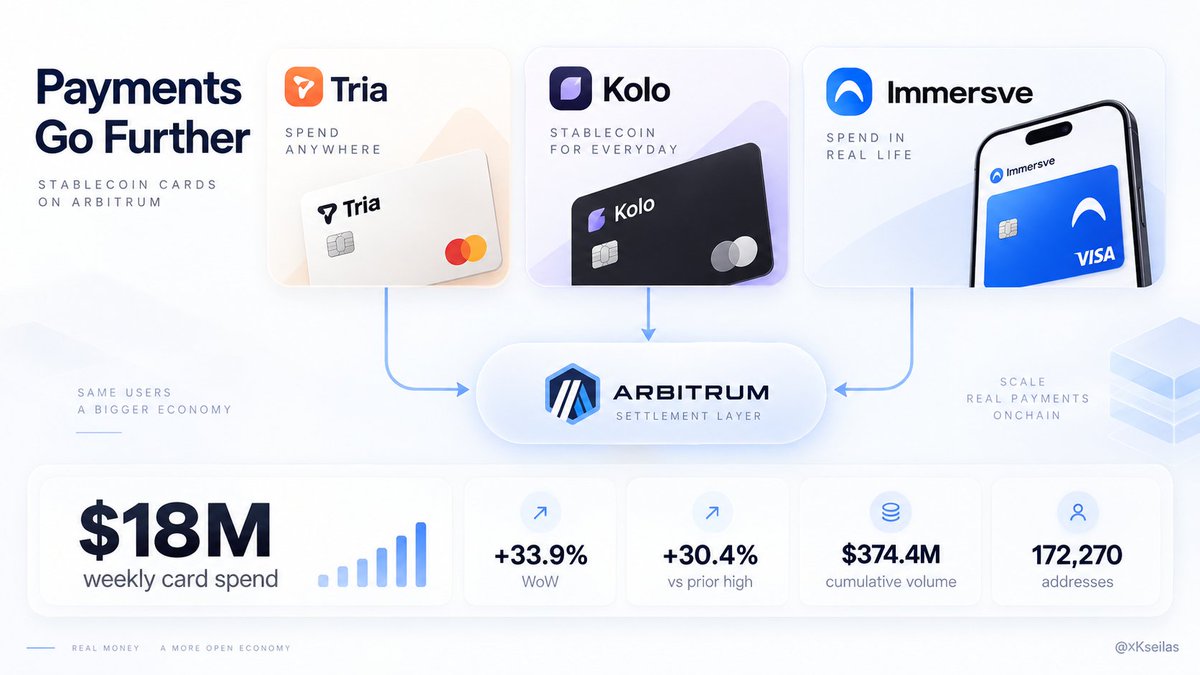
Crypto cards just had their biggest week ever on Arbitrum.
$18M in stablecoin card spend in 7 days.
That is:
> +33.9% week over week
> 30.4% above the previous record
> nearly $1B annualized if this pace held
The previous weekly high was only around $13.8M.
Most of the new activity is coming through Tria, Kolo and cards running on Immersve infrastructure.
And these are very different products.
@useTria lets users top up cards from Arbitrum alongside other chains.
@KoloHub has already made Arbitrum one of its biggest payment rails.
@immersve sits underneath multiple card programs and supports USDC spending directly from Arbitrum.
So this is becoming less about one successful card and more about Arbitrum turning into an actual settlement rail for them.
Paymentscan now tracks:
> $374.4M cumulative card volume on Arbitrum
> 172,270 addresses
> $18M in the latest week alone
The cards can have completely different brands.
The stablecoins underneath them are increasingly settling in the same place.
Which card pushes Arbitrum through $25M/week first?
Banks just sent dollars from Singapore to New York on a Saturday.
It took minutes.
DBS and Citi completed the payment using tokenized deposits on Swift’s new Digital Ledger.
Normally, this kind of cross-border bank payment can take up to two business days.
Here it worked 24/7.
But the interesting part is what actually moved.
The dollars themselves did not travel onchain.
Instead:
> Citi and DBS represented bank deposits on a shared ledger
> the receiving bank could credit the payment immediately
> the banks could settle what they owed each other through the existing banking system afterward
So banks are not replacing their core systems with blockchain.
They are adding a layer around them that can coordinate payments across time zones and weekends.
That also keeps the money inside the banking system.
A tokenized deposit is still a claim on a bank.
It is very different from sending USDC or USDT through an open stablecoin network.
Swift says 17 banks across six continents are preparing pilot transactions.
And there is a lot of money to defend here.
> Citi Services: $21.3B revenue in 2025
> J.P. Morgan Payments: $19.4B
Banks are clearly not ignoring stablecoins.
They are building their own version of 24/7 money.
The question is whether these bank-led networks can connect to each other before stablecoins become the default rail.
@FilonenkoOles There is a no-KYC angle, but not for the Wirex card itself.
You can use an unverified external card with lower limits, but getting/using the actual Wirex card still requires KYC.
The hidden risks of no-KYC crypto cards.
“No-KYC” crypto cards are not really skipping KYC.
Someone else is doing it for you.
I went through the contracts behind 16 cards marketed as no-KYC.
A common setup looks like this:
> a company passes KYB with the issuer
> it gets access to a corporate card program
> users are added under that company
> you fund the service in USDT and receive a card from its program
So the issuing bank may know the company behind the card. It may not know you as its direct customer.
That is why some of these products can offer a card with only an email while the actual issuer still runs a fully compliant card program.
The trade-off is fees.
Across the cards I checked:
> top-ups can cost 2–5%
> opening a card ranges from $5 to $168
> one charges $0.25 for every authorization attempt, even if declined
> another charges 3% on declined transactions
> one can charge 10% of the remaining balance every month after 90 days of inactivity
And the bigger risk is what happens when something goes wrong.
If the issuer freezes the program, you may not be its direct customer at all.
One provider even disclosed that a banking partner froze accounts in February 2026 and trapped part of customer balances.
It says most users were eventually refunded voluntarily.
There are also cards that can block certain merchant categories, countries or platforms based on the issuer’s risk rules.
And three of the products I checked had no proper terms, privacy policy or legal information on the site at all.
So “no-KYC” does not mean anonymous banking.
Usually it means the compliance relationship sits one layer above you.
Before putting serious money into one, I want four things:
> named issuer
> program manager
> who legally owns the card account
> what happens to my money if the program gets frozen
Privacy is useful.
Not knowing who actually holds your money is not.
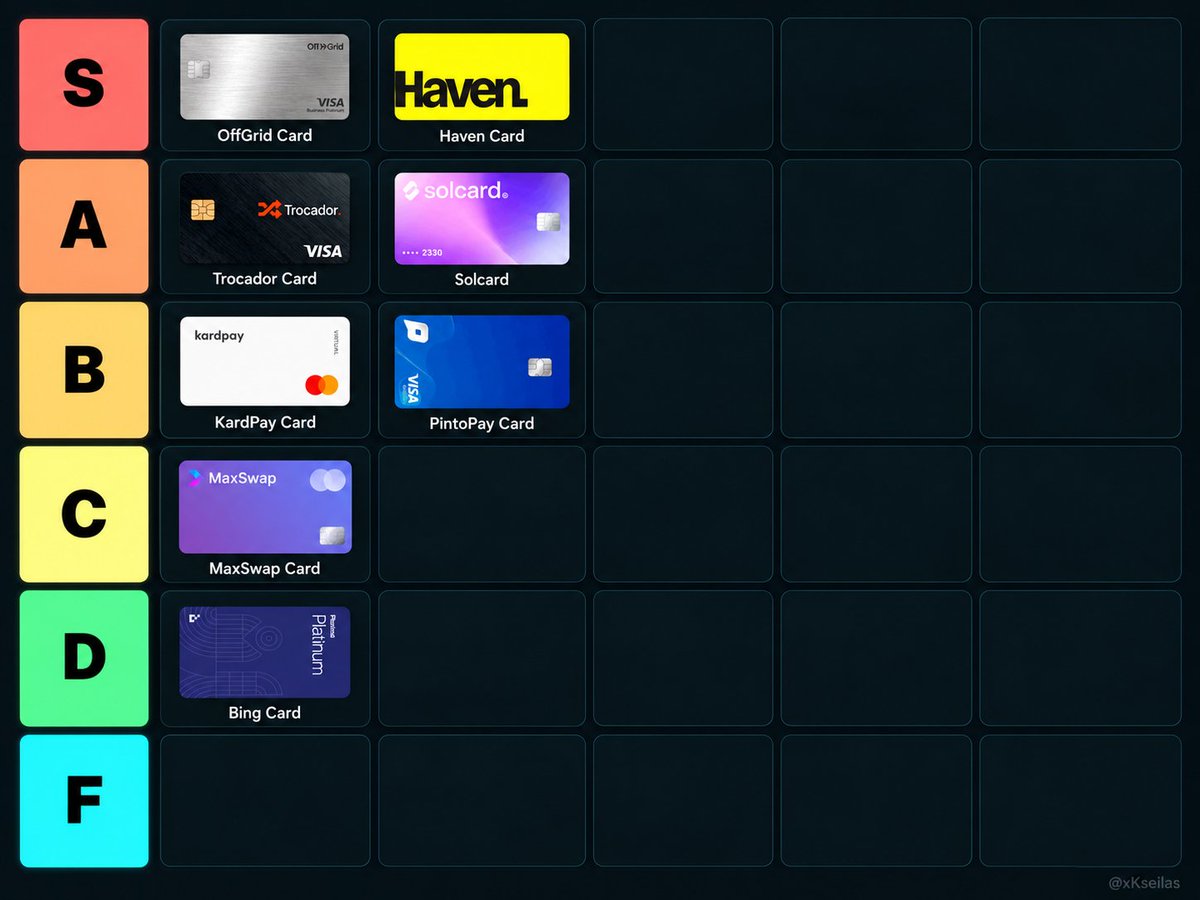
TIER LIST CRYPTO CARDS WITHOUT KYC
Most no-KYC crypto cards are terrible deals. I ranked the ones I’d actually consider using.
S
@offgridcash
> $49/year
> ~$1K daily limit
> privacy-first setup
> 0% advertised FX markup
Best option here if privacy is the priority.
@Haven_Hn_
> self-sovereign card
> Apple Pay / Google Pay
> privacy-focused architecture
Most interesting long-term, but still less proven today.
A
@trocadorapp
> ~$2 to get started
> ~$1K daily limit
> no traditional KYC
Cheap and simple. Main downside is FX that can reach ~2.75% + $0.60.
@solcard
> email-only basic tier
> virtual card
> easy crypto funding
Very easy to start using, but the better features sit behind higher tiers.
B
@kardpay
> ~$28 registration
> no-KYC access
Works, but I want more transparency around fees and infrastructure.
@pintopay_me
> $35 card
> Apple Pay
> 2.5% top-up fee
Good UX, but expensive if you use it heavily.
C
@MaxSwapSocial
> $50 issuance
> 4.5% + $1 top-up
> 0.4% + $0.25 transaction fee
Privacy is nice. Paying almost 5% to load the card is not.
D
@cryptoBingCard
> high limits
> no-KYC virtual cards
But the fee stack is ugly and the physical Platinum card requires KYC.
My picks:
> Privacy: OffGrid
> Cheapest to test: Trocador
> Easiest: SolCard
> Biggest upside: Haven
No-KYC does not mean no freezes, no AML checks or no issuer risk.
Which one did I rank too high?
Wise charged €6.65 to send €59.
That is 11.3% gone before the money even reached the recipient.
The transfer:
> €59.00 sent
> €6.65 fee
> €52.35 actually converted
> 1 EUR = 0.8790 GBP
> £46 sent to the recipient
So more than 1 euro out of every 10 was lost to the transfer fee alone.
And at the time of the screenshot, the money was still moving through the banking network.
This is where stablecoins start to look much more interesting.
Moving the asset itself can cost cents. The expensive part is usually everything around it:
> FX
> off-ramp
> local bank delivery
> compliance
Stablecoins do not make the last mile free.
But paying €6.65 to move €59 across currencies is exactly the kind of friction they are competing with.
Next I want to send the same amount through @Wise, @Revolut and a stablecoin payout route and compare exactly how many pounds arrive.
Which one do you think wins?
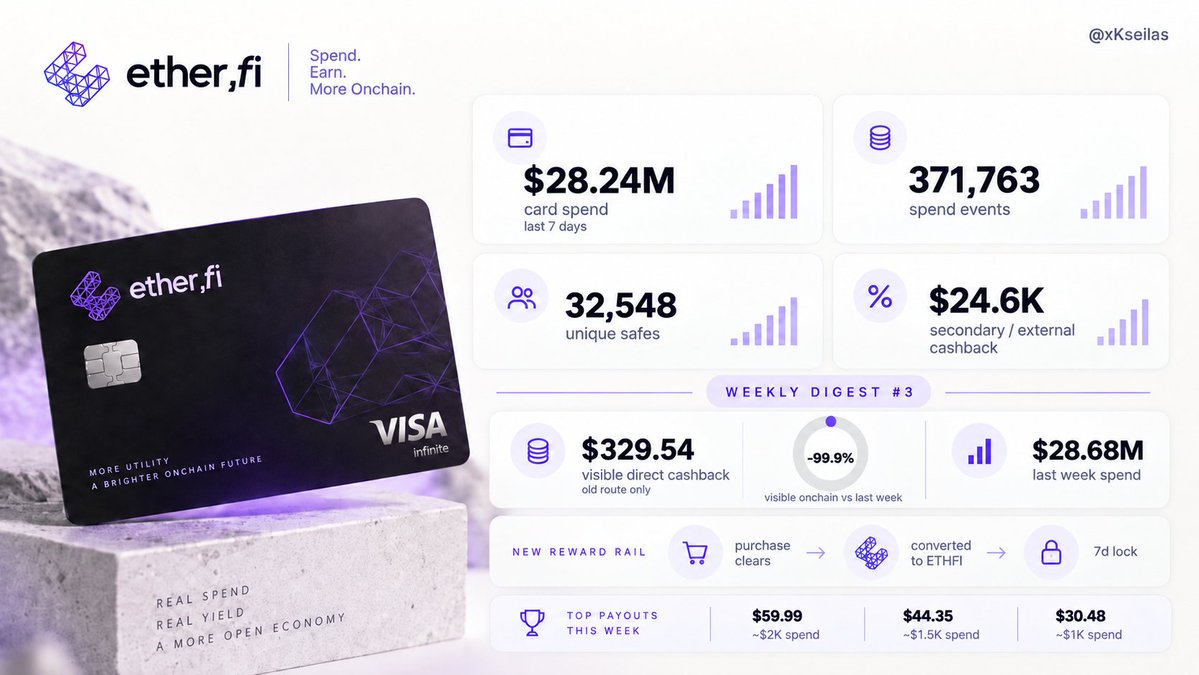
EtherFi did $28.24M in card spend this week: WEEK 3.
WEEK 3 - September 13–19:
> $28.24M card spend
> 371,763 spend events
> 32,548 unique safes
> $329.54 direct cardholder cashback visible through the old route
> $24.6K secondary / external cashback
Compared with last week:
> card spend: -1.5%
> unique safes: +1.4%
> direct cashback visible onchain: -99.9%
At first glance, it looks like cashback disappeared.
It didn’t.
@ether_fi changed the payout mechanics on September 11.
Cashback is now converted into ethereum:0xfe0c30065b384f05761f15d0cc899d4f9f9cc0eb after a purchase clears, then locked for 7 days before it becomes claimable.
So this week is the first one where the old cashback series is no longer directly comparable.
Card activity itself barely moved.
> $28.68M last week.
> $28.24M this week.
And unique users actually increased.
The biggest direct payouts still visible through the old route were:
> $59.99 back on ~$2K spend - 3%
> $44.35 back on ~$1.5K - 3%
> $30.48 back on ~$1K - 3%
So WEEK 3 comes with a tracker upgrade too.
From now on I need to follow ETHFI cashback claims / buybacks alongside the old dispatcher data.
The spend stayed strong. The reward rail changed.
See you next week!
EtherFi paid another $528K in cashback this week: WEEK 2
September 6–12:
> $28.68M in card spend
> $528.2K total cashback paid
> $473.3K direct cardholder cashback
> 362,287 spend events
> 32,108 unique safes
That works out to roughly:
> $75K cashback per day
> 1.84% of total spend returned to users
Direct cardholder cashback alone was 1.65%.
And some of the individual payouts were huge.
Top 3 this week:
> $3.6K back on $194.2K spend
> $2.9K back on $119.7K
> $1.9K back on $101.2K
Last week @ether_fi paid around $793K.
This week was lower, but card spend stayed strong at $28.68M.
So across just the last two weeks, @ether_fi has already paid users more than $1.3M in cashback.
That is the number I care about most.
I’m going to keep tracking total cashback, card spend and the biggest payouts every week.
Which card has better cashback in Europe?
PART 2
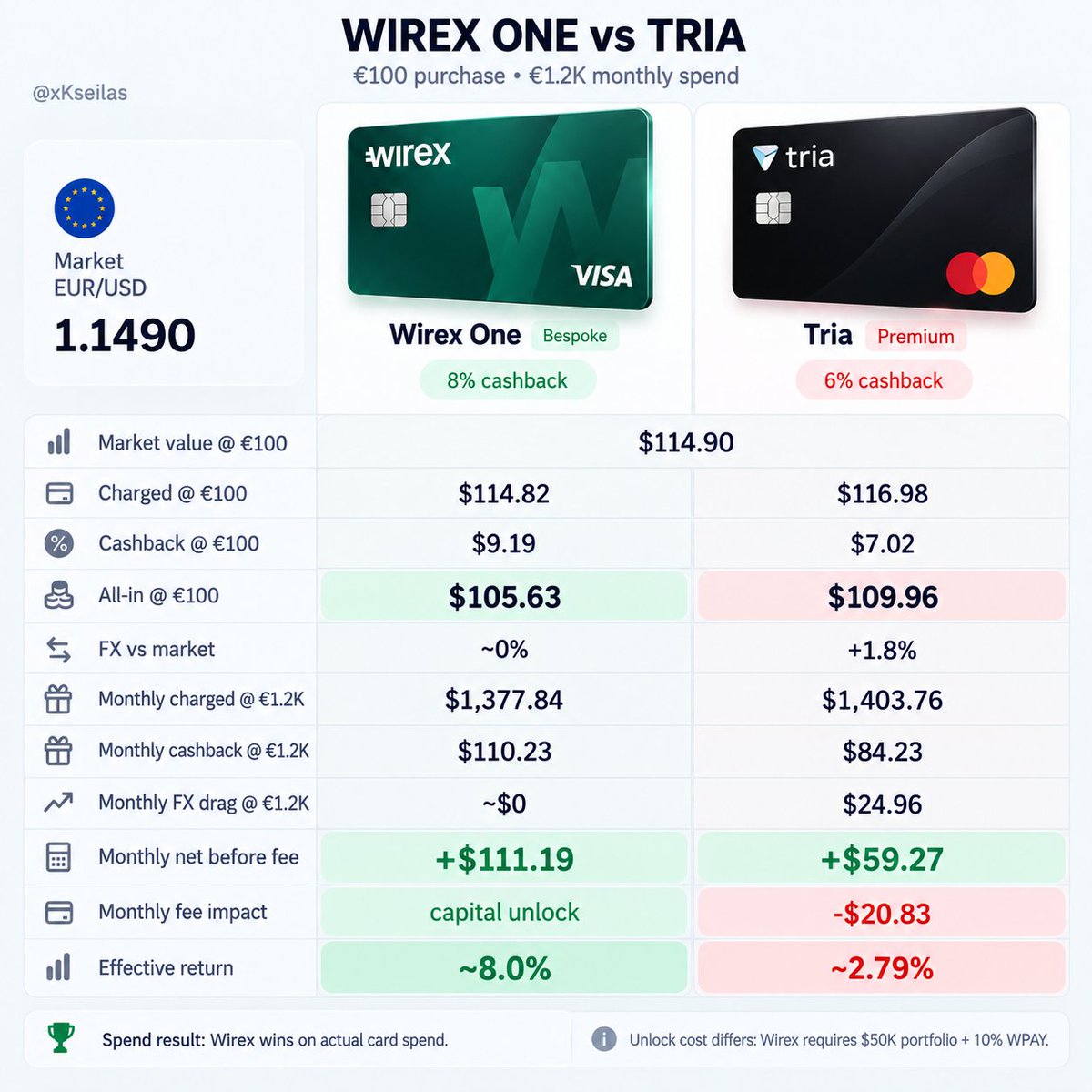
Wirex One vs Tria.
Same shop, same purchase conditions, both cards used within two minutes.
Both advertise big cashback rates:
> @wirexapp Bespoke: 8%
> @useTria Premium: 6%
But FX changes the result more than the headline suggests.
Using the observed rates from the test, take a €100 purchase.
Market value: $114.90
Wirex One:
> $114.82 charged
> $9.19 cashback
> $105.63 all-in
Tria:
> $116.98 charged
> $7.02 cashback
> $109.96 all-in
Wirex converted almost exactly at the market rate. Tria was roughly 1.8% above it.
The Tria receipt itself lists:
> 1% Visa FX
> 0.5% Tria fee
Now scale the same observed rates to €1,200 of monthly spending.
Wirex:
> $1,377.84 charged
> $110.23 cashback
> essentially no FX drag
> ~$111.19 net benefit versus market
Tria:
> $1,403.76 charged
> $84.23 cashback
> $24.96 lost to FX
> ~$59.27 net benefit before membership
So Tria’s advertised 6% becomes roughly 4.30% after the observed FX cost. Then there is the $250/year Premium fee.
Spread across the year, that is another $20.83/month. At €1,200 monthly spend, Tria’s effective return falls to roughly 2.79%.
Wirex keeps almost the full 8%. But Wirex has a very different entry cost:
> $50K minimum portfolio
> 10% of it held in WPAY
> $2K monthly cashback cap
Tria Premium costs $250/year instead, and its terms allow cashback to be distributed up to 12 months after the reward period ends.
So this is not really 8% vs 6%.
You have to compare FX, membership cost, capital requirements, reward caps and payout speed together.
Using these observed rates, Wirex clearly wins the actual spend.
The harder question is whether keeping enough capital in Wirex to unlock 8% is worth it.
Which card has better cashback in Europe?
Plasma One vs RedotPay.
Both advertise 3%.
But cashback is only half the equation.
Using the FX rates from the same real-world test, take a €100 purchase:
> Market value: $114.90
> @Plasma Core: $116.35 charged, $3.49 back, $112.86 all-in
> @RedotPay Pro: $117.83 charged, $3.53 back, $114.30 all-in
Plasma converted about 1.26% above market. RedotPay was about 2.55% above market.
Now scale that to €1,200 of monthly spending.
Plasma:
> $1,396.20 charged
> $17.40 lost to FX
> $37.92 cashback
> +$20.52 net before membership
Why $37.92? Plasma pays 3% on the first $1,000, then 2% after that.
RedotPay:
> $1,413.96 charged
> $35.16 lost to FX
> $18 cashback
> -$17.16 net before membership
RedotPay Pro pays 3% only on the first $600, so cashback is capped at $18. Annualized at €1,200/month, assuming the same observed FX rates:
> Plasma: +$246.29 before the $199 Core fee
> Plasma after the fee: +$47.29
> RedotPay: -$205.92 before the $129 Pro fee
> RedotPay after the fee: -$334.92
So even though both cards advertise 3% cashback, the result is completely different once FX, cashback bands and membership fees are included.
One live FX test does not mean these rates stay identical every day.
But it shows why I never compare crypto cards by headline cashback alone.
3% vs 3% can still produce very different bills.
Which two cards should I compare next?
The first fintechs are already live on Arc
Arc mainnet is live.
And its first payment stack is already taking shape.
@PulsarMoneyApp is the consumer side.
> USD and EUR accounts in your name
> a card that spends directly from your balance
> Apple Pay + Google Pay
> available across 110+ countries
The card and account infrastructure comes from @wirexapp.
Wirex is doing both sides now:
> its own crypto card products
> BaaS infrastructure for other fintechs
Pulsar is one of the first examples of that stack running on Arc.
Then there is @moonpay.
MoonPay Enterprise already provides:
> virtual bank accounts
> fiat-to-stablecoin ramps
> global payouts
> stablecoin conversion
> branded stablecoin issuance
And underneath all of them sits @arc.
Arc gives these products a shared stablecoin settlement layer with:
> USDC used for network fees
> sub-second settlement
> native USDC and EURC
> 100+ builders already onboard at mainnet launch
This is the part I find interesting.
Arc is not launching with another DEX as the main story.
Its first visible stack is already cards, bank accounts, stablecoin ramps and payouts.
Pulsar owns the app.
Wirex connects it to cards and banking rails.
MoonPay handles more of the fiat/stablecoin infrastructure.
Arc settles underneath.
That is a pretty clear picture of what Circle wants this chain to become.
Could you name a subscription that’s actually worth it?
Meet Pulsar Pro: your first month is free and doesn't have any hidden charges.
Like getting your first order on the house, with delivery included. 👀
Which card has better cashback in Europe?
Plasma One vs RedotPay.
Both advertise 3%.
But cashback is only half the equation.
Using the FX rates from the same real-world test, take a €100 purchase:
> Market value: $114.90
> @Plasma Core: $116.35 charged, $3.49 back, $112.86 all-in
> @RedotPay Pro: $117.83 charged, $3.53 back, $114.30 all-in
Plasma converted about 1.26% above market. RedotPay was about 2.55% above market.
Now scale that to €1,200 of monthly spending.
Plasma:
> $1,396.20 charged
> $17.40 lost to FX
> $37.92 cashback
> +$20.52 net before membership
Why $37.92? Plasma pays 3% on the first $1,000, then 2% after that.
RedotPay:
> $1,413.96 charged
> $35.16 lost to FX
> $18 cashback
> -$17.16 net before membership
RedotPay Pro pays 3% only on the first $600, so cashback is capped at $18. Annualized at €1,200/month, assuming the same observed FX rates:
> Plasma: +$246.29 before the $199 Core fee
> Plasma after the fee: +$47.29
> RedotPay: -$205.92 before the $129 Pro fee
> RedotPay after the fee: -$334.92
So even though both cards advertise 3% cashback, the result is completely different once FX, cashback bands and membership fees are included.
One live FX test does not mean these rates stay identical every day.
But it shows why I never compare crypto cards by headline cashback alone.
3% vs 3% can still produce very different bills.
Which two cards should I compare next?
Rain quietly sits behind nearly 1 in 3 dollars tracked across crypto cards.
Paymentscan attributes:
> $3.78B in cumulative issuer volume
> 358,765 active addresses
> 14 card programs
> 31.7% of the $11.93B tracked crypto card market
August alone:
> $468M volume
> 503K transactions
> 99K active addresses
And the growth since January is strong:
> volume: +92%
> transactions: +35%
> active addresses: +24%
Average transaction size also climbed from $653 to $930.
The interesting part is that most users never see the Rain name.
@raincards sits underneath cards from KAST, EtherFi Cash, Plasma One, Karta, Tria and others.
Different apps. Different rewards. Different brands.
But a lot of the issuing and settlement infrastructure underneath them is the same.
Rain now covers Visa and Mastercard issuing, USDC settlement, wallets, digital-dollar accounts, on/offramps, compliance and program operations.
So while crypto card brands keep multiplying, the infrastructure underneath them is starting to concentrate.
One caveat: Paymentscan says its Rain attribution is based on its interpretation of the onchain architecture and has not been confirmed by Rain.
Still, 31.7% of tracked volume sitting around one infrastructure provider is hard to ignore.
How many crypto cards in your wallet are secretly running on Rain?
Banks just sent dollars from Singapore to New York on a Saturday.
It took minutes.
DBS and Citi completed the payment using tokenized deposits on Swift’s new Digital Ledger.
Normally, this kind of cross-border bank payment can take up to two business days.
Here it worked 24/7.
But the interesting part is what actually moved.
The dollars themselves did not travel onchain.
Instead:
> Citi and DBS represented bank deposits on a shared ledger
> the receiving bank could credit the payment immediately
> the banks could settle what they owed each other through the existing banking system afterward
So banks are not replacing their core systems with blockchain.
They are adding a layer around them that can coordinate payments across time zones and weekends.
That also keeps the money inside the banking system.
A tokenized deposit is still a claim on a bank.
It is very different from sending USDC or USDT through an open stablecoin network.
Swift says 17 banks across six continents are preparing pilot transactions.
And there is a lot of money to defend here.
> Citi Services: $21.3B revenue in 2025
> J.P. Morgan Payments: $19.4B
Banks are clearly not ignoring stablecoins.
They are building their own version of 24/7 money.
The question is whether these bank-led networks can connect to each other before stablecoins become the default rail.
Stablecoins woke the banks up.
Now Swift has a blockchain and banks are moving dollars on Saturdays.
“Just use a database” misses the point.
How tokenized deposits actually work, why banks want them, and where stablecoins still have the edge 👇 https://t.co/nTTrKy4Zj9
@Bank_Run_Barry I don't care what you personally think, and I won't try to prove anything to you. The only fact here that's clear is that you're wrong.
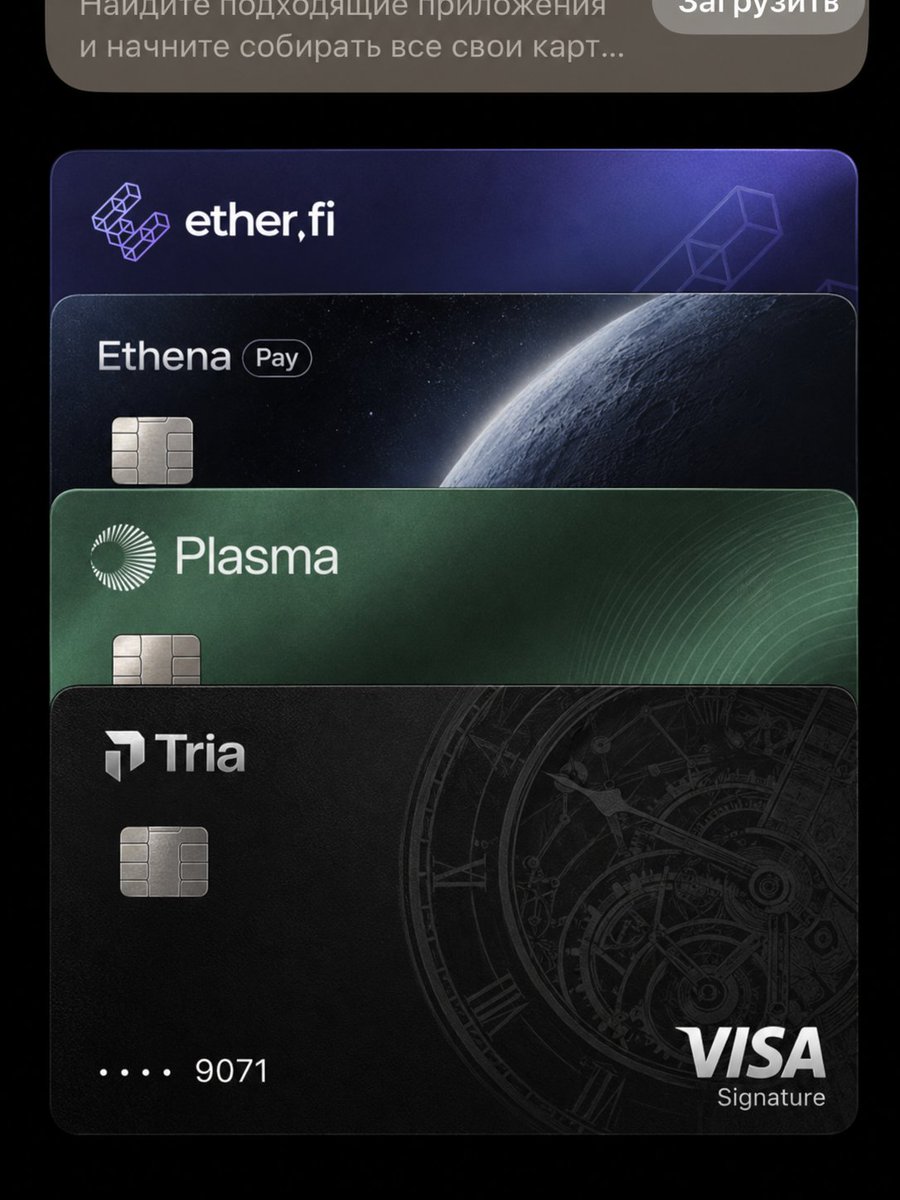
Four crypto cards sit in my Apple Wallet.
Here is which one I would actually use for everyday spending.
I compared EtherFi, Ethena Pay, Plasma One and Tria by the numbers that actually matter: cashback bands, FX and what happens after you hit the headline rate.
@EthenaPay
> Standard is free
> 4% on the first $2.5K/month
> 1% from $2.5K to $4K
> 0% above $4K
> cashback paid in AVAX
For normal USD spending, this is probably my favorite. At $2K/month, Standard earns $80 without paying for a membership.
@ether_fi
> Luxe costs $199/year
> 3% on the first $10K/month
> 1% on the next $10K
> 0.5% after that
> cashback paid in ETHFI
For heavier spending, this is the one I would pick. At $5K/month, Luxe earns $150 versus $115 on Ethena Standard.
And for EUR spending EtherFi gets even more interesting:
> 0% FX markup
> 3% on the first €3K
> 1% from €3K to €6K
The trade-off is that cashback now comes in ETHFI, locks for 7 days and needs at least $5 to claim.
@Plasma
> Core costs $199/year or a 20K XPL lock
> 3% on the first $1K
> 2% on the next $1K
> 1% on the next $1K
> 0.25% after that
> 0.5% FX markup
I would not use Core as my default card for every purchase. I would use it when Plasma gives me a reason to. 5% AI cashback, Apple, travel, Dyson and the other targeted promos are where this card becomes much more interesting.
@useTria
> Signature: 4.5% on the first $1K
> 1% after that
> $109/year
> cashback paid in USDT/USDC
It actually has the highest rate of these four on the first $1K. But the annual fee matters, the high rate ends quickly, and cashback can take much longer to arrive.
I also want Tria to clean up its public FX documentation. The current membership page says zero Tria FX fees while older card terms still allow additional FX and international transaction fees.
The best one changes with the currency, the size of the purchase and how much you have already spent that month.
Which one is sitting first in your Wallet?
Why don’t all crypto card apps show this?
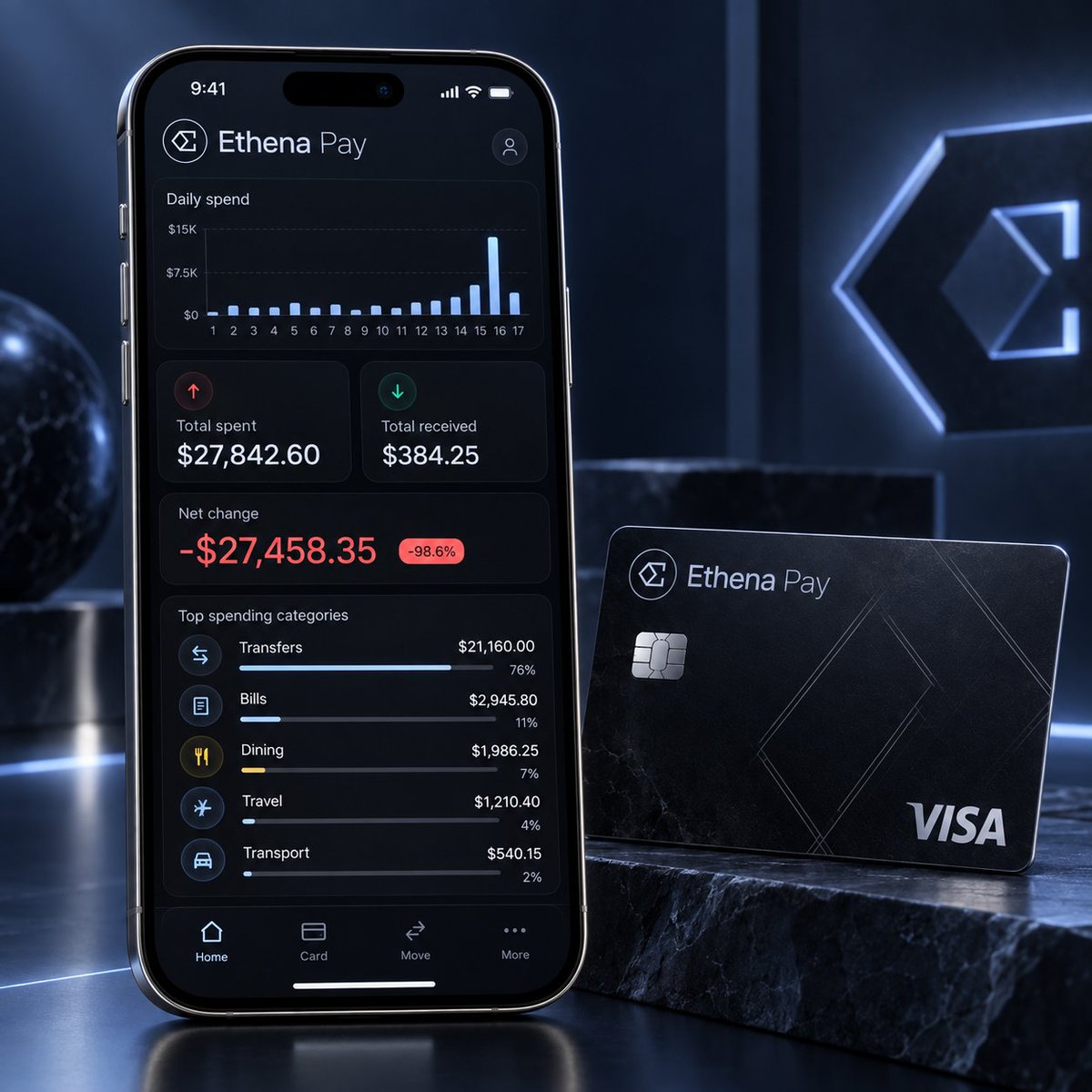
@EthenaPay now breaks down exactly where your money goes.
In this example:
> $27,842.60 spent
> $384.25 received
> -$27,458.35 net change
Top categories:
> Transfers: $21,160 - 76%
> Bills: $2,945.80 - 11%
> Dining: $1,986.25 - 7%
> Travel: $1,210.40 - 4%
> Transport: $540.15 - 2%
Most crypto card apps still give you a balance, a transaction list and cashback.
I want more than that.
Show me what I spent on, which merchants take the most money, how this month compares with the last one and how much cashback each category earned.
Ethena Pay is moving in the right direction.
The only thing I would change here is separating wallet transfers from actual card spend.
76% of this activity is classified as “Transfers”, which makes the spending analytics much less useful.
Crypto cards are already competing on rewards.
Now I want them to compete on the app too.
Four crypto cards sit in my Apple Wallet.
Here is which one I would actually use for everyday spending.
I compared EtherFi, Ethena Pay, Plasma One and Tria by the numbers that actually matter: cashback bands, FX and what happens after you hit the headline rate.
@EthenaPay
> Standard is free
> 4% on the first $2.5K/month
> 1% from $2.5K to $4K
> 0% above $4K
> cashback paid in AVAX
For normal USD spending, this is probably my favorite. At $2K/month, Standard earns $80 without paying for a membership.
@ether_fi
> Luxe costs $199/year
> 3% on the first $10K/month
> 1% on the next $10K
> 0.5% after that
> cashback paid in ETHFI
For heavier spending, this is the one I would pick. At $5K/month, Luxe earns $150 versus $115 on Ethena Standard.
And for EUR spending EtherFi gets even more interesting:
> 0% FX markup
> 3% on the first €3K
> 1% from €3K to €6K
The trade-off is that cashback now comes in ETHFI, locks for 7 days and needs at least $5 to claim.
@Plasma
> Core costs $199/year or a 20K XPL lock
> 3% on the first $1K
> 2% on the next $1K
> 1% on the next $1K
> 0.25% after that
> 0.5% FX markup
I would not use Core as my default card for every purchase. I would use it when Plasma gives me a reason to. 5% AI cashback, Apple, travel, Dyson and the other targeted promos are where this card becomes much more interesting.
@useTria
> Signature: 4.5% on the first $1K
> 1% after that
> $109/year
> cashback paid in USDT/USDC
It actually has the highest rate of these four on the first $1K. But the annual fee matters, the high rate ends quickly, and cashback can take much longer to arrive.
I also want Tria to clean up its public FX documentation. The current membership page says zero Tria FX fees while older card terms still allow additional FX and international transaction fees.
The best one changes with the currency, the size of the purchase and how much you have already spent that month.
Which one is sitting first in your Wallet?