[공지] 공식 텔레그램 계정 안내
안녕하세요, 김프가입니다.
텔레그램 계정 관련 중요 안내입니다.
기존 @kimpga 텔레그램 계정은 저희가 보유한 계정이 아니며, 김프가의 유일한 공식 텔레그램 계정은 @kimpga_com입니다.
혼동 및 피해 방지를 위해 반드시 공식 계정을 확인해 주세요. 감사합니다.
🚨The South Korean stock market is seeing unprecedented SPECULATION:
The value of leveraged ETFs in Korea and Taiwan hit a record $65 BILLION.
Since the beginning of the year, leveraged ETF assets have SKYROCKETED by over +400%.
To put this into perspective, in the US this figure sits at ~$180 billion.
Furthermore, margin debt in South Korea surged to a record ~$24.7 billion, up +39% from ~$17.8 billion at the end of 2025.
This comes as 16 single-stock leveraged ETFs tied to Samsung Electronics and SK Hynix were launched 2 weeks ago, products that were previously banned in South Korea.
Most importantly, they require daily rebalancing to maintain their leverage ratio, mechanically forcing them to purchase into rallies and sell into declines, acting as a volatility accelerator.
The South Korean market has become a CASINO.
🪙 Gold Premium: -5.23%
🇰🇷 Korean Gold Market continues to trade lower than Global Markets
Track real-time "Gold Premium" in Kimpga 🔎
👉https://t.co/XxBXCdyMB2
#Kimpga#GoldPremium
South Korea’s equity market has overtaken India’s as the world’s sixth largest, driven by a relentless surge in chip heavyweights powering the global artificial intelligence buildout. More here: https://t.co/lFkiI2G1n5
📷: SeongJoon Cho/Bloomberg
🪙 Gold Premium: -3.89%
🇰🇷 Korean Gold Market is trading lower than Global Markets
Track real-time "Gold Premium" in Kimpga 🔎
👉 https://t.co/XxBXCdyMB2
#Kimpga#GoldMarket
🚨S. KOREA MAKES FIRST DEX RUG PULL ARREST
South Korean prosecutors charged a group behind the Solana-based CATFI rug pull, which allegedly caused about $585K in losses for 256 investors.
The main suspect reportedly posed as influencer “Eth Father” while the group made around $260K in illegal profits.
🚨 GLOBAL FUNDS ARE DUMPING SOUTH KOREAN STOCKS AT THE FASTEST PACE IN HISTORY.
South Korea's KOSPI continued to hit new ATH after semiconductor stocks like SAMSUNG, SKHYNIX soared multiple highs.
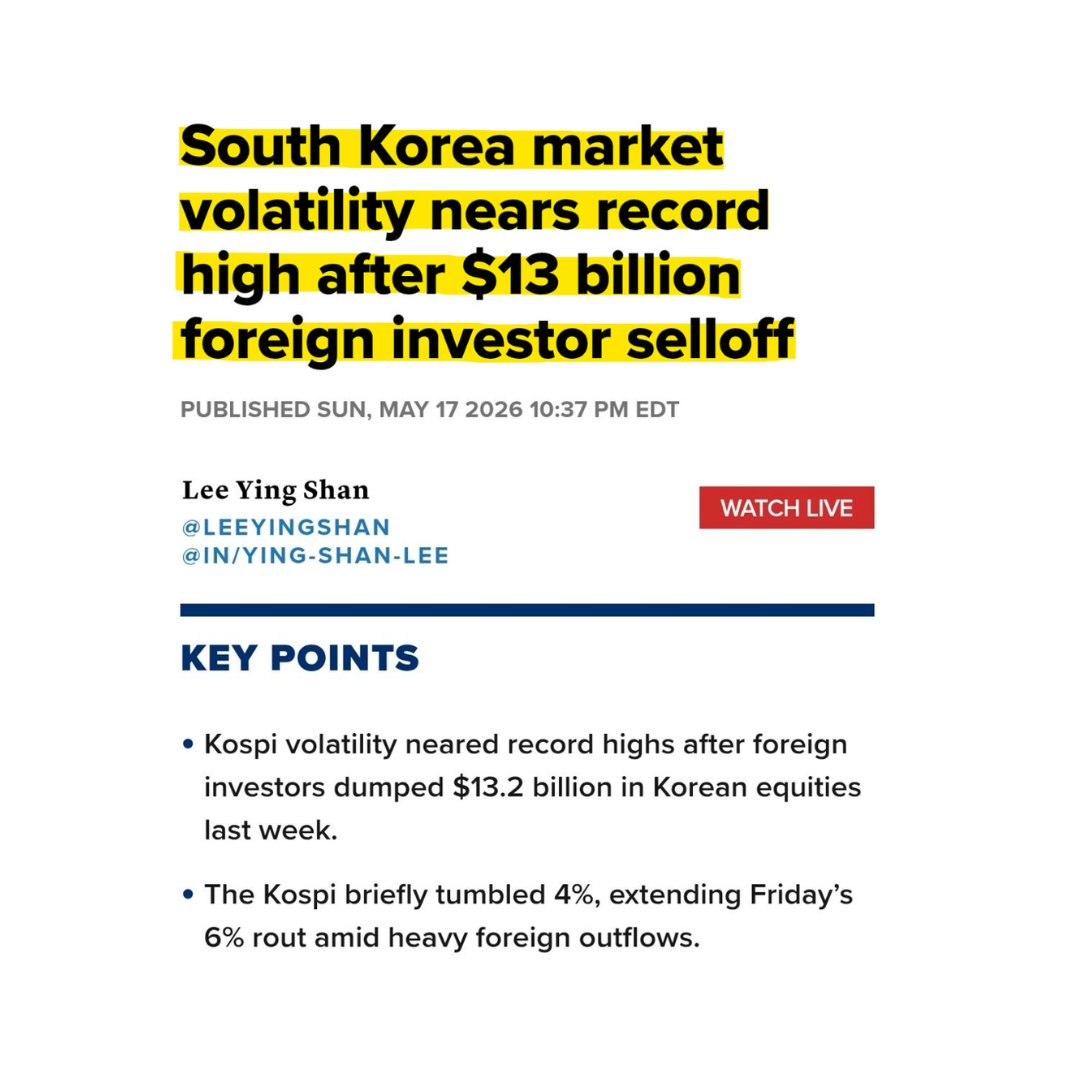
Now global funds are rapidly pulling money out as volatility spikes, dumping $13.2 BILLION in May.
Foreign investors have offloaded more than 112 TRILLION won or $74+ BILLION in Korean stocks so far in 2026.
In March alone, overseas investors sold a record 43.5 TRILLION won or $29.5 BILLION worth of Korean equities, that was the largest monthly foreign sell-off EVER recorded.
Samsung Electronics and SK Hynix saw massive outflows.
KOSPI reaching record highs even after massive outflows, while South Koreans are cashing out their Life Insurance and Loans for buying stocks.
Is this what a market bubble looks like?
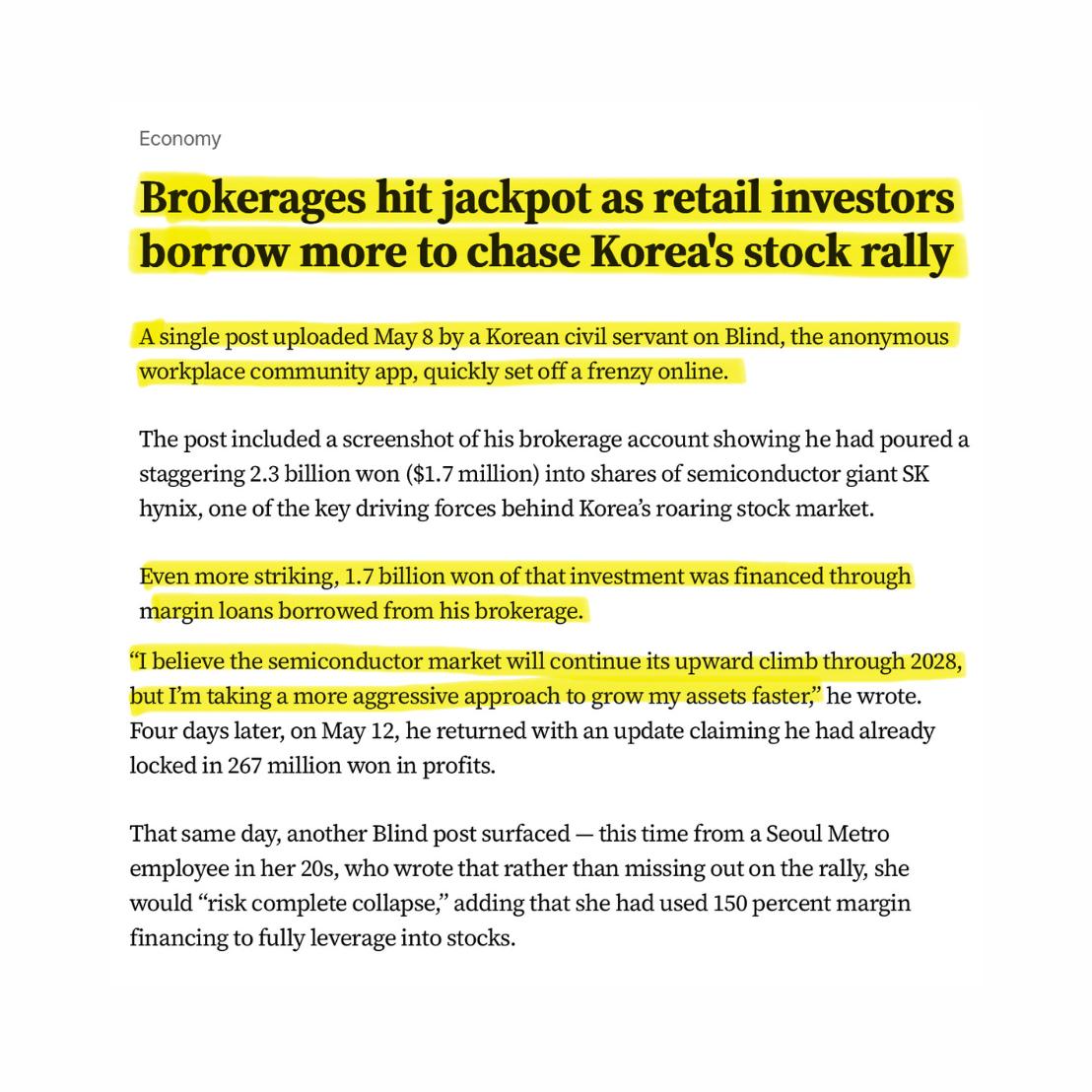
Korean retail investors have borrowed a record 36.47 trillion won to buy stocks at all time highs, at interest rates between 7 and 9% annually. That number has doubled in exactly 12 months.
The KOSPI went from 6,000 to an intraday high of 8,046 in nine trading days before crashing 6.12% in the same session it hit that peak.
On the day the KOSPI touched 8,000, retail investors net-bought 7.18 trillion won in a single session, the largest single-day retail purchase in Korean market history, while foreign investors were dumping 5.61 trillion won on the other side of those exact same trades.
It is not just young investors chasing returns.
Investors aged 50 and above now hold 62.3% of all margin debt in Korea. Personal credit lines at the five largest Korean banks hit a 3-year high in the same month, with analysts describing the funds as being pulled directly into the stock market.
Korea's 10 largest brokerages made 600 billion won in interest income from margin lending in Q1 2026 alone, up 56% from the same period last year. The brokerages collect that interest whether the market goes up or down.
This exact pattern has appeared before every major market crash in modern history.
US margin debt peaked in March 2000, the exact month Nasdaq peaked before falling 78%. It peaked in July 2007, three months before the S&P 500 topped out before falling 55%.
It peaked in October 2021, two months before markets topped before falling 25%.
Korea's margin debt just peaked at its highest level in history. The KOSPI hit 8,000 and reversed in the same session.
China's margin debt just surpassed its 2015 bubble peak. Taiwan's margin balance has more than doubled this year. US margin debt hit a record $1.28 trillion in January 2026 before starting to decline.
Every major market simultaneously. Every retail investor borrowing to chase returns. Every brokerage printing record interest income.
The data is identical to what preceded every crash of the past 25 years.
Korea's biggest bank just ran a won stablecoin end-to-end
KB Financial Group, parent of KB Kookmin, completed a proof of concept covering the full lifecycle of a won-denominated stablecoin, from issuance through offline payments, merchant settlement, and overseas remittance.
The retail test ran at a Hollys coffee kiosk, keeping the normal checkout while moving back-end settlement to blockchain. A cross-border leg converted the won stablecoin to a dollar stablecoin via @KaiaChain's on-chain liquidity, then paid out to a Vietnamese bank account in three minutes, down from days, cutting fees roughly 87% versus traditional rails.
KB Kookmin is South Korea's largest bank, with about $266 billion in assets. It wants to launch the moment Korea's digital asset law lands.
In the Last 2 days 🇰🇷 South Korea’s KOSPI fell -7% and Samsung crashed -10%.
Two things hit at exactly the same time.
1) A government official proposed taxing AI profits and giving every citizen a dividend. Foreign investors dumped $3.8 billion in one session because markets hate surprises from politicians.
2) The Samsung strike fear kicked in. May 21st is eight days away. JPMorgan says an 18 day strike will wipe 40 trillion won from Samsung's annual profit.
Market can recover quickly if Union accepts a deal and Strike gets cancelled.
The next update from the union is the most important news in Asian markets right now.