Founders and investors. You have to be able to explain in one to two sentences what the startup does and why.
I love explaining companies that I’m excited about and see if it resonates with others not in tech and also in tech.
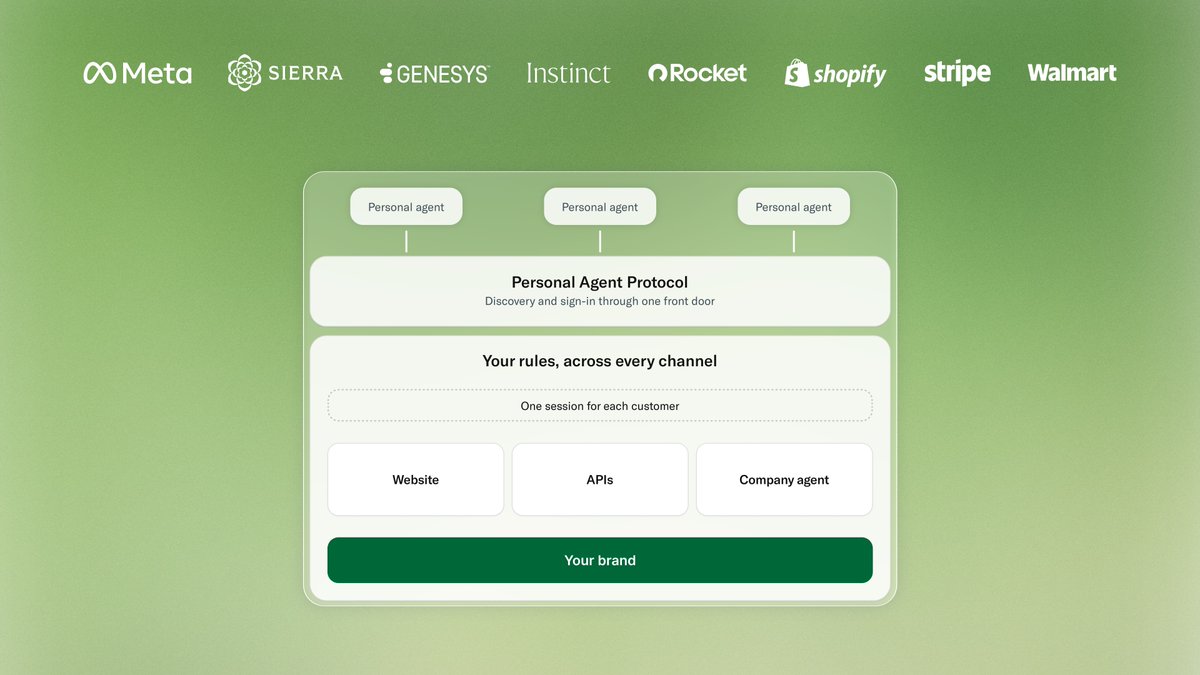
I might be an outlier here but in business I have ALWAYS loved a visual that articulates “the what”. I feel like so many companies are struggling to keep it simple right now.
Today we’re announcing Personal Agent Protocol — an open standard @Meta and @SierraPlatform are developing along with industry partners at @Genesys, @instinct, @RocketOTD, @Shopify, @stripe, and @Walmart. It will help define how personal agents interact with businesses and is open for anyone to implement. You can read more here - and if anyone is interested in joining let me know! https://t.co/Yb90VEHMnn
My first time caring for Veterans was at the VAMC in Ann Arbor. What began there became a weekly VA clinic for nearly eight years, first in Ann Arbor and later in Pittsburgh.
What always stayed with me was how much Veterans had given in service and how little they asked for in return.
At @AbridgeHQ, we’ve had the opportunity to improve the care delivery experience for many more Veterans than I could have ever seen as a doctor in a clinic. We’ve supported VA clinicians with cutting edge tools that help them spend less time staring at a computer screen and more time focusing on the Veteran in front of them.
We started with a pilot deployment at 5 VA medical centers, which has since grown to more than 75 sites across the country.
Now, Abridge has been selected to bring our clinician intelligence platform to Veteran care nationwide through the VA enterprise contract for ambient AI.
As the VA undertakes one of the largest electronic medical record transitions in history, its clinicians remain committed to delivering exceptional care to Veterans. They deserve tools that ease documentation demands, create more space for connection during each encounter, and help preserve important details across visits and care teams.
Abridge meets VA clinicians where they are, by being fully operational on both VistA/CPRS and the Federal EHR.
This is the level of care that Veterans deserve and the VA's mission demands.
It is our privilege to serve the needs of those who have served and the clinicians who care for them.
https://t.co/OJ8xwpgqK8
Canada has what the world wants: energy, minerals, talent, trade reach, and fiscal room.
Today’s Investment Summit turned that into nearly $500B of real commitments: Maple Fund, bank financing at scale, AI infrastructure, and a Productivity Mega Deduction that makes us the most competitive place in the G7 to invest.
Proud of this country. Let’s actually build.
Thank you @MarkJCarney 🤜🤛
We just announced Canada’s new Productivity Mega Deduction.
This cuts Canada’s marginal effective tax rate from 13% to 6.4% on new business investment — the lowest of any major economy in the world.
Canada is building big — and becoming the best place in the world to build.
More here: https://t.co/hlPD31AVnz
🚨📄 New preprint! We find the “boiling the frog” equivalent of AI use. In a series of RCTs, we show that after just 10 min of AI assistance people perform worse and give up more often than those who never used AI.
w Grace Liu @brianchristian Mira Dumbalska and Rachit Dubey 🧵
Every company says they have Forward-Deployed Engineers now.
ElevenLabs CEO and former Palantir Deployment Strategist @mati gives one of the best explanations of what an FDE is—and says companies are missing the key piece of what actually makes FDEs valuable:
“In our case, FDEs are part of the product team. They are not part of the go-to-market team. They are deeply embedded in understanding what the roadmap of the product is.”
“You want all the FDEs to actually solve the customer problem and stretch your product in that direction. But the second thing you want them to do is bring any of that knowledge back to the product, so the product becomes better for the next generation of companies building on top of it. I feel like the second part is frequently missed.”
“The beauty of that is—everybody benefits because you work with one customer, learn, and you bring that into the product experience. Both of those customers benefited from having their product optimized for better work.”
“The domain expertise they have is still theirs. They can win based on their domain expertise. But the product experience of how you build based on that domain expertise can be abstracted, and can be reusable.”
Two things early founders often get wrong, and should remember:
1) Building culture can feel like it's just fluff at the start. Until you start to raise capital or hire teams, and then you see how it shapes everything you do moving forward.
2) You should build a team so talented that it makes you slightly uncomfortable to be with them, because you know you are going to have to raise your game to keep up.
There's still whitespace for vertical AI startups.
If you’re building vertical AI, look for four things in a market:
- The work repeats often enough to learn from
- Judgment matters, so there’s nuance to learn
- An expert can quickly evaluate the output and explain what to improve
- You can start with one task and grow into owning more of the job
Together, these can create a strong learning loop. That’s a key part of the vertical AI advantage. Focus can earn deeper access, more job-specific data and context, and a better understanding over time of what good work looks like.
Incumbents may own the record. Labs may own the front door. Vertical AI can still own the job.
a16z’s @seema_amble on where vertical AI can still win: https://t.co/iXt6sYNljU
Underrated life advice. Master the fresh start. You will fail, get rejected, lose money and embarrass yourself. Learn to shrink the time between fail and recovery.