🚨 Blockaid detected an ongoing exploit targeting
@StakeDAOHQ on Arbitrum.
The attacker just minted over 5.4 trillion vsdCRV and is actively swapping it for ETH.
More details in 🧵
How do you get DeFi insurance for under 20bps?
It all relates to how much insurance protocols should actually pay for per TVL.
From shopping around, I can confidently say that the price in the market being offered is between 1.5-4% on lending and borrowing crime insurance.
"but.. but.. you said the expected value is 3bps"
yes but the insurers are:
1) skittish about cover, and
2) they have to take into account Expected Shortfall, and given no-one is buying cover they have pretty high concentrations on what they write.
How the hell do you get to <20bps when you're paying 2% ?
Start with defn of protocol crime insurance for hacks:
- exclude bridge-related events
- Solana and EVM
- Protocol exploits or oracle manipulation involving a theft, a few others things too but it's PROTOCOL stuff
Lets also give an explicit counter-example...
START EXAMPLE SIDE QUEST >>>
As a concrete example, most people in crypto talk about the "Aave hack". @aave didn't get hacked by any stretch of the imagination, you would definitely know if they did.
@aave had a credit event. A collateral lost its peg because of an error in technical configuration. That error was propagated from a criminal cyber attack / hack on a bridge, who had also made an error in a recommendation to their client on their DVN setup.
This is not a protocol hack of @aave and no crime insurance policy covering Aave would pay out for this.
This is a credit default risk and protected by a Credit Default Swap.
Where it gets confusing is that Aave's DAO appoints risk managers that are supposed to price the margins for collateral. However, you spin it though, the risk manager missed a credit event and the protocol remained resilient.
What should ideally have happened is @aave have umbrella, collateral have Crime & E&O coverage and Bridge has Crime & E&O coverage. Insurers then get triggered by both collateral and bridge and then sue each other to decide who pays what %.
There could be some argument that the risk manager might have some liability but it's going to be hard ground to justify because they have a framework, it's very public, they published their homework and we all deposited in a non-custodial fashion.
<< END EXAMPLE SIDE QUEST
Getting back to the quant stuff.
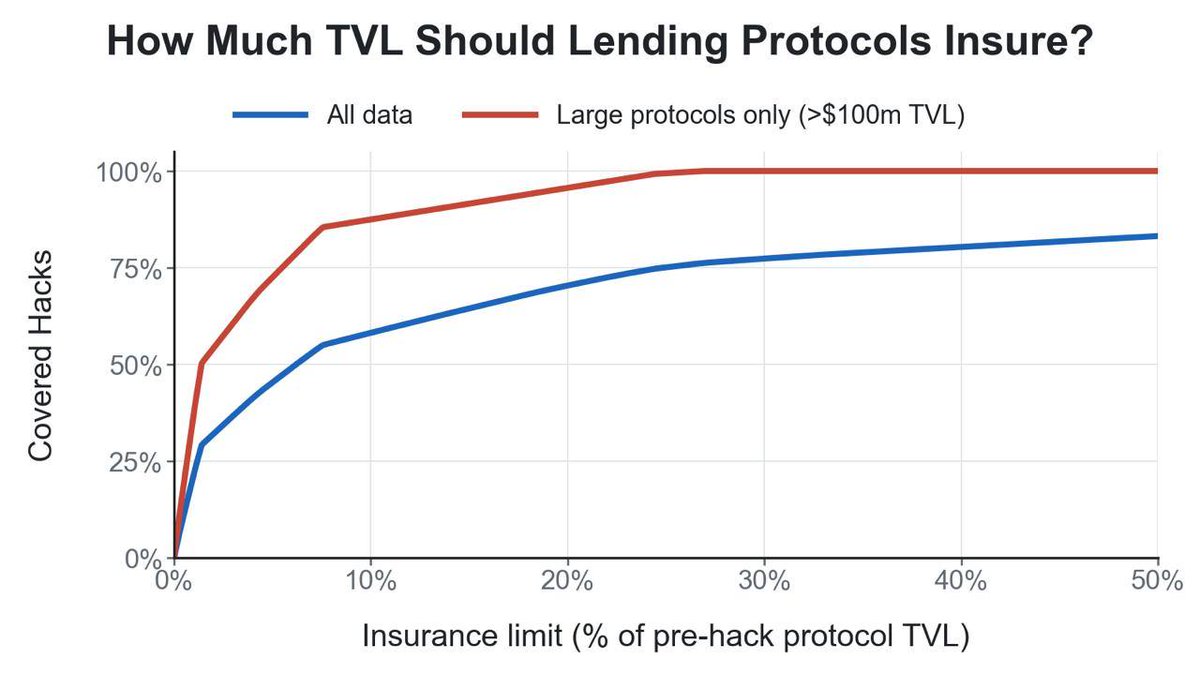
When you look at all the data of the 600 lending/borrowing protocols and 100+ hacks, especially on the larger protocols (of which there are nearly 20 hacks now) you notice something kind of interesting.
The data suggests that the majority of protocols get pinged for a low proportion of their overall TVL. In fact the largest protocol hack was @eulerfinance and even that zero-day took about 63%
There is a myth that is misunderstood, by even some brokers I discussed this with this morning, that hacks are total loss scenario. It might be for random off-the-book hedge funds but in the public and open-source Ethereum / Solana landscape we see all and it says the losses are varied but on average a small ratio.
In fact you would cover 73% of all losses if you had just 5% of the TVL insured.
Now hold up.
If quotes in the market are around 1.5-4% and we can insure a large chunk with just 5% of cover then the passthrough to lenders is 1.5-4% / 20 per unit of TVL
However, Increased Limits Factors kick in
(honestly I don't even know if that's the correct acronym expansion, I just know it as "ILF")
Insurers will generally insure blocks and create a "tower" which means that those at the bottom of the tower have higher risk. If the bottom of the tower is priced at 1% then the next guy might be happy to do next-loss cover at 90bps which implies an ILF of 90/100 = 90%
On average ILF can vary but I think it's conservative to estimate around 95-99%. One of my broker buddies has also said there is a commercially minimum rate around 60bps so no matter how high the tower, you'll pay at least 60bps to get someone out of bed on each tower chunk.
When you look at how this scales, on $1b of coverage you would buy actually just $50m of cover which would cover 73% of all losses.
You would pay between 120.4bps and 325bps on that $50m
You would pass through ONLY 5-19bps though to lenders.
From a protocol perspective this is a total no brainer and insane that people don't do it more.
The caveat? And why I care.
"Unpermissioned DeFi is broadly uninsurable", a well known DeFi broker.
Plug @KeyringNetwork...
Lucky for you fuckers we charge no money on this and Keyring can onboard users with ZKPs in 3-30 seconds without selfies or passports. And most importantly, there is no backend review process, so you remain fully decentralised without triggering "points of control" for regulators.
If you want to get insured, it's likely you'll want to look at putting a door lock on the think you insure to get a non ridiculous quote. Or get a quote at all.
@PharaohExchange If you move to 1pm .. then kind media , the kind recordings team & kwizerana finance will all be able to be part of the fun !!!!! Regardless we will always support 100%
@PharaohExchange@avax@TopGunHatch@kwidao & @kindgroove building Kwizerana (privacy on avax & compound on avax ! ) & after months in beta we finally launched "membrane" to public on Friday which is agent based memory .. let's build & grow together ! $phar is our key !!
This is why kwizerana is building on AVAX 1st !!!! Key wealth preservation & privacy tools With options for small & large users ! @kwidao@AvaCloud@broadridge@avax_one
Another Fortune 500 company is building on Avalanche
US based @Broadridge is building an L1 using @AvaCloud tech, with the goal of “bringing proxy voting, corporate actions, and investor communications onchain.”
Excellent, but what do these terms actually mean?
Proxy voting - like absentee voting for a company, letting you cast your vote on big decisions online if you can’t show up in person.
Corporate Actions - Big moves companies make, like splitting stocks or sharing profits with holders. Things that change outcomes for everyone involved.
Investor Communications - the way a company sends shareholders official updates, like financial reports and invitations to important meetings, to keep investors in the loop.
@avax & @AvaCloud is powering it all
Privacy is a prerequisite to freedom from coercion.
And this sense of freedom is innate to our sense of humanity and individuality. Ultimately, it's what makes life worth living.
As the State becomes more coercive, Zcash becomes more valuable.
Shielded pool & chill.
decentralization is coordination without central authority
a thought experiment:
assume the most decentralized blockchain in existence. hundreds of thousands of nodes, run at home, with distributed mining power and coin supply.
now assume, hypothetically, that if North Korea is able to move funds from Wallet A to Wallet B on this chain in a time period T, then it's tied to an automatic switch such that NK is able to detonate nuclear weapons in a majority of countries in the world simultaneously
(remember, it's a thought experiment)
finally, assume that the blockchain was able to fork such that Wallet A funds were frozen and billions didn't die
now: was that blockchain decentralized or not?
well, given that the incentive of humans is to not die, they were able to coordinate under a shared incentive to prevent this
so while the chain itself is decentralized, that does not imply that the chain is disorganized
put differently: decentralization actually means coordination without central authority
if the cost of coordination is functionally zero, then it's centralized
however, if the cost is infinite, then technically speaking, it is still not decentralized because you can not even apply that terminology to a non functional system (i.e you can't even process state transitions if the nodes don't coordinate to make blocks)
this OpenClaw agent SELLS roof inspections on autopilot.
it watches hail radar 24/7, finds every $1M+ home in the storm path, and mails them a postcard with a satellite shot of their actual roof + a QR to a personalized video pitch by the next day
reply "HAIL" + RT and I'll send you the full guide so you can build this too (must be following so I can DM)
We’ve identified a security incident that involved unauthorized access to certain internal Vercel systems, impacting a limited subset of customers. Please see our security bulletin:
https://t.co/0S939n3qHC
Good looking @GMX_IO ! This is perfect'
This looks like we can now utilize GMX for one of kwizerana finances "edge" algorithms for XAU & XAG using AVAX instead of going cross chain!!
We respect your move & will take advantage of for our community!
@kwidao
The oldest stores of value in human history. Now tradable on GMX: 24/7, permissionless, no middlemen.
Gold and Silver don't care about market hours. Neither do we.