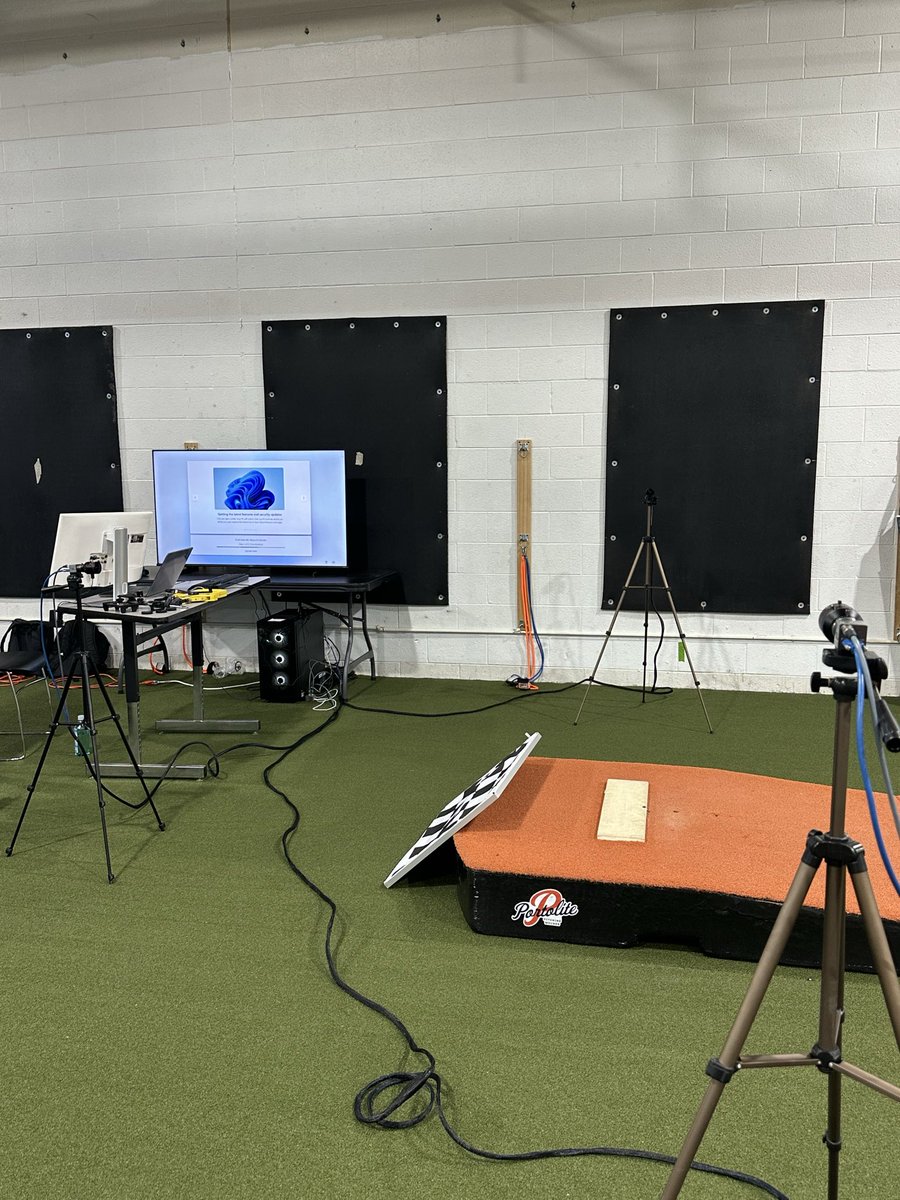
The future of markerless MOCAP.
Lab grade kinematics, predicted ground reaction forces, and bat/ball tracking with no additional sensors. DM to request a demo.
AI doesn’t make you a pitching expert.
Googling your symptoms doesn’t make you a neurosurgeon. Having access to data doesn’t mean you know what to do with it.
Technology is only as valuable as the coach interpreting it. That’s why we use KineBase — 3D motion capture, Email [email protected] to get started.
#KineBase #BaseballTraining #Pitching #MotionCapture #ArmCare
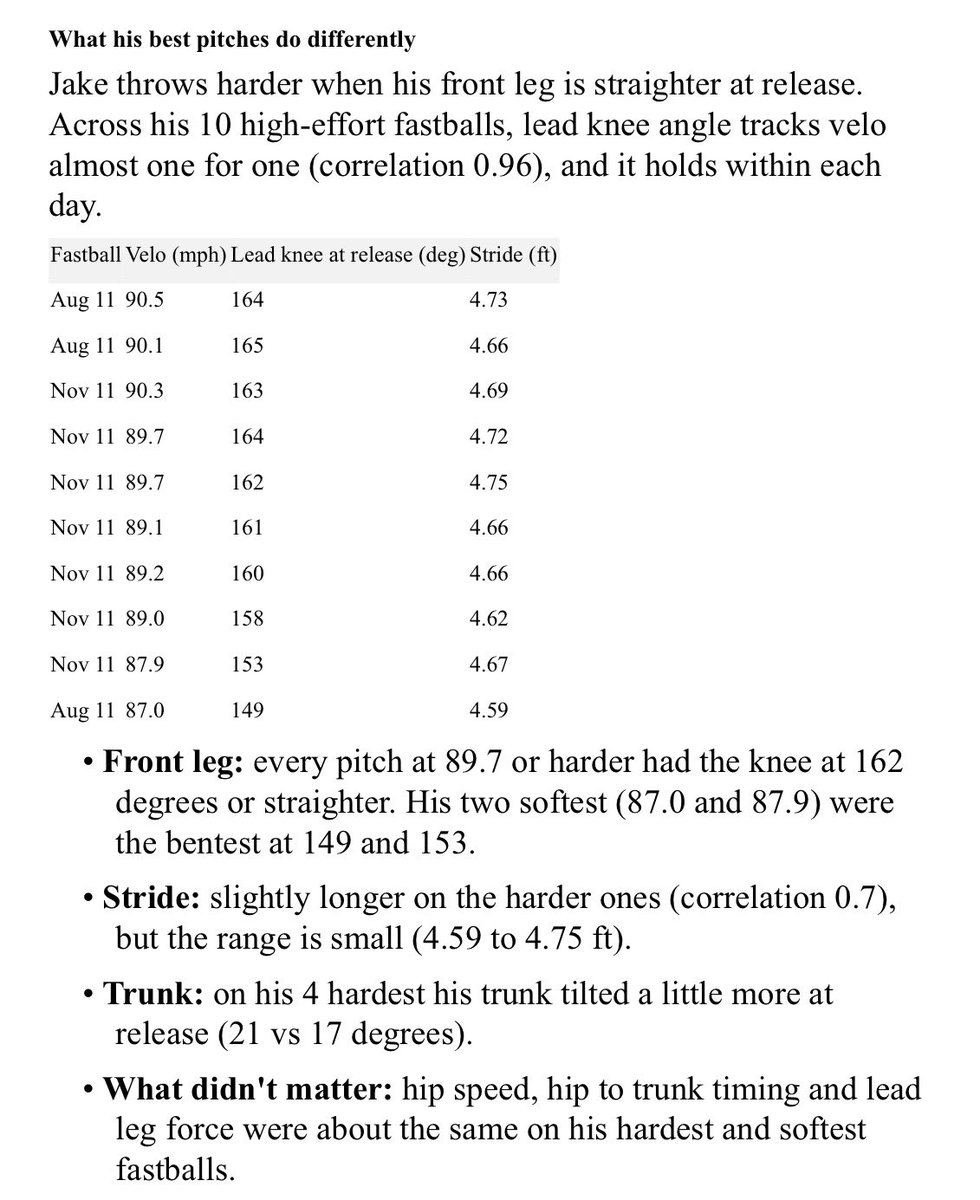
Automating reports based on our kinematic data, ground reaction force data, and ball flight data with @kinebase for our @PDPAthletics athletes. Finding trends between what guys do when they’re at their best, what has the strongest correlations for specific players, and where data suggests athletes are tipping pitches based on kinematics.
Testing ball flight and data speeds for @kinebase . Today we were averaging ball velocity data 3.55 seconds faster than TrackMan processing time and average variance of ball velocity .22mph.
2/ Both pitches are the same velocity with the same athlete.
Look at the pink skeleton.
The shoulders tilt back during leg lift, and as the delivery progresses, the front of the pelvis works uphill.
You may be creating tilt early, but what position is it putting you in later?
1/ Is spinal tilt killing your extension? 🧵
Pitching coaches have preached the “spinal engine” for years—and for good reason. Movement of the trunk can play a major role in creating rotational velocity.
But there’s a problem: more spinal tilt isn’t always better.
Velocity is a receipt, not a reason.
It tells you what happened. It doesn’t tell you why it happened.
Two pitchers can have the same velocity despite creating that velocity in very distinct ways. One gets there with an extremely deep flip up of the arm path while the other gets there by creating more force in a linear direction.
If all you're tracking is the outcome, you can't tell them apart until it's too late.
Ball flight data (velocity, movement, spin) should not be our driving factor when trying to create sustainable changes. That’s why @kinebase doesn’t view kinematics, ground reaction forces, and ball flight as three separate systems that need an API. KineBase tracks all of them within seconds with no additional technology needed.
The ground doesn’t lie.
The pitch or swing starts as force pushed into the dirt. Force goes into the ground which is redirected to the legs, hips, trunk, and eventually the hand/ball.
Biomechanics without ground force data is incomplete. However, athletes shouldn’t have to treat it as a separate “force plate day.” KineBase predicts ground reaction forces on any mound, anywhere, on every throw you make.
KineBase’s Ghost Mode lets you compare captures and data side by side, so you can actually see what changes when you introduce a new training tool, drill, cue, or even months of training.
In this example, we compared the same hitter with the Slot Ball vs. without it.
The bat tracer shows a noticeably more direct path to the ball with the Slot Ball, while the data gives us another piece of the story: connection.
Right Elbow Angle at contact:
Slot Ball: 120.4°
No Slot Ball: 140.1°
That’s nearly a 20° difference, with the Slot Ball producing a much more connected position at contact.
Instead of guessing whether a drill, cue, or training tool is creating the change you want, Ghost Mode lets you see it, measure it, and compare it.
Train. Capture. Compare. Validate.
DM “Assess” for more information on either assessments or getting your own KineBase system.
Tomorrow August 26 from 8:00 to 8:30 AM pacific, KineBase’s Jake Suddreth joins Jeremy Wolf on Open Athletes.
They’ll talk all things baseball, how KineBase came to be, and how we see KineBase changing the future of player development by bringing high level biomechanics and performance data into the real training environment.
@Jsudds44
🎙️ Tune in live at https://t.co/CNDBcyYDFY
#KineBase #Baseball #PlayerDevelopment #SportsTech
Build a lab, without the lab. KineBase combines $35,000+ ground reaction force data, $100,000 kinematic data, and $10,000 launch monitor data into one portable system. Starting at $28,000 with early adopter rates available. Email [email protected] for more information.
My question is how can we measure it on a force plate mound that is turf and guarantee it’s accurate compared to a real mound.
@kinebase ‘s force prediction models are predicted, but through proprietary methods and have been validated to 98-99% as accurate as AMTI. I don’t believe the goal is “accurate measurement” as much as it is accuracy in terms of what data translates to the game environment.
Is “accurate” data actually the goal? We don’t believe that just because a product’s ability to measure is 100% accurate that it represents true data. If the environment is not the same as the environment a player would be in during a game, output and data for both kinematics and ground reaction forces will never perfectly display what it would in a game. KineBase’s predicted ground reaction forces are roughly 98% accurate to an industry leading force plate mound for frontal, lateral, and vertical forces (lead and trail foot)… the only difference is we can do it on a clay mound.