The final Part 3 of my LeHome Challenge deep dive is out (🥈 real-robot final at ICRA 2026).
This one is about the real world: the sim-to-real gap, my home data-collection rig, domain randomization, and the human-in-the-loop DAgger recovery data collection.
Video generation models have become powerful world simulators: give one a scene and a goal, and it can dream a plausible future. But it can't drive a robot. It's too slow, and its imagined frames aren't tied to any action. VLA policies have the opposite problem: they act at control rate, but carry no model of what happens next.
LingBot-VA's bet: generate the future video and the future action together, in one system. 🧵👇
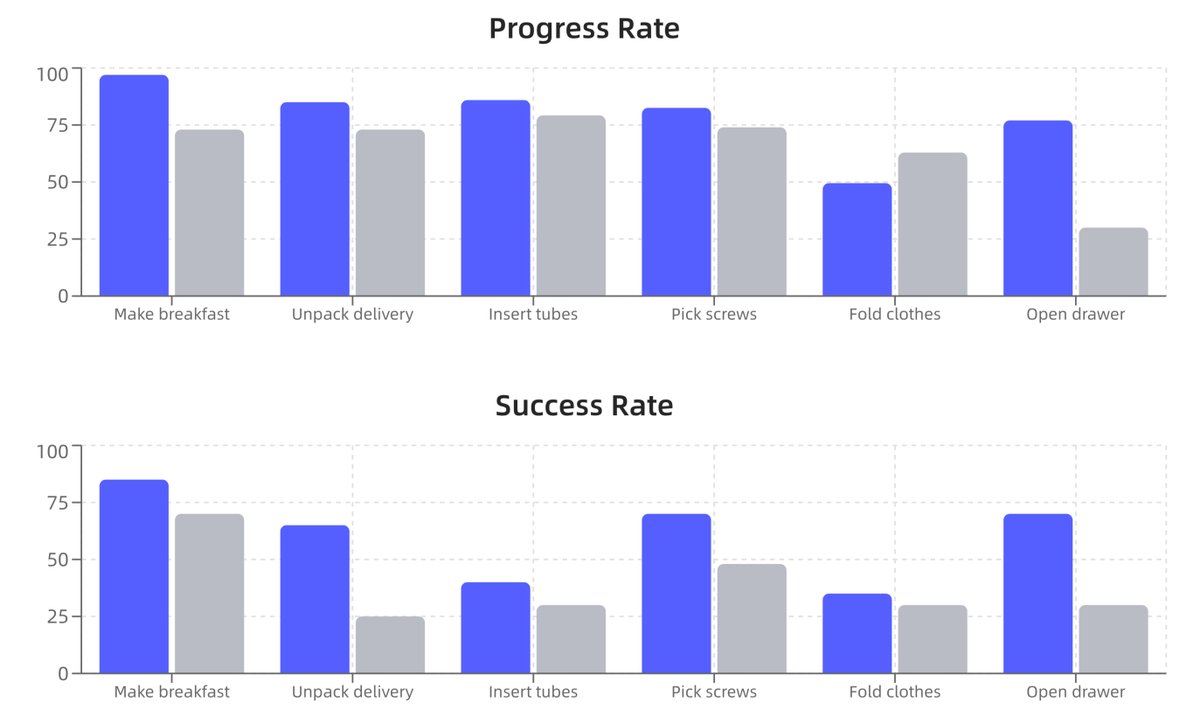
The numbers hold up in deployment. 92.93% average on RoboTwin 2.0 Easy, 91.55% on Hard, 98.5% on LIBERO-Long, with 8.2-9.1% gains on the longer-horizon tasks. The ablations show why. Strip out the refreshed async and long-horizon control collapses: at Horizon=3, naive async drops from 93.2 to 32.9. The lesson: the architecture and the systems work are inseparable. Treating action as something you generate is what makes a world model deployable.
How do you build a robot simulation without paying a PhD student to spend weeks in Blender? You skip the Blender. A phone video of a warehouse now becomes a fully interactive physics sim, shelving, pallets, roller doors, hinges and all. The interesting part is that the whole thing scales with videos and compute, not with human annotation. Gaussian splatting for the geometry, foundation models to figure out what's a shelf versus a bin versus a conveyor and articulate the joints. Same procedure, any warehouse, scene-specific environments with basically no human effort. That's the shift that matters.
How do you build a robot simulation without paying a PhD student to spend weeks in Blender? You skip the Blender. A phone video of a warehouse now becomes a fully interactive physics sim, shelving, pallets, roller doors, hinges and all. The interesting part is that the whole thing scales with videos and compute, not with human annotation. Gaussian splatting for the geometry, foundation models to figure out what's a shelf versus a bin versus a conveyor and articulate the joints. Same procedure, any warehouse, scene-specific environments with basically no human effort. That's the shift that matters.
A robot just learned 1,000 distinct tasks in 24 hours, from a single demonstration each. The norm in robotics is the opposite: thousands of demos to master one task. @imperialcollege London researchers inverted the ratio: 31 skills, 42 objects, 1,000 demos in 17 hours. In doing so they challenged the consensus that more data and compute always wins. The trick isn't a bigger model. Here's what they did instead.
@blocmates Hello mate, we're reindustrialising UK manufacturing with open embodied AI 🤖 Our robots may or may not confirm instructions in a think Scouse accent; they do learn and get better at their jobs continuously. The UK robotics and automation scene is certainly one to watch.