I help logistics and supply chain brands communicate their solutions to current and potential clients via
✍🏾Blogs
✍🏾Newsletters
✍🏾Thought Leadership
✍🏾Case Studies
✍🏾E-books
✍🏾Email Marketing
Here is my portfolio:
https://t.co/ewdwG2mmvX
When Russia invaded Ukraine, BMW and other European car manufacturers got into a lot of trouble because of a $200 vehicle part.
It was so cheap that they forgot to diversify their supplier base.
Don't do that. Diversify now so when the crisis comes, you won't get into trouble.
Cisco’s supply chain runs on speed and safety.
Customers expect routers in weeks, and Cisco delivers — building to order fast, shipping from hubs near demand.
But Cisco remembers old wounds: chip shortages, earthquakes, and shutdowns. The supply chain dual-sources critical parts, maintains buffer stocks, and conducts disruption “war games.”
In 2020, this balance paid off. While competitors stumbled, Cisco continued to deliver for the world’s surge in remote work.
Lesson: Agility without resilience breaks.
A single-source “lean” chain appears inexpensive until it fails.
The winning supply chains? Fast and safe.
Patagonia doesn’t measure its supply chain in quarters but in generations.
When others chased cheap cotton, Patagonia went organic. Although the cost rose and supply tightened, the move built soil health, farmer welfare, and long-term trust.
When others paid for speed, Patagonia slowed down, choosing ocean freight over air because lower emissions mattered more than bragging about fast arrivals.
When others pushed new sales, Patagonia repaired old gear. Recycling, repairs, re-wear made short-term hits for long-term loyalty.
Lesson: The strongest supply chains aren’t the cheapest today. They’re the ones built to last tomorrow.
Companies that plan for decades, not quarters, win resilience, trust, and customers who stick.
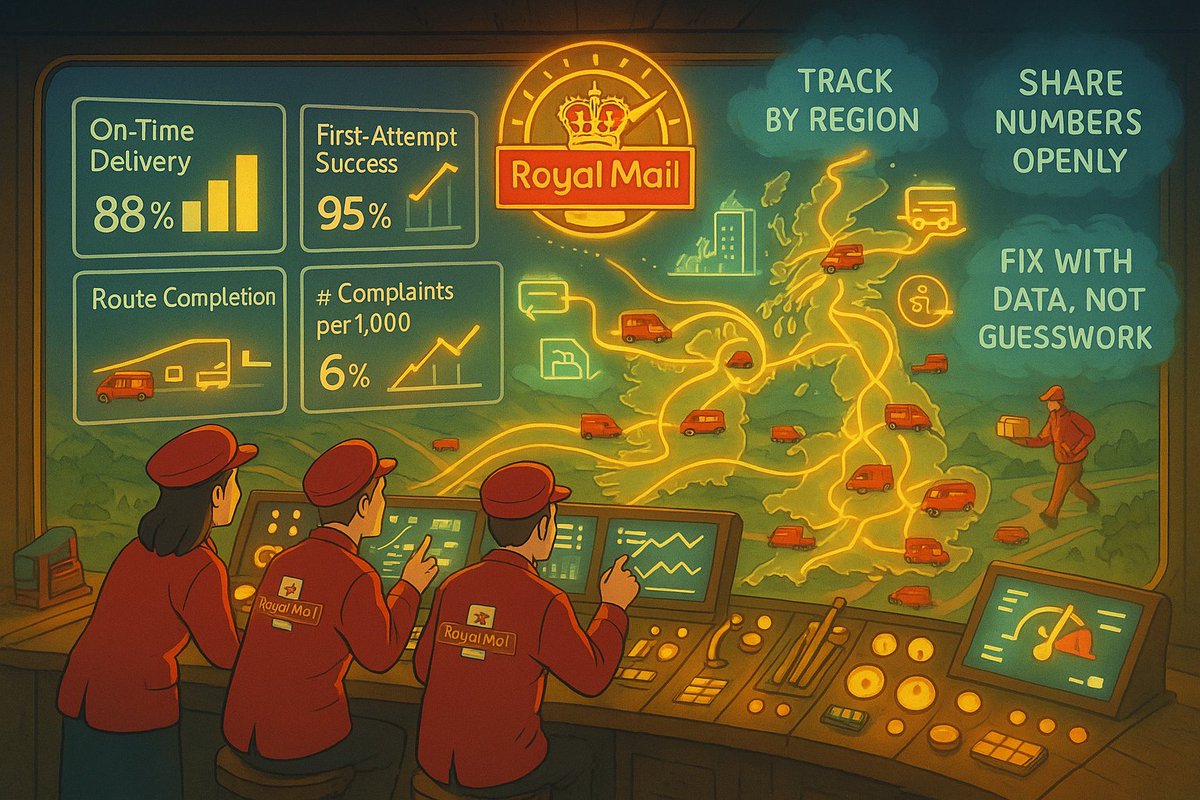
Royal Mail’s war room isn’t about trucks, it’s dashboards.
As letters declined and parcels exploded, Royal Mail didn’t just add vans. The company tracked every step: on-time rates, failed deliveries, route times, and even friendliness scores.
And the numbers exposed patterns:
Some depots always ran late, so routes were split.
Some regions had endless failed attempts, so more lockers were installed.
In 2019, data showed too many parcels circling back. Solution? Automated notifications + online redelivery. Within a year, success rates jumped and repeat trips dropped.
Lesson: What you measure, you can move.
Supply chains collapse when blind, and they adapt when data flows.
Companies that track metrics relentlessly turn problems into opportunities for improvement.
Miss the numbers, miss the chance.
Want more supply chain stories?
Subscribe here:
https://t.co/VMyFBFZFuJ
Check out our website:
https://t.co/SKROxWldLY
Uber Eats ends every delivery with a rating, and that strategy has proven that the last mile is built on customer feedback.
The company checks for:
Timeliness. Food condition. Courier behavior.
But it takes it a step further and turns these into action:
– High ratings = more deliveries.
– Low ratings = coaching or removal.
– “Cold food” complaints → push restaurants to prep faster.
– “Late delivery” notes → algorithm dispatches sooner or adds couriers.
Even small praise—“driver found my tricky address”—reinforces habits.
The principle here is that feedback is a live data stream, not an afterthought.
Takeaway for supply chains:
– Build loops where feedback triggers fixes.
– Treat customer voices as operational signals.
– Share feedback directly with workers to guide behavior.
The payoff?
-Faster adjustments.
-Fewer repeats of mistakes.
-And stronger loyalty.
The last mile is where promises meet reality and customers always hold the pen.
In 2020, Walmart turned pandemic necessity into a permanent advantage.
When the lockdowns happened, Walmart's business model was in trouble.
The company had to adapt. It raced to roll out:
– Contactless curbside pickup.
– “Leave at door” home delivery.
– Smart lockers for groceries + packages.
Customers loved the speed + control.
And what began as a temporary solution to COVID-19 soon became the norm.
Walmart kept it—and made last-mile faster, safer, and more flexible.
The principle? A crisis can force innovation you may have never thought possible. It is essential to always keep an open mind.
Takeaways for supply chains:
– Pilot under pressure, keep what works.
– Design for convenience, not just safety.
– Make last-mile options flexible enough for every customer.
Resilience isn’t about survival—it’s about turning disruption into a durable advantage.
-
Want more supply chain stories?
Subscribe here:
https://t.co/VMyFBG0dkh
Check out our website:
https://t.co/SKROxWlLBw
Nestlé proved that new tech fails without training.
When it rolled out SAP, the danger wasn’t software failure. It was user rejection.
So Nestl�� doubled down on people:
– Train the trainer model.
– Simulation labs for real practice.
– War rooms + 24/7 hotlines at launch.
Result: Employees used the system correctly, adoption remained steady, and the rollout was successful.
FedEx learned the same lesson when it gave couriers handheld devices.
Simulations + ride-alongs made adoption stick—and gave it an edge.
Here is the principle: Tech alone doesn’t transform supply chains. Training does.
Actionable takeaway:
– Start training early.
– Make it hands-on.
– Support users in the first critical weeks.
Because the best system means nothing if people can’t use it.
--
Want more supply chain stories?
Subscribe here:
https://t.co/VMyFBFZFuJ
Check out our website:
https://t.co/SKROxWldLY
Stitch Fix turned feedback into a $2B supply chain engine where every box shipped out is personal.
Algorithms + stylists pick the clothes. But the real magic is in the loop.
Stitch Fix captures:
– What you kept.
– What you returned.
– And why you said no.
That data feeds machine learning models, ensuring that the next shipment is smarter, warehouses adjust their picking routes, inventory forecasts become sharper, and even new designs emerge from client feedback.
The cycle is endless:
Feedback → Data → Better picks → Higher retention.
Result: $2B+ in revenue. Loyal customers. And a supply chain that continually learns and improves.
Takeaway: If you personalize, measure it.
– Track every touch point.
– Build analytics into fulfillment, not just sales.
– Treat returns as gold—data that makes you better.
A supply chain that listens is a supply chain that grows.
Inditex (Zara's parent company) runs a dual supply chain model:
– Basics like jeans are sourced in Asia, where scale cuts costs.
– Trendy fashion pieces are made in Spain/nearby, where speed wins.
The idea behind this is to ensure low-cost stability and rapid responsiveness. This way, Zara can react in weeks while competitors need months.
Apple does the same: global suppliers for chips, regional ones for custom parts or quick hedges. Automakers, too, get steel globally and trims locally.
The principle is simple but powerful: segment your products. Use one chain for efficiency, another for agility.
Apply it today:
– Map your portfolio.
– Decide which items need cost, which need speed.
– Build two tracks instead of forcing one.
When your chain matches your product, resilience and responsiveness follow. And that’s how you stay ahead.
Most retailers in the early 90s relied on faxes, phone calls, and weekly reports to tell suppliers what was happening on shelves. By the time the data traveled up the chain, stockouts had already cost sales.
Walmart changed that in 1991 with Retail Link. The system gave suppliers like P&G real-time access to Walmart’s sales and inventory. Suddenly, a supplier in Cincinnati could see that a shampoo was running low in Dallas that same day, not a week later.
That visibility allowed P&G and other suppliers to adjust production and shipments instantly. As a result, stockouts fell, shelves stayed full, and Walmart kept customers happy.
The principle is timeless: if you want customization at scale or rapid replenishment, break the silos in your supply chain.
Here’s how your supply chain can copy Walmart’s playbook:
– Share live dashboards with suppliers.
– Use alerts, not emails, to flag changes.
– Treat data as a common language, not a secret.
When the whole chain sees the same numbers, it can act as one, which is how you turn speed into an advantage.
Hypocrisy is the name of the game.
Know your personal values and die by them. If you look to another person for morality, you would be disappointed at least 50% of the time.
People don't often say what they believe. They practice it.
Coca-Cola’s supply chain secret is global direction, local execution.
The Global HQ sets shared goals such as cost per case, service levels, and sustainability, among others. But local teams run their own scorecards.
For example: Volatile market? Improve forecast accuracy. Mature market? Cut logistics costs. Africa pioneered solar coolers, which have now scaled worldwide.
Key Takeaway: Global supply chains thrive when alignment ≠ uniformity. One vision, many scorecards.
Here’s the playbook:
Tailor local KPIs to market realities
Share local wins globally to multiply impact
Set a handful of global metrics everyone must hit
Empower regional leaders to make operational calls
Coca-Cola’s supply chain secret is global direction, local execution.
The Global HQ sets shared goals such as cost per case, service levels, and sustainability, among others. But local teams run their own scorecards.
For example: Volatile market? Improve forecast accuracy. Mature market? Cut logistics costs. Africa pioneered solar coolers, which have now scaled worldwide.
Key Takeaway: Global supply chains thrive when alignment ≠ uniformity. One vision, many scorecards.
Here’s the playbook:
Tailor local KPIs to market realities
Share local wins globally to multiply impact
Set a handful of global metrics everyone must hit
Empower regional leaders to make operational calls
The success of J&J’s product serialization campaign wasn’t about the tech, even though it was necessary—it was about support.
The company chose a vendor with whom it could collaborate effectively.
That way, there were on-site experts on the ground 24/ 7 to fix glitches, update the system as rules changed, and train staff.
Years later, the system still works. Others who picked “cheap” vendors got bugs, silence, and stalled adoption.
Key Takeaway: in supply chain tech, shiny features fade—support lasts. Choose a partner, not just a product.
Here’s how you can apply J&J's playbook:
Look for partners with a clear roadmap, not one-off fixes
Check a vendor’s track record, not just their demo
Secure strong support agreements before rollout
Involve vendors in key project checkpoints
The success of J&J’s product serialization campaign wasn’t about the tech, even though it was necessary—it was about support.
The company chose a vendor with whom it could collaborate effectively.
That way, there were on-site experts on the ground 24/ 7 to fix glitches, update the system as rules changed, and train staff.
Years later, the system still works. Others who picked “cheap” vendors got bugs, silence, and stalled adoption.
Key Takeaway: in supply chain tech, shiny features fade—support lasts. Choose a partner, not just a product.
Here’s how you can apply J&J's playbook:
Look for partners with a clear roadmap, not one-off fixes
Check a vendor’s track record, not just their demo
Secure strong support agreements before rollout
Involve vendors in key project checkpoints
Walmart saves billions by building warehouses in areas with cheap land.
Instead of paying big-city rents, Walmart plants 1M+ sq ft DCs in semi-rural towns. Land is cheaper, taxes are lower, and wages and utilities cost less.
Yes, trucks may drive 50 miles more.
But when you’re moving thousands of loads, lower overhead beats higher fuel. Their Virginia import hub proves it—cheap inland land + rail links = decades of savings.
Takeaway: controlling fixed costs builds a cost edge. The leaner your distribution overhead, the lower your prices can go.
Coca-Cola’s procurement blind spots were costing the supply chain millions.
CCEP, the largest Coke bottler, had spend data scattered across markets with no single source of truth. Suppliers were duplicated, prices inconsistent, and delivery issues hidden.
However, in 2017, the company partnered with IBM to create a central analytics tracker. Suddenly, 98% of spend could be classified and compared.
The result? $40M saved, smarter sourcing, and better supplier performance.
Here is the lesson for today: procurement isn’t about paperwork—it’s about visibility. Companies that see clearly act faster, save bigger, and build stronger supply chains.
In a world where people fear robots will replace humans, Amazon used one million robots to make workers 22x more productive.
A decade ago, Amazon workers shipped 175 packages per worker annually. Today, they ship 3,870 packages per worker. And it is because of the robots! They ferry shovels to human pickers, sort packages, and coordinate movements, cutting travel distances by 10%.
The transformation eliminated warehouse walking time, picking errors, and manual bottlenecks. Amazon operates 24/7 without fatigue issues and flexes capacity by adjusting algorithms, not hiring temporary staff.
This isn't just about Amazon. FedEx, Walmart, and Alibaba are deploying similar automation to meet e-commerce speed demands that manual methods can't match.
Automation eliminated repetitive tasks while creating skilled technical positions. Supply chains that master human-robot collaboration will dominate, while competitors struggle with manual inefficiencies and labor shortages during peak seasons.
Most fashion supply chains optimize for the lowest transport costs, but Zara optimized for the fastest market response and dominated fast fashion.
While competitors built regional warehouses to minimize shipping expenses, Zara centralized distribution in Spain near design teams. The company ships new collections globally multiple times per week via expensive air freight, getting designs from the factory to the store in 2-3 weeks.
The strategy seemed costly, especially considering that air freight costs 10x more than ocean shipping. But Zara's automated Spanish hubs dispatch to any store worldwide overnight. And these stores get new assortments twice weekly, creating constant customer traffic and quick trend feedback.
This mirrors broader retail evolution. Shein uses similar speed-focused logistics, while Amazon Prime prioritizes delivery speed over shipping costs.
Here is the takeaway:
-Optimize for customer value, not operational efficiency.