idiot edge
sometimes edges appear due to other trader's stupidity
i'll show you a crypto trade that is so silly you might not believe it
but i promise you it's real.
Nasdaq (QQQ) Mean Reversion (Trading Strategy Analysis):
The Internal Bar Strength indicator (IBS) has worked remarkably well for over two decades. We can only guess why, but the stock market has been highly mean-reverting during this period, and this has, of course, given the IBS a nice tailwind.
* IBS= (Close-Low)/(High-Low);
* Buy= IBS<0.2 ;
* buyPrice=C ; //buy on the close
* Sell= IBS>0.8 ;
* sellPrice=C ; //sell on the close
We buy on close if IBS is lower than 0.2, and we sell any day later when the IBS closes above 0.8. An incredible simple IBS strategy and IBS trade!
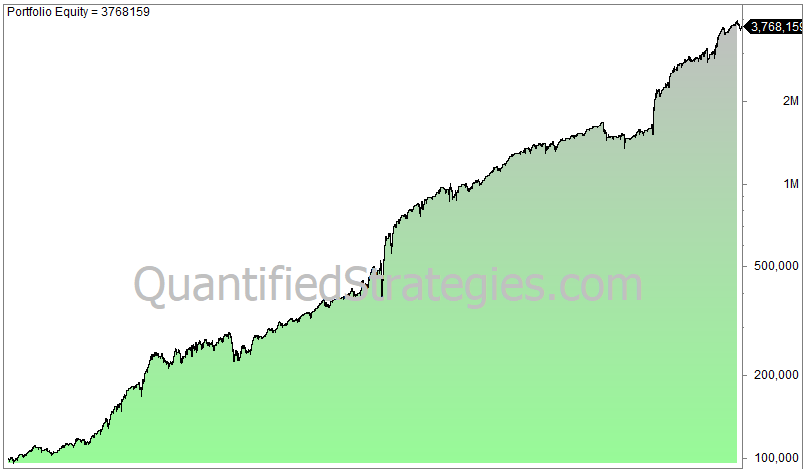
The equity curve looks like the image shown below (compounded).
Can the strategy be improved or made different? If you have any suggestions, please comment 👇
VVIX + VIX Term Structure - The Ultimate Volatility Trading System
🧵 Combining VVIX levels with VIX term structure creates a 3-dimensional view of volatility
This system has 75%+ win rate on volatility trades
Here's the complete framework and how I use VVIX in addition to VIX analysis to evaluate what volatility regime the market is in👇
HFT Market-Making Systems
I spent the first 13 years of my career designing algorithmic trading systems for large HFTs in options, futures, and ETFs (intl/US equities, commodities, fixed income, volatility). Here’s a summary of each component, note the role AI/ML actually plays.
Market data. A market-making system requires realtime orderbook deltas and trades, not just for the symbol that’s being quoted but also for every related instrument used in computing the theoretical fair value of the instrument. Every exchange has a different protocol specification and format, from JSON over websocket (slowest) to FIX (common) to fixed-width binary (fastest). The lowest latency systems will ingest market data on a different thread or process to avoid interfering with the core trading logic of the system.
Fair Value. Successful market making depends on a precise understanding of the theoretic fair value of an instrument, which is the indifference point between buying and selling the instrument modulo fees and other costs. The complexity spans from a several-parameter model based on one or two instruments to highly multivariate calculations across a basket of different symbols. This component is usually the firm’s most guarded intellectual property.
Order placement. Accurately predicting the price of an instrument is only half of the core logic of a trading system; deciding where and how to place orders is equally determinative of P&L. Maintaining balanced two-sided quotes, optimizing for queue position, minimizing traffic to comply with order rate limits, canceling to avoid adverse selection, and order sizing are all intricately determined by the strategy designer.
Exchange connectivity. Similar to the market data component, all trading systems must send orders and cancels using each exchange’s unique messaging protocol. JSON, FIX, and binary formats are all used, with the last most common among traditional exchanges where latency and throughput are optimized. The connectivity layer can be embedded within the order placement process or segregated as its own gateway process.
Offline training. Training is not part of realtime transformation of ticks to trades, but it is one of most important differentiators between trading firms. All parameters that define fair value calculation and order placement are set via offline compute tasks that are often guided by machine learning. A significant amount of the GPUs that large HFTs buy or rent are directed to model discovery and parameter optimization.
A handful of HFTs already use specialized GPUs for the linear algebra behind valuation, but the practice remains rare, confined to strategies where predictive power matters more than shaving the last nanoseconds off latency. As purpose-built inference silicon such as Google’s TPU and OpenAI’s Jalapeño becomes widely available, more HFTs will fold online ML and inference into their systems’ trading loops.
If you’re living in Dubai, this is a thread for you:
2 years ago, I started putting some effort into improving my quality of life.
Here are some of the best changes I’ve made so far:
1. Purify your air.
I installed multiple Atem X Air Purifier units from IQAir at home and in my gym.
It is crazy to me that in this day and age you can create enterprise value just by having impeccable tastes in design and implementation and having the ability to articulate these tastes.
Implementation risk is now a function of eloquence.
Want to see if people are panic selling Dubai real estate?
I built a site that tracks every price drop across 16,000+ luxury listings in real-time.
➡️ https://t.co/DbMTJzcMZP
It was funny to watch Claude Cowork scroll the Twitter feed up and down and try to figure out how the website works:
https://t.co/0hKfugpxTc
However when the task in the hand can be converted to a repeatable skill and when the skill can be made to rely on APIs (even if automatically reverse engineered by LLM), then it works much better.
GPT-5.2 > Opus-4.5 > GPT-5.1 > Sonnet-4.5 > GLM-4.7 > Kimi-2.5
GPT-5.2 is the best as main brain of @openclaw since that model can fix code right away, without needing to call another coding agent.
Opus make many "quick win" mistakes when working alone. Usually it needs to pair with Sonnet (for context exploring) and another Opus (For code review + audit) as a coding team.