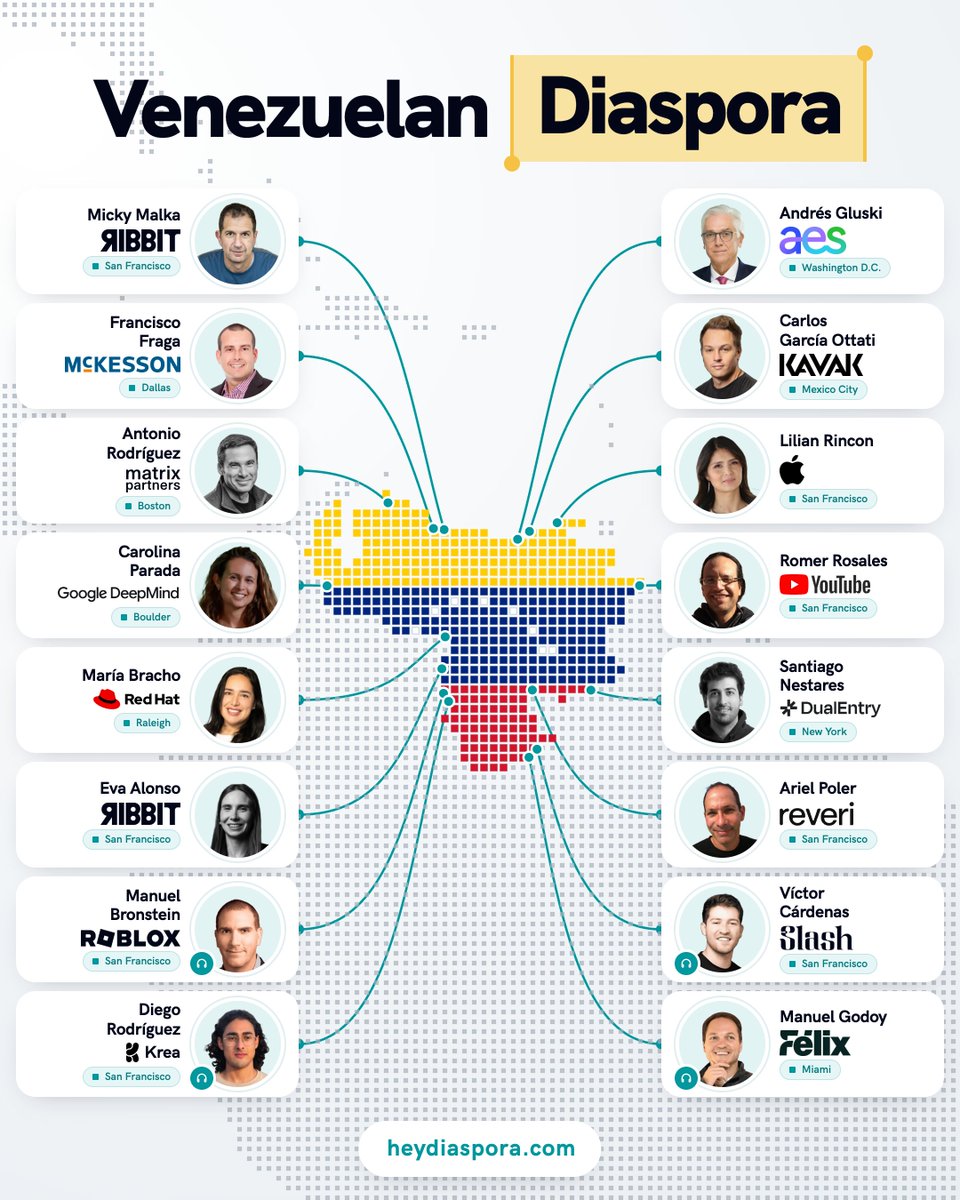
Venezuelans backed Coinbase and Nubank early, run AES and lead product for Apple Intelligence and Siri.
From Ribbit to Roblox, 16 Venezuelans at the top 👇
▪️ Micky Malka @mickymalka, founder of Ribbit Capital (early backer of Coinbase, Nubank and Robinhood)
▪️ Andrés Gluski @AndresGluski, CEO of AES, the energy company supplying 10+ GW to tech companies (agreed to a ~$33B takeover in 2026)
▪️ Francisco Fraga, CIO & CTO of McKesson ($403B in revenue), ex-global CTO of P&G
▪️ Carlos García Ottati @carlosjgarciao, founder & CEO of Kavak (Mexico's first unicorn)
▪️ Antonio Rodríguez @antrod, General Partner at Matrix (early investor in Canva and Oculus)
▪️ Lilian Rincon @lilianr, leads product for Apple Intelligence and Siri (ex-Google VP)
▪️ Carolina Parada @carolina_parada, leads robotics at Google DeepMind
▪️ Romer Rosales, VP of Engineering for YouTube recommendations at Google
▪️ María Bracho @mariabracho, CTO for the Americas at Red Hat
▪️ Santiago Nestares @santinestea, co-founder of DualEntry ($90M Series A from Lightspeed and Khosla)
▪️ Eva Alonso, investor at Ribbit Capital (ex-Goldman Sachs)
▪️ Ariel Poler @ariel, co-founder of Reveri; earlier founded I/PRO and Topica and was an early angel in AdMob (acquired by Google)
▪️ 🎧 Manuel Bronstein @mbronstein, former CPO of Roblox
▪️ 🎧 Víctor Cárdenas @victorcardenas, co-founder & CEO of Slash (~$10B a year in card spend)
▪️ 🎧 Diego Rodríguez @asciidiego, co-founder of Krea ($500M valuation)
▪️ 🎧 Manuel Godoy @manueljgodoym, co-founder & CEO of Félix (WhatsApp remittances, backed by Castle Island Ventures and MELI Capital)
🎧 = I've interviewed them on Startupeable.
Since I moved to SF, I've been interviewing and mapping the founders and execs from around the world at the top of tech. That map is Diaspora and Venezuela is one of 30+ countries on it.
Find your country: https://t.co/jQXfOzIDK8
🙏 Thanks to Paul Navarro (@AshurstPerkins) and Bianca Junqueira (@gojumpstart_) for supporting this!
This sell-off has been driven by a perfect storm created by: 1) The Blue Tidal Wave win and fears about an anti-AI/anti-datacenter DC, 2) losing the global leader of the AI Revolution Jensen in his black eye moment, 3) China driven regulatory concerns across the rest of semis/memory stocks (e.g. AMD short report yesterday), 4) multiple market clearing events which have just led to more selling, 5)Anthropic IPO being a massive success but marginally reducing liquidity from other tech names, 6) significant fund P&L pain diminishing buying power, and 7) sticky inflation and hawkish Fed speak with concerns around more hikes and constricting financial conditions….The $4 trillion AI buildout is still happening and our tech thesis into 2027 remains.
This @standuquesne story is legendary for so many reasons.
I guarantee were it not for those two junior traders that he was comparing his performance to, he never would have made that mistake.
Every trader knows how strong FOMO is when your close comparisons are banking. Every up day must have been a knife to the gut.
Celebrating my 10th Black Friday with TradingView! To mark the occasion, @tradingview is giving away 2 FREE annual subscriptions — one Ultimate and one Premium — to 2 lucky followers here. A little thank you to the community.
How to enter:
🔁 Retweet this post
📷 Follow me and @tradingview
Winners will be announced next Wednesday. Good luck! 🎁
Lots being talked about on Druckenmiller's view of the macro etc. In my humble view the MOST important part of this interview is where he talks about his risk management 9:35 mark...'we don't use VAR, we don't use stress tests, we don't use any of that stuff.'
Perfect small rant on using progressive exposure from arguably the best to ever do it. Yet banks want VAR and institutional managers want to hear about complex hedging and all the rest. He explains clearly why he doesn't use that stuff.
https://t.co/9j3eVagav0
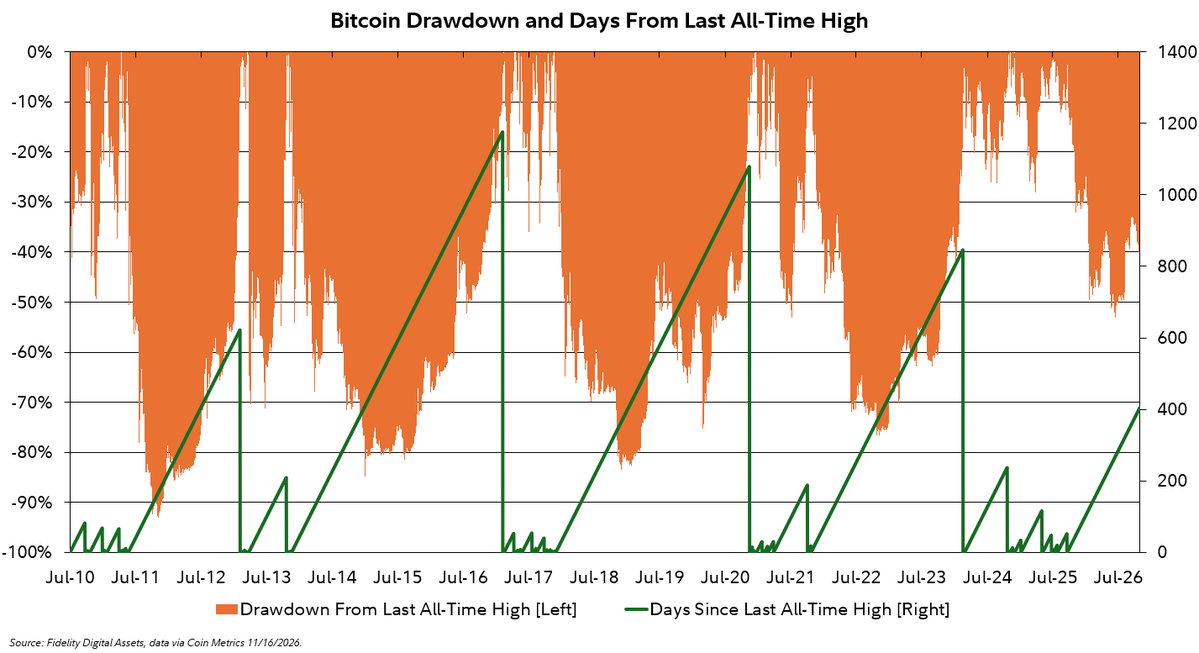
I've been at @DigitalAssets for a little over 5 years now and the price of bitcoin is now getting close to where it was when I started!
But if we look at the past bitcoin bear markets in terms of two major sources of pain, drawdowns and days since last all-time high, what we are currently experiencing isn't that bad (at least historically).
I'll admit, I'm feeling a bit down, but the human mind is pretty bad at taking events into context of past, objective data, and instead basing it on current feelings (recency bias).
This isn't a prediction on future price action or bear market length, just a reminder that we've been here before and survived.
Conversations like these are why we started DB Live.
Bill Gurley @bgurley on Anthropic’s remarkable business and its controversial vision for AI, what Jensen’s exit means for competition, and "handoverism" --the idea that humans might one day cede control to AI.
Chapters
Anthropic, Nvidia and the fight over AI competition
How open source can prevent monopolies
Could Google, Meta and startups build together?
What happens to the “Bank of Nvidia”?
Has AI spending reached the edge?
Anthropic’s finances and commitments
“Anthropic is big tech”
“Handoverism”: who stays in control of AI?
Should Nvidia consider bringing Jensen back?
Gurley’s closing take on Anthropic
Vinod Khosla called me an “uncredentialed founder.”
I couldn’t be more honored.
@vkhosla invested in our company and said, “These aren’t founders who are credentialed. I think they’re from Venezuela.”
He meant it as a compliment, and I take it as one.
When you have no credential to defend, there’s no ego to feed.
You stop spending energy on looking successful and spend it on actually being successful.
Credentials aren't a negative mark either. Plenty of the CFOs we work with have them, and they’re sharp.
That said, in accounting, it doesn't matter where you went to school.
It matters what insights you offer and how fast you deliver them.
That’s the team we’re building at DualEntry.
We want more "uncredentialed" people who want to build the number one ERP.
This was really good interview with the author of two of my favorite financial history books: Devil Take the Hindmost and The Price of Time.
@WilfredFrost
Leonardo DiCaprio has famously avoided sequels for almost his entire career. The one exception is CRITTERS 3 (1991), his feature-film debut, which he made as a teenager before becoming one of Hollywood’s biggest stars.
In a 2015 interview with Variety, DiCaprio explained his thinking: he has always viewed each film as its own individual piece of art. He wasn’t against sequels, but said he found it difficult to imagine revisiting a story once it had reached its ending.
Now, 35 years after CRITTERS 3, he’s breaking that pattern with Michael Mann’s HEAT 2.
DiCaprio will play Chris Shiherlis, the skilled getaway driver and member of Neil McCauley’s crew, originally portrayed by Val Kilmer in the 1995 original. It’s an especially interesting casting choice because DiCaprio isn’t returning to one of his own characters. He’s stepping into a role from a film he wasn’t even part of.
HEAT 2 is also an unusual sequel. Based on the 2022 novel co-written by Mann and Meg Gardiner, the story moves between two timelines. The sequel portion begins just one day after the events of HEAT, with the wounded Chris Shiherlis trying to escape Los Angeles. The prequel timeline goes back to 1988, exploring the earlier lives of the characters, including Vincent Hanna and Neil McCauley.
DiCaprio’s casting also brings him together with Christian Bale, who plays the younger Vincent Hanna, originally portrayed by Al Pacino. Stephen Graham takes on Neil McCauley, Robert De Niro’s role, while Michael Mann returns to write and direct.
There’s another reason this project feels significant: Mann has never directed a sequel before. He has explained that the characters in HEAT remained so vivid in his mind that he knew their histories and futures beyond what audiences saw in the original. He eventually found a way to tell both sides of their stories.
DiCaprio has described the film as its own story rather than an attempt to recreate the original, saying that HEAT cannot be duplicated and that the new film should have its own identity.
For an actor who has spent decades choosing standalone projects and working with some of cinema’s most distinctive filmmakers, HEAT 2 is a rare departure. The man who made CRITTERS 3 his first and, until now, only sequel is finally returning to an established movie universe.
And he’s doing it with Michael Mann revisiting one of the greatest crime films ever made.
I’ve decided to leave NVIDIA. There are a few things I want to say.
As a robotics engineer at NVIDIA, I have seen Jensen as much more than the company’s CEO.
I admire his willingness to invest in a future that was not yet obvious. He committed to CUDA long before the deep learning boom and positioned NVIDIA for AI before it became everyone’s priority. Those decisions helped build the infrastructure that powers today’s AI.
I have seen that same vision in physical AI: investing in robotics, sharing open-source tools and projects, and building computing platforms that bring AI into the physical world. This is the work I do every day—and a future I believe in.
But what matters most to me is the culture he helped build.
Engineers are encouraged to explore, take risks, and learn from mistakes. Jensen reads employees’ Top 5 emails, follows their work, and engages directly. In a company this large, that connection matters. It makes an individual engineer feel that their ideas can still be heard.
That is why this has been so disappointing.
I do not have all the facts surrounding the allegations, and I cannot prejudge the investigation. My admiration for Jensen does not put him above scrutiny.
What I find difficult to accept is having to come to terms with his departure before receiving an explanation that helps me understand it. What this means for our direction, our culture, and the people doing the work remains unclear to me.
I have felt that engineers’ perspectives matter here. On this decision, I have not felt heard. That gap has been more painful than I expected.
I understand that some information cannot be shared immediately. But that does not erase the feeling of being left outside a decision that affects the company we help build every day.
A company’s greatness comes from its leadership, its governance, and the people who turn its ambitions into reality. Employees’ trust and sense of belonging are part of that, too.
Jensen’s vision and the engineering culture he shaped were important reasons I wanted to stay. His departure led me to decide that my own chapter here should also come to a close.
I leave with sadness and gratitude. The colleagues I have worked with, and the work we believed in together, will always matter to me.
These are my personal views.