@Dom_MMK@kunchenguid Interesting thought on crewmates arguing or review loops spiraling, how much time is your typical review loops? I've seen mine even going to couple of hours in no-mistakes most I've seen is around 6 hours I think , want to know if its usual or should be of concern.
@kunchenguid Also i'm using glm5.3 max as orchestrator and glm 5.3 flash for implementing . Haven't had much trouble wanted to see if I can replace glm 5.3 flash with mimo given similar ROI with but similar or sometimes greater intelligence than glm 5.3
herdr passed 1m cumulative downloads, 40k stars and 1,200 community plugins. thanks to this awesome community ❤️
btw, you asked for a discord, so we have one now! come hang out, share your workflows and plugins, or just chat.
https://t.co/wKboqVbEMf
finally found time to make a new video! https://t.co/uuRpjRGd5g
this time i'm sharing a slightly more advanced agentic engineering session, focused on high throughput multi-tasking
hope you find helpful!
Herdr and Firstmate by @kunchenguid make me feel like I can deal with infinite complexity without stressing about cognitive load.
Agent orchestration is clearly the next evolutionary step function in this phase of the singularity.
I didn't realize how much demand there's for a minimal GPU API. I thought NoGraphicsAPI is a curiosity, because the hardware coverage is lacking. But there's 931 stars and 27 forks already in 2 days (weekend) and issues and PRs. Need to get it into production shape quicky...
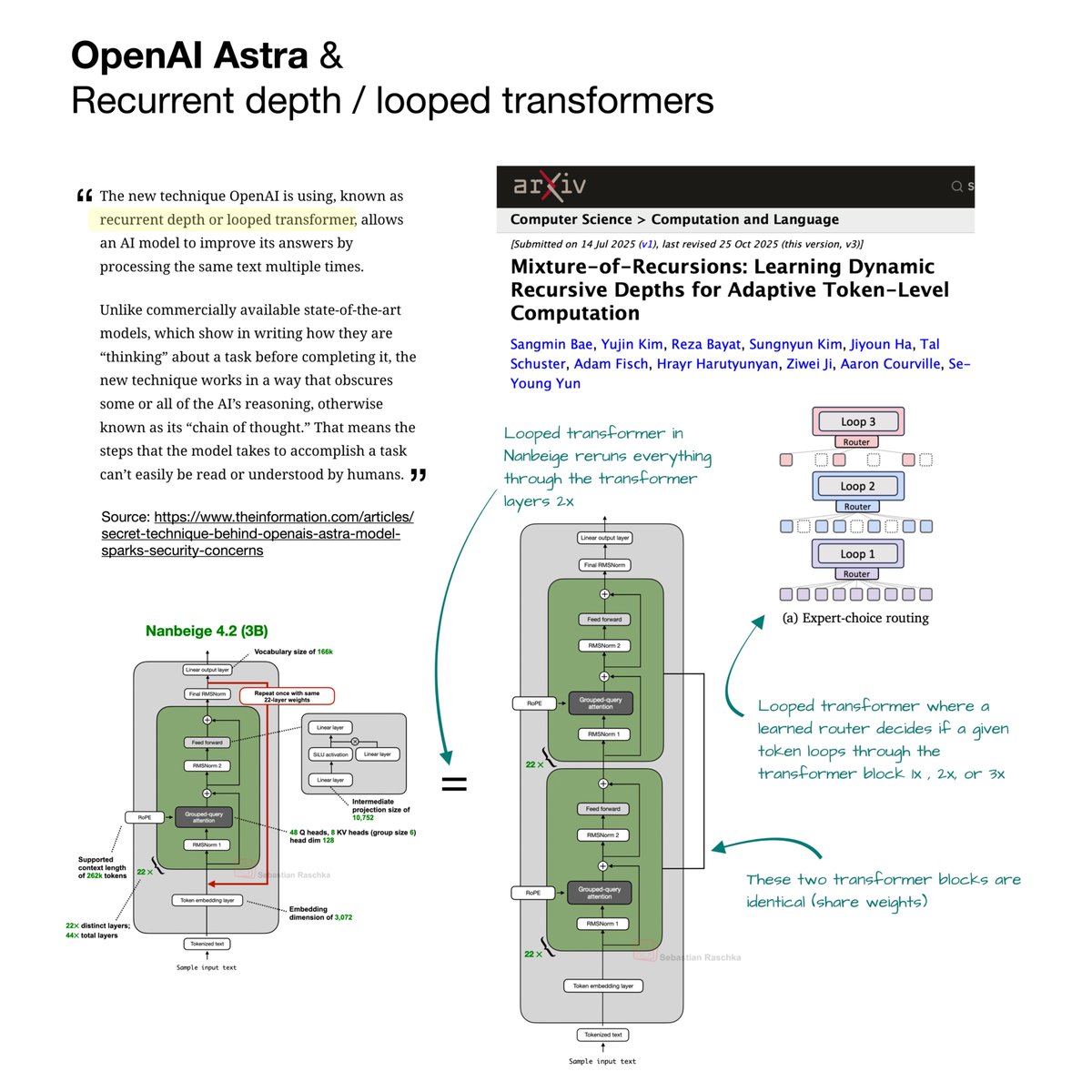
A lot of hype around OpenAI's Astra model here on my timeline today. Apparently, this goes back to a new article from The Information, which said Astra is a "recurrent depth or looped transformer".
It's always interesting to read about new or different approaches (including rumors about what the closed labs may be up to), but let's debunk this a bit.
About 2 months ago, I shared the architecture details of Nanbeige, for example, where "Nanbeige4.2-3B is pretrained from scratch on 28T tokens with a Looped Transformer that reuses the layer stack to increase capacity without adding parameters."
Yes, that's it. The looped transformer idea is just reusing layers in the transformer block.
In the case of Nanbeige, the main idea is to reuse the same 22-layer stack (=transformer block) twice instead of once. So, effectively it extends the 22-layer architecture to 44 layers, but without duplicating the weights.
In simple terms, this roughly doubles the size of the model (if we ignore the embedding and output layers for a second). But instead of requiring 2x the storage and RAM to host this model, it stays at the same size since we reuse the components. However, it's almost 2x as expensive in terms of compute, because we run the embedded text through almost 2x as many layers.
Why? In the Nanbeige 4.2 technical report, the researchers found that two passes gave the best trade-off and retained about 75% of the token efficiency of a standard architecture. (More passes gave barely any gains but made the training much slower and much more expensive.)
While, as far as I know, Nanbeige 4.2 is the first notable open-weight model that adopted this approach, the idea goes back to the NeurIPS paper "Mixture-of-recursions: Learning dynamic recursive depths for adaptive token-level computation". Actually, this paper proposes a mechanism that is a bit more sophisticated by adding a learned router that determines whether each token receives one, two, or more passes. So, easy tokens can exit early while harder tokens receive additional computation.
In sum, Astra may be a really good model, but this shouldn't be about this "looped transformer aspect," which is just a tiny architectural tweak.
Also, the statement "the new technique works in a way that obscures some or all of the AI's reasoning, otherwise known as 'chain-of-thought'" is not necessarily true with respect to the looped transformer method. It's possible that The Information journalist refers to some other technique or misunderstood the looped transformer method.
Reusing layers does not by itself suppress visible chain of thought. It adds computation in hidden states before the next token is emitted, just as ordinary transformer layers do.
But based on the information we have, the only plausible interpretation here is that if a model uses more of these recurrent passes, it may need to generate fewer intermediate reasoning tokens. So then more of its computation happens in latent activations that cannot be read as text. But we would get the same effect if we were scaling up the model size, like GPT 5.6 Luna -> GPT 5.6 Sol.
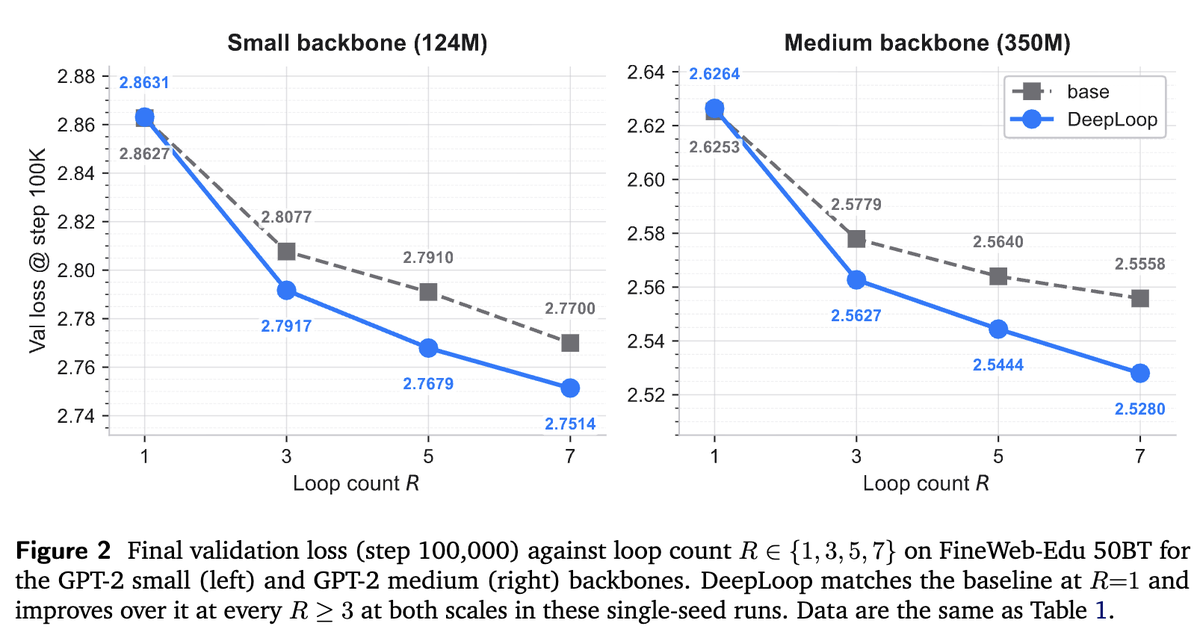
Heard that some frontier models are basically a 48-layer transformer looped twice (48L x 2).
Now we are introducing DeepLoop: Depth Scaling for Looped Transformers (https://t.co/jtxllo9aFF),
making the loop transformer stable and scalable!
We’re publishing a deeper technical report on why generation is needed for the next leap toward photorealism.
VRAM and compute limit both the scene abstraction and the number of rays we can afford. Previous DLSS reconstructs from that representation—so even perfect reconstruction is still bounded by what the scene contains.
DLSS 5 is the first DLSS to generate beyond that abstraction and break through that ceiling, while staying grounded in the game and controlled by the artist.
We also compare it with offline generative models and renderers at similar scaling cost.
https://t.co/uk03ksIFmq
@kunchenguid Which agent are you using for orchastration currently , have you looked into Luna Max or glm5.3 max , I'm tired of gpt 4.6 Sol high overengineering and cost want to switch .
i suddenly realized that i haven’t opened neovim at all for many days
it used to be the ONLY place i do anything kind of development
while i’m happy that i’m now getting a lot more done with agents, i do miss the “flow” i used to have in code editors, profoundly
think, edit, save, and see the result. zen. focus. one thing at a time
working with agents we have today is almost the opposite of that. the experience is not right. we need a complete rethink
This was my last day at HypeHype. Going to take a long sabbatical to be with my family and to focus on my hobby projects.
Lot of cool videos coming: SDFs, mass physics, fluids/lava, explosions, ray-tracing, GPGPU and fun fast paced gameplay. PC/Steam focus.
@kunchenguid@pidotdev Also a side question have your tried luna (max) with server side compaction . I saw that luna (max) scored quite high on artifical analysis bench while being dirt cheap have you experienced the same? Initially with snapcompact luna just forget or loops but server side comp helped
@kunchenguid@pidotdev Hi @kunchenguid , I've been using omp with firstmate for past couple of days, there was no support for it initially but gradually I now have something that works for the most part.
Curious why firstmate doesn't support omp , What was your experience with omp, if you tried?