When you're irked but choose to pause and hold back, you rise above the initial frustration and respond with greater composure. That’s not to say your frustrations aren’t sometimes entirely valid — only that restraint gives you the space to respond more effectively.
We're getting closer to Laravel 11.
Slim application structure. 💅
Better conventions. ✅
What else would make the next version of Laravel jaw-droppingly good?
For many years, I considered all talk about scale to be irrelevant. If you throw enough money at it, any web stack can scale to handle more traffic.
With an abundance of free investor money, I've always believed that startups should choose the stack that allows them to move faster and further.
As focus shifted to profitability in the recent year or two, cost control has become an important concern.
PHP is my favorite programming language, but it blocks execution threads and network connections (DB, HTTP, Cache, etc.). Should we abandon PHP? NO! is my answer! Why should development speed be sacrificed for cost control? Why not have it both ways?
I placed a bet on PHP and added GoLang to the stack and the results exceeded my expectations.
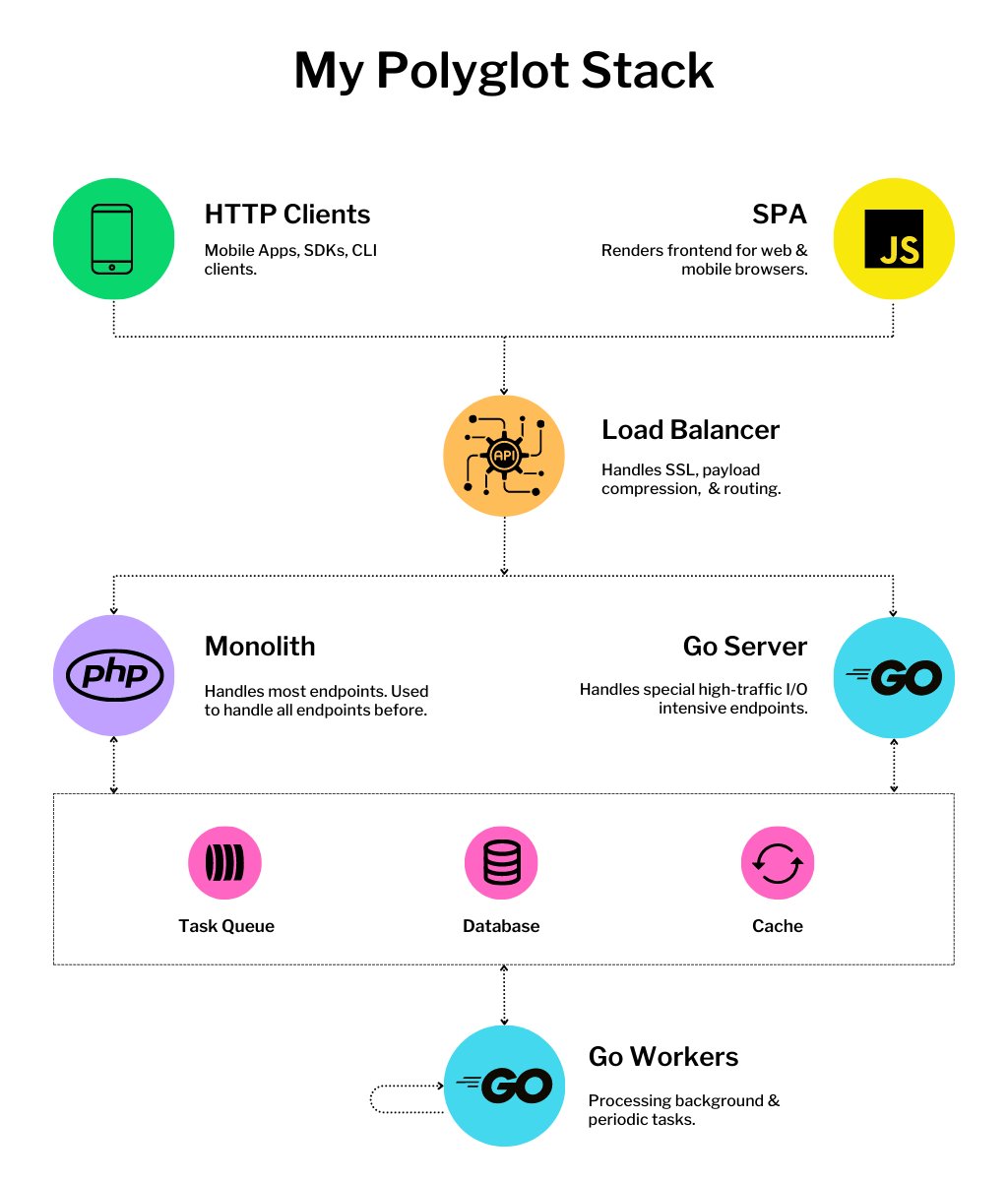
Here's a look at my current stack (for cost control):
1. All web clients talk to a load balancer.
2. The load balancer handles SSL & routes most requests to the PHP monolith.
3. Requests to endpoints that receive high traffic & perform many I/O operations are routed to a Go web server.
4. The PHP monolith & Go server dispatch tasks to the queue & read/write from/to database & cache clusters.
5. A separate Go program handles background jobs (from the queue) and periodic tasks (scheduled).
What do I get from Go?
- Handlers waiting for I/O operations yield to the runtime so others can run.
- I can handle concurrent workloads without having to start new worker processes. Which translates to less memory consumption.
- Network connections are kept alive & re-used.
- Database connections are put back for reuse once the query finishes. They aren't kept hostage until a response is sent.
What do I get by keeping PHP?
The tooling available in the ecosystem (& Laravel in specific) is lightyears ahead. It allows developers to get things done faster by spending their time adding functionality rather than re-inventing the wheel.
Should you switch to this stack?
Are you struggling with compute infrastructure cost at the moment? If the answer is no, stick with PHP. It'll help you move faster, add value, onboard more customers, and hopefully get crazy traffic so you start having infrastructure cost concerns :) That's a nice problem to have, specially that solutions are available.
"Now I play a critical role in guiding & managing operations through the maze of local, global & national privacy & data protection laws" ~ @PrivacyPros
Want to grow from a junior developer to a mid-senior?
Create a project with DB tables with 10 million records.
Introduce multi-tenancy.
Test it with a lot of concurrent users.
While building/fixing it, you will learn most of what you need for mid-senior positions.
Im a 4 for sure! I might add another vertical monitor on the left, but for now I love it
Exciting news! My latest blog post on @hashnode has already received 24 likes and counting! 🎉 If you're looking to make your GitHub profile stand out, this is a must-read. Check it out now and level up your coding game! 💪✨
🔗 Read here: https://t.co/F5U9YRYckN
#GitHubTips #CodingCommunity #Blogpost
In its lifetime, a single bee can only produce around 1/12th of a teaspoon of honey 🍯
They have been known to 'steal' the honey of other bee colonies, when nectar sources are low, or if their own colonies are struggling.
#EarthCapture by The Wandering Gaze via Instagram
"The size and age of the Cosmos are beyond ordinary human understanding. Lost somewhere between immensity and eternity is our tiny planetary home."
— Carl Sagan