एक पाकिस्तानी अकाउंट द्वारा एयर मार्शल जितेंद्र मिश्रा पर एक झूठ फैलाया जिसे भारत में बैठकर कुछ कांग्रेसियों सहित कॉकरोच जनता पार्टी वाले @abhijeet_dipke से लेकर @SauravDassss तक सबने amplify किया।
लेकिन शराब के साथ डांस करने का वीडियो राम मंदिर ट्रस्ट के CEO जितेंद्र मिश्रा का नहीं है। देखिये पूरा fact check
@himanshi__bisht
Once, Shobha De compared Raghuram Rajan to Ranbir Kapoor in Sawaariya, semi-clad in a towel, wishfully hoping the towel would drop.
The trash that gets printed and fed to us during 2005-15
Clarification regarding media reports on concerns relating to Space Sector Reforms and the role of ISRO
ISRO’s Next Chapter: Leading India’s National Space Ecosystem
There has been considerable reporting in parts of the media around the future role of ISRO including speculations and misinformation that there is an attempt to privatise ISRO or reduce its role. These assertions are completely baseless and incorrect.
We wish to categorically state that ISRO will neither be privatised nor will its importance be diminished.
ISRO will continue to remain India’s principal institution for advanced space research and technology development, national and strategic missions, space science and exploration, and critical and frontier space capabilities.
Participation of private sector in space is not about reducing ISRO’s role. It is about enabling ISRO to focus even more strongly on the next generation of India’s space programme, while industry scales mature technologies and capabilities. What is changing is not the importance of ISRO, but the scale and structure of India’s space ecosystem.
Towards an ISRO-Led Space Ecosystem
The space-sector reforms initiated since 2020 and institutionalised through the Indian Space Policy 2023, along with progressive liberalisation of FDI policy, aim to create a larger, stronger and globally competitive Indian space ecosystem.
Industry, start-ups and academia are being enabled to participate across the space value chain, complementing and multiplying ISRO’s capabilities. The reforms should therefore be seen as ecosystem expansion and capability multiplication, not privatisation.
As India’s industrial and technological capabilities have grown, mature and scalable activities can increasingly be undertaken by Indian industry. ISRO has already transferred around multiple technologies to industry. Transferring a mature technology does not mean ISRO is withdrawing from that domain.
It enables large-scale production, commercialisation, innovation and access to global markets while allowing ISRO’s scientific and technical manpower to concentrate on advanced research, next-generation technologies and complex national missions.
The transition is therefore towards an “ISRO-led national space ecosystem.”
ISRO’s Focus Will Move Further Towards Frontier Technologies
ISRO’s role will progressively strengthen in areas where its scientific expertise matters most: frontier R&D, advanced technologies, human spaceflight, next-generation launch systems, deep-space and planetary missions and strategic national capabilities.
It will continue developing cutting-edge technologies, including advanced payloads for communication, navigation and Earth observation, sensors, propulsion systems and other critical technologies.
Meanwhile, mature and routinely manufactured systems can increasingly be scaled through industry. Production of mature launch vehicles, routine satellites and other established systems can increasingly be undertaken by industry or PSUs through appropriate competitive processes.
This allows ISRO to devote more resources and scientific manpower to the next generation of technologies and missions, while the wider ecosystem provides the investment, manufacturing capacity and scale required by an expanding national space programme.
The Next Frontier: Space Station, Moon and Planetary Exploration
This transition is particularly important in the context of Space Vision 2047. India’s ambitions include establishing the Bharatiya Antariksh Station by 2035, undertaking an Indian crewed mission to the Moon by 2040, developing next-generation and reusable launch systems, pursuing sustained lunar and planetary exploration, and establishing India as a major global space power.
These are technologically demanding missions that require ISRO to remain focused on advanced research and capabilities that cannot simply be substituted by commercial activity.
The objective is therefore to enable industry to scale mature capabilities while ISRO pushes India towards the next technological frontier. The new institutional architecture gives each part of the space ecosystem a distinct role.
The Department of Space provides overall policy direction. ISRO remains the core organisation for advanced R&D, technology development and national missions. IN-SPACe facilitates and authorises the participation of non-government entities, while NSIL undertakes commercialisation and industry-led utilisation of mature capabilities.
Industry and start-ups contribute investment, innovation, manufacturing capacity and market access.
At the same time, ownership and control of critical national space infrastructure and strategic capabilities will continue to remain with the Government. Private participation in operations and services will be enabled where appropriate and will remain subject to national-security, safety and other regulatory requirements. Strategic and nationally critical capabilities will continue to be governed by security, safety, quality and national-interest considerations.
Building India’s Overall Space Capability
The emergence of a vibrant private space ecosystem is already one of the major outcomes of 2020 space reforms.
From only a handful of Indian space start-ups in 2020, India today has more than 450, working across launch vehicles, satellites, propulsion, ground systems, Earth observation, communications and space applications. This has brought additional investment, entrepreneurial talent and technological innovation while creating opportunities for highly skilled professionals and strengthening India’s overall space capability.
India’s space economy is presently estimated at around $8.4 billion, still a relatively small share of the rapidly expanding global space economy. India aims to increase its share of the global space market to $44 billion by 2033.
That scale cannot be achieved through government resources and ISRO’s manpower alone. It requires private capital, industrial capacity, entrepreneurship and global market access.
A stronger Indian space industry can augment ISRO’s capabilities, strengthen domestic supply chains, attract talent and investment, increase production and competitiveness, and enable India to capture a larger share of the global space economy.
A Stronger ISRO at the Centre
The success of the reforms should ultimately be measured by the growth of India’s aggregate space capability.
ISRO remains at the centre of India’s space programme, leading national efforts in advanced research, strategic capabilities, human space-flight, next-generation launch technologies, the Bharatiya Antariksh Station and lunar and planetary exploration, while a wider Indian ecosystem provides the scale needed to realise India’s Space Vision 2047.
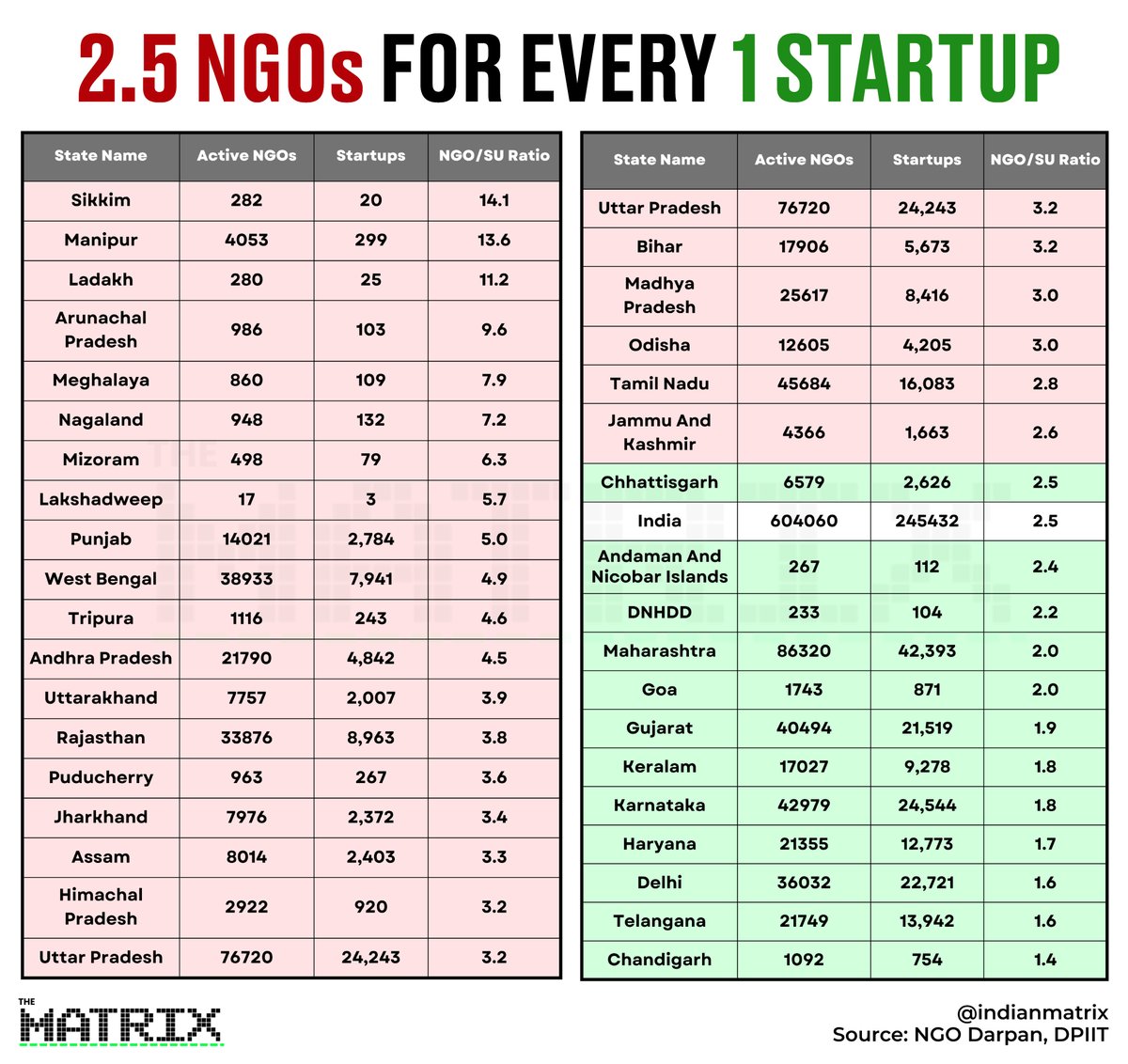
India is hailed as a global startup hub, but our research reveals a startling friction: For every 1 Startup, there are 2.5 NGOs. In strategic border states, this ratio hits as high as 14:1.
Is India becoming a nation of builders or gatekeepers?
Read the full report: https://t.co/25t1eM2Rs9 🧵
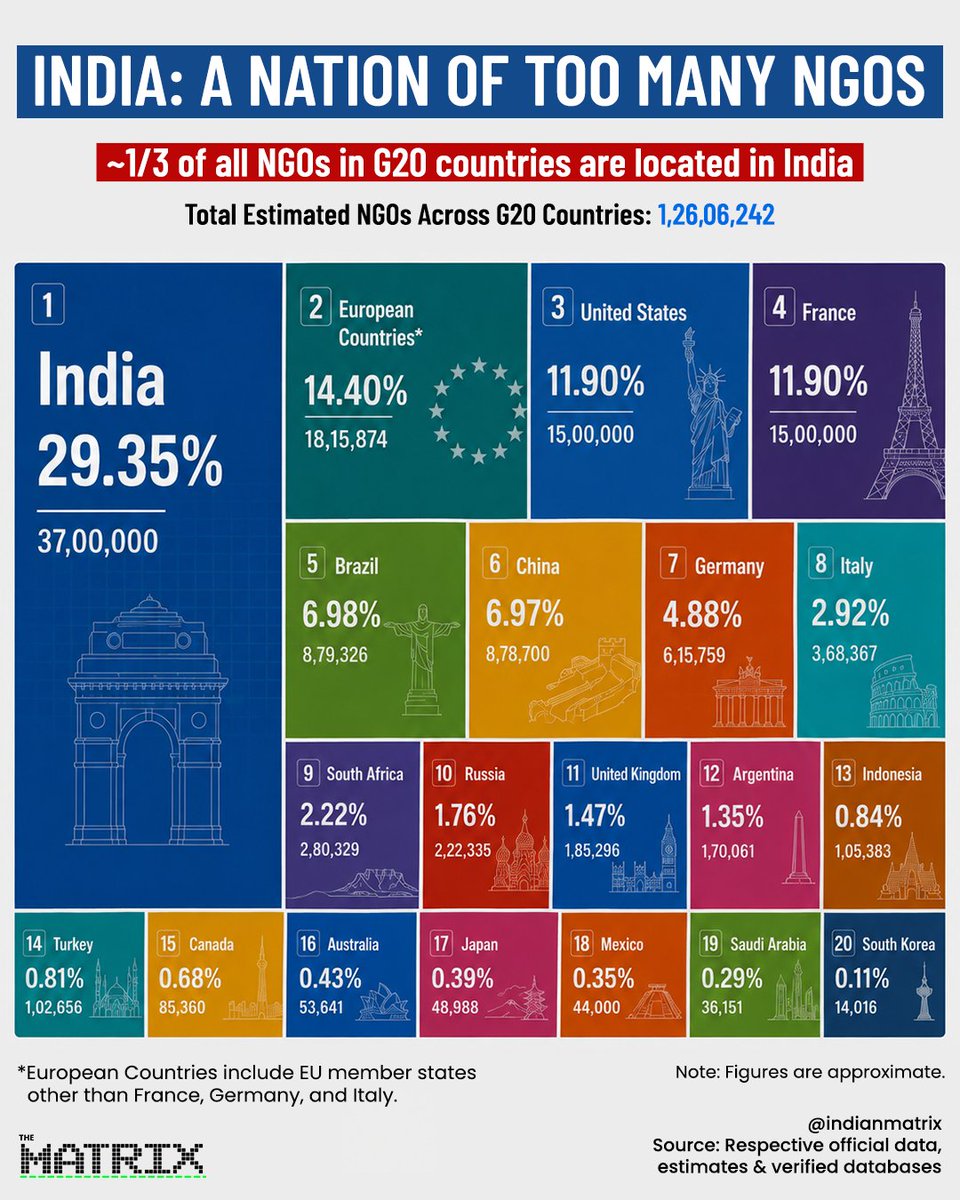
While 6 lakh NGOs are officially registered, total estimates reach 37 lakh-roughly 1/3rd of all NGOs in the entire G20.
This means the real Institutional Energy ratio is closer to 15 NGOs for every 1 startup. We’ve built an ecosystem where ‘monitoring’ and 'advocacy' have become more lucrative than 'creating' and 'manufacturing.'
(1/6)
India is hailed as a global startup hub, but our research reveals a startling friction: For every 1 Startup, there are 2.5 NGOs. In strategic border states, this ratio hits as high as 14:1.
Is India becoming a nation of builders or gatekeepers?
Read the full report: https://t.co/25t1eM2Rs9 🧵
While 6 lakh NGOs are officially registered, total estimates reach 37 lakh-roughly 1/3rd of all NGOs in the entire G20.
This means the real Institutional Energy ratio is closer to 15 NGOs for every 1 startup. We’ve built an ecosystem where ‘monitoring’ and 'advocacy' have become more lucrative than 'creating' and 'manufacturing.'
(1/6)
Is a nation truly free if its developmental agenda can be vetoed by unaccountable, foreign-funded entities?
Our own laws are being used as a weighted vest, slowing us down in a race for survival.
The data is clear: 'Green States' thrive because they prioritise builders. 'Red States' stall because they are trapped by gatekeepers. To reach a $5 trillion economy, we must tilt the scales back. It must be easier to build a factory than it is to organise a paid protest.
The red lights on our map are flashing. It is time we turned them green.
Subscribe to @indianmatrix for more data-driven analysis: https://t.co/42yyvUIV3G
(6/6)
We must stop mistaking organised disruption for 'spontaneous activism.'
Investigations into the 'Environics Trust' revealed an industry of 'paid protests' targeting coal projects.
Why do foreign entities target Indian ports and mines? Because every year of delay keeps India dependent on expensive imports and slows our march toward maritime and energy sovereignty.
(5/6)
This isn’t a partisan issue. In 2012, PM Manmohan Singh warned that foreign-funded NGOs were sabotaging India’s energy security, specifically targeting the Kudankulam Nuclear Plant.
By 2014, an Intelligence Bureau (IB) report estimated that organised protests against mega-projects shave 2% to 3% off India’s annual GDP growth.
This 'activism tax' is the difference between a developing nation and a global superpower. It represents millions of jobs never created and thousands of crores in project delays that the Indian taxpayer eventually pays for.
(4/6)
This imbalance is a national security Red Buzzer.
Border states are our frontlines - Ladakh, Arunachal, and Manipur require strategic infrastructure for troop mobility and tactical depth.
Yet, these are exactly where the NGO network is most dense. Beyond stalled roads and bridges, these networks often focus on activities that alter the social fabric, including mass religious conversion.
These demographic shifts, fueled by opaque external funding, create internal friction points that adversaries exploit. Using the legal fabric of a democracy to paralyse its defensive infrastructure is a new dimension of asymmetric warfare.
(3/6)
What is the 'NGO-to-Startup' ratio?
It’s a measure of a region's 'Institutional Energy.'
Low ratios (Telangana 1.6, Karnataka 1.8) signify 'Green States,' the engines of India's GDP, where the focus is on production. But in the 'Red States,' the numbers skyrocket. Sikkim sits at 14.1, Manipur at 13.6, and Ladakh at 11.2.
Why is our institutional DNA in sensitive border zones so heavily skewed toward mediation rather than wealth generation? When NGOs outnumber entrepreneurs as high as 14 to 1, the spirit of enterprise is being replaced by a culture of obstruction.
(2/6)
Below are some of the world's highest GDP countries of US (LaGuardia airport), Japan (train station), China. You would have never heard of these because their people don't demean and mock themselves over these things.
Flooding happens everywhere. Only in India it is made into "something happening only in India" and entire India's development and growth are mocked at using such smaller issues in the grand scheme of things.
If we keep mocking ourselves and blackpilling ourselves all the time (for politics or otherwaise), we are doing a great disservice to the future of the country.
The only way forward is constructive criticism and some effort to try fix the issues by pushing the govt, if the govt is not at all acting.
This is misleading 🤡
If we calculate as per old 2011-12 base the Q1FY27 GDP would be 95 L Cr.
Which is more than 7.8% GROWTH (even higher)
@grok
Please check the video and my calculation and validate.
GDP is fine. GOI must think of lowering STT, STCG & LTCG for stock market to run.
MOSPI @GoIStats put out detailed methodology documents for the base year revision in February 2026 (6 months back). For @arvindsubraman to claim that the methodology has not been made available - and worse, for @sardesairajdeep to accept this canard gleefully on prime time tv - is the essence of the unfortunate pantomime that this GDP debate is!
A superpower means a country that is an economic power and has the military might to back that economic power.
Today, one country wants to be the only superpower. And that country doesn't want any other military and economic power to compete with it for anything.
So it deploys sepoys in any country that tries. These sepoys are made to speak like commies who make such ambitions look bad.
They make aspiring for being a military and economic power look violent and criminal. They put this idea into the heads of the youth and the country.
They question and derail development, manufacturing, data centers, infrastructure, economic growth, military spending, and make all strategic companies of the country look criminal and anti-national.
At the same time, they constantly blackpill all Indians about India and keep creating fear, uncertainty, and doubt about the country.
They keep saying India is failing and the economy is crashing. These slaves of the ideology of the power that wants to be the only superpower are the worse than naxalites.
They don't live in the forests, brainwash uneducated villagers, train young children to be violent and create anarchy to break the country. They create anarchy by sitting in towns, appearing in television, and tear down the country's progress poisoning the minds of millions.